Sponsored by Your local Profiles representative and  Profiles International, Inc.   An Executive Briefing Identifying and Retaining  Top Performers
Today’s Objectives To  IDENTIFY  the characteristics    of top performers To maximize employee    PRODUCTIVITY To increase the  RETENTION  of   peak performers
Over  700 Local Offices 40,000 Clients 100 Countries
Have you ever hired someone who did not reach your expectations?
History Résumé, Past Employment, Education, Background Check Selection Process – Step 1 PAST
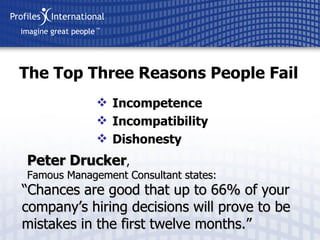
Incompetence Incompatibility Dishonesty The Top Three Reasons People Fail Peter Drucker , Famous Management Consultant states: “ Chances are good that up to 66% of your company’s hiring decisions will prove to be mistakes in the first twelve months.”
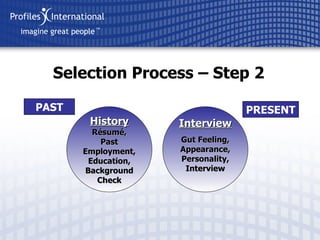
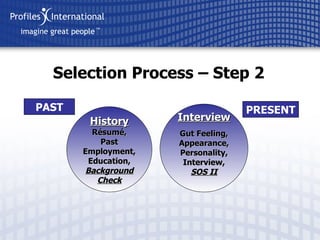
Selection Process – Step 2 PAST History Résumé, Past Employment, Education, Background Check PRESENT Interview Gut Feeling, Appearance, Personality, Interview
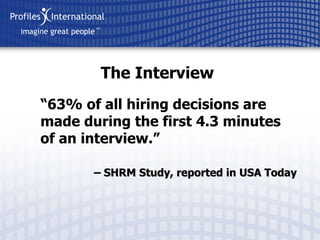
“ 63% of all hiring decisions are made during the first 4.3 minutes of an interview.” The Interview –  SHRM Study, reported in USA Today
36,000 business failures are caused by employee theft Employees steal 10 times more than shoplifters Absenteeism costs a 50 employee company $31,100 annually Check Applicants This is your applicant pool!
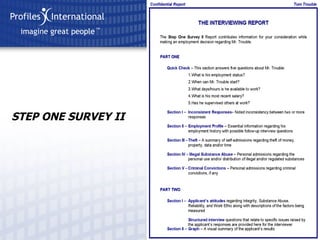
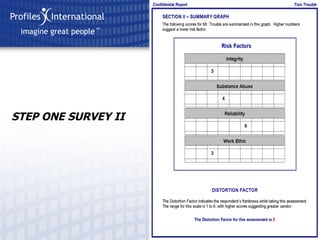
Provides a structured interview and employment history STEP ONE SURVEY II
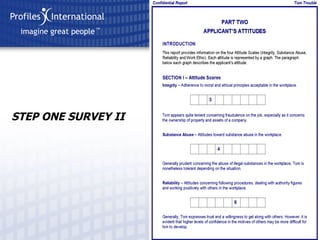
STEP ONE SURVEY II
STEP ONE SURVEY II
STEP ONE SURVEY II
Selection Process – Step 2 PAST History Résumé, Past Employment, Education,  Background Check PRESENT Interview Gut Feeling, Appearance, Personality, Interview, SOS II
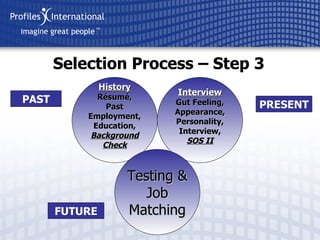
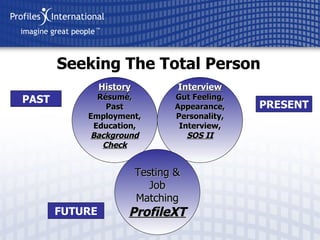
Selection Process – Step 3 PAST PRESENT History Résumé, Past Employment, Education,  Background Check Interview Gut Feeling, Appearance, Personality, Interview, SOS II Testing & Job Matching FUTURE
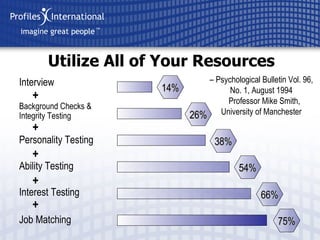
Utilize All of Your Resources 75% 66% 54% 38% 26% 14% Interview Background Checks & Integrity Testing Personality Testing Ability Testing Interest Testing Job Matching + + + + + –  Psychological Bulletin  Vol. 96, No. 1, August 1994 Professor Mike Smith, University of Manchester
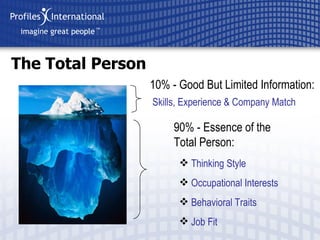
The Total Person 10% - Good But Limited Information: Skills, Experience & Company Match 90% - Essence of the Total Person: Thinking Style Occupational Interests Behavioral Traits Job Fit
US Department of Labor Employment and Training Administration Publication
Using Assessments “ The appropriate  use of professionally developed assessment tools on average enables organizations to make more effective employment-related decisions than the use of simple observation or random de cision  making. ” “ Testing and Assessment: An Employer’s Guide to Good Practices” US Department of Labor Employment and Training Administration
Seeking The Total Person PAST PRESENT History Résumé, Past Employment, Education,  Background Check Interview Gut Feeling, Appearance, Personality, Interview, SOS II Testing & Job Matching ProfileXT FUTURE
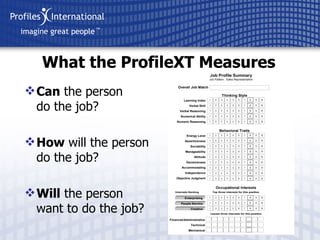
Can  the person do the job? How  will the person do the job? Will  the person want to do the job? What the ProfileXT Measures
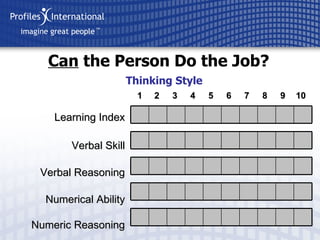
Can  the Person Do the Job? Thinking Style Learning Index Verbal Skill Verbal Reasoning Numerical Ability Numeric Reasoning 1 2 3 4 5 6 7 8 9 10
The Learning Index One Gallon One Gallon
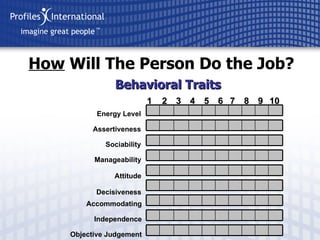
How  Will The Person Do the Job? Behavioral Traits 1 2 3 4 5 6 7 8 9 10 Energy Level Assertiveness Sociability Manageability Attitude Decisiveness Accommodating Independence Objective Judgement
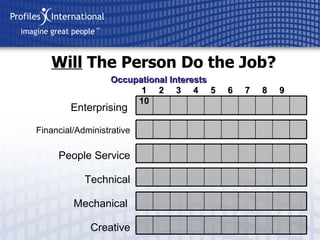
Will  The Person Do the Job? Enterprising Financial/Administrative People Service Technical Mechanical Creative Occupational Interests 1  2  3  4  5  6  7  8  9  10
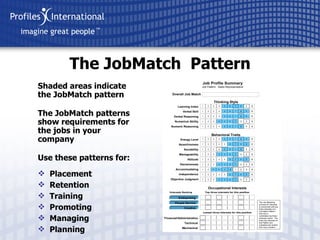
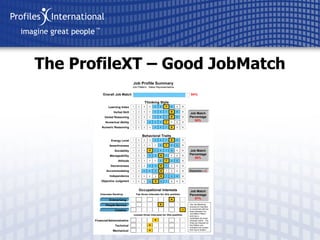
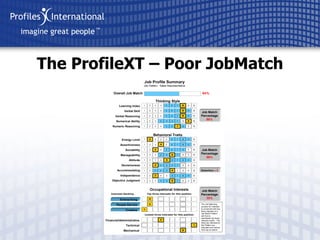
The JobMatch  Pattern ™   Shaded areas indicate the JobMatch pattern The JobMatch patterns show requirements for the jobs in your company Use these patterns for: Placement Retention Training Promoting Managing Planning
The ProfileXT – Good JobMatch
The ProfileXT – Poor JobMatch
What kind of high stress situations have you experienced in which important calculations were necessary? When making budgetary decisions, can you rapidly see where resources can be reallocated or redistributed? If required to organize financial data, what would motivate you best to get the job done? If working long hours analyzing data or solving technical problems, what ways do you maintain your motivation to persevere? Interview Questions
The Placement Report The Individual Report The Coaching and Managing Report The Multi-Job Match Report The Multi-Candidate Match Report The Job Summary Report The Job Summary Graph Multiple ProfileXT Reports
Today’s Objectives To  IDENTIFY  the characteristics    of top performers To maximize employee    PRODUCTIVITY To increase the  RETENTION  of   peak performers
“ In these days of talent wars, the best way to keep your stars is to know them better than they know themselves – and then use that information to customize the careers of their dreams.” –  “ Job Sculpting: The Art of Retaining Your best People” Harvard Business Review September. - Oct. 1999 Maximizing Productivity
Productivity Quality of Work Initiative Teamwork Problem Solving Job Related Competencies
Response to job-related stress, frustration and conflict How to motivate the employee Whether the employee is internally or externally motivated Additional Information
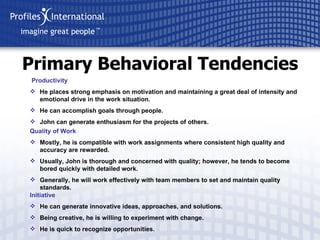
Primary Behavioral Tendencies Productivity He places strong emphasis on motivation and maintaining a great deal of intensity and emotional drive in the work situation. He can accomplish goals through people. John can generate enthusiasm for the projects of others. Quality of Work Mostly, he is compatible with work assignments where consistent high quality and accuracy are rewarded. Usually, John is thorough and concerned with quality; however, he tends to become bored quickly with detailed work. Generally, he will work effectively with team members to set and maintain quality standards. Initiative He can generate innovative ideas, approaches, and solutions. Being creative, he is willing to experiment with change. He is quick to recognize opportunities.
Response to Job Related Stress When experiencing stress, frustration, and/or conflict in a job setting, John may: Be optimistic, reassuring. Be trusting and accepting. Display a positive attitude regarding outcomes of conflict. Be approachable and open to others. Demonstrate flexibility in making workable compromises. See both sides of an argument. If, however, the level of stress, frustration, and/or conflict becomes intense and/or continues over an extended period of time, there may be a tendency to: Become careless and disorganized. Make overly optimistic assessments of others and outcomes. Over-estimate his own ability to change others. Experience difficulty planning and estimating time expenditure. Make overly optimistic, unrealistic promises. Oversell himself, relying too much on his verbal skills. Become overly entertaining, which could distract from the seriousness of the situation.
Work Motivation This section of the report describes the different types of incentives, rewards, and conditions that are most compatible with John’s behavioral tendencies and motivational style.  In motivating him, consider providing: Public and social recognition. Approval and acceptance. Group activities outside of the job, participating in the community, identifying with various social groups. Assignments with a high degree of people contacts, opportunity to be with people. Freedom from controls and details. The opportunity for freedom of artistic expression. Acknowledgement of his feelings. Attention, popularity, the opportunity to be in the spotlight.
Motivational Energy (ME) Motivational Energy (ME) reflects the intensity that an individual shows and how he approaches most situations.  John’s ME indicates that he will approach most situations with a moderate intensity and suggests that he might be inclined to show one or more of the following behavioral tendencies: Capable of making unpopular decisions under normal circumstances, he becomes reluctant to make decisions when disagreements escalate. He may become overly involved in socializing at the expense of proper time management. John might be inclined to make overly optimistic and unrealistic promises.
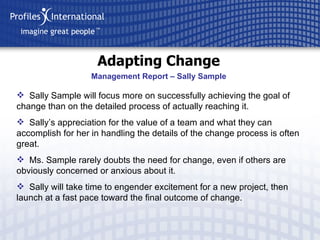
Adapting Change Sally Sample will focus more on successfully achieving the goal of change than on the detailed process of actually reaching it. Sally’s appreciation for the value of a team and what they can accomplish for her in handling the details of the change process is often great. Ms. Sample rarely doubts the need for change, even if others are obviously concerned or anxious about it. Sally will take time to engender excitement for a new project, then launch at a fast pace toward the final outcome of change. Management Report – Sally Sample
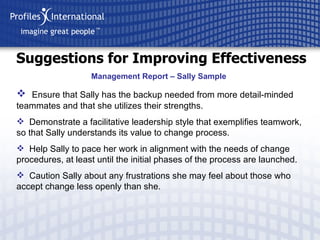
Suggestions for Improving Effectiveness Ensure that Sally has the backup needed from more detail-minded teammates and that she utilizes their strengths. Demonstrate a facilitative leadership style that exemplifies teamwork, so that Sally understands its value to change process. Help Sally to pace her work in alignment with the needs of change procedures, at least until the initial phases of the process are launched. Caution Sally about any frustrations she may feel about those who accept change less openly than she. Management Report – Sally Sample
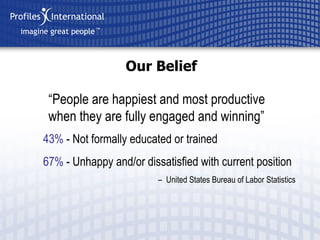
Our Belief “ People are happiest and most productive when they are fully engaged and winning” 43%  - Not formally educated or trained 67%  - Unhappy and/or dissatisfied with current position –  United States Bureau of Labor Statistics
Today’s Objectives To  IDENTIFY  the characteristics    of top performers To maximize employee    PRODUCTIVITY To increase the  RETENTION  of   peak performers
Build Effective Teams Develop World Class Customer Service Create Effective and Profitable Call Centers Receive Objective Management Feedback Obtain Thorough Background Checks Monthly educational  Newsletter  subscription We Can Help You
One Decision Can Change Your Life!

Retaining Top Performers[1]

  • 1.
    Sponsored by Yourlocal Profiles representative and Profiles International, Inc. An Executive Briefing Identifying and Retaining Top Performers
  • 2.
    Today’s Objectives To IDENTIFY the characteristics of top performers To maximize employee PRODUCTIVITY To increase the RETENTION of peak performers
  • 3.
    Over 700Local Offices 40,000 Clients 100 Countries
  • 4.
    Have you everhired someone who did not reach your expectations?
  • 5.
    History Résumé, PastEmployment, Education, Background Check Selection Process – Step 1 PAST
  • 6.
    Incompetence Incompatibility DishonestyThe Top Three Reasons People Fail Peter Drucker , Famous Management Consultant states: “ Chances are good that up to 66% of your company’s hiring decisions will prove to be mistakes in the first twelve months.”
  • 7.
    Selection Process –Step 2 PAST History Résumé, Past Employment, Education, Background Check PRESENT Interview Gut Feeling, Appearance, Personality, Interview
  • 8.
    “ 63% ofall hiring decisions are made during the first 4.3 minutes of an interview.” The Interview – SHRM Study, reported in USA Today
  • 9.
    36,000 business failuresare caused by employee theft Employees steal 10 times more than shoplifters Absenteeism costs a 50 employee company $31,100 annually Check Applicants This is your applicant pool!
  • 10.
    Provides a structuredinterview and employment history STEP ONE SURVEY II
  • 11.
  • 12.
  • 13.
  • 14.
    Selection Process –Step 2 PAST History Résumé, Past Employment, Education, Background Check PRESENT Interview Gut Feeling, Appearance, Personality, Interview, SOS II
  • 15.
    Selection Process –Step 3 PAST PRESENT History Résumé, Past Employment, Education, Background Check Interview Gut Feeling, Appearance, Personality, Interview, SOS II Testing & Job Matching FUTURE
  • 16.
    Utilize All ofYour Resources 75% 66% 54% 38% 26% 14% Interview Background Checks & Integrity Testing Personality Testing Ability Testing Interest Testing Job Matching + + + + + – Psychological Bulletin Vol. 96, No. 1, August 1994 Professor Mike Smith, University of Manchester
  • 17.
    The Total Person10% - Good But Limited Information: Skills, Experience & Company Match 90% - Essence of the Total Person: Thinking Style Occupational Interests Behavioral Traits Job Fit
  • 18.
    US Department ofLabor Employment and Training Administration Publication
  • 19.
    Using Assessments “The appropriate use of professionally developed assessment tools on average enables organizations to make more effective employment-related decisions than the use of simple observation or random de cision making. ” “ Testing and Assessment: An Employer’s Guide to Good Practices” US Department of Labor Employment and Training Administration
  • 20.
    Seeking The TotalPerson PAST PRESENT History Résumé, Past Employment, Education, Background Check Interview Gut Feeling, Appearance, Personality, Interview, SOS II Testing & Job Matching ProfileXT FUTURE
  • 21.
    Can theperson do the job? How will the person do the job? Will the person want to do the job? What the ProfileXT Measures
  • 22.
    Can thePerson Do the Job? Thinking Style Learning Index Verbal Skill Verbal Reasoning Numerical Ability Numeric Reasoning 1 2 3 4 5 6 7 8 9 10
  • 23.
    The Learning IndexOne Gallon One Gallon
  • 24.
    How WillThe Person Do the Job? Behavioral Traits 1 2 3 4 5 6 7 8 9 10 Energy Level Assertiveness Sociability Manageability Attitude Decisiveness Accommodating Independence Objective Judgement
  • 25.
    Will ThePerson Do the Job? Enterprising Financial/Administrative People Service Technical Mechanical Creative Occupational Interests 1 2 3 4 5 6 7 8 9 10
  • 26.
    The JobMatch Pattern ™ Shaded areas indicate the JobMatch pattern The JobMatch patterns show requirements for the jobs in your company Use these patterns for: Placement Retention Training Promoting Managing Planning
  • 27.
    The ProfileXT –Good JobMatch
  • 28.
    The ProfileXT –Poor JobMatch
  • 29.
    What kind ofhigh stress situations have you experienced in which important calculations were necessary? When making budgetary decisions, can you rapidly see where resources can be reallocated or redistributed? If required to organize financial data, what would motivate you best to get the job done? If working long hours analyzing data or solving technical problems, what ways do you maintain your motivation to persevere? Interview Questions
  • 30.
    The Placement ReportThe Individual Report The Coaching and Managing Report The Multi-Job Match Report The Multi-Candidate Match Report The Job Summary Report The Job Summary Graph Multiple ProfileXT Reports
  • 31.
    Today’s Objectives To IDENTIFY the characteristics of top performers To maximize employee PRODUCTIVITY To increase the RETENTION of peak performers
  • 32.
    “ In thesedays of talent wars, the best way to keep your stars is to know them better than they know themselves – and then use that information to customize the careers of their dreams.” – “ Job Sculpting: The Art of Retaining Your best People” Harvard Business Review September. - Oct. 1999 Maximizing Productivity
  • 33.
    Productivity Quality ofWork Initiative Teamwork Problem Solving Job Related Competencies
  • 34.
    Response to job-relatedstress, frustration and conflict How to motivate the employee Whether the employee is internally or externally motivated Additional Information
  • 35.
    Primary Behavioral TendenciesProductivity He places strong emphasis on motivation and maintaining a great deal of intensity and emotional drive in the work situation. He can accomplish goals through people. John can generate enthusiasm for the projects of others. Quality of Work Mostly, he is compatible with work assignments where consistent high quality and accuracy are rewarded. Usually, John is thorough and concerned with quality; however, he tends to become bored quickly with detailed work. Generally, he will work effectively with team members to set and maintain quality standards. Initiative He can generate innovative ideas, approaches, and solutions. Being creative, he is willing to experiment with change. He is quick to recognize opportunities.
  • 36.
    Response to JobRelated Stress When experiencing stress, frustration, and/or conflict in a job setting, John may: Be optimistic, reassuring. Be trusting and accepting. Display a positive attitude regarding outcomes of conflict. Be approachable and open to others. Demonstrate flexibility in making workable compromises. See both sides of an argument. If, however, the level of stress, frustration, and/or conflict becomes intense and/or continues over an extended period of time, there may be a tendency to: Become careless and disorganized. Make overly optimistic assessments of others and outcomes. Over-estimate his own ability to change others. Experience difficulty planning and estimating time expenditure. Make overly optimistic, unrealistic promises. Oversell himself, relying too much on his verbal skills. Become overly entertaining, which could distract from the seriousness of the situation.
  • 37.
    Work Motivation Thissection of the report describes the different types of incentives, rewards, and conditions that are most compatible with John’s behavioral tendencies and motivational style. In motivating him, consider providing: Public and social recognition. Approval and acceptance. Group activities outside of the job, participating in the community, identifying with various social groups. Assignments with a high degree of people contacts, opportunity to be with people. Freedom from controls and details. The opportunity for freedom of artistic expression. Acknowledgement of his feelings. Attention, popularity, the opportunity to be in the spotlight.
  • 38.
    Motivational Energy (ME)Motivational Energy (ME) reflects the intensity that an individual shows and how he approaches most situations. John’s ME indicates that he will approach most situations with a moderate intensity and suggests that he might be inclined to show one or more of the following behavioral tendencies: Capable of making unpopular decisions under normal circumstances, he becomes reluctant to make decisions when disagreements escalate. He may become overly involved in socializing at the expense of proper time management. John might be inclined to make overly optimistic and unrealistic promises.
  • 39.
    Adapting Change SallySample will focus more on successfully achieving the goal of change than on the detailed process of actually reaching it. Sally’s appreciation for the value of a team and what they can accomplish for her in handling the details of the change process is often great. Ms. Sample rarely doubts the need for change, even if others are obviously concerned or anxious about it. Sally will take time to engender excitement for a new project, then launch at a fast pace toward the final outcome of change. Management Report – Sally Sample
  • 40.
    Suggestions for ImprovingEffectiveness Ensure that Sally has the backup needed from more detail-minded teammates and that she utilizes their strengths. Demonstrate a facilitative leadership style that exemplifies teamwork, so that Sally understands its value to change process. Help Sally to pace her work in alignment with the needs of change procedures, at least until the initial phases of the process are launched. Caution Sally about any frustrations she may feel about those who accept change less openly than she. Management Report – Sally Sample
  • 41.
    Our Belief “People are happiest and most productive when they are fully engaged and winning” 43% - Not formally educated or trained 67% - Unhappy and/or dissatisfied with current position – United States Bureau of Labor Statistics
  • 42.
    Today’s Objectives To IDENTIFY the characteristics of top performers To maximize employee PRODUCTIVITY To increase the RETENTION of peak performers
  • 43.
    Build Effective TeamsDevelop World Class Customer Service Create Effective and Profitable Call Centers Receive Objective Management Feedback Obtain Thorough Background Checks Monthly educational Newsletter subscription We Can Help You
  • 44.
    One Decision CanChange Your Life!

Editor's Notes

  • #2 Good ___________, and welcome to our program – Identifying and Retaining Top Performers .   This briefing is being sponsored by (partner’s name) and Profiles International, Inc.   There are three extremely important objectives we want to achieve today.