
Sales Managers
 Assessing & Fostering
   Your Team and You


                Peter Rovick
                PDR Professional Development
                                               1
Contents
• Common Sales Reps. – Cast of Characters
• Typical Manager Types
• How Can I Manage Better?
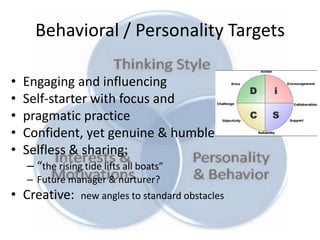
  – Characteristics of Top Sales People
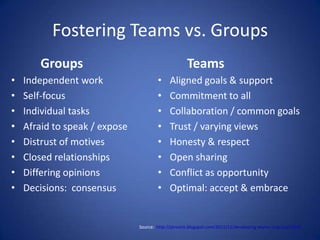
  – Teams vs. Groups
  – Best Practices for Managing


                                            2
Who’s on your Team?
  … and how can you improve?


                               3
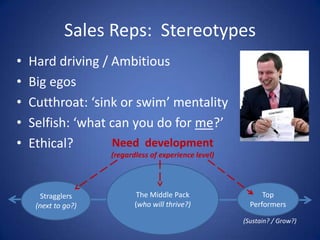
Sales Reps: Stereotypes
•   Hard driving / Ambitious
•   Big egos
•   Cutthroat: ‘sink or swim’ mentality
•   Selfish: ‘what can you do for me?’
•   Ethical?       Need development
                     (regardless of experience level)


       Stragglers            The Middle Pack                  Top
     (next to go?)          (who will thrive?)            Performers

                                                        (Sustain? / Grow?)
                                                                             4
Common Sale Reps
 Typical Cast of Characters
       “Not on my team!”


                              5
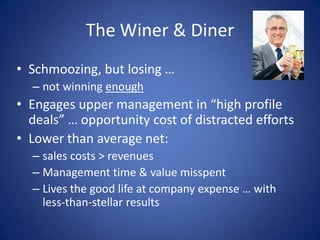
The Winer & Diner
• Schmoozing, but losing …
  – not winning enough
• Engages upper management in “high profile
  deals” … opportunity cost of distracted efforts
• Lower than average net:
  – sales costs > revenues
  – Management time & value misspent
  – Lives the good life at company expense … with
    less-than-stellar results
                                                    6
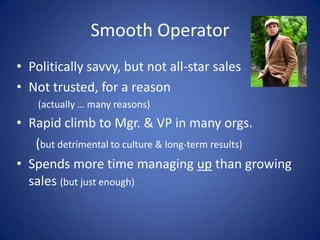
Smooth Operator
• Politically savvy, but not all-star sales
• Not trusted, for a reason
    (actually … many reasons)
• Rapid climb to Mgr. & VP in many orgs.
   (but detrimental to culture & long-term results)
• Spends more time managing up than growing
  sales (but just enough)


                                                      8
The New Hire(s)
•   Eager to form friendships
•   Seeks insights & “the real story”
•   Testing the waters
•   May become your best friend or worst enemy

           Welcome them & share selflessly / sincerely,
      then assess motives and share if/when they reciprocate


                                                               11
So who do you want on your team?
     Will you make needed changes?


                                     12
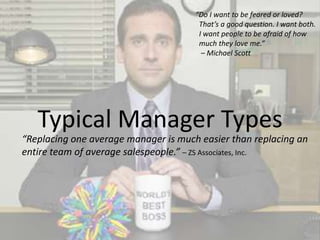
“Do I want to be feared or loved?
                                       That’s a good question. I want both.
                                       I want people to be afraid of how
                                       much they love me.”
                                        – Michael Scott


   Typical Manager Types
“Replacing one average manager is much easier than replacing an
entire team of average salespeople.” – ZS Associates, Inc.


                                                                    13
Three Types of Sales Managers
• The Best Intended Sales Manager           (<10%)
    – Characterized by their willingness to invest their time .... Yet, even with these
      best intentions, and the lack of important insights (other than ‘what has
      already happened’) their coaching efforts are ineffective.
• The Average Sales Manager                  ( 30%)
    – Characterized by willingness to ‘live with’ the limited reports ... These coaches
      find themselves ‘guessing’ what the information means, and ‘second guessing’
      its accuracy. Not surprisingly, these sales managers are ineffective coaches.
• The Less Skilled Sales Manager             (>60%)
    – … the less skilled sales manager may not have the tools or the competencies
      to lead and coach a sales force. This is due to many factors, including a lack of
      training, poor hiring, and... with limited insights to the hidden problems of
      sales performance, these managers do very little coaching – and results suffer.


  “… all-too-common practice of promoting great sales people
   thinking they will also be great sales managers”
                                            Source: St. Meyer & Hubbard, Elizabeth Cabalka
                                                                                       14
Common Manager Types


                   16
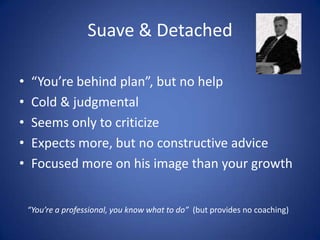
Suave & Detached

•    “You’re behind plan”, but no help
•    Cold & judgmental
•    Seems only to criticize
•    Expects more, but no constructive advice
•    Focused more on his image than your growth


    “You’re a professional, you know what to do” (but provides no coaching)

                                                                              17
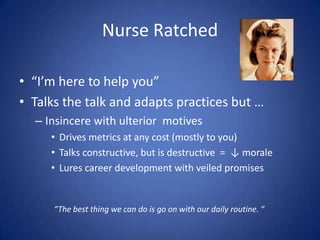
Nurse Ratched

• “I’m here to help you”
• Talks the talk and adapts practices but …
  – Insincere with ulterior motives
     • Drives metrics at any cost (mostly to you)
     • Talks constructive, but is destructive = ↓ morale
     • Lures career development with veiled promises


      “The best thing we can do is go on with our daily routine. ”

                                                                     18
The Feudal Lord
  fief·dom: Something over which one dominant person or group
  exercises control

  • Attitude: “You’re here to serve me”
  • Cares only about self-advancement
  • Looks great in front of superiors, but doesn’t
    care about team development or
  • Takes credit for your accomplishments
  • More focused on managing up, than
    managing reports
“What do ‘we’ need to do to book these sales before end of quarter?”
                                                                       20
How Can I Manage Better?
 Actual & active, not traditional management


                                               21
7 Personality Traits of Top Salespeople
1. Modesty:      ostentatious salespeople who are full of bravado alienate far more
    customers than they win over
2. Conscientiousness:                strong sense of duty and being responsible and
    reliable
3. Achievement Orientation:                     performers seek to understand the politics of
    customer decision-making
4. Curiosity: correlates to an active presence during sales calls
5. Lack of Gregariousness: overly friendly salespeople are too close to
    their customers and have difficulty establishing dominance.
6. Lack of Discouragement: correlation between sports and sales success
7. Lack of Self-Consciousness: action-oriented and unafraid to call high in
    their accounts


  Source: HBR Blog Network
  http://blogs.hbr.org/cs/2011/06/the_seven_personality_traits_o.html
                                                                                           23
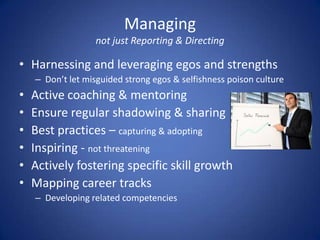
Managing
                   not just Reporting & Directing

• Harnessing and leveraging egos and strengths
    – Don’t let misguided strong egos & selfishness poison culture
•   Active coaching & mentoring
•   Ensure regular shadowing & sharing
•   Best practices – capturing & adopting
•   Inspiring - not threatening
•   Actively fostering specific skill growth
•   Mapping career tracks
    – Developing related competencies


                                                                     24
Characteristics of Teams
•   Clear goals
•   Results-driven structure
•   Competent team members
•   Unified commitment
•   Collaborative climate
•   High standards embraced by all
•   External support and encouragement
•   Principled leadership


                                                                   27
                   Source: NTD Resource Center, Teamwork in the Classroom
Best Practices
… but not just lip service … actual adoption & team growth

  • Document & share success stories
     – What strategies & tactics worked … and why?
  • Develop & deploy processes
     – Active / frequent coaching & ongoing modification
  • Continuous development of competencies
  • Mentors, not feudal lords
  • Rewards merit, ignores sychophants
                                                       28
12 Best Practices for Successful Teams
7. Process: Don’t over engineer it, but don’t ignore it.
   Come alongside team members to motivate and reward them in a social format
   that brings out the best in them in a way that inspires everyone
8. Coaching: In the day – in the moment.
9. Herding cats: Dealing with the mavericks and high performers.
    Turning great individual performers into great performing teams
10. Leading Indicators: Worrisome patterns of behavior.
   Be proactive by coaching reps as they perform… helps prevent weaker
   performances from becoming … bad habits that sap overall productivity and sales.
11. Protect their time: can’t sell if aren’t spending time with customers.
12. Celebrate: Winning is fun. Celebrate it!
   Effective sales managers understand that the best way to
   dispel some of the pressure is to reward wins – even
   small ones – as often as possible

                                             Source: Blog.Salesforce.com 12 Best Practices That30
                                                                                                Help
Next Steps / Action Plan
•   Resist tradition … innovate
•   Reassess & realign
•   Change is difficult, but culture gains
•   Actions speak louder than words
•   Actively engage professional development

            “A rising tide lifts all boats”

                                               31
About me
Experience
• Sales, Customer Service, Product Specialist
• Training, Coaching, Facilitating
• Continuous Process Improvement
• Creativity & Initiative (multiple awards)

Personal highlights
• Twitter: @SmartphoneTrack
• Blog:      plrovick.blogspot.com
• LinkedIn: www.linkedin.com/in/rovick/   Inquiries:
                                          Peter Rovick
                                          Full Cycle Professional Development
                                          Sherborn, MA (USA)
                                          e: provick@gmail.com
                                                                     32

Sales Managers: Assessing & Fostering Your Team and You

  • 1.
    Sales Managers Assessing& Fostering Your Team and You Peter Rovick PDR Professional Development 1
  • 2.
    Contents • Common SalesReps. – Cast of Characters • Typical Manager Types • How Can I Manage Better? – Characteristics of Top Sales People – Teams vs. Groups – Best Practices for Managing 2
  • 3.
    Who’s on yourTeam? … and how can you improve? 3
  • 4.
    Sales Reps: Stereotypes • Hard driving / Ambitious • Big egos • Cutthroat: ‘sink or swim’ mentality • Selfish: ‘what can you do for me?’ • Ethical? Need development (regardless of experience level) Stragglers The Middle Pack Top (next to go?) (who will thrive?) Performers (Sustain? / Grow?) 4
  • 5.
    Common Sale Reps Typical Cast of Characters “Not on my team!” 5
  • 6.
    The Winer &Diner • Schmoozing, but losing … – not winning enough • Engages upper management in “high profile deals” … opportunity cost of distracted efforts • Lower than average net: – sales costs > revenues – Management time & value misspent – Lives the good life at company expense … with less-than-stellar results 6
  • 7.
    Smooth Operator • Politicallysavvy, but not all-star sales • Not trusted, for a reason (actually … many reasons) • Rapid climb to Mgr. & VP in many orgs. (but detrimental to culture & long-term results) • Spends more time managing up than growing sales (but just enough) 8
  • 8.
    The New Hire(s) • Eager to form friendships • Seeks insights & “the real story” • Testing the waters • May become your best friend or worst enemy Welcome them & share selflessly / sincerely, then assess motives and share if/when they reciprocate 11
  • 9.
    So who doyou want on your team? Will you make needed changes? 12
  • 10.
    “Do I wantto be feared or loved? That’s a good question. I want both. I want people to be afraid of how much they love me.” – Michael Scott Typical Manager Types “Replacing one average manager is much easier than replacing an entire team of average salespeople.” – ZS Associates, Inc. 13
  • 11.
    Three Types ofSales Managers • The Best Intended Sales Manager (<10%) – Characterized by their willingness to invest their time .... Yet, even with these best intentions, and the lack of important insights (other than ‘what has already happened’) their coaching efforts are ineffective. • The Average Sales Manager ( 30%) – Characterized by willingness to ‘live with’ the limited reports ... These coaches find themselves ‘guessing’ what the information means, and ‘second guessing’ its accuracy. Not surprisingly, these sales managers are ineffective coaches. • The Less Skilled Sales Manager (>60%) – … the less skilled sales manager may not have the tools or the competencies to lead and coach a sales force. This is due to many factors, including a lack of training, poor hiring, and... with limited insights to the hidden problems of sales performance, these managers do very little coaching – and results suffer. “… all-too-common practice of promoting great sales people thinking they will also be great sales managers” Source: St. Meyer & Hubbard, Elizabeth Cabalka 14
  • 12.
  • 13.
    Suave & Detached • “You’re behind plan”, but no help • Cold & judgmental • Seems only to criticize • Expects more, but no constructive advice • Focused more on his image than your growth “You’re a professional, you know what to do” (but provides no coaching) 17
  • 14.
    Nurse Ratched • “I’mhere to help you” • Talks the talk and adapts practices but … – Insincere with ulterior motives • Drives metrics at any cost (mostly to you) • Talks constructive, but is destructive = ↓ morale • Lures career development with veiled promises “The best thing we can do is go on with our daily routine. ” 18
  • 15.
    The Feudal Lord fief·dom: Something over which one dominant person or group exercises control • Attitude: “You’re here to serve me” • Cares only about self-advancement • Looks great in front of superiors, but doesn’t care about team development or • Takes credit for your accomplishments • More focused on managing up, than managing reports “What do ‘we’ need to do to book these sales before end of quarter?” 20
  • 16.
    How Can IManage Better? Actual & active, not traditional management 21
  • 17.
    7 Personality Traitsof Top Salespeople 1. Modesty: ostentatious salespeople who are full of bravado alienate far more customers than they win over 2. Conscientiousness: strong sense of duty and being responsible and reliable 3. Achievement Orientation: performers seek to understand the politics of customer decision-making 4. Curiosity: correlates to an active presence during sales calls 5. Lack of Gregariousness: overly friendly salespeople are too close to their customers and have difficulty establishing dominance. 6. Lack of Discouragement: correlation between sports and sales success 7. Lack of Self-Consciousness: action-oriented and unafraid to call high in their accounts Source: HBR Blog Network http://blogs.hbr.org/cs/2011/06/the_seven_personality_traits_o.html 23
  • 18.
    Managing not just Reporting & Directing • Harnessing and leveraging egos and strengths – Don’t let misguided strong egos & selfishness poison culture • Active coaching & mentoring • Ensure regular shadowing & sharing • Best practices – capturing & adopting • Inspiring - not threatening • Actively fostering specific skill growth • Mapping career tracks – Developing related competencies 24
  • 19.
    Characteristics of Teams • Clear goals • Results-driven structure • Competent team members • Unified commitment • Collaborative climate • High standards embraced by all • External support and encouragement • Principled leadership 27 Source: NTD Resource Center, Teamwork in the Classroom
  • 20.
    Best Practices … butnot just lip service … actual adoption & team growth • Document & share success stories – What strategies & tactics worked … and why? • Develop & deploy processes – Active / frequent coaching & ongoing modification • Continuous development of competencies • Mentors, not feudal lords • Rewards merit, ignores sychophants 28
  • 21.
    12 Best Practicesfor Successful Teams 7. Process: Don’t over engineer it, but don’t ignore it. Come alongside team members to motivate and reward them in a social format that brings out the best in them in a way that inspires everyone 8. Coaching: In the day – in the moment. 9. Herding cats: Dealing with the mavericks and high performers. Turning great individual performers into great performing teams 10. Leading Indicators: Worrisome patterns of behavior. Be proactive by coaching reps as they perform… helps prevent weaker performances from becoming … bad habits that sap overall productivity and sales. 11. Protect their time: can’t sell if aren’t spending time with customers. 12. Celebrate: Winning is fun. Celebrate it! Effective sales managers understand that the best way to dispel some of the pressure is to reward wins – even small ones – as often as possible Source: Blog.Salesforce.com 12 Best Practices That30 Help
  • 22.
    Next Steps /Action Plan • Resist tradition … innovate • Reassess & realign • Change is difficult, but culture gains • Actions speak louder than words • Actively engage professional development “A rising tide lifts all boats” 31
  • 23.
    About me Experience • Sales,Customer Service, Product Specialist • Training, Coaching, Facilitating • Continuous Process Improvement • Creativity & Initiative (multiple awards) Personal highlights • Twitter: @SmartphoneTrack • Blog: plrovick.blogspot.com • LinkedIn: www.linkedin.com/in/rovick/ Inquiries: Peter Rovick Full Cycle Professional Development Sherborn, MA (USA) e: provick@gmail.com 32

Editor's Notes

  • #6 “Replacing one average manager is much easier than replacing an entire team of average salespeople.” – ZS Associates, Inc. http://bit.ly/SYvmjF
  • #14 “Replacing one average manager is much easier than replacing an entire team of average salespeople.” – ZS Associates, Inc. http://bit.ly/SYvmjF
  • #15 http://www.stmeyerandhubbard.com/blog/The Best Intended Sales Manager.  This group represents less than 10% of sales managers, characterized by their willingness to invest their time (or that of an administrative assistant) assembling sales reports from a variety of disparate systems, a time-consuming monthly process.  These managers take the time to search for answers to important questions so they can make important management decisions.  Yet, even with these best intentions, and the lack of important insights (other than ‘what has already happened’) their coaching efforts are ineffective.The Average Sales Manager.   This group represents about 30% of sales managers, characterized by their willingness to ‘live with’ the limited reports that are available. These coaches find themselves ‘guessing’ what the information means, and ‘second guessing’ its accuracy.  Not surprisingly, these sales managers are ineffective coaches.The Less Skilled Sales Manager.   This group represents the largest group (over 60%) of sales managers, characterized by their unwillingness to invest their time in the existing reports.  Additionally, the less skilled sales manager may not have the tools or the competencies to lead and coach a sales force. This is due to many factors, including a lack of training, poor hiring, and the all-too-common practice of promoting great sales people thinking they will also be great sales managers.  Without answers to their questions and with limited insights to the hidden problems of sales performance, these managers do very little coaching – and results suffer.
  • #16 Blogs.salesforce.comhttp://bit.ly/SKdiKe
  • #23 Source: Strategic Visions, Inc. http://www.strategicvisionsinc.com/uploaded/toptensales.pdf
  • #28 Source:  NTD Resource Center, Teamwork in the Classroomhttp://www.ndt-ed.org/TeachingResources/ClassroomTips/Teamwork.htm
  • #30 Source: Blog.Salesforce.com 12 Best Practices That Help Sales Managers Make Their Teams Successful http://bit.ly/SKdiKe
  • #31 Source: Blog.Salesforce.com 12 Best Practices That Help Sales Managers Make Their Teams Successful http://bit.ly/SKdiKe