Presented by:
Amit Kumar ( BM 012015)
Bhashker Jee (BM 012041)
Brajesh Singh (BM 012042)
Arunesh Tiwari (BM 012035)
Divya Shree Srivastava (BM 012050)
Abhay Singh(BM 012002)
Motivation
What is Motivation?
Motivation is some driving force within
individuals by which they attempt to
achieve some goal in order to fulfill some
need or expectation.
What is Sales Force Motivation?
Motivation is the effort salespeople want to
make to complete various aspects of their
jobs.
In term of sales force:
• Motivation is the inner feeling to work better
to achieve best result
• It is desire to do better than the best.
Performance = Ability x Motivation
Types of Motivation
• Extrinsic motivation ( related to tangible
rewards such as money )
• Intrinsic motivation ( related to psychological
rewards such as the sense of challenge and
achievement).
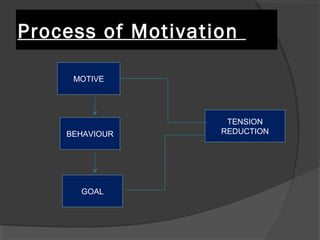
Process of Motivation
MOTIVE
TENSION
REDUCTIONBEHAVIOUR
GOAL
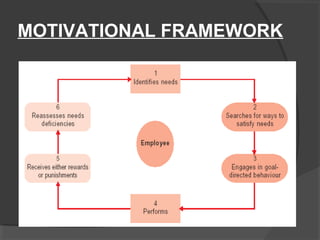
MOTIVATIONAL FRAMEWORK
 Unique nature of the sales job
 Changes in market Environment
 Individuality of Sales people
 Diversity in Company Goals
FINANCIAL REWARDS
 Basic Compensation plan
 Salary
 Commissions
 Bonus payments
 Sales Contests
 Merchandise & travel
 Through Cyberspace Incentives
NON FINANCIAL REWARDSNON FINANCIAL REWARDS
 Recognition awards; such as trophies,
Certificates
 Promotions
 Praise and encouragement from management
 Job enrichment
 Sales meetings and conventions
Motivation of Sales
People
There is mainly four ways to motivate
sales people:
 Need Hierarchy Theory
 Hertzberg’s Two Factor Theory
 ERG Theory
 Goal Setting Theory
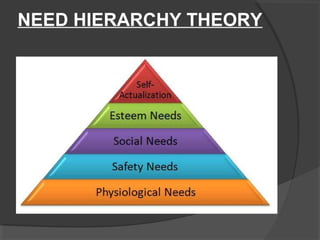
NEED HIERARCHY THEORY
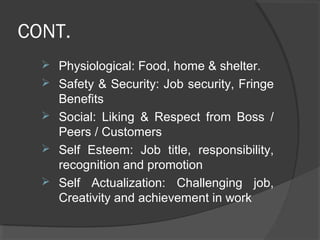
CONT.
 Physiological: Food, home & shelter.
 Safety & Security: Job security, Fringe
Benefits
 Social: Liking & Respect from Boss /
Peers / Customers
 Self Esteem: Job title, responsibility,
recognition and promotion
 Self Actualization: Challenging job,
Creativity and achievement in work
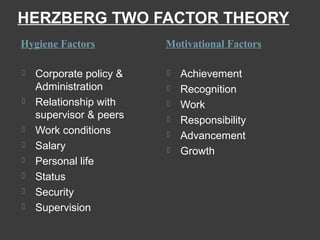
HERZBERG TWO FACTOR THEORY
Hygiene Factors Motivational Factors
 Corporate policy &
Administration
 Relationship with
supervisor & peers
 Work conditions
 Salary
 Personal life
 Status
 Security
 Supervision
 Achievement
 Recognition
 Work
 Responsibility
 Advancement
 Growth
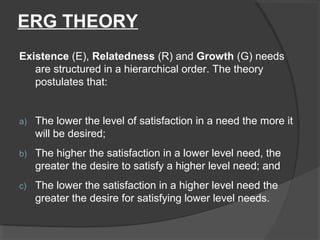
ERG THEORY
Existence (E), Relatedness (R) and Growth (G) needs
are structured in a hierarchical order. The theory
postulates that:
a) The lower the level of satisfaction in a need the more it
will be desired;
b) The higher the satisfaction in a lower level need, the
greater the desire to satisfy a higher level need; and
c) The lower the satisfaction in a higher level need the
greater the desire for satisfying lower level needs.
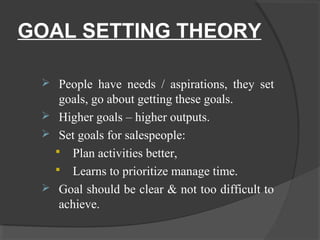
GOAL SETTING THEORY
 People have needs / aspirations, they set
goals, go about getting these goals.
 Higher goals – higher outputs.
 Set goals for salespeople:
 Plan activities better,
 Learns to prioritize manage time.
 Goal should be clear & not too difficult to
achieve.
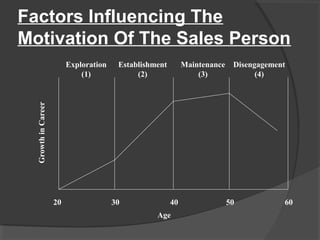
Factors Influencing The
Motivation Of The Sales Person
20 30 40 50 60
Exploration
(1)
Establishment
(2)
Maintenance
(3)
Disengagement
(4)
Age
GrowthinCareer
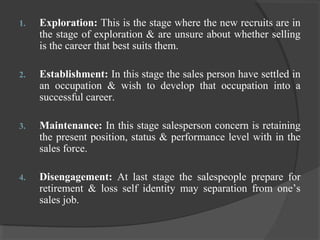
1. Exploration: This is the stage where the new recruits are in
the stage of exploration & are unsure about whether selling
is the career that best suits them.
2. Establishment: In this stage the sales person have settled in
an occupation & wish to develop that occupation into a
successful career.
3. Maintenance: In this stage salesperson concern is retaining
the present position, status & performance level with in the
sales force.
4. Disengagement: At last stage the salespeople prepare for
retirement & loss self identity may separation from one’s
sales job.
Sales force motivation role, scope and methods

Sales force motivation role, scope and methods

  • 1.
    Presented by: Amit Kumar( BM 012015) Bhashker Jee (BM 012041) Brajesh Singh (BM 012042) Arunesh Tiwari (BM 012035) Divya Shree Srivastava (BM 012050) Abhay Singh(BM 012002)
  • 2.
    Motivation What is Motivation? Motivationis some driving force within individuals by which they attempt to achieve some goal in order to fulfill some need or expectation. What is Sales Force Motivation? Motivation is the effort salespeople want to make to complete various aspects of their jobs.
  • 3.
    In term ofsales force: • Motivation is the inner feeling to work better to achieve best result • It is desire to do better than the best. Performance = Ability x Motivation Types of Motivation • Extrinsic motivation ( related to tangible rewards such as money ) • Intrinsic motivation ( related to psychological rewards such as the sense of challenge and achievement).
  • 4.
  • 5.
  • 7.
     Unique natureof the sales job  Changes in market Environment  Individuality of Sales people  Diversity in Company Goals
  • 8.
    FINANCIAL REWARDS  BasicCompensation plan  Salary  Commissions  Bonus payments  Sales Contests  Merchandise & travel  Through Cyberspace Incentives
  • 9.
    NON FINANCIAL REWARDSNONFINANCIAL REWARDS  Recognition awards; such as trophies, Certificates  Promotions  Praise and encouragement from management  Job enrichment  Sales meetings and conventions
  • 10.
    Motivation of Sales People Thereis mainly four ways to motivate sales people:  Need Hierarchy Theory  Hertzberg’s Two Factor Theory  ERG Theory  Goal Setting Theory
  • 11.
  • 12.
    CONT.  Physiological: Food,home & shelter.  Safety & Security: Job security, Fringe Benefits  Social: Liking & Respect from Boss / Peers / Customers  Self Esteem: Job title, responsibility, recognition and promotion  Self Actualization: Challenging job, Creativity and achievement in work
  • 13.
    HERZBERG TWO FACTORTHEORY Hygiene Factors Motivational Factors  Corporate policy & Administration  Relationship with supervisor & peers  Work conditions  Salary  Personal life  Status  Security  Supervision  Achievement  Recognition  Work  Responsibility  Advancement  Growth
  • 14.
    ERG THEORY Existence (E),Relatedness (R) and Growth (G) needs are structured in a hierarchical order. The theory postulates that: a) The lower the level of satisfaction in a need the more it will be desired; b) The higher the satisfaction in a lower level need, the greater the desire to satisfy a higher level need; and c) The lower the satisfaction in a higher level need the greater the desire for satisfying lower level needs.
  • 15.
    GOAL SETTING THEORY People have needs / aspirations, they set goals, go about getting these goals.  Higher goals – higher outputs.  Set goals for salespeople:  Plan activities better,  Learns to prioritize manage time.  Goal should be clear & not too difficult to achieve.
  • 16.
    Factors Influencing The MotivationOf The Sales Person 20 30 40 50 60 Exploration (1) Establishment (2) Maintenance (3) Disengagement (4) Age GrowthinCareer
  • 17.
    1. Exploration: Thisis the stage where the new recruits are in the stage of exploration & are unsure about whether selling is the career that best suits them. 2. Establishment: In this stage the sales person have settled in an occupation & wish to develop that occupation into a successful career. 3. Maintenance: In this stage salesperson concern is retaining the present position, status & performance level with in the sales force. 4. Disengagement: At last stage the salespeople prepare for retirement & loss self identity may separation from one’s sales job.