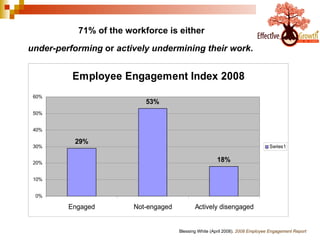
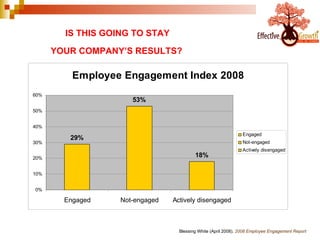
Blessing White (April 2008).  2008 Employee Engagement Report   71% of the workforce is either  under-performing  or  actively undermining their work .
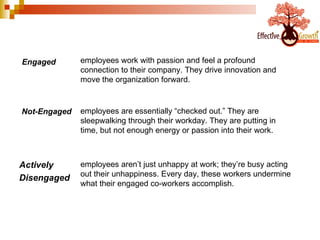
employees work with passion and feel a profound connection to their company. They drive innovation and move the organization forward. employees are essentially “checked out.” They are sleepwalking through their workday. They are putting in time, but not enough energy or passion into their work. employees aren’t just unhappy at work; they’re busy acting out their unhappiness. Every day, these workers undermine what their engaged co-workers accomplish. Actively Disengaged Engaged Not-Engaged
WHAT IS ENGAGEMENT? “ An employee's involvement with, commitment to, and satisfaction with work.”   Seijts, Gerard H. and Dan Crim (2006).  "The Ten C's of Employee Engagement"   “ Engaged employees  care  about the future of the company and are  willing to invest   the discretionary effort.”
Companies that  engage  their employees  perform 2.6 times better  than their competition.  The Hay Group found that offices with engaged employees were up to  43% more productive . Disengaged  employees cost their organizations millions through  - poor customer service,  - damage to the brand,  - operational inefficiencies,  - lost opportunities,  - low productivity &  - high staff  turnover costs Source: Gallup Organisation Research, 2005
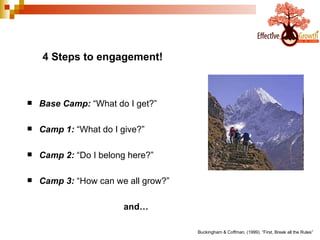
Buckingham & Coffman, (1999). “First, Break all the Rules”   4 Steps to engagement! Base Camp:  “What do I get?”  Camp 1:  “What do I give?”  Camp 2:  “Do I belong here?” Camp 3:  “How can we all grow?” and…
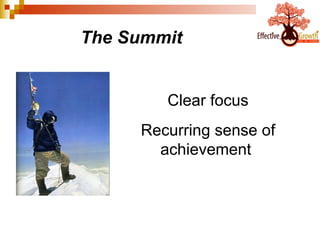
The Summit Clear focus Recurring sense of achievement
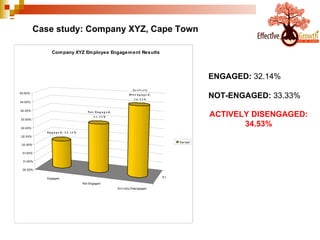
Case study: Company XYZ, Cape Town FOCUS ENGAGED:  32.14% NOT-ENGAGED:  33.33% ACTIVELY DISENGAGED:   34.53%
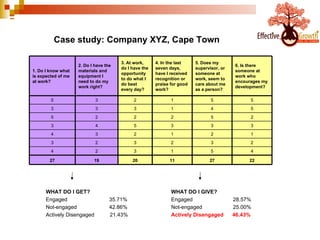
Case study: Company XYZ, Cape Town WHAT DO I GET? Engaged   35.71% Not-engaged   42.86% Actively Disengaged 21.43% WHAT DO I GIVE?   Engaged   28.57% Not-engaged   25.00% Actively Disengaged  46.43% FOCUS 22 27 11 20 19 27 4 5 1 3 2 4 2 3 2 3 2 3 1 2 1 2 3 4 3 3 3 5 4 3 2 5 2 2 2 5 5 4 1 3 3 3 5 5 1 2 3 5 6. Is there someone at work who encourages my development? 5. Does my supervisor, or someone at work, seem to care about me as a person? 4. In the last seven days, have I received recognition or praise for good work? 3. At work, do I have the opportunity to do what I do best every day? 2. Do I have the materials and equipment I need to do my work right? 1. Do I know what is expected of me at work?
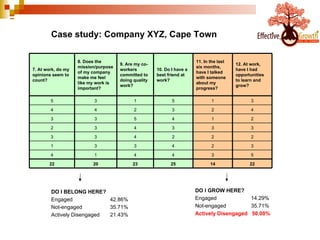
Case study: Company XYZ, Cape Town DO I BELONG HERE? Engaged   42.86% Not-engaged   35.71% Actively Disengaged  21.43% DO I GROW HERE?   Engaged   14.29% Not-engaged   35.71% Actively Disengaged  50.00% FOCUS 22 14 25 23 20 22 5 3 4 4 1 4 3 2 4 3 3 1 2 2 2 4 3 3 3 3 3 4 3 2 2 1 4 5 3 3 4 2 3 2 4 4 3 1 5 1 3 5 12. At work, have I had opportunities to learn and grow? 11. In the last six months, have I talked with someone about my progress? 10. Do I have a best friend at work? 9. Are my co-workers committed to doing quality work? 8. Does the mission/purpose of my company make me feel like my work is important? 7. At work, do my opinions seem to count?
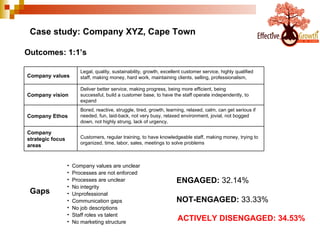
Case study: Company XYZ, Cape Town Outcomes: 1:1’s AIM Gaps Company values are unclear  Processes are not enforced  Processes are unclear  No integrity Unprofessional  Communication gaps  No job descriptions  Staff roles vs talent No marketing structure ENGAGED:  32.14% NOT-ENGAGED:  33.33% ACTIVELY DISENGAGED:   34.53% Customers, regular training, to have knowledgeable staff, making money, trying to  organized, time, labor, sales, meetings to solve problems Company  strategic focus  areas Bored, reactive, struggle, tired, growth, learning, relaxed, calm, can get serious if  needed, fun, laid-back, not very busy, relaxed environment, jovial, not bogged down, not highly strung, lack of urgency. Company Ethos Deliver better service, making progress, being more efficient, being  successful, build a customer base, to have the staff operate independently, to  expand Company vision Legal, quality, sustainability, growth, excellent customer service, highly qualified  staff, making money, hard work, maintaining clients, selling, professionalism,  Company values
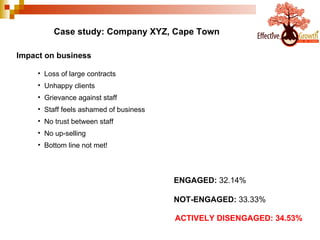
Case study: Company XYZ, Cape Town Impact on business AIM Loss of large contracts  Unhappy clients  Grievance against staff  Staff feels ashamed of business  No trust between staff No up-selling Bottom line not met! ENGAGED:  32.14% NOT-ENGAGED:  33.33% ACTIVELY DISENGAGED:   34.53%
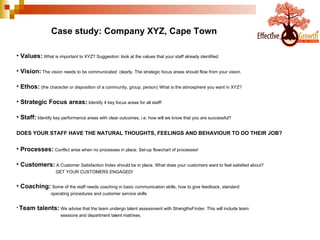
Case study: Company XYZ, Cape Town Values:  What is important to XYZ? Suggestion: look at the values that your staff already identified. Vision:   The vision needs to be communicated  clearly. The strategic focus areas should flow from your vision. Ethos:  (the character or disposition of a community, group, person) What is the atmosphere you want in XYZ?  Strategic Focus areas:   Identify 4 key focus areas for all staff! Staff:   Identify key performance areas with clear outcomes, i.e. how will we know that you are successful?  DOES YOUR STAFF HAVE THE NATURAL THOUGHTS, FEELINGS AND BEHAVIOUR TO DO THEIR JOB? Processes:   Conflict arise when no processes in place. Set-up flowchart of processes!  Customers:   A Customer Satisfaction Index should be in place. What does your customers want to feel satisfied about?  GET YOUR CUSTOMERS ENGAGED! Coaching:   Some of the staff needs coaching in basic communication skills, how to give feedback, standard  operating procedures and customer service skills Team talents:   We advise that the team undergo talent assessment with StrengthsFinder. This will include team  sessions and department talent matrixes. AIM
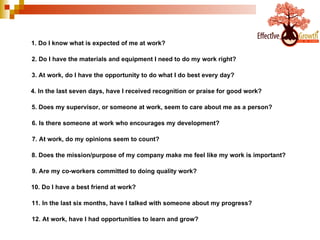
1. Do I know what is expected of me at work? 2. Do I have the materials and equipment I need to do my work right? 3. At work, do I have the opportunity to do what I do best every day? 4. In the last seven days, have I received recognition or praise for good work? 5. Does my supervisor, or someone at work, seem to care about me as a person? 6. Is there someone at work who encourages my development? 7. At work, do my opinions seem to count? 8. Does the mission/purpose of my company make me feel like my work is important? 9. Are my co-workers committed to doing quality work? 10. Do I have a best friend at work? 11. In the last six months, have I talked with someone about my progress? 12. At work, have I had opportunities to learn and grow?
Blessing White (April 2008).  2008 Employee Engagement Report   IS THIS GOING TO STAY  YOUR COMPANY’S RESULTS?
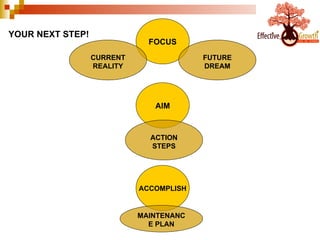
FOCUS AIM ACCOMPLISH YOUR NEXT STEP! CURRENT REALITY FUTURE DREAM ACTION STEPS MAINTENANCE PLAN
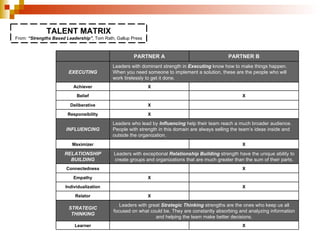
TALENT MATRIX From:  “Strengths Based Leadership” , Tom Rath, Gallup Press X Learner Leaders with great  Strategic Thinking  strengths are the ones who keep us all focused on what could be. They are constantly absorbing and analyzing information and helping the team make better decisions. STRATEGIC THINKING X Relator X Individualization X Empathy X Connectedness Leaders with exceptional  Relationship Building  strength have the unique ability to create groups and organizations that are much greater than the sum of their parts. RELATIONSHIP BUILDING X Maximizer Leaders who lead by  Influencing  help their team reach a much broader audience. People with strength in this domain are always selling the team’s ideas inside and outside the organization. INFLUENCING X Responsibility X Deliberative X Belief X Achiever Leaders with dominant strength in  Executing  know how to make things happen. When you need someone to implement a solution, these are the people who will work tirelessly to get it done. EXECUTING PARTNER B PARTNER A
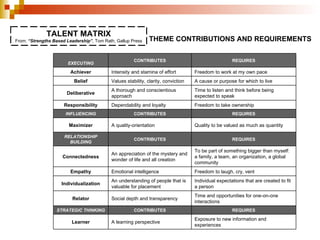
THEME CONTRIBUTIONS AND REQUIREMENTS AIM TALENT MATRIX From:  “Strengths Based Leadership” , Tom Rath, Gallup Press Exposure to new information and experiences A learning perspective Learner REQUIRES CONTRIBUTES STRATEGIC THINKING Time and opportunities for one-on-one interactions Social depth and transparency Relator Individual expectations that are created to fit a person An understanding of people that is valuable for placement Individualization Freedom to laugh, cry, vent Emotional intelligence Empathy To be part of something bigger than myself: a family, a team, an organization, a global community An appreciation of the mystery and wonder of life and all creation Connectedness REQUIRES CONTRIBUTES RELATIONSHIP BUILDING Quality to be valued as much as quantity A quality-orientation Maximizer REQUIRES CONTRIBUTES INFLUENCING Freedom to take ownership Dependability and loyalty Responsibility Time to listen and think before being expected to speak A thorough and conscientious approach Deliberative A cause or purpose for which to live Values stability, clarity, conviction Belief Freedom to work at my own pace Intensity and stamina of effort Achiever REQUIRES CONTRIBUTES EXECUTING
www.effectivegrowth.co.za

Slideshare effective growth

  • 1.
  • 2.
    Blessing White (April2008). 2008 Employee Engagement Report 71% of the workforce is either under-performing or actively undermining their work .
  • 3.
    employees work withpassion and feel a profound connection to their company. They drive innovation and move the organization forward. employees are essentially “checked out.” They are sleepwalking through their workday. They are putting in time, but not enough energy or passion into their work. employees aren’t just unhappy at work; they’re busy acting out their unhappiness. Every day, these workers undermine what their engaged co-workers accomplish. Actively Disengaged Engaged Not-Engaged
  • 4.
    WHAT IS ENGAGEMENT?“ An employee's involvement with, commitment to, and satisfaction with work.” Seijts, Gerard H. and Dan Crim (2006). "The Ten C's of Employee Engagement" “ Engaged employees care about the future of the company and are willing to invest the discretionary effort.”
  • 5.
    Companies that engage their employees perform 2.6 times better than their competition. The Hay Group found that offices with engaged employees were up to 43% more productive . Disengaged employees cost their organizations millions through - poor customer service, - damage to the brand, - operational inefficiencies, - lost opportunities, - low productivity & - high staff turnover costs Source: Gallup Organisation Research, 2005
  • 6.
    Buckingham & Coffman,(1999). “First, Break all the Rules” 4 Steps to engagement! Base Camp: “What do I get?” Camp 1: “What do I give?” Camp 2: “Do I belong here?” Camp 3: “How can we all grow?” and…
  • 7.
    The Summit Clearfocus Recurring sense of achievement
  • 8.
    Case study: CompanyXYZ, Cape Town FOCUS ENGAGED: 32.14% NOT-ENGAGED: 33.33% ACTIVELY DISENGAGED: 34.53%
  • 9.
    Case study: CompanyXYZ, Cape Town WHAT DO I GET? Engaged 35.71% Not-engaged 42.86% Actively Disengaged 21.43% WHAT DO I GIVE?   Engaged 28.57% Not-engaged 25.00% Actively Disengaged 46.43% FOCUS 22 27 11 20 19 27 4 5 1 3 2 4 2 3 2 3 2 3 1 2 1 2 3 4 3 3 3 5 4 3 2 5 2 2 2 5 5 4 1 3 3 3 5 5 1 2 3 5 6. Is there someone at work who encourages my development? 5. Does my supervisor, or someone at work, seem to care about me as a person? 4. In the last seven days, have I received recognition or praise for good work? 3. At work, do I have the opportunity to do what I do best every day? 2. Do I have the materials and equipment I need to do my work right? 1. Do I know what is expected of me at work?
  • 10.
    Case study: CompanyXYZ, Cape Town DO I BELONG HERE? Engaged 42.86% Not-engaged 35.71% Actively Disengaged 21.43% DO I GROW HERE?   Engaged 14.29% Not-engaged 35.71% Actively Disengaged 50.00% FOCUS 22 14 25 23 20 22 5 3 4 4 1 4 3 2 4 3 3 1 2 2 2 4 3 3 3 3 3 4 3 2 2 1 4 5 3 3 4 2 3 2 4 4 3 1 5 1 3 5 12. At work, have I had opportunities to learn and grow? 11. In the last six months, have I talked with someone about my progress? 10. Do I have a best friend at work? 9. Are my co-workers committed to doing quality work? 8. Does the mission/purpose of my company make me feel like my work is important? 7. At work, do my opinions seem to count?
  • 11.
    Case study: CompanyXYZ, Cape Town Outcomes: 1:1’s AIM Gaps Company values are unclear Processes are not enforced Processes are unclear No integrity Unprofessional Communication gaps No job descriptions Staff roles vs talent No marketing structure ENGAGED: 32.14% NOT-ENGAGED: 33.33% ACTIVELY DISENGAGED: 34.53% Customers, regular training, to have knowledgeable staff, making money, trying to organized, time, labor, sales, meetings to solve problems Company strategic focus areas Bored, reactive, struggle, tired, growth, learning, relaxed, calm, can get serious if needed, fun, laid-back, not very busy, relaxed environment, jovial, not bogged down, not highly strung, lack of urgency. Company Ethos Deliver better service, making progress, being more efficient, being successful, build a customer base, to have the staff operate independently, to expand Company vision Legal, quality, sustainability, growth, excellent customer service, highly qualified staff, making money, hard work, maintaining clients, selling, professionalism, Company values
  • 12.
    Case study: CompanyXYZ, Cape Town Impact on business AIM Loss of large contracts Unhappy clients Grievance against staff Staff feels ashamed of business No trust between staff No up-selling Bottom line not met! ENGAGED: 32.14% NOT-ENGAGED: 33.33% ACTIVELY DISENGAGED: 34.53%
  • 13.
    Case study: CompanyXYZ, Cape Town Values: What is important to XYZ? Suggestion: look at the values that your staff already identified. Vision: The vision needs to be communicated clearly. The strategic focus areas should flow from your vision. Ethos: (the character or disposition of a community, group, person) What is the atmosphere you want in XYZ? Strategic Focus areas: Identify 4 key focus areas for all staff! Staff: Identify key performance areas with clear outcomes, i.e. how will we know that you are successful? DOES YOUR STAFF HAVE THE NATURAL THOUGHTS, FEELINGS AND BEHAVIOUR TO DO THEIR JOB? Processes: Conflict arise when no processes in place. Set-up flowchart of processes! Customers: A Customer Satisfaction Index should be in place. What does your customers want to feel satisfied about? GET YOUR CUSTOMERS ENGAGED! Coaching: Some of the staff needs coaching in basic communication skills, how to give feedback, standard operating procedures and customer service skills Team talents: We advise that the team undergo talent assessment with StrengthsFinder. This will include team sessions and department talent matrixes. AIM
  • 14.
    1. Do Iknow what is expected of me at work? 2. Do I have the materials and equipment I need to do my work right? 3. At work, do I have the opportunity to do what I do best every day? 4. In the last seven days, have I received recognition or praise for good work? 5. Does my supervisor, or someone at work, seem to care about me as a person? 6. Is there someone at work who encourages my development? 7. At work, do my opinions seem to count? 8. Does the mission/purpose of my company make me feel like my work is important? 9. Are my co-workers committed to doing quality work? 10. Do I have a best friend at work? 11. In the last six months, have I talked with someone about my progress? 12. At work, have I had opportunities to learn and grow?
  • 15.
    Blessing White (April2008). 2008 Employee Engagement Report IS THIS GOING TO STAY YOUR COMPANY’S RESULTS?
  • 16.
    FOCUS AIM ACCOMPLISHYOUR NEXT STEP! CURRENT REALITY FUTURE DREAM ACTION STEPS MAINTENANCE PLAN
  • 17.
    TALENT MATRIX From: “Strengths Based Leadership” , Tom Rath, Gallup Press X Learner Leaders with great Strategic Thinking strengths are the ones who keep us all focused on what could be. They are constantly absorbing and analyzing information and helping the team make better decisions. STRATEGIC THINKING X Relator X Individualization X Empathy X Connectedness Leaders with exceptional Relationship Building strength have the unique ability to create groups and organizations that are much greater than the sum of their parts. RELATIONSHIP BUILDING X Maximizer Leaders who lead by Influencing help their team reach a much broader audience. People with strength in this domain are always selling the team’s ideas inside and outside the organization. INFLUENCING X Responsibility X Deliberative X Belief X Achiever Leaders with dominant strength in Executing know how to make things happen. When you need someone to implement a solution, these are the people who will work tirelessly to get it done. EXECUTING PARTNER B PARTNER A
  • 18.
    THEME CONTRIBUTIONS ANDREQUIREMENTS AIM TALENT MATRIX From: “Strengths Based Leadership” , Tom Rath, Gallup Press Exposure to new information and experiences A learning perspective Learner REQUIRES CONTRIBUTES STRATEGIC THINKING Time and opportunities for one-on-one interactions Social depth and transparency Relator Individual expectations that are created to fit a person An understanding of people that is valuable for placement Individualization Freedom to laugh, cry, vent Emotional intelligence Empathy To be part of something bigger than myself: a family, a team, an organization, a global community An appreciation of the mystery and wonder of life and all creation Connectedness REQUIRES CONTRIBUTES RELATIONSHIP BUILDING Quality to be valued as much as quantity A quality-orientation Maximizer REQUIRES CONTRIBUTES INFLUENCING Freedom to take ownership Dependability and loyalty Responsibility Time to listen and think before being expected to speak A thorough and conscientious approach Deliberative A cause or purpose for which to live Values stability, clarity, conviction Belief Freedom to work at my own pace Intensity and stamina of effort Achiever REQUIRES CONTRIBUTES EXECUTING
  • 19.