Add Fizz to your
Sales Team by working
on the ‘Inner Game’
Research on Motivation, Resilience and
Ability to cope with Pressure in sales teams
Sales-Motivations
Introduction

Having identified the importance of these factors,
we have been working with sales forces to see if it
is possible to systematically help their sales teams

The news has been awash recently with the

become more resilient and better able to deal with

fantastic exploits of sports superstars such as

pressure, to help them boost sales results. We have

Andy Murray winning the men’s singles at

been able to collect enough data now to assess

Wimbledon, the English Cricket team winning the

what can be achieved with the right tools.

Ashes again and our record breaking tally of
medals at the 2012 Olympics. All of these superb

This involved using the Sales-Motivations

sportsmen and women are highly motivated and

program (see www.sales-motivations.com), which

have built up their skills, endurance and

uses the proven Cognitive Behavioural approach

capabilities over many years of hard work, to help

to fine tuning thoughts, feelings and behaviour to

them reach the top of their respective games. But

bring about the results that are desired. In a

so have all of their competitors! So what is it that

carefully constructed trial with a sales team , we

gets them to the top and makes them super-stars?

measured everybody’s levels of motivation,
resilience and ability to cope with pressure at the

Given that all top level sportsmen and women are

start of the trial then split the group in half, one

already highly motivated, there are two more

half using the Sales-Motivations program and the

significant factors that come to play; resilience

other half carrying on as normal without it.

and the ability to deal effectively with pressure.
We then measured everybody’s levels of
Whilst top sports people such as Murray use a

motivation, resilience and ability to cope with

Sports Psychologist who work with them to

pressure again and compared the ‘participants’

develop the ‘inner game’ very often sales people

verses the ‘controls’. We also had a group of Sales

receive little or no help in these critical areas. Yet

Managers who undertook the program, although

without the ability to keep bouncing back and

we didn’t have a control group against which to

keep going under intense pressure, better than the

compare them, as they all wanted to use the

competition, consistent sales success is very

program.

unlikely.

Page 1 of 5
So what were the results?

As well the relative changes in scores in these
factors, we also looked at the absolute sores at the

We used the on-line Sales Motivation and
Resilience Questionnaire, which consists of forty

end of the evaluation period between the Control
and Participant groups, as shown below;

questions, to measure the results. It asks eight
questions for each of these factors, plus ‘selfreported sales performance’ (i.e. how well do you
think you are doing) then calculates a total score
for each factor as a percentage from 0% (very
low) to 100% (very high). The changes in each
factor achieved in each group are shown below;
Absolute Effects of the Program
In absolute terms the Participants average scores
after the Sales Motivations program exceeded the
Control group scores in all dimensions.
We also know from the Feedback survey
conducted that every single Participant who has
taken the Sales-Motivations program believes that
their sales will be higher in future.
Relative Effects of Sales-Motivations Program


Participants made significant gains over
the Control group in all factors, with a
10% gain in ability to cope with pressure
and a 11% gain in resilience



Getting more active
Finally we also measured number of face to face
sales calls per week, which was already a part of
the sales teams’ normal reporting metrics. The
calls per week were measured before, after and

Resilience and Coping with pressure


Managers made significant gains in

during the pilot program, which provides a

Control group showed small gains in

comparison of the activity levels between

Motivation and Coping with pressure and

participant and control groups.

a slight reduction in Resilience.
Page 2 of 5
The control group showed a steady decline in

It is well known that attitude and self-belief are

average weekly calls, dropping from twenty to

crucial in sales success. This is especially true in

fourteen calls per week. The entire period

current market conditions when budgets are

measured corresponded to an unseasonably cool

stretched and competition is fierce.

and wet spring, which always results in lower than
normal demand for the main product being sold.

“We now have empirical evidence

However in contrast the Participant group almost

that that it is possible to

maintained their activity levels, dropping just one
call per week on average.

systematically grow motivation,
resilience, ability to cope with
pressure and sales activity by using a
cognitive behavioural development
system specifically designed for sales
people, such as the Sales-

Activity rates - calls per week
The Participant group became 30% more active

Motivations program”
How does the program work?

than the control group, which would equate to
around two hundred and seventy more calls per
person each year.

Sales-Motivations is a unique self-coaching
learning system that builds motivation, resilience,

So what does this all mean?

and ability to deal with pressure and as a result,

Having completed the program, we are now

sales performance. The core concept is that

monitoring sales performance in both groups. As

everybody can learn, through specific researched

the techniques are applied to more opportunities

and proven techniques, to take more control over

we fully anticipate significant and long lasting

what they think, how they feel, and how they

improvements in sales results in the Participants

subsequently behave in challenging situations,

group, based on a previous large scale study

establishing more helpful habits in the process.

which utilised the same Cognitive Behavioural
approach as the Sales-Motivations program and
saw a 20% improvement in sales.
Page 3 of 5
The program is used on a ‘drip-feed’ basis over a
period of six weeks, which gives lots of
opportunities to try out then practise the
techniques on normal day to day selling activities.
It can be delivered either as face to face
workshops, advanced e-learning, or a combination
of these approaches. The e-learning is fully
interactive, has over 40 videos, lots of quizzes and

Patterns of thinking

on-line activities. Including the exercises the
program is equivalent to two days training, but is
used over a period of at least six weeks.
Users start by benchmarking themselves by taking
the Sales Motivation and Resilience
Questionnaire, which measures their current levels
of motivation, resilience and ability to cope with
pressure. They receive a personalised six page
report which gives them some insight into ‘what
good looks like’.
Generally people who work in sales are already
highly motivated, but we see a much wider and
usually lower range of scores for both resilience
and ability to cope well with pressure.
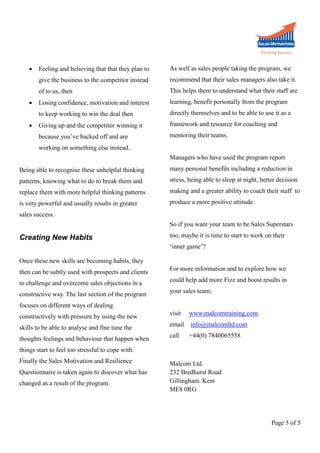
Each factor is presented as a ‘speedometer’ type
graph showing the percentage as well as a low,
mid or high range indication, as shown below;

They then learn how to capture details about
their thoughts, feelings and behaviour around
challenging sales situations, followed by
learning how identify any common unhelpful
thinking patterns (we all acquire them from
time to time) that are getting in the way of
them achieving their goals. One very common
unhelpful thinking pattern is known as
‘catastrophising’, where a relatively small set
back is interpreted as a sign that everything is
going wrong and that things will spiral out of
control.
This might, for example, be along the lines of;


A prospective client not responding as
quickly as usual to emails or phone calls,
then



Thinking that you are being deliberately
ignored, then



Thinking that the prospective client must
be spending time with a competitor instead
then
Page 4 of 5


recommend that their sales managers also take it.

of to us, then

This helps them to understand what their staff are

Losing confidence, motivation and interest

learning, benefit personally from the program

to keep working to win the deal then

directly themselves and to be able to use it as a

Giving up and the competitor winning it

framework and resource for coaching and

because you’ve backed off and are



As well as sales people taking the program, we

give the business to the competitor instead


Feeling and believing that that they plan to

mentoring their teams.

working on something else instead.
Managers who have used the program report
Being able to recognise these unhelpful thinking

many personal benefits including a reduction in

patterns, knowing what to do to break them and

stress, being able to sleep at night, better decision

replace them with more helpful thinking patterns

making and a greater ability to coach their staff to

is very powerful and usually results in greater

produce a more positive attitude.

sales success.
So if you want your team to be Sales Superstars

Creating New Habits

too, maybe it is time to start to work on their
‘inner game’?

Once these new skills are becoming habits, they
then can be subtly used with prospects and clients

For more information and to explore how we

to challenge and overcome sales objections in a

could help add more Fizz and boost results in

constructive way. The last section of the program

your sales team;

focuses on different ways of dealing
constructively with pressure by using the new

visit

www.malcomtraining.com.

skills to be able to analyse and fine tune the

email

info@malcomltd.com

call

+44(0) 7840065558

thoughts feelings and behaviour that happen when
things start to feel too stressful to cope with.
Finally the Sales Motivation and Resilience
Questionnaire is taken again to discover what has
changed as a result of the program.

Malcom Ltd.
232 Bredhurst Road
Gillingham. Kent
ME8 0RG

Page 5 of 5

Sales motivations research - executive summary -

  • 1.
    Add Fizz toyour Sales Team by working on the ‘Inner Game’ Research on Motivation, Resilience and Ability to cope with Pressure in sales teams Sales-Motivations
  • 2.
    Introduction Having identified theimportance of these factors, we have been working with sales forces to see if it is possible to systematically help their sales teams The news has been awash recently with the become more resilient and better able to deal with fantastic exploits of sports superstars such as pressure, to help them boost sales results. We have Andy Murray winning the men’s singles at been able to collect enough data now to assess Wimbledon, the English Cricket team winning the what can be achieved with the right tools. Ashes again and our record breaking tally of medals at the 2012 Olympics. All of these superb This involved using the Sales-Motivations sportsmen and women are highly motivated and program (see www.sales-motivations.com), which have built up their skills, endurance and uses the proven Cognitive Behavioural approach capabilities over many years of hard work, to help to fine tuning thoughts, feelings and behaviour to them reach the top of their respective games. But bring about the results that are desired. In a so have all of their competitors! So what is it that carefully constructed trial with a sales team , we gets them to the top and makes them super-stars? measured everybody’s levels of motivation, resilience and ability to cope with pressure at the Given that all top level sportsmen and women are start of the trial then split the group in half, one already highly motivated, there are two more half using the Sales-Motivations program and the significant factors that come to play; resilience other half carrying on as normal without it. and the ability to deal effectively with pressure. We then measured everybody’s levels of Whilst top sports people such as Murray use a motivation, resilience and ability to cope with Sports Psychologist who work with them to pressure again and compared the ‘participants’ develop the ‘inner game’ very often sales people verses the ‘controls’. We also had a group of Sales receive little or no help in these critical areas. Yet Managers who undertook the program, although without the ability to keep bouncing back and we didn’t have a control group against which to keep going under intense pressure, better than the compare them, as they all wanted to use the competition, consistent sales success is very program. unlikely. Page 1 of 5
  • 3.
    So what werethe results? As well the relative changes in scores in these factors, we also looked at the absolute sores at the We used the on-line Sales Motivation and Resilience Questionnaire, which consists of forty end of the evaluation period between the Control and Participant groups, as shown below; questions, to measure the results. It asks eight questions for each of these factors, plus ‘selfreported sales performance’ (i.e. how well do you think you are doing) then calculates a total score for each factor as a percentage from 0% (very low) to 100% (very high). The changes in each factor achieved in each group are shown below; Absolute Effects of the Program In absolute terms the Participants average scores after the Sales Motivations program exceeded the Control group scores in all dimensions. We also know from the Feedback survey conducted that every single Participant who has taken the Sales-Motivations program believes that their sales will be higher in future. Relative Effects of Sales-Motivations Program  Participants made significant gains over the Control group in all factors, with a 10% gain in ability to cope with pressure and a 11% gain in resilience  Getting more active Finally we also measured number of face to face sales calls per week, which was already a part of the sales teams’ normal reporting metrics. The calls per week were measured before, after and Resilience and Coping with pressure  Managers made significant gains in during the pilot program, which provides a Control group showed small gains in comparison of the activity levels between Motivation and Coping with pressure and participant and control groups. a slight reduction in Resilience. Page 2 of 5
  • 4.
    The control groupshowed a steady decline in It is well known that attitude and self-belief are average weekly calls, dropping from twenty to crucial in sales success. This is especially true in fourteen calls per week. The entire period current market conditions when budgets are measured corresponded to an unseasonably cool stretched and competition is fierce. and wet spring, which always results in lower than normal demand for the main product being sold. “We now have empirical evidence However in contrast the Participant group almost that that it is possible to maintained their activity levels, dropping just one call per week on average. systematically grow motivation, resilience, ability to cope with pressure and sales activity by using a cognitive behavioural development system specifically designed for sales people, such as the Sales- Activity rates - calls per week The Participant group became 30% more active Motivations program” How does the program work? than the control group, which would equate to around two hundred and seventy more calls per person each year. Sales-Motivations is a unique self-coaching learning system that builds motivation, resilience, So what does this all mean? and ability to deal with pressure and as a result, Having completed the program, we are now sales performance. The core concept is that monitoring sales performance in both groups. As everybody can learn, through specific researched the techniques are applied to more opportunities and proven techniques, to take more control over we fully anticipate significant and long lasting what they think, how they feel, and how they improvements in sales results in the Participants subsequently behave in challenging situations, group, based on a previous large scale study establishing more helpful habits in the process. which utilised the same Cognitive Behavioural approach as the Sales-Motivations program and saw a 20% improvement in sales. Page 3 of 5
  • 5.
    The program isused on a ‘drip-feed’ basis over a period of six weeks, which gives lots of opportunities to try out then practise the techniques on normal day to day selling activities. It can be delivered either as face to face workshops, advanced e-learning, or a combination of these approaches. The e-learning is fully interactive, has over 40 videos, lots of quizzes and Patterns of thinking on-line activities. Including the exercises the program is equivalent to two days training, but is used over a period of at least six weeks. Users start by benchmarking themselves by taking the Sales Motivation and Resilience Questionnaire, which measures their current levels of motivation, resilience and ability to cope with pressure. They receive a personalised six page report which gives them some insight into ‘what good looks like’. Generally people who work in sales are already highly motivated, but we see a much wider and usually lower range of scores for both resilience and ability to cope well with pressure. Each factor is presented as a ‘speedometer’ type graph showing the percentage as well as a low, mid or high range indication, as shown below; They then learn how to capture details about their thoughts, feelings and behaviour around challenging sales situations, followed by learning how identify any common unhelpful thinking patterns (we all acquire them from time to time) that are getting in the way of them achieving their goals. One very common unhelpful thinking pattern is known as ‘catastrophising’, where a relatively small set back is interpreted as a sign that everything is going wrong and that things will spiral out of control. This might, for example, be along the lines of;  A prospective client not responding as quickly as usual to emails or phone calls, then  Thinking that you are being deliberately ignored, then  Thinking that the prospective client must be spending time with a competitor instead then Page 4 of 5
  • 6.
     recommend that theirsales managers also take it. of to us, then This helps them to understand what their staff are Losing confidence, motivation and interest learning, benefit personally from the program to keep working to win the deal then directly themselves and to be able to use it as a Giving up and the competitor winning it framework and resource for coaching and because you’ve backed off and are  As well as sales people taking the program, we give the business to the competitor instead  Feeling and believing that that they plan to mentoring their teams. working on something else instead. Managers who have used the program report Being able to recognise these unhelpful thinking many personal benefits including a reduction in patterns, knowing what to do to break them and stress, being able to sleep at night, better decision replace them with more helpful thinking patterns making and a greater ability to coach their staff to is very powerful and usually results in greater produce a more positive attitude. sales success. So if you want your team to be Sales Superstars Creating New Habits too, maybe it is time to start to work on their ‘inner game’? Once these new skills are becoming habits, they then can be subtly used with prospects and clients For more information and to explore how we to challenge and overcome sales objections in a could help add more Fizz and boost results in constructive way. The last section of the program your sales team; focuses on different ways of dealing constructively with pressure by using the new visit www.malcomtraining.com. skills to be able to analyse and fine tune the email info@malcomltd.com call +44(0) 7840065558 thoughts feelings and behaviour that happen when things start to feel too stressful to cope with. Finally the Sales Motivation and Resilience Questionnaire is taken again to discover what has changed as a result of the program. Malcom Ltd. 232 Bredhurst Road Gillingham. Kent ME8 0RG Page 5 of 5