SALESPERSON
PERFORMANCE:
MOTIVATING THE SALES
FORCE
LEARNING OBJECTIVES:
 Understand the process of motivation
 Discuss the effect of personal characteristics on
salesperson motivation
 Understand how an individual’s career stage
influences motivation
 Discuss the effects of environment factors on
motivation
WHAT IS MOTIVATION?
Getting people to contribute to their
maximum effort toward the attainment
of organizational objectives.
THE PSYCHOLOGICAL
PROCESS OF MOTIVATION
MOTIVATION – IS AN INDIVIDUAL’S
CHOICE TO:
- INITIATE ACTION
- EXPEND- (CONSUME)
- PERSIST -(CONTINUE
Approaches To Motivation
a.) Work Performance-stress rewards
b.)Environmental-comfortable
c.) Need Satisfaction-product worker
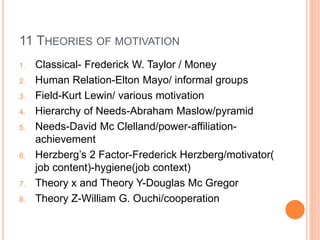
11 THEORIES OF MOTIVATION
1. Classical- Frederick W. Taylor / Money
2. Human Relation-Elton Mayo/ informal groups
3. Field-Kurt Lewin/ various motivation
4. Hierarchy of Needs-Abraham Maslow/pyramid
5. Needs-David Mc Clelland/power-affiliation-
achievement
6. Herzberg’s 2 Factor-Frederick Herzberg/motivator(
job content)-hygiene(job context)
7. Theory x and Theory Y-Douglas Mc Gregor
8. Theory Z-William G. Ouchi/cooperation
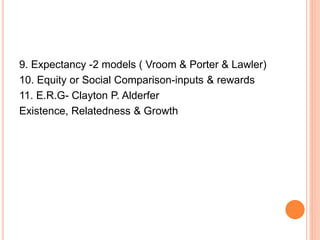
9. Expectancy -2 models ( Vroom & Porter & Lawler)
10. Equity or Social Comparison-inputs & rewards
11. E.R.G- Clayton P. Alderfer
Existence, Relatedness & Growth
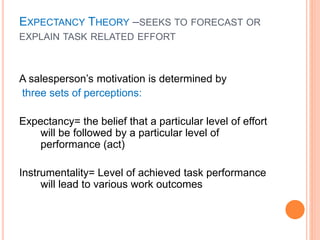
A salesperson’s motivation is determined by
three sets of perceptions:
Expectancy= the belief that a particular level of effort
will be followed by a particular level of
performance (act)
Instrumentality= Level of achieved task performance
will lead to various work outcomes
EXPECTANCY THEORY –SEEKS TO FORECAST OR
EXPLAIN TASK RELATED EFFORT
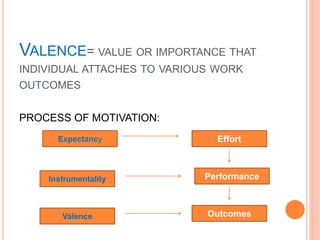
VALENCE= VALUE OR IMPORTANCE THAT
INDIVIDUAL ATTACHES TO VARIOUS WORK
OUTCOMES
PROCESS OF MOTIVATION:
Expectancy
Instrumentality
Valence Outcomes
Performance
Effort
2 ASPECTS OF SUBORDINATES
EXPECTANCY PERCEPTIONS:
(1) MAGNITUDE –LEVEL /IMPORTANCE
(2) ACCURACY- CORRECTNESS
Expectancy: (effort-energy)
 Magnitude of expectancy estimates
- the ability to control or influence his or her job
performance
 Accuracy of Expectancies estimates
- the salesperson understands the relationship
between effort and performance
Instrumentality: (performance-action)
 Magnitude of instrumentality estimates
- is the firms compensation plan.
 Accuracy of instrumentality estimates
- sales performance evaluation
- rewards for levels of performance
VALENCE FOR REWARDS
- THE INCREASED REWARDS FROM
IMPROVED PERFORMANCE.
CAN THE MOTIVATION PARADIGM
PREDICT :
SALESPERSON EFFORT AND
PERFORMANCE?
Three determinants of motivation affected by:
(1) Differences in the personal characteristics of
individuals
(2) Environmental conditions, and
(3) The organizations policies and procedures
THE IMPACT OF A SALESPERSON’S
PERSONAL CHARACTERISTICS ON
MOTIVATION
The Individuals satisfaction
Demographic Variables
Job experience
Psychological variables
 INDIVIDUAL’S SATISFACTION
 whether a salesperson’s satisfaction with
current rewards has any impact on the desire for
more or on different kinds of rewards.
 DEMOGRAPHIC CHARACTERISIC
such as age, family size, and education also
affect a salesperson’s valence for rewards
 JOB EXPERIENCE
o for as they gain experience, salespeople have
opportunities to sharpen their selling skills and
they have the ability to perform successfully.
 PSYCHOLOGICAL TRAITS
o People with strong achievement needs are likely to have
higher valences for such as higher-order rewards as
recognition, personal growth, and feeling
accomplishment.
PERFORMANCE ATTRIBUTIONS
 (acknowledgement/ designation)
 Stable internal factors --personal
skills and abilities.
 Unstable internal factors – vary from time
to time such as amount of effort expended
or mood at the time.
 Stable external factors
---the nature of the task
---the competitive situation in a particular territory
 Unstable external factors
---aggressive advertising campaign
CAREER STAGES AND
SALESPERSON MOTIVATION
Career Stages
- Exploration Stage
–are often unsure about whether selling is the
most appropriate occupation for them and
whether they can be successful salespeople.
- Establishment Stage
– usually in their late 20s or early 30s
-- have settled(decided to stay) on an occupation
and desire to build it into a successful career.
- Maintenance Stage
– This stage normally begins in a
salesperson’s late 30s or early 40s.
---continuation
---preservation or care
- Disengagement (disconnection) Stage
- – People withdraw from their job,
- ---often seeking to maintain just an ”acceptable”
level of performance with a minimum amount of
effort
 The problem of the Plateaued (stable/
stagnation) Salesperson
- Plateaued Salespeople
- – Plateauing or early disengagement,
- ---is not isolated or common
- Causes of Plateauing:
- A.) boredom and
- B.) frustration
Ideas to Motivate the sales force:
> Accountability
> Compensation
> Travel opportunity
> Positive Attitude
> Information
> Selection
> Training
THE IMPACT OF ENVIRONMENTAL
CONDITIONS ON MOTIVATION
• Factors:
• Territory potential
• Strength of competition
• Salesperson’s willingness to expend effort
• Other Factors:
• Economic conditions
• Competitors activities
• Customer concentrations
Assessment of firm’s competitive position :
 Market place ( customer)
 Quality of its products and services
 Selling efforts ( salesperson)
The Impact of Organizational Variables on
Motivation
Supervisory variables and leadership
 increasing subordinates personal
rewards
 rewards easier to follow ( attainable)
 Reducing roadblocks and pitfalls
(drawback)
 Increase opportunities for personal
satisfaction

Salesperson performance

  • 1.
  • 2.
    LEARNING OBJECTIVES:  Understandthe process of motivation  Discuss the effect of personal characteristics on salesperson motivation  Understand how an individual’s career stage influences motivation  Discuss the effects of environment factors on motivation
  • 3.
    WHAT IS MOTIVATION? Gettingpeople to contribute to their maximum effort toward the attainment of organizational objectives.
  • 4.
    THE PSYCHOLOGICAL PROCESS OFMOTIVATION MOTIVATION – IS AN INDIVIDUAL’S CHOICE TO: - INITIATE ACTION - EXPEND- (CONSUME) - PERSIST -(CONTINUE Approaches To Motivation a.) Work Performance-stress rewards b.)Environmental-comfortable c.) Need Satisfaction-product worker
  • 5.
    11 THEORIES OFMOTIVATION 1. Classical- Frederick W. Taylor / Money 2. Human Relation-Elton Mayo/ informal groups 3. Field-Kurt Lewin/ various motivation 4. Hierarchy of Needs-Abraham Maslow/pyramid 5. Needs-David Mc Clelland/power-affiliation- achievement 6. Herzberg’s 2 Factor-Frederick Herzberg/motivator( job content)-hygiene(job context) 7. Theory x and Theory Y-Douglas Mc Gregor 8. Theory Z-William G. Ouchi/cooperation
  • 6.
    9. Expectancy -2models ( Vroom & Porter & Lawler) 10. Equity or Social Comparison-inputs & rewards 11. E.R.G- Clayton P. Alderfer Existence, Relatedness & Growth
  • 7.
    A salesperson’s motivationis determined by three sets of perceptions: Expectancy= the belief that a particular level of effort will be followed by a particular level of performance (act) Instrumentality= Level of achieved task performance will lead to various work outcomes EXPECTANCY THEORY –SEEKS TO FORECAST OR EXPLAIN TASK RELATED EFFORT
  • 8.
    VALENCE= VALUE ORIMPORTANCE THAT INDIVIDUAL ATTACHES TO VARIOUS WORK OUTCOMES PROCESS OF MOTIVATION: Expectancy Instrumentality Valence Outcomes Performance Effort
  • 9.
    2 ASPECTS OFSUBORDINATES EXPECTANCY PERCEPTIONS: (1) MAGNITUDE –LEVEL /IMPORTANCE (2) ACCURACY- CORRECTNESS Expectancy: (effort-energy)  Magnitude of expectancy estimates - the ability to control or influence his or her job performance  Accuracy of Expectancies estimates - the salesperson understands the relationship between effort and performance
  • 10.
    Instrumentality: (performance-action)  Magnitudeof instrumentality estimates - is the firms compensation plan.  Accuracy of instrumentality estimates - sales performance evaluation - rewards for levels of performance
  • 11.
    VALENCE FOR REWARDS -THE INCREASED REWARDS FROM IMPROVED PERFORMANCE.
  • 12.
    CAN THE MOTIVATIONPARADIGM PREDICT : SALESPERSON EFFORT AND PERFORMANCE? Three determinants of motivation affected by: (1) Differences in the personal characteristics of individuals (2) Environmental conditions, and (3) The organizations policies and procedures
  • 13.
    THE IMPACT OFA SALESPERSON’S PERSONAL CHARACTERISTICS ON MOTIVATION The Individuals satisfaction Demographic Variables Job experience Psychological variables
  • 14.
     INDIVIDUAL’S SATISFACTION whether a salesperson’s satisfaction with current rewards has any impact on the desire for more or on different kinds of rewards.  DEMOGRAPHIC CHARACTERISIC such as age, family size, and education also affect a salesperson’s valence for rewards
  • 15.
     JOB EXPERIENCE ofor as they gain experience, salespeople have opportunities to sharpen their selling skills and they have the ability to perform successfully.  PSYCHOLOGICAL TRAITS o People with strong achievement needs are likely to have higher valences for such as higher-order rewards as recognition, personal growth, and feeling accomplishment.
  • 16.
    PERFORMANCE ATTRIBUTIONS  (acknowledgement/designation)  Stable internal factors --personal skills and abilities.  Unstable internal factors – vary from time to time such as amount of effort expended or mood at the time.
  • 17.
     Stable externalfactors ---the nature of the task ---the competitive situation in a particular territory  Unstable external factors ---aggressive advertising campaign
  • 18.
    CAREER STAGES AND SALESPERSONMOTIVATION Career Stages - Exploration Stage –are often unsure about whether selling is the most appropriate occupation for them and whether they can be successful salespeople. - Establishment Stage – usually in their late 20s or early 30s -- have settled(decided to stay) on an occupation and desire to build it into a successful career.
  • 19.
    - Maintenance Stage –This stage normally begins in a salesperson’s late 30s or early 40s. ---continuation ---preservation or care - Disengagement (disconnection) Stage - – People withdraw from their job, - ---often seeking to maintain just an ”acceptable” level of performance with a minimum amount of effort
  • 20.
     The problemof the Plateaued (stable/ stagnation) Salesperson - Plateaued Salespeople - – Plateauing or early disengagement, - ---is not isolated or common - Causes of Plateauing: - A.) boredom and - B.) frustration
  • 21.
    Ideas to Motivatethe sales force: > Accountability > Compensation > Travel opportunity > Positive Attitude > Information > Selection > Training
  • 22.
    THE IMPACT OFENVIRONMENTAL CONDITIONS ON MOTIVATION • Factors: • Territory potential • Strength of competition • Salesperson’s willingness to expend effort • Other Factors: • Economic conditions • Competitors activities • Customer concentrations
  • 23.
    Assessment of firm’scompetitive position :  Market place ( customer)  Quality of its products and services  Selling efforts ( salesperson)
  • 24.
    The Impact ofOrganizational Variables on Motivation Supervisory variables and leadership  increasing subordinates personal rewards  rewards easier to follow ( attainable)  Reducing roadblocks and pitfalls (drawback)  Increase opportunities for personal satisfaction