







Sales Force Motivation
Why motivation for Sales Force






Inherent nature of the sales job
Salesperson’s boundary position and Role
conflicts
Tendency towards Apathy
Maintaining a feeling of Group Identity




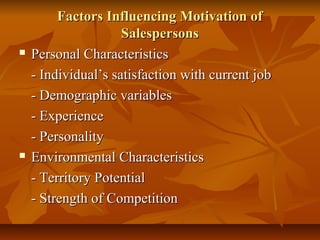
Factors Influencing Motivation of
Salespersons
Personal Characteristics
- Individual’s satisfaction with current job
- Demographic variables
- Experience
- Personality
Environmental Characteristics
- Territory Potential
- Strength of Competition


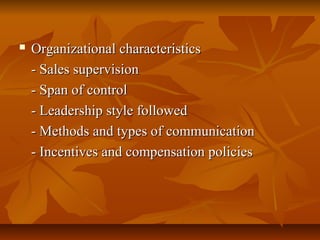
Organizational characteristics
- Sales supervision
- Span of control
- Leadership style followed
- Methods and types of communication
- Incentives and compensation policies
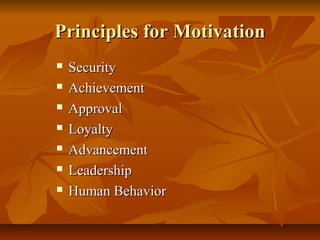
Principles for Motivation








Security
Achievement
Approval
Loyalty
Advancement
Leadership
Human Behavior
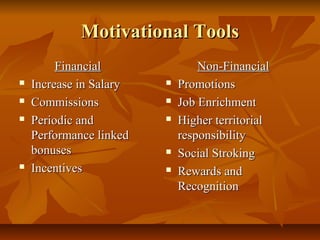
Motivational Tools






Financial
Increase in Salary
Commissions
Periodic and
Performance linked
bonuses
Incentives








Non-Financial
Promotions
Job Enrichment
Higher territorial
responsibility
Social Stroking
Rewards and
Recognition
Motivational Tools









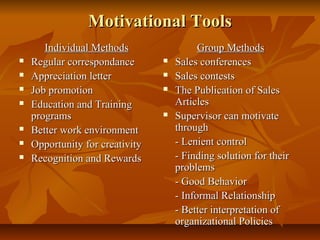
Individual Methods
Regular correspondance
Appreciation letter
Job promotion
Education and Training
programs
Better work environment
Opportunity for creativity
Recognition and Rewards







Group Methods
Sales conferences
Sales contests
The Publication of Sales
Articles
Supervisor can motivate
through
- Lenient control
- Finding solution for their
problems
- Good Behavior
- Informal Relationship
- Better interpretation of
organizational Policies
Motivational Theories





Hierarchy of needs
Motivation-hygiene theory
Achievement motivation theory
Expectancy Model
Hierarchy of needs







Theory developed by A.H.Maslow
Sales person’s need for job varies from
individual to individual
Sales management should identify the
unsatisfied portion of the sales staff
Accordingly design the reward system
Motivation-hygiene theory








Developed by Frederick Herzberg and Co-researcher
Two factor model: Hygiene factors and Motivational
Factors
Deficiencies in fulfilling hygiene needs leads to job
dissatisfaction
Motivational factors leads to job satisfaction
Two implications:
1) Management must see that job provides the
conditions that prevent job dissatisfaction
2) Management must provide opportunities for
motivational factors
Achievement-Motivation Theory








Developed by David McClelland and other
researcher
Theory says that if person spends considerable
time thinking about doing his or her job better,
accomplishing something unusual and
important, or advancing his or her career, that
individual has a high need of achievement
nAch is motivation to exceed some standard of
quality in personal behavior
Implications: management should provide
proper environment so that this achievers can
flourish
Expectancy Model






1)

2)

Developed by Vroom
According to him Motivation is a process of
governing choices of behavioral activity
The strength of a tendency to act in a certain way
depends upon the strength of an expectation that act
will be followed by given outcome and its
attractiveness to the individual
Implications:
Need support from sales management to improve
performance
Sale personnel need guidance to see their own
competencies
Interdependence and
Motivation
Motivation and
Leadership
Motivation and
Communication

Sm 10