MOTIVATING THE SALES 
FORCE 
PRESENTED BY: NAVEEN DHANAWAT 
NISHANT 
RISHIKA SAHU 
PRATIBHA 
PRIYANSHU
What is motivation.... 
 Motivation is the word derived from the word ’motive’ which means 
needs, desires, wants or drives within the individuals. 
 It is the process of stimulating people to actions to accomplish the 
goals. 
 Motivation is a theoretical construct, used to explain behaviour
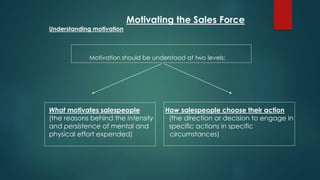
Motivating the Sales Force 
Understanding motivation 
Motivation should be understood at two levels: 
What motivates salespeople How salespeople choose their action 
(the reasons behind the intensity (the direction or decision to engage in 
and persistence of mental and specific actions in specific 
physical effort expended) circumstances)
MOTIVATIONAL THEORIES... 
 A concept that describes the activation of goal-oriented 
behaviours in humans. 
Some theories are as fallows: 
 Maslow's hierarchy of needs 
 Hertzberg’s dual-factor 
 Vroom's expectancy theory 
 Adam’s Equity theory
Motivational theories addressing the issue: 
“what” motivates salespeople 
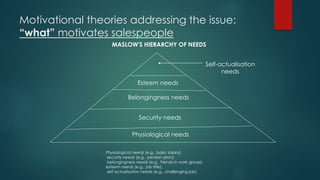
MASLOW'S HIERARCHY OF NEEDS 
Esteem needs 
Belongingness needs 
Security needs 
Physiological needs 
Self-actualisation 
needs 
Physiological needs (e.g., basic salary); 
security needs (e.g., pension plan); 
belongingness needs (e.g., friends in work group); 
esteem needs (e.g., job title); 
self actualisation needs (e.g., challenging job).
HERTZBERG’S DUAL-FACTOR 
 Motivation factors (e.g., achievement, recognition, responsibility) 
 Hygiene factors (e.g., supervision, pay, job security, working 
conditions) 
 The theory argues that: 
 The motivation factors or motivators are the primary causes of 
motivation and address the question “why work harder”; 
 The hygiene factors are necessary conditions to achieve a state of 
neutrality and address the question “why work here”.
HYGIENE FACTORS 
 Pay and Benefits 
 Company Policy and Administration 
 Relationships with co-workers 
 Physical Environment 
 Supervision 
 Status 
 Salary 
 Job Security
Motivational theories addressing the issue: 
“how do salespeople choose their actions?” 
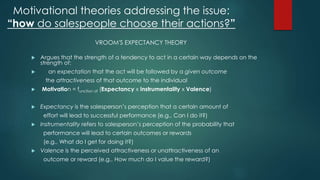
VROOM'S EXPECTANCY THEORY 
 Argues that the strength of a tendency to act in a certain way depends on the 
strength of: 
 an expectation that the act will be followed by a given outcome 
the attractiveness of that outcome to the individual 
 Motivation = function of (Expectancy x Instrumentality x Valence) 
 Expectancy is the salesperson’s perception that a certain amount of 
effort will lead to successful performance (e.g., Can I do it?) 
 Instrumentality refers to salesperson’s perception of the probability that 
performance will lead to certain outcomes or rewards 
(e.g., What do I get for doing it?) 
 Valence is the perceived attractiveness or unattractiveness of an 
outcome or reward (e.g., How much do I value the reward?)
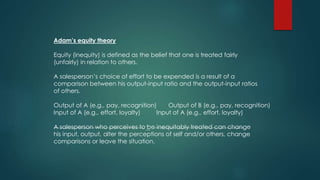
Adam’s equity theory 
Equity (inequity) is defined as the belief that one is treated fairly 
(unfairly) in relation to others. 
A salesperson’s choice of effort to be expended is a result of a 
comparison between his output-input ratio and the output-input ratios 
of others. 
Output of A (e.g., pay, recognition) Output of B (e.g., pay, recognition) 
Input of A (e.g., effort, loyalty) Input of A (e.g., effort, loyalty) 
A salesperson who perceives to be inequitably treated can change 
his input, output, alter the perceptions of self and/or others, change 
comparisons or leave the situation.
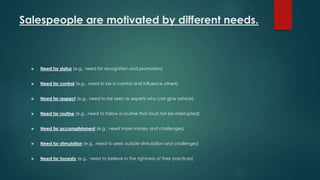
Salespeople are motivated by different needs. 
 Need for status (e.g., need for recognition and promotion) 
 Need for control (e.g., need to be in control and influence others) 
 Need for respect (e.g., need to be seen as experts who can give advice) 
 Need for routine (e.g., need to follow a routine that must not be interrupted) 
 Need for accomplishment (e.g., need more money and challenges) 
 Need for stimulation (e.g., need to seek outside stimulation and challenges) 
 Need for honesty (e.g., need to believe in the rightness of their practices)
Contents/ Techniques of 
Motivation 
 Motivational tools should satisfy at least two criteria. 
a) Should generate extra effort that will help the company to achieve 
its objectives 
b) Must increase job satisfaction among salespeople 
 A manger must know what techniques can be applied so that he 
can motivate his sales people
Contents/ Techniques of 
Motivation 
 Financial Motivators : Financial motivation relates to the way for sales 
person in which an organization uses compensation structure to motivate 
workers to high performance. 
Some are as follows: 
 straight salary, 
 pay per hour, 
 pay per production, 
 commission, 
 performance bonuses, 
 profit sharing
 Non financial motivation: Non financial motivation is related 
with the sales person in which he is satisfied by Recognition of 
work done by him. 
Some are as follows: 
 Participation 
 Status 
 Competition 
 Job Enrichment appreciation and non monitory recognisition.

Motivating the sales force

  • 1.
    MOTIVATING THE SALES FORCE PRESENTED BY: NAVEEN DHANAWAT NISHANT RISHIKA SAHU PRATIBHA PRIYANSHU
  • 2.
    What is motivation....  Motivation is the word derived from the word ’motive’ which means needs, desires, wants or drives within the individuals.  It is the process of stimulating people to actions to accomplish the goals.  Motivation is a theoretical construct, used to explain behaviour
  • 3.
    Motivating the SalesForce Understanding motivation Motivation should be understood at two levels: What motivates salespeople How salespeople choose their action (the reasons behind the intensity (the direction or decision to engage in and persistence of mental and specific actions in specific physical effort expended) circumstances)
  • 4.
    MOTIVATIONAL THEORIES... A concept that describes the activation of goal-oriented behaviours in humans. Some theories are as fallows:  Maslow's hierarchy of needs  Hertzberg’s dual-factor  Vroom's expectancy theory  Adam’s Equity theory
  • 5.
    Motivational theories addressingthe issue: “what” motivates salespeople MASLOW'S HIERARCHY OF NEEDS Esteem needs Belongingness needs Security needs Physiological needs Self-actualisation needs Physiological needs (e.g., basic salary); security needs (e.g., pension plan); belongingness needs (e.g., friends in work group); esteem needs (e.g., job title); self actualisation needs (e.g., challenging job).
  • 6.
    HERTZBERG’S DUAL-FACTOR Motivation factors (e.g., achievement, recognition, responsibility)  Hygiene factors (e.g., supervision, pay, job security, working conditions)  The theory argues that:  The motivation factors or motivators are the primary causes of motivation and address the question “why work harder”;  The hygiene factors are necessary conditions to achieve a state of neutrality and address the question “why work here”.
  • 7.
    HYGIENE FACTORS Pay and Benefits  Company Policy and Administration  Relationships with co-workers  Physical Environment  Supervision  Status  Salary  Job Security
  • 8.
    Motivational theories addressingthe issue: “how do salespeople choose their actions?” VROOM'S EXPECTANCY THEORY  Argues that the strength of a tendency to act in a certain way depends on the strength of:  an expectation that the act will be followed by a given outcome the attractiveness of that outcome to the individual  Motivation = function of (Expectancy x Instrumentality x Valence)  Expectancy is the salesperson’s perception that a certain amount of effort will lead to successful performance (e.g., Can I do it?)  Instrumentality refers to salesperson’s perception of the probability that performance will lead to certain outcomes or rewards (e.g., What do I get for doing it?)  Valence is the perceived attractiveness or unattractiveness of an outcome or reward (e.g., How much do I value the reward?)
  • 9.
    Adam’s equity theory Equity (inequity) is defined as the belief that one is treated fairly (unfairly) in relation to others. A salesperson’s choice of effort to be expended is a result of a comparison between his output-input ratio and the output-input ratios of others. Output of A (e.g., pay, recognition) Output of B (e.g., pay, recognition) Input of A (e.g., effort, loyalty) Input of A (e.g., effort, loyalty) A salesperson who perceives to be inequitably treated can change his input, output, alter the perceptions of self and/or others, change comparisons or leave the situation.
  • 10.
    Salespeople are motivatedby different needs.  Need for status (e.g., need for recognition and promotion)  Need for control (e.g., need to be in control and influence others)  Need for respect (e.g., need to be seen as experts who can give advice)  Need for routine (e.g., need to follow a routine that must not be interrupted)  Need for accomplishment (e.g., need more money and challenges)  Need for stimulation (e.g., need to seek outside stimulation and challenges)  Need for honesty (e.g., need to believe in the rightness of their practices)
  • 11.
    Contents/ Techniques of Motivation  Motivational tools should satisfy at least two criteria. a) Should generate extra effort that will help the company to achieve its objectives b) Must increase job satisfaction among salespeople  A manger must know what techniques can be applied so that he can motivate his sales people
  • 12.
    Contents/ Techniques of Motivation  Financial Motivators : Financial motivation relates to the way for sales person in which an organization uses compensation structure to motivate workers to high performance. Some are as follows:  straight salary,  pay per hour,  pay per production,  commission,  performance bonuses,  profit sharing
  • 13.
     Non financialmotivation: Non financial motivation is related with the sales person in which he is satisfied by Recognition of work done by him. Some are as follows:  Participation  Status  Competition  Job Enrichment appreciation and non monitory recognisition.