Child’s First Language Acquisition Stages
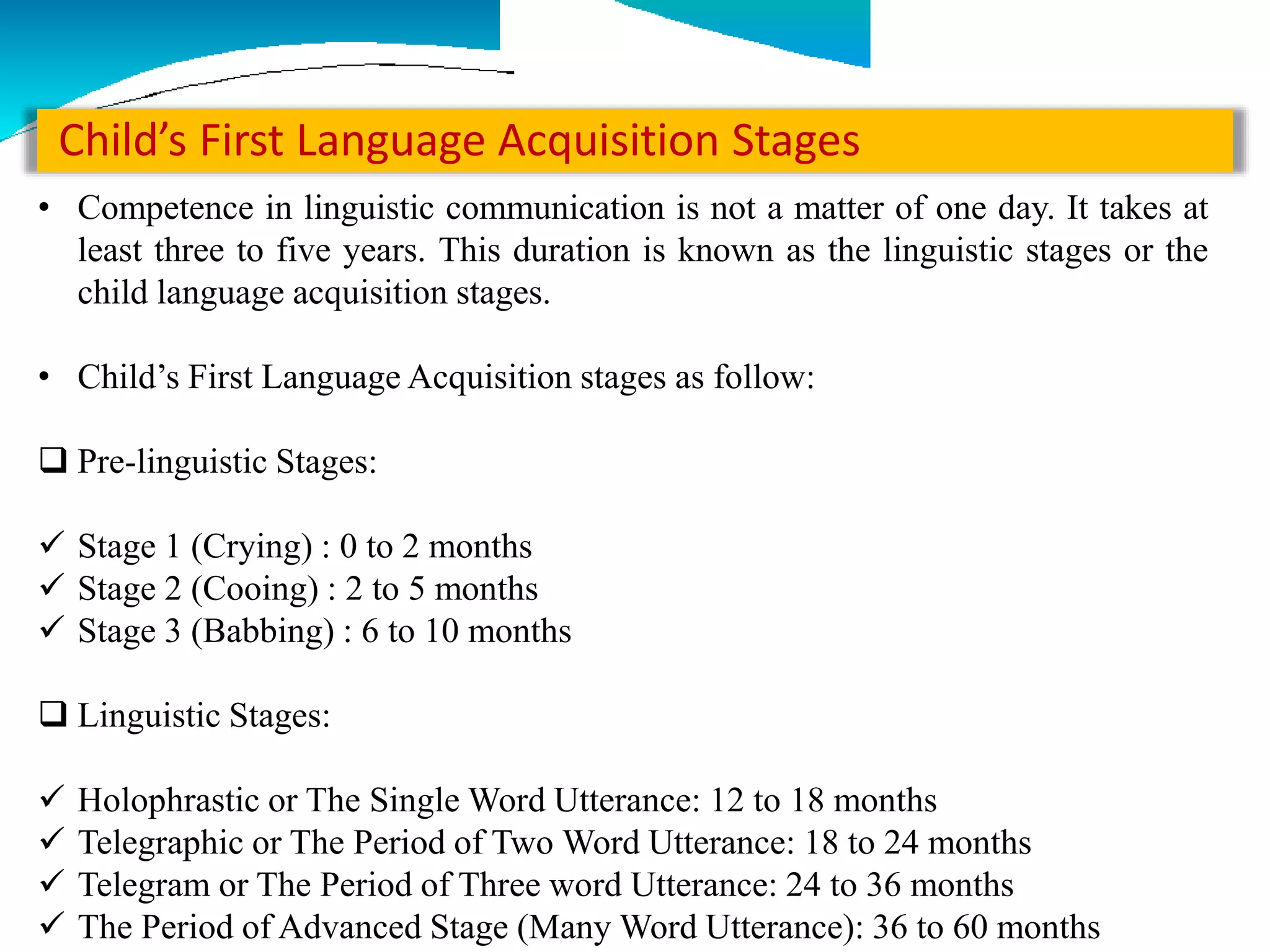
• Competence in linguistic communication is not a matter of one day. It takes at
least three to five years. This duration is known as the linguistic stages or the
child language acquisition stages.
• Child’s First Language Acquisition stages as follow:
 Pre-linguistic Stages:
 Stage 1 (Crying) : 0 to 2 months
 Stage 2 (Cooing) : 2 to 5 months
 Stage 3 (Babbing) : 6 to 10 months
 Linguistic Stages:
 Holophrastic or The Single Word Utterance: 12 to 18 months
 Telegraphic or The Period of Two Word Utterance: 18 to 24 months
 Telegram or The Period of Three word Utterance: 24 to 36 months
 The Period of Advanced Stage (Many Word Utterance): 36 to 60 months
Pre-linguistic Stages
 Crying
After the birth, from 0 to 2 month, the child is not capable of producing any sounds
but crying. He cries to gain attention in many ways.
For example:
• Hunger Cry- When he is hungry, So, he cries to let his mother know that he is
hungry.
• Pain Cry- When he is feeling pain which can be from various reasons.
• Mad Cry or Fake Cry- When he needs someone to look after him.
Pre-linguistic Stages
 Cooing
• From 2 to 5 months, babies begin making comfort sounds, typically in response
to pleasurable interaction with a caregiver.
• By four months of age, they develop the ability of bringing the back of the
tongue into regular contact with the back of the palate which allows children
create sounds similar to the velar consonants [k] and [g], hence the common
sound description as ‘cooing’ or ‘gooing’ for this type of production. For
example: ‘ahhh, goo, uooo’.
• By the age of 5 months, child starts to listening closely to what people are
saying and learning to distinguish their words down to the syllable.
• He starts to discover sounds as fun and thus produces sounds in response to
others which is the earliest form of imitation for him.
Pre-linguistic Stages
 Babbling
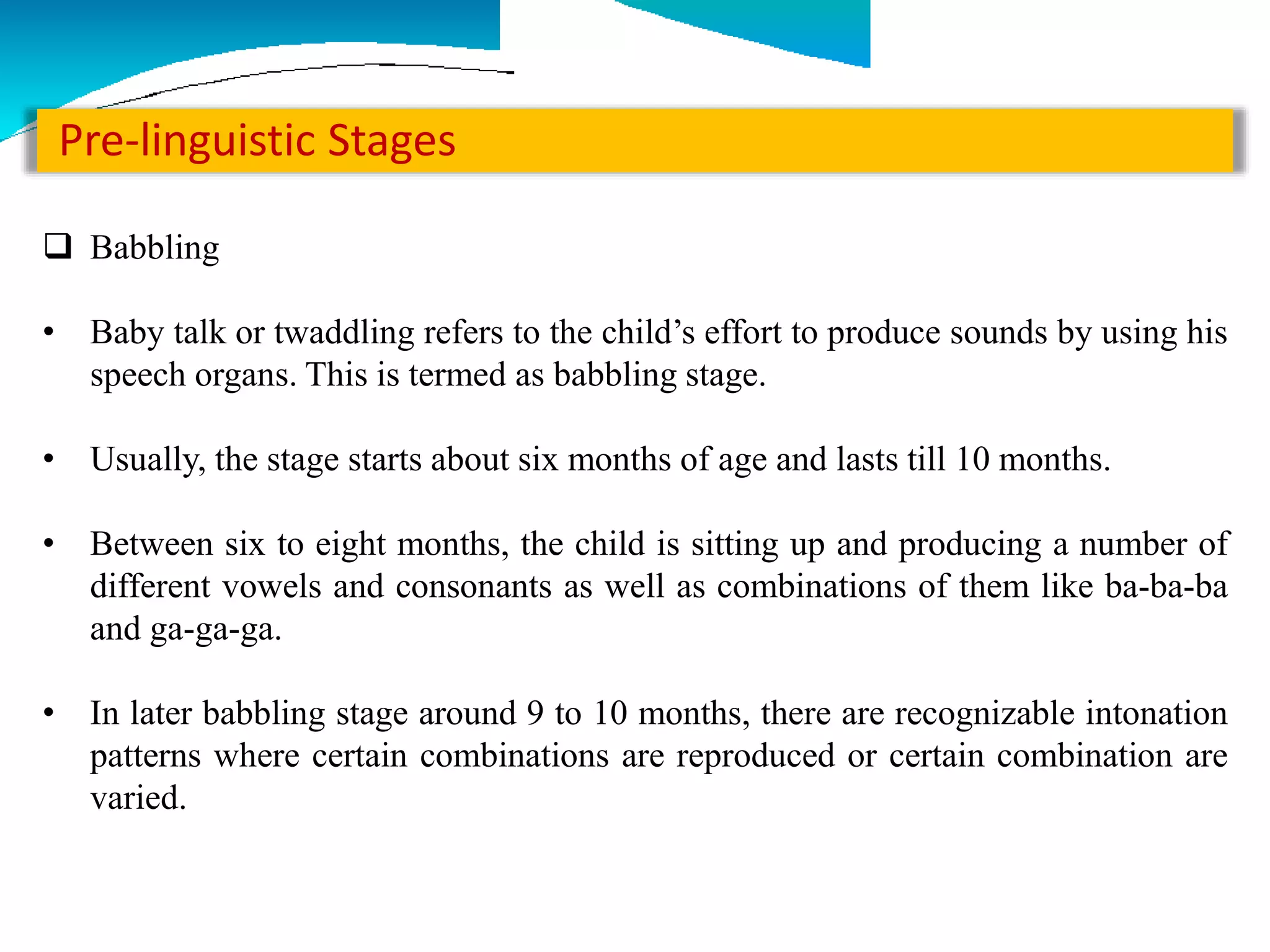
• Baby talk or twaddling refers to the child’s effort to produce sounds by using his
speech organs. This is termed as babbling stage.
• Usually, the stage starts about six months of age and lasts till 10 months.
• Between six to eight months, the child is sitting up and producing a number of
different vowels and consonants as well as combinations of them like ba-ba-ba
and ga-ga-ga.
• In later babbling stage around 9 to 10 months, there are recognizable intonation
patterns where certain combinations are reproduced or certain combination are
varied.
Pre-linguistic Stages
 Babbling
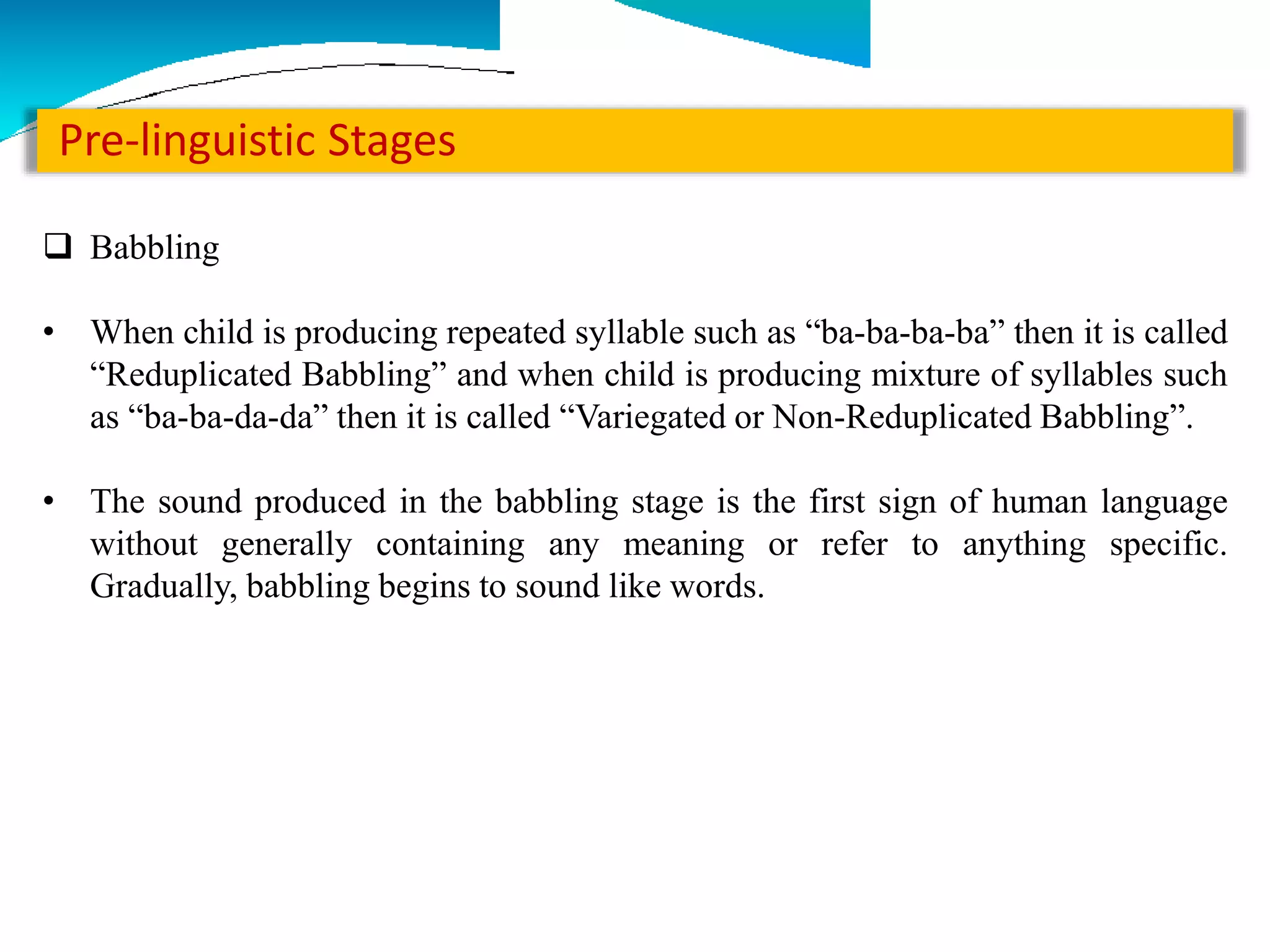
• When child is producing repeated syllable such as “ba-ba-ba-ba” then it is called
“Reduplicated Babbling” and when child is producing mixture of syllables such
as “ba-ba-da-da” then it is called “Variegated or Non-Reduplicated Babbling”.
• The sound produced in the babbling stage is the first sign of human language
without generally containing any meaning or refer to anything specific.
Gradually, babbling begins to sound like words.
Linguistic Stages
 Holophrastic or The Single Word Utterance
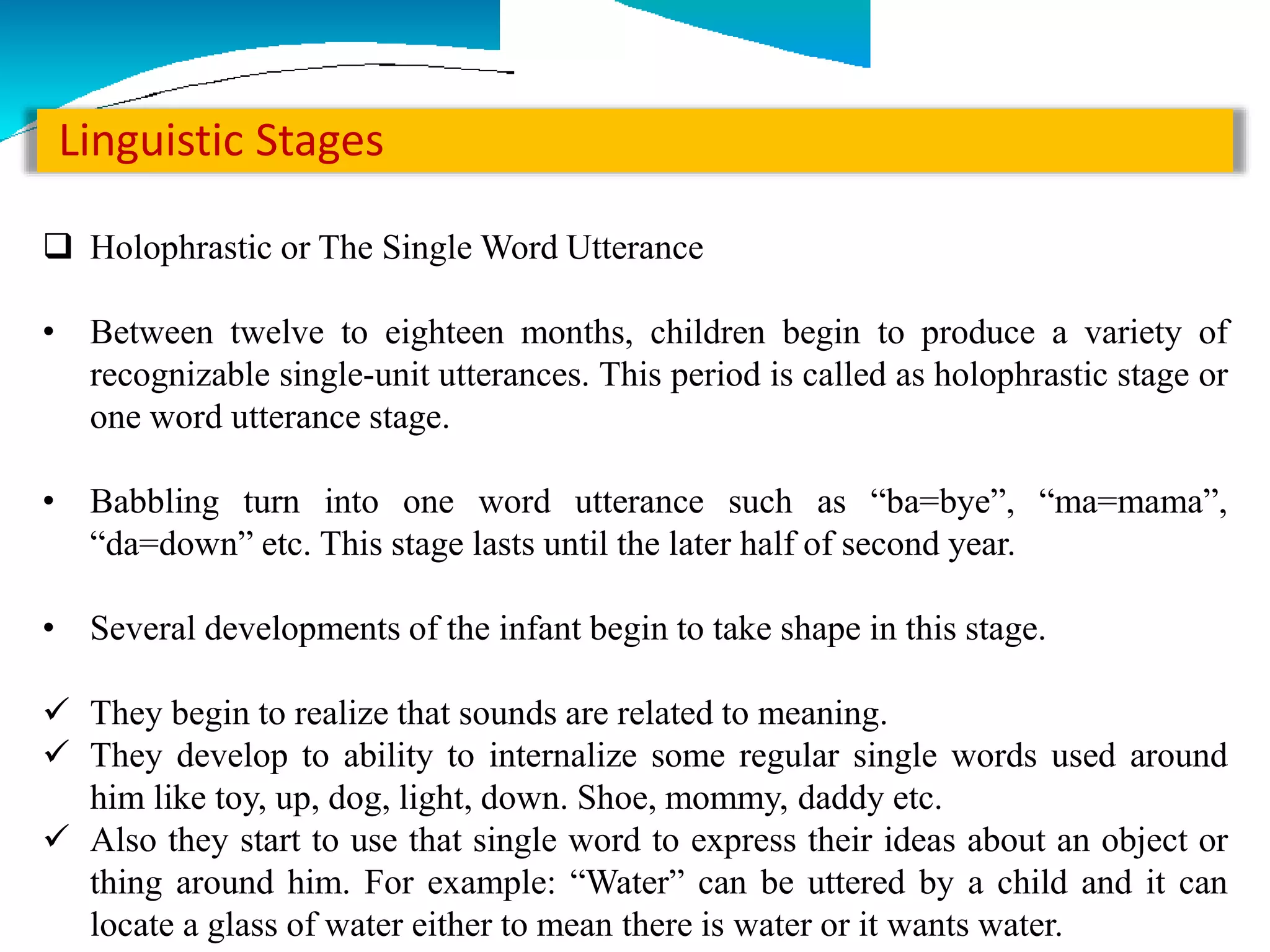
• Between twelve to eighteen months, children begin to produce a variety of
recognizable single-unit utterances. This period is called as holophrastic stage or
one word utterance stage.
• Babbling turn into one word utterance such as “ba=bye”, “ma=mama”,
“da=down” etc. This stage lasts until the later half of second year.
• Several developments of the infant begin to take shape in this stage.
 They begin to realize that sounds are related to meaning.
 They develop to ability to internalize some regular single words used around
him like toy, up, dog, light, down. Shoe, mommy, daddy etc.
 Also they start to use that single word to express their ideas about an object or
thing around him. For example: “Water” can be uttered by a child and it can
locate a glass of water either to mean there is water or it wants water.
Linguistic Stages
 Holophrastic or The Single Word Utterance
 Since, it just shifted from babbling to single word, in it’s utterance of single
words, we see some similarities to babbling as certain letters are not yet
internalized by the child. Such as ‘rat=lat’ and ‘dog=gog’.
 Telegraphic or Two Word Utterance Stage
 The period from a child’s one year and a half to two years is usually recognized as the
two-word stage. This stage is also known as Telegraphic stage.
 During this stage, children begin to combine single words into two-word utterances.
Child produces two word utterances like ‘more milk’, ‘mama come’.
 This may mean that the baby wants more milk or he wants his mother to come to him.
Mother tries her best to assist the child’s language acquisition in this stage by modifying
her usual speeches using her language in shorter, slower, simpler, more concrete and
more direct. This is called ‘motherese’.
Linguistic Stages
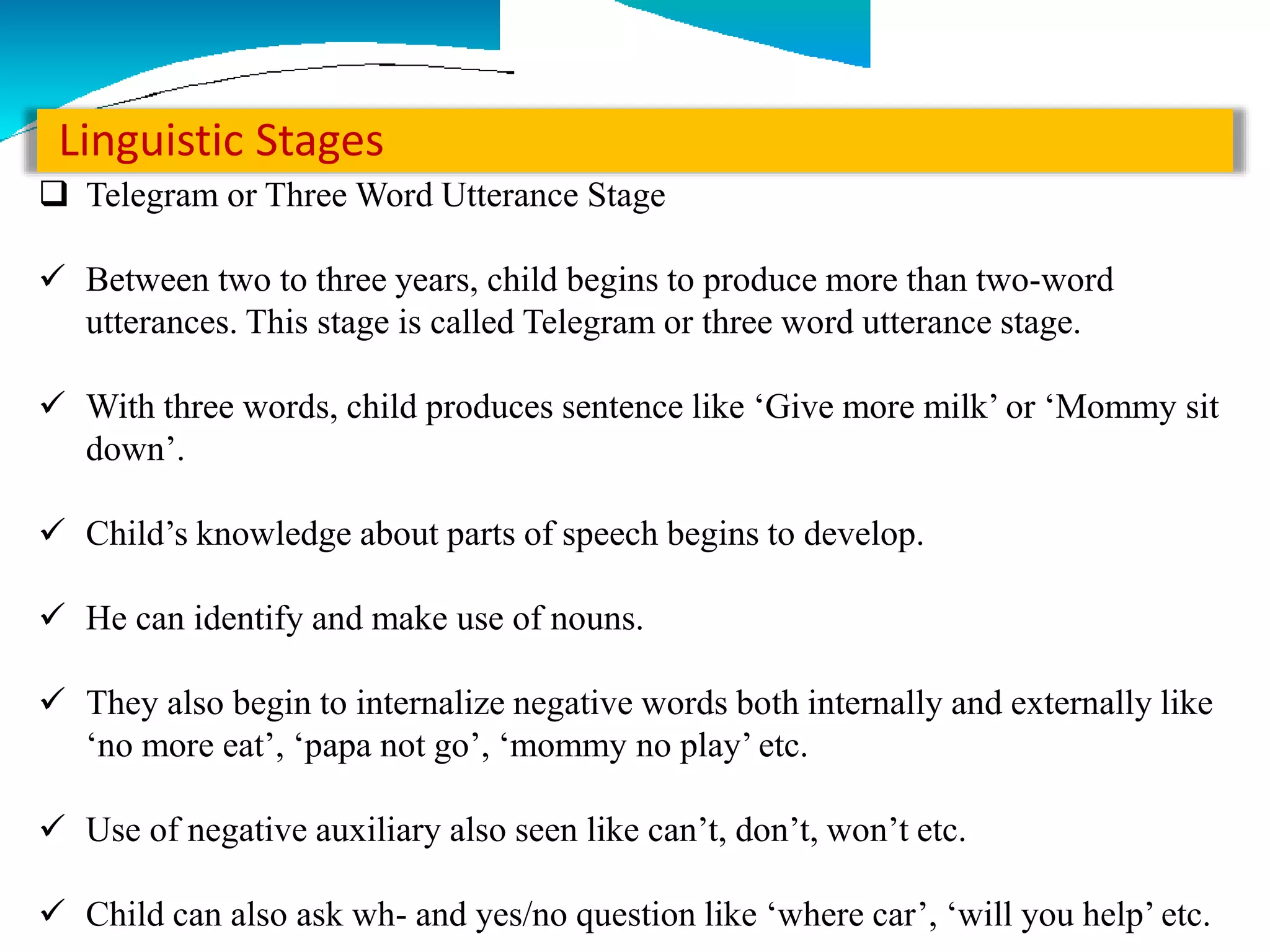
 Telegram or Three Word Utterance Stage
 Between two to three years, child begins to produce more than two-word
utterances. This stage is called Telegram or three word utterance stage.
 With three words, child produces sentence like ‘Give more milk’ or ‘Mommy sit
down’.
 Child’s knowledge about parts of speech begins to develop.
 He can identify and make use of nouns.
 They also begin to internalize negative words both internally and externally like
‘no more eat’, ‘papa not go’, ‘mommy no play’ etc.
 Use of negative auxiliary also seen like can’t, don’t, won’t etc.
 Child can also ask wh- and yes/no question like ‘where car’, ‘will you help’ etc.
Linguistic Stages
 The Period of Advanced Stage (Many Word Utterance)
 Between three to five years, child can produce adult like sentences using
grammatical elements.
 He can use imperative, optative and exclamatory sentences in this stage.
 All types of sentences emerge in him like questions, complements, passives,
conjunctions etc.
 He starts to acquire knowledge about the relationship between language and
society. Before the child turns to five years, all parts of language are acquired by
him.

Child's first language acquisition

  • 2.
    Child’s First LanguageAcquisition Stages • Competence in linguistic communication is not a matter of one day. It takes at least three to five years. This duration is known as the linguistic stages or the child language acquisition stages. • Child’s First Language Acquisition stages as follow:  Pre-linguistic Stages:  Stage 1 (Crying) : 0 to 2 months  Stage 2 (Cooing) : 2 to 5 months  Stage 3 (Babbing) : 6 to 10 months  Linguistic Stages:  Holophrastic or The Single Word Utterance: 12 to 18 months  Telegraphic or The Period of Two Word Utterance: 18 to 24 months  Telegram or The Period of Three word Utterance: 24 to 36 months  The Period of Advanced Stage (Many Word Utterance): 36 to 60 months
  • 3.
    Pre-linguistic Stages  Crying Afterthe birth, from 0 to 2 month, the child is not capable of producing any sounds but crying. He cries to gain attention in many ways. For example: • Hunger Cry- When he is hungry, So, he cries to let his mother know that he is hungry. • Pain Cry- When he is feeling pain which can be from various reasons. • Mad Cry or Fake Cry- When he needs someone to look after him.
  • 4.
    Pre-linguistic Stages  Cooing •From 2 to 5 months, babies begin making comfort sounds, typically in response to pleasurable interaction with a caregiver. • By four months of age, they develop the ability of bringing the back of the tongue into regular contact with the back of the palate which allows children create sounds similar to the velar consonants [k] and [g], hence the common sound description as ‘cooing’ or ‘gooing’ for this type of production. For example: ‘ahhh, goo, uooo’. • By the age of 5 months, child starts to listening closely to what people are saying and learning to distinguish their words down to the syllable. • He starts to discover sounds as fun and thus produces sounds in response to others which is the earliest form of imitation for him.
  • 5.
    Pre-linguistic Stages  Babbling •Baby talk or twaddling refers to the child’s effort to produce sounds by using his speech organs. This is termed as babbling stage. • Usually, the stage starts about six months of age and lasts till 10 months. • Between six to eight months, the child is sitting up and producing a number of different vowels and consonants as well as combinations of them like ba-ba-ba and ga-ga-ga. • In later babbling stage around 9 to 10 months, there are recognizable intonation patterns where certain combinations are reproduced or certain combination are varied.
  • 6.
    Pre-linguistic Stages  Babbling •When child is producing repeated syllable such as “ba-ba-ba-ba” then it is called “Reduplicated Babbling” and when child is producing mixture of syllables such as “ba-ba-da-da” then it is called “Variegated or Non-Reduplicated Babbling”. • The sound produced in the babbling stage is the first sign of human language without generally containing any meaning or refer to anything specific. Gradually, babbling begins to sound like words.
  • 7.
    Linguistic Stages  Holophrasticor The Single Word Utterance • Between twelve to eighteen months, children begin to produce a variety of recognizable single-unit utterances. This period is called as holophrastic stage or one word utterance stage. • Babbling turn into one word utterance such as “ba=bye”, “ma=mama”, “da=down” etc. This stage lasts until the later half of second year. • Several developments of the infant begin to take shape in this stage.  They begin to realize that sounds are related to meaning.  They develop to ability to internalize some regular single words used around him like toy, up, dog, light, down. Shoe, mommy, daddy etc.  Also they start to use that single word to express their ideas about an object or thing around him. For example: “Water” can be uttered by a child and it can locate a glass of water either to mean there is water or it wants water.
  • 8.
    Linguistic Stages  Holophrasticor The Single Word Utterance  Since, it just shifted from babbling to single word, in it’s utterance of single words, we see some similarities to babbling as certain letters are not yet internalized by the child. Such as ‘rat=lat’ and ‘dog=gog’.  Telegraphic or Two Word Utterance Stage  The period from a child’s one year and a half to two years is usually recognized as the two-word stage. This stage is also known as Telegraphic stage.  During this stage, children begin to combine single words into two-word utterances. Child produces two word utterances like ‘more milk’, ‘mama come’.  This may mean that the baby wants more milk or he wants his mother to come to him. Mother tries her best to assist the child’s language acquisition in this stage by modifying her usual speeches using her language in shorter, slower, simpler, more concrete and more direct. This is called ‘motherese’.
  • 9.
    Linguistic Stages  Telegramor Three Word Utterance Stage  Between two to three years, child begins to produce more than two-word utterances. This stage is called Telegram or three word utterance stage.  With three words, child produces sentence like ‘Give more milk’ or ‘Mommy sit down’.  Child’s knowledge about parts of speech begins to develop.  He can identify and make use of nouns.  They also begin to internalize negative words both internally and externally like ‘no more eat’, ‘papa not go’, ‘mommy no play’ etc.  Use of negative auxiliary also seen like can’t, don’t, won’t etc.  Child can also ask wh- and yes/no question like ‘where car’, ‘will you help’ etc.
  • 10.
    Linguistic Stages  ThePeriod of Advanced Stage (Many Word Utterance)  Between three to five years, child can produce adult like sentences using grammatical elements.  He can use imperative, optative and exclamatory sentences in this stage.  All types of sentences emerge in him like questions, complements, passives, conjunctions etc.  He starts to acquire knowledge about the relationship between language and society. Before the child turns to five years, all parts of language are acquired by him.