Allomorphs and Word
Formation
MA English
Paper II English Langauge
Unit I Morphology
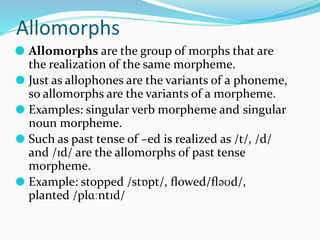
Allomorphs
⚫ Allomorphs are the group of morphs that are
the realization of the same morpheme.
⚫ Just as allophones are the variants of a phoneme,
so allomorphs are the variants of a morpheme.
⚫ Examples: singular verb morpheme and singular
noun morpheme.
⚫ Such as past tense of –ed is realized as /t/, /d/
and /ɪd/ are the allomorphs of past tense
morpheme.
⚫ Example: stopped /stɒpt/, flowed/fləʊd/,
planted /plɑːntɪd/
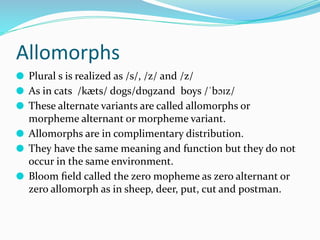
Allomorphs
⚫ Plural s is realized as /s/, /z/ and /z/
⚫ As in cats /kæts/ dogs/dɒɡzand boys /ˈbɔɪz/
⚫ These alternate variants are called allomorphs or
morpheme alternant or morpheme variant.
⚫ Allomorphs are in complimentary distribution.
⚫ They have the same meaning and function but they do not
occur in the same environment.
⚫ Bloom field called the zero mopheme as zero alternant or
zero allomorph as in sheep, deer, put, cut and postman.
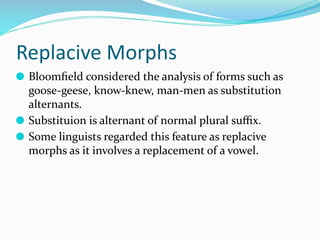
Replacive Morphs
⚫ Bloomfield considered the analysis of forms such as
goose-geese, know-knew, man-men as substitution
alternants.
⚫ Substituion is alternant of normal plural suffix.
⚫ Some linguists regarded this feature as replacive
morphs as it involves a replacement of a vowel.
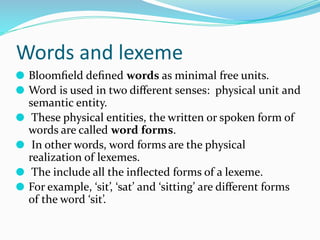
Words and lexeme
⚫ Bloomfield defined words as minimal free units.
⚫ Word is used in two different senses: physical unit and
semantic entity.
⚫ These physical entities, the written or spoken form of
words are called word forms.
⚫ In other words, word forms are the physical
realization of lexemes.
⚫ The include all the inflected forms of a lexeme.
⚫ For example, ‘sit’, ‘sat’ and ‘sitting’ are different forms
of the word ‘sit’.
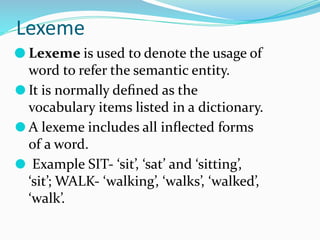
Lexeme
⚫ Lexeme is used to denote the usage of
word to refer the semantic entity.
⚫ It is normally defined as the
vocabulary items listed in a dictionary.
⚫ A lexeme includes all inflected forms
of a word.
⚫ Example SIT- ‘sit’, ‘sat’ and ‘sitting’,
‘sit’; WALK- ‘walking’, ‘walks’, ‘walked’,
‘walk’.
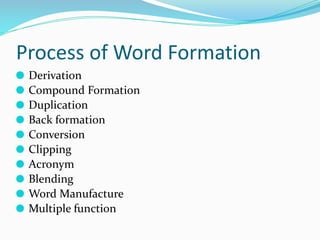
Process of Word Formation
⚫ Derivation
⚫ Compound Formation
⚫ Duplication
⚫ Back formation
⚫ Conversion
⚫ Clipping
⚫ Acronym
⚫ Blending
⚫ Word Manufacture
⚫ Multiple function
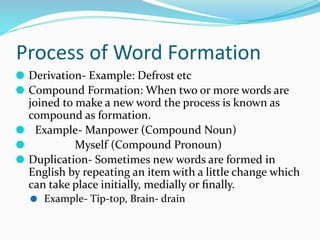
Process of Word Formation
⚫ Derivation- Example: Defrost etc
⚫ Compound Formation: When two or more words are
joined to make a new word the process is known as
compound as formation.
⚫ Example- Manpower (Compound Noun)
⚫ Myself (Compound Pronoun)
⚫ Duplication- Sometimes new words are formed in
English by repeating an item with a little change which
can take place initially, medially or finally.
⚫ Example- Tip-top, Brain- drain
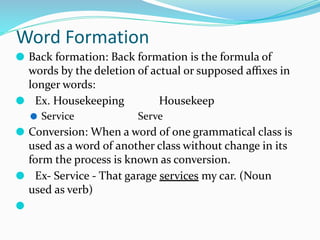
Word Formation
⚫ Back formation: Back formation is the formula of
words by the deletion of actual or supposed affixes in
longer words:
⚫ Ex. Housekeeping Housekeep
⚫ Service Serve
⚫ Conversion: When a word of one grammatical class is
used as a word of another class without change in its
form the process is known as conversion.
⚫ Ex- Service - That garage services my car. (Noun
used as verb)
⚫
Word Formation
⚫ Clipping: The process by which a word is curtailed by
retaining only its initial and recognizable part without
effecting any change in meaning and grammatical class is
called clipping.
⚫ Ex. - Perambulator – Pram
⚫ Telephone – Phone
⚫ Acronym: Pronounceable word coined from initial letters
of the words in a name (mostly of an organization), title or
phrase.
⚫ Ex- TOEFL – Teaching of English as Foreign Language
⚫ WHO- World Health Organization
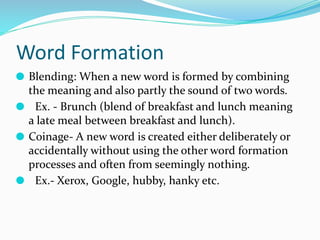
Word Formation
⚫ Blending: When a new word is formed by combining
the meaning and also partly the sound of two words.
⚫ Ex. - Brunch (blend of breakfast and lunch meaning
a late meal between breakfast and lunch).
⚫ Coinage- A new word is created either deliberately or
accidentally without using the other word formation
processes and often from seemingly nothing.
⚫ Ex.- Xerox, Google, hubby, hanky etc.

Allomorps and word formation.pptx - Google Slides.pdf

  • 1.
    Allomorphs and Word Formation MAEnglish Paper II English Langauge Unit I Morphology
  • 2.
    Allomorphs ⚫ Allomorphs arethe group of morphs that are the realization of the same morpheme. ⚫ Just as allophones are the variants of a phoneme, so allomorphs are the variants of a morpheme. ⚫ Examples: singular verb morpheme and singular noun morpheme. ⚫ Such as past tense of –ed is realized as /t/, /d/ and /ɪd/ are the allomorphs of past tense morpheme. ⚫ Example: stopped /stɒpt/, flowed/fləʊd/, planted /plɑːntɪd/
  • 3.
    Allomorphs ⚫ Plural sis realized as /s/, /z/ and /z/ ⚫ As in cats /kæts/ dogs/dɒɡzand boys /ˈbɔɪz/ ⚫ These alternate variants are called allomorphs or morpheme alternant or morpheme variant. ⚫ Allomorphs are in complimentary distribution. ⚫ They have the same meaning and function but they do not occur in the same environment. ⚫ Bloom field called the zero mopheme as zero alternant or zero allomorph as in sheep, deer, put, cut and postman.
  • 4.
    Replacive Morphs ⚫ Bloomfieldconsidered the analysis of forms such as goose-geese, know-knew, man-men as substitution alternants. ⚫ Substituion is alternant of normal plural suffix. ⚫ Some linguists regarded this feature as replacive morphs as it involves a replacement of a vowel.
  • 5.
    Words and lexeme ⚫Bloomfield defined words as minimal free units. ⚫ Word is used in two different senses: physical unit and semantic entity. ⚫ These physical entities, the written or spoken form of words are called word forms. ⚫ In other words, word forms are the physical realization of lexemes. ⚫ The include all the inflected forms of a lexeme. ⚫ For example, ‘sit’, ‘sat’ and ‘sitting’ are different forms of the word ‘sit’.
  • 6.
    Lexeme ⚫ Lexeme isused to denote the usage of word to refer the semantic entity. ⚫ It is normally defined as the vocabulary items listed in a dictionary. ⚫ A lexeme includes all inflected forms of a word. ⚫ Example SIT- ‘sit’, ‘sat’ and ‘sitting’, ‘sit’; WALK- ‘walking’, ‘walks’, ‘walked’, ‘walk’.
  • 7.
    Process of WordFormation ⚫ Derivation ⚫ Compound Formation ⚫ Duplication ⚫ Back formation ⚫ Conversion ⚫ Clipping ⚫ Acronym ⚫ Blending ⚫ Word Manufacture ⚫ Multiple function
  • 8.
    Process of WordFormation ⚫ Derivation- Example: Defrost etc ⚫ Compound Formation: When two or more words are joined to make a new word the process is known as compound as formation. ⚫ Example- Manpower (Compound Noun) ⚫ Myself (Compound Pronoun) ⚫ Duplication- Sometimes new words are formed in English by repeating an item with a little change which can take place initially, medially or finally. ⚫ Example- Tip-top, Brain- drain
  • 9.
    Word Formation ⚫ Backformation: Back formation is the formula of words by the deletion of actual or supposed affixes in longer words: ⚫ Ex. Housekeeping Housekeep ⚫ Service Serve ⚫ Conversion: When a word of one grammatical class is used as a word of another class without change in its form the process is known as conversion. ⚫ Ex- Service - That garage services my car. (Noun used as verb) ⚫
  • 10.
    Word Formation ⚫ Clipping:The process by which a word is curtailed by retaining only its initial and recognizable part without effecting any change in meaning and grammatical class is called clipping. ⚫ Ex. - Perambulator – Pram ⚫ Telephone – Phone ⚫ Acronym: Pronounceable word coined from initial letters of the words in a name (mostly of an organization), title or phrase. ⚫ Ex- TOEFL – Teaching of English as Foreign Language ⚫ WHO- World Health Organization
  • 11.
    Word Formation ⚫ Blending:When a new word is formed by combining the meaning and also partly the sound of two words. ⚫ Ex. - Brunch (blend of breakfast and lunch meaning a late meal between breakfast and lunch). ⚫ Coinage- A new word is created either deliberately or accidentally without using the other word formation processes and often from seemingly nothing. ⚫ Ex.- Xerox, Google, hubby, hanky etc.