- alter stems to derive new words.
They may change the word’s meaning
(derivational) or its grammatical
functions (inflectional).
There are several different types of
processes, not all of which are present in all
languages.
Some of these are concatenative, meaning
that they involve the linear combination of
morphemes (affixation, for example),
while others are non-concatenative,
involving the internal alternation of
morphemes.
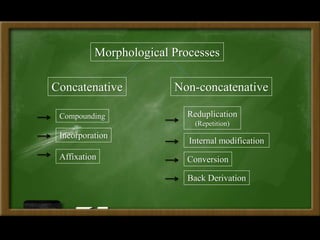
Morphological Processes
Concatenative Non-concatenative
Compounding
Affixation
Incorporation
Reduplication
(Repetition)
Internal modification
Conversion
Back Derivation
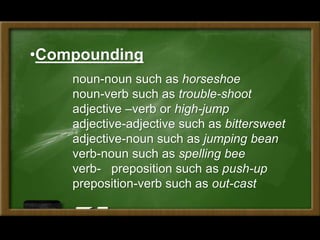
Compounding can be used to form new
words through combining two stems as
in the words blackbird or housekeeper.
Compounds can be composed of many
parts of speech. Some examples
include:
•Compounding
noun-noun such as horseshoe
noun-verb such as trouble-shoot
adjective –verb or high-jump
adjective-adjective such as bittersweet
adjective-noun such as jumping bean
verb-noun such as spelling bee
verb- preposition such as push-up
preposition-verb such as out-cast
•Compounding
•Incorporation
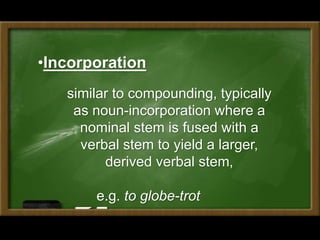
similar to compounding, typically
as noun-incorporation where a
nominal stem is fused with a
verbal stem to yield a larger,
derived verbal stem,
e.g. to globe-trot
•Affixation
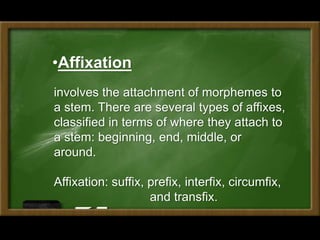
involves the attachment of morphemes to
a stem. There are several types of affixes,
classified in terms of where they attach to
a stem: beginning, end, middle, or
around.
Affixation: suffix, prefix, interfix, circumfix,
and transfix.
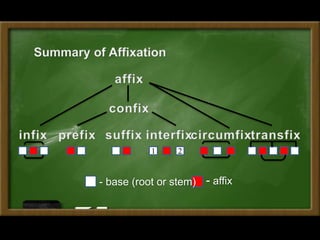
1 2
- affix- base (root or stem)
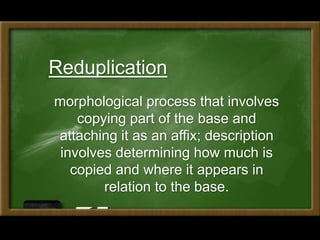
Reduplication
morphological process that involves
copying part of the base and
attaching it as an affix; description
involves determining how much is
copied and where it appears in
relation to the base.
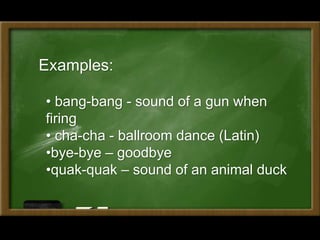
Examples:
• bang-bang - sound of a gun when
firing
• cha-cha - ballroom dance (Latin)
•bye-bye – goodbye
•quak-quak – sound of an animal duck
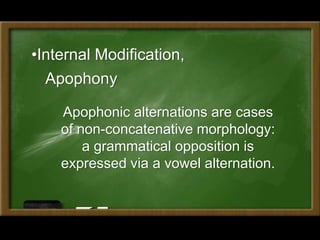
•Internal Modification,
Apophony
Apophonic alternations are cases
of non-concatenative morphology:
a grammatical opposition is
expressed via a vowel alternation.
Vowel Modification
strong’ verbs in English:
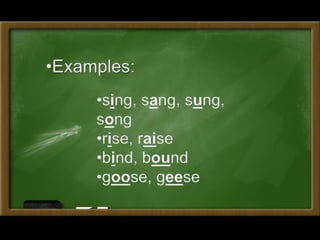
[I] – [æ] begin – began, ring-rang, sing – sang.
[i:] – [ou] speak –spoke, steal – stole, weave –
wove.
[ai] - [au] bind – bound, find – found, wind –
wound.
Noun/Verb in English:
[θ] – [ð] mouth – mouth, sheath – sheathe, wreath –
wreathe
[f] – [v] belief – believe, grief – grieve, proof – prove
[s] – [z] advice – advise, device – devise, house –
house
[s] – [d] defence – defend, offence – offend
[t] – [d] bent – bend, ascent – ascend, descent –
descend
Consonant
modification
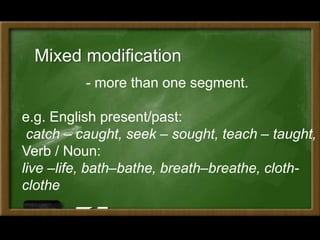
Mixed modification
- more than one segment.
e.g. English present/past:
catch – caught, seek – sought, teach – taught,
Verb / Noun:
live –life, bath–bathe, breath–breathe, cloth-
clothe
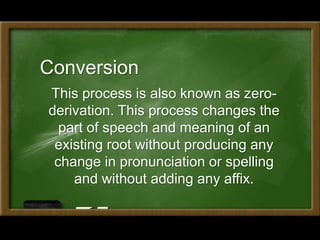
Conversion
This process is also known as zero-
derivation. This process changes the
part of speech and meaning of an
existing root without producing any
change in pronunciation or spelling
and without adding any affix.
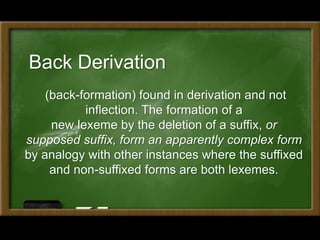
Back Derivation
(back-formation) found in derivation and not
inflection. The formation of a
new lexeme by the deletion of a suffix, or
supposed suffix, form an apparently complex form
by analogy with other instances where the suffixed
and non-suffixed forms are both lexemes.
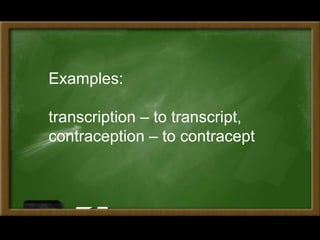
Examples:
transcription – to transcript,
contraception – to contracept
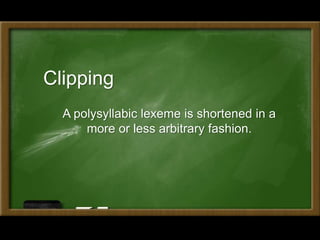
A polysyllabic lexeme is shortened in a
more or less arbitrary fashion.
Clipping
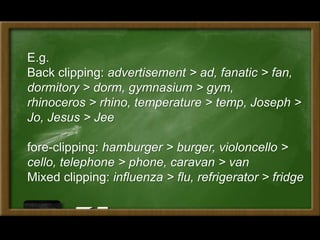
E.g.
Back clipping: advertisement > ad, fanatic > fan,
dormitory > dorm, gymnasium > gym,
rhinoceros > rhino, temperature > temp, Joseph >
Jo, Jesus > Jee
fore-clipping: hamburger > burger, violoncello >
cello, telephone > phone, caravan > van
Mixed clipping: influenza > flu, refrigerator > fridge
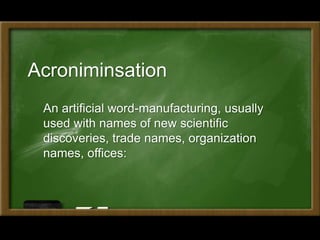
Acroniminsation
An artificial word-manufacturing, usually
used with names of new scientific
discoveries, trade names, organization
names, offices:
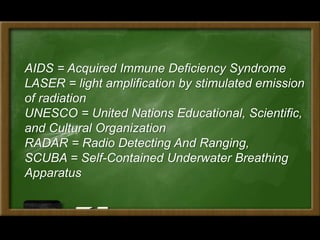
AIDS = Acquired Immune Deficiency Syndrome
LASER = light amplification by stimulated emission
of radiation
UNESCO = United Nations Educational, Scientific,
and Cultural Organization
RADAR = Radio Detecting And Ranging,
SCUBA = Self-Contained Underwater Breathing
Apparatus

Morphological Processes

  • 2.
    - alter stemsto derive new words. They may change the word’s meaning (derivational) or its grammatical functions (inflectional).
  • 3.
    There are severaldifferent types of processes, not all of which are present in all languages. Some of these are concatenative, meaning that they involve the linear combination of morphemes (affixation, for example), while others are non-concatenative, involving the internal alternation of morphemes.
  • 4.
  • 6.
    Compounding can beused to form new words through combining two stems as in the words blackbird or housekeeper. Compounds can be composed of many parts of speech. Some examples include: •Compounding
  • 7.
    noun-noun such ashorseshoe noun-verb such as trouble-shoot adjective –verb or high-jump adjective-adjective such as bittersweet adjective-noun such as jumping bean verb-noun such as spelling bee verb- preposition such as push-up preposition-verb such as out-cast •Compounding
  • 8.
    •Incorporation similar to compounding,typically as noun-incorporation where a nominal stem is fused with a verbal stem to yield a larger, derived verbal stem, e.g. to globe-trot
  • 9.
    •Affixation involves the attachmentof morphemes to a stem. There are several types of affixes, classified in terms of where they attach to a stem: beginning, end, middle, or around. Affixation: suffix, prefix, interfix, circumfix, and transfix.
  • 10.
    1 2 - affix-base (root or stem)
  • 12.
    Reduplication morphological process thatinvolves copying part of the base and attaching it as an affix; description involves determining how much is copied and where it appears in relation to the base.
  • 13.
    Examples: • bang-bang -sound of a gun when firing • cha-cha - ballroom dance (Latin) •bye-bye – goodbye •quak-quak – sound of an animal duck
  • 14.
    •Internal Modification, Apophony Apophonic alternationsare cases of non-concatenative morphology: a grammatical opposition is expressed via a vowel alternation.
  • 16.
    Vowel Modification strong’ verbsin English: [I] – [æ] begin – began, ring-rang, sing – sang. [i:] – [ou] speak –spoke, steal – stole, weave – wove. [ai] - [au] bind – bound, find – found, wind – wound.
  • 17.
    Noun/Verb in English: [θ]– [ð] mouth – mouth, sheath – sheathe, wreath – wreathe [f] – [v] belief – believe, grief – grieve, proof – prove [s] – [z] advice – advise, device – devise, house – house [s] – [d] defence – defend, offence – offend [t] – [d] bent – bend, ascent – ascend, descent – descend Consonant modification
  • 18.
    Mixed modification - morethan one segment. e.g. English present/past: catch – caught, seek – sought, teach – taught, Verb / Noun: live –life, bath–bathe, breath–breathe, cloth- clothe
  • 19.
    Conversion This process isalso known as zero- derivation. This process changes the part of speech and meaning of an existing root without producing any change in pronunciation or spelling and without adding any affix.
  • 20.
    Back Derivation (back-formation) foundin derivation and not inflection. The formation of a new lexeme by the deletion of a suffix, or supposed suffix, form an apparently complex form by analogy with other instances where the suffixed and non-suffixed forms are both lexemes.
  • 21.
    Examples: transcription – totranscript, contraception – to contracept
  • 22.
    A polysyllabic lexemeis shortened in a more or less arbitrary fashion. Clipping
  • 23.
    E.g. Back clipping: advertisement> ad, fanatic > fan, dormitory > dorm, gymnasium > gym, rhinoceros > rhino, temperature > temp, Joseph > Jo, Jesus > Jee fore-clipping: hamburger > burger, violoncello > cello, telephone > phone, caravan > van Mixed clipping: influenza > flu, refrigerator > fridge
  • 24.
    Acroniminsation An artificial word-manufacturing,usually used with names of new scientific discoveries, trade names, organization names, offices:
  • 25.
    AIDS = AcquiredImmune Deficiency Syndrome LASER = light amplification by stimulated emission of radiation UNESCO = United Nations Educational, Scientific, and Cultural Organization RADAR = Radio Detecting And Ranging, SCUBA = Self-Contained Underwater Breathing Apparatus