Applied Linguistic
Introduction to Linguistics
Lecturer : Siti Mukminatun., S.S.,M.Hum
Muhammad Ammar Basith Nawawi (17202244030)
Aprian Boanerges (17202244036)
Kristoforus Roga (17202249002)
Marthen Uropka (17202249004)
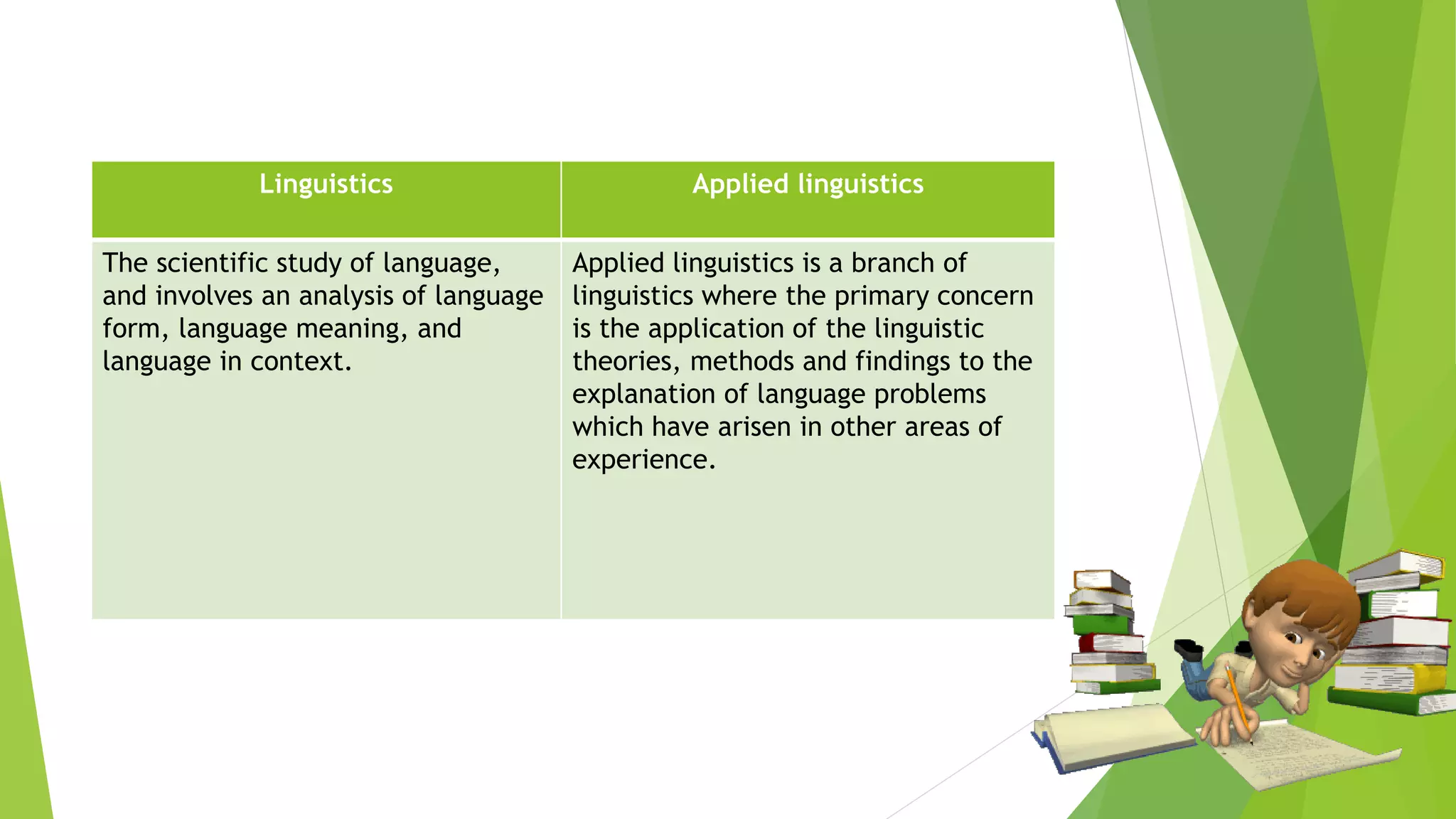
Linguistics Applied linguistics
The scientific study of language,
and involves an analysis of language
form, language meaning, and
language in context.
Applied linguistics is a branch of
linguistics where the primary concern
is the application of the linguistic
theories, methods and findings to the
explanation of language problems
which have arisen in other areas of
experience.
Applied linguistics cover two main points
 The study of second and foreign language
learning and teaching
 The study of language and linguistics in relation
to practical problems
What is the relation between linguistics
and applied linguistics?
 Linguistics is primarily concerned with language in itself and in findings ways
of analysing language and building theories that describe language.
 Applied linguistics is concerned with the role of language in peoples’ lives and
problems associated with language use in peoples’ lives.
 Linguistics is essential but not the only feeder discipline.
The relation between applied linguistics
and language teaching
Applied Linguistics is used to solve specific
class problems that arise in setting up,
implementing a language teaching program
and answering certain types of questions that
arise in the planning process
Applied Linguistics:
When did it all begin?
• The term Applied Linguistics (AL) is an
Anglo-American coinage.
• It was founded first at the University of
Edinburgh School of Applied Linguistics in
1956.
• Then at the Center of Applied Linguistics
in Washington D.C. in 1957.
Applied Linguistics:
When did it all begin?
 The British Association of Applied Linguistics (BAAL) was
formally established in 1967, with the following aims:
“the advancement of education by fostering and
promoting, by any lawful charitable means, the study of
language use, language acquisition and language teaching
and the fostering of inter-disciplinary collaboration in this
study”
 It was largely taken for granted in the 1960s and 1970s
that applied linguistics was about language teaching.
Aim of Applied Linguistic Studies
1. The study of second language and foreign
language learning and teaching
2. Investigate problems related to language
learning and teaching
3. To find some practical steps to solve those
problems.
The need for Applied Linguistics
 The Importance of Applied Linguistic lies in the
significant role it has in solving language-related
problems.
 Language is crucial to human lives. Without
language, most important activities will be
inconceivable.
 Throughout the history and across the world,
people have been using language to
communicate.
Scopes of apllied lingusitics
 Language teaching and learning
 Language testing
 Psycho-and neuorolinguistics
 Sociolinguistics
 Discourse analysis
 Computational linguistics
 Translation studies
Interdisciplinary Studies
 Interdisciplinarity involves the combining of two or more academic disciplines
into one activity (e.g., a research project).
 It is about creating something new by crossing boundaries, and thinking across
them.
 It is related to an interdiscipline, which is an organizational unit that crosses
traditional boundaries between academic disciplines, as new need and
professions emerge. (origin of languange, Translation of lang. Through
computers)
 Some of the area related to A L
 What is interdiciplinary linguistics?
interdiciplinary studies involve two or more academic diciplines which are considered
distinct. The most common interdiciplinary branches of linguistics are:
• Historical linguistics,
• Sociolinguistics
• Psycholinguistics
• Ethnolinguistics
• Computational linguistics
• Neurolinguistics.
psycholinguistics
 Looks at how language is aquired by humsns
 How speech is created in real time
 How speech is perceived
 How language is stord
Socolinguistics
 Looks at how language is used in a social context, e.g.
• Language use and social class
• Language use and gender
• Language usd and occupatio
• Bilingualism
• Code switching
What is the relationship between applied
linguistics and other language related
disciplines?
 Applied linguistics occupies an intermediary, mediating position between
language related disciplines (linguistics, psycholinguistics and sociolinguistics)
and professional practice
 It uses theories/principles from language related disciplines in order to
understand language related issues and to solve language related problems.
The choice of which disciplines are involved in applied linguistics matters
depends on the circumstances.
 Applied linguistics conducts research into professional practice and on the
basis of the results develops theory.
References
 https://en.wikipedia.org/wiki/Applied_linguistics#History
 Cook, G (2003). Apllied linguistics.Oxford : Oxford University Press.
 R.B.Kaplan (Ed.) (2002), The oxford handbook of applied linguistics New York :
Oxford University Press.

Applied linguisticss

  • 1.
    Applied Linguistic Introduction toLinguistics Lecturer : Siti Mukminatun., S.S.,M.Hum Muhammad Ammar Basith Nawawi (17202244030) Aprian Boanerges (17202244036) Kristoforus Roga (17202249002) Marthen Uropka (17202249004)
  • 2.
    Linguistics Applied linguistics Thescientific study of language, and involves an analysis of language form, language meaning, and language in context. Applied linguistics is a branch of linguistics where the primary concern is the application of the linguistic theories, methods and findings to the explanation of language problems which have arisen in other areas of experience.
  • 3.
    Applied linguistics covertwo main points  The study of second and foreign language learning and teaching  The study of language and linguistics in relation to practical problems
  • 4.
    What is therelation between linguistics and applied linguistics?  Linguistics is primarily concerned with language in itself and in findings ways of analysing language and building theories that describe language.  Applied linguistics is concerned with the role of language in peoples’ lives and problems associated with language use in peoples’ lives.  Linguistics is essential but not the only feeder discipline.
  • 5.
    The relation betweenapplied linguistics and language teaching Applied Linguistics is used to solve specific class problems that arise in setting up, implementing a language teaching program and answering certain types of questions that arise in the planning process
  • 6.
    Applied Linguistics: When didit all begin? • The term Applied Linguistics (AL) is an Anglo-American coinage. • It was founded first at the University of Edinburgh School of Applied Linguistics in 1956. • Then at the Center of Applied Linguistics in Washington D.C. in 1957.
  • 7.
    Applied Linguistics: When didit all begin?  The British Association of Applied Linguistics (BAAL) was formally established in 1967, with the following aims: “the advancement of education by fostering and promoting, by any lawful charitable means, the study of language use, language acquisition and language teaching and the fostering of inter-disciplinary collaboration in this study”  It was largely taken for granted in the 1960s and 1970s that applied linguistics was about language teaching.
  • 8.
    Aim of AppliedLinguistic Studies 1. The study of second language and foreign language learning and teaching 2. Investigate problems related to language learning and teaching 3. To find some practical steps to solve those problems.
  • 9.
    The need forApplied Linguistics  The Importance of Applied Linguistic lies in the significant role it has in solving language-related problems.  Language is crucial to human lives. Without language, most important activities will be inconceivable.  Throughout the history and across the world, people have been using language to communicate.
  • 10.
    Scopes of aplliedlingusitics  Language teaching and learning  Language testing  Psycho-and neuorolinguistics  Sociolinguistics  Discourse analysis  Computational linguistics  Translation studies
  • 11.
    Interdisciplinary Studies  Interdisciplinarityinvolves the combining of two or more academic disciplines into one activity (e.g., a research project).  It is about creating something new by crossing boundaries, and thinking across them.  It is related to an interdiscipline, which is an organizational unit that crosses traditional boundaries between academic disciplines, as new need and professions emerge. (origin of languange, Translation of lang. Through computers)
  • 12.
     Some ofthe area related to A L  What is interdiciplinary linguistics? interdiciplinary studies involve two or more academic diciplines which are considered distinct. The most common interdiciplinary branches of linguistics are: • Historical linguistics, • Sociolinguistics • Psycholinguistics • Ethnolinguistics • Computational linguistics • Neurolinguistics.
  • 13.
    psycholinguistics  Looks athow language is aquired by humsns  How speech is created in real time  How speech is perceived  How language is stord
  • 14.
    Socolinguistics  Looks athow language is used in a social context, e.g. • Language use and social class • Language use and gender • Language usd and occupatio • Bilingualism • Code switching
  • 15.
    What is therelationship between applied linguistics and other language related disciplines?  Applied linguistics occupies an intermediary, mediating position between language related disciplines (linguistics, psycholinguistics and sociolinguistics) and professional practice  It uses theories/principles from language related disciplines in order to understand language related issues and to solve language related problems. The choice of which disciplines are involved in applied linguistics matters depends on the circumstances.  Applied linguistics conducts research into professional practice and on the basis of the results develops theory.
  • 16.
    References  https://en.wikipedia.org/wiki/Applied_linguistics#History  Cook,G (2003). Apllied linguistics.Oxford : Oxford University Press.  R.B.Kaplan (Ed.) (2002), The oxford handbook of applied linguistics New York : Oxford University Press.