Finite State Machine
FSM
• A finite-state machine (FSM) or finite-state automaton (FSA,
plural: automata), finite automaton, or simply a state machine, is a
mathematical model of computation.
• It is an abstract machine that can be in exactly one of a finite number
of states at any given time.
• The FSM can change from one state to another in response to
some inputs; the change from one state to another is called
a transition.
• An FSM is defined by a list of its states, its initial state, and the inputs
that trigger each transition.
FSM
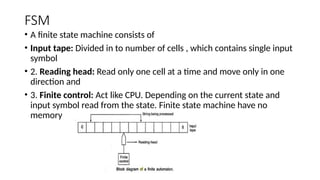
• A finite state machine consists of
• Input tape: Divided in to number of cells , which contains single input
symbol
• 2. Reading head: Read only one cell at a time and move only in one
direction and
• 3. Finite control: Act like CPU. Depending on the current state and
input symbol read from the state. Finite state machine have no
memory
Automata:
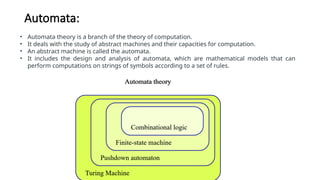
• Automata theory is a branch of the theory of computation.
• It deals with the study of abstract machines and their capacities for computation.
• An abstract machine is called the automata.
• It includes the design and analysis of automata, which are mathematical models that can
perform computations on strings of symbols according to a set of rules.
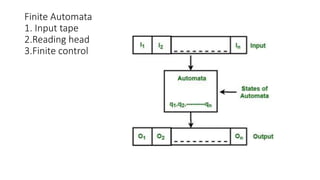
Finite Automata
1. Input tape
2.Reading head
3.Finite control
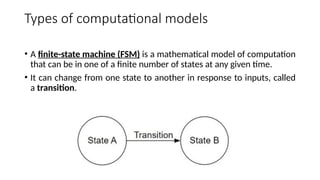
Types of computational models
• A finite-state machine (FSM) is a mathematical model of computation
that can be in one of a finite number of states at any given time.
• It can change from one state to another in response to inputs, called
a transition.
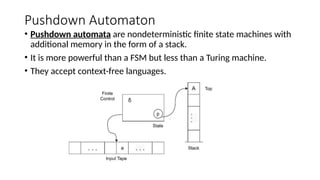
Pushdown Automaton
• Pushdown automata are nondeterministic finite state machines with
additional memory in the form of a stack.
• It is more powerful than a FSM but less than a Turing machine.
• They accept context-free languages.
Contd..
• For example, to ensure a valid code, a programmer can feed the code
into a pushdown automaton programmed with transition functions
that implement the context-free grammar for the language of
balanced parentheses.
• If the code is valid and all parentheses are matched, the pushdown
automaton will accept the code.
• If unbalanced parentheses are present, the automaton can return the
code's invalidity.
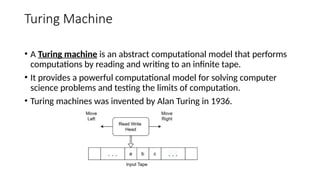
Turing Machine
• A Turing machine is an abstract computational model that performs
computations by reading and writing to an infinite tape.
• It provides a powerful computational model for solving computer
science problems and testing the limits of computation.
• Turing machines was invented by Alan Turing in 1936.
Contd..
• A Turing Machine consists of an infinite tape, a tape head, and a state
transition table.
• They execute on an input string of bits, with the tape head in a certain
state and the table governing its behavior.
• Turing machines can simulate the complexity of a program and its
reactions to different data in memory.
Finite Automata
• Finite Automata (FA) is the simplest machine to recognize patterns
(Regular Expression).
• The finite automata or finite state machine is an abstract machine
which has five elements or tuple.
• It has a set of states and rules for moving from one state to another
but it depends upon the applied input symbol.
• Basically it is an abstract model of digital computer.
Contd..
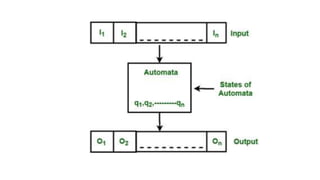
Features of automata:
• Input
• Output
• States of automata
• State relation
• Output relation
Contd..
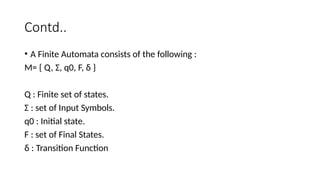
• A Finite Automata consists of the following :
M= { Q, Σ, q0, F, δ }
Q : Finite set of states.
Σ : set of Input Symbols.
q0 : Initial state.
F : set of Final States.
δ : Transition Function

toc Security group for my web server and new

  • 1.
  • 2.
    FSM • A finite-statemachine (FSM) or finite-state automaton (FSA, plural: automata), finite automaton, or simply a state machine, is a mathematical model of computation. • It is an abstract machine that can be in exactly one of a finite number of states at any given time. • The FSM can change from one state to another in response to some inputs; the change from one state to another is called a transition. • An FSM is defined by a list of its states, its initial state, and the inputs that trigger each transition.
  • 3.
    FSM • A finitestate machine consists of • Input tape: Divided in to number of cells , which contains single input symbol • 2. Reading head: Read only one cell at a time and move only in one direction and • 3. Finite control: Act like CPU. Depending on the current state and input symbol read from the state. Finite state machine have no memory
  • 4.
    Automata: • Automata theoryis a branch of the theory of computation. • It deals with the study of abstract machines and their capacities for computation. • An abstract machine is called the automata. • It includes the design and analysis of automata, which are mathematical models that can perform computations on strings of symbols according to a set of rules.
  • 5.
    Finite Automata 1. Inputtape 2.Reading head 3.Finite control
  • 6.
    Types of computationalmodels • A finite-state machine (FSM) is a mathematical model of computation that can be in one of a finite number of states at any given time. • It can change from one state to another in response to inputs, called a transition.
  • 7.
    Pushdown Automaton • Pushdownautomata are nondeterministic finite state machines with additional memory in the form of a stack. • It is more powerful than a FSM but less than a Turing machine. • They accept context-free languages.
  • 8.
    Contd.. • For example,to ensure a valid code, a programmer can feed the code into a pushdown automaton programmed with transition functions that implement the context-free grammar for the language of balanced parentheses. • If the code is valid and all parentheses are matched, the pushdown automaton will accept the code. • If unbalanced parentheses are present, the automaton can return the code's invalidity.
  • 9.
    Turing Machine • ATuring machine is an abstract computational model that performs computations by reading and writing to an infinite tape. • It provides a powerful computational model for solving computer science problems and testing the limits of computation. • Turing machines was invented by Alan Turing in 1936.
  • 10.
    Contd.. • A TuringMachine consists of an infinite tape, a tape head, and a state transition table. • They execute on an input string of bits, with the tape head in a certain state and the table governing its behavior. • Turing machines can simulate the complexity of a program and its reactions to different data in memory.
  • 11.
    Finite Automata • FiniteAutomata (FA) is the simplest machine to recognize patterns (Regular Expression). • The finite automata or finite state machine is an abstract machine which has five elements or tuple. • It has a set of states and rules for moving from one state to another but it depends upon the applied input symbol. • Basically it is an abstract model of digital computer.
  • 13.
    Contd.. Features of automata: •Input • Output • States of automata • State relation • Output relation
  • 14.
    Contd.. • A FiniteAutomata consists of the following : M= { Q, Σ, q0, F, δ } Q : Finite set of states. Σ : set of Input Symbols. q0 : Initial state. F : set of Final States. δ : Transition Function