5 reasons to do a MOOC


5 reasons NOT to do a MOOC
Overview
 Brief history of MOOCs
 H817Open
 5 Reasons to do a MOOC
 5 Reasons NOT to do a MOOC
 MOOC reactions
 Conclusions
The early MOOCers


   David Wiley
   George Siemens & Stephen Downes
   Alec Couros
   Dave Cormier
   Jim Groom
                                      http://www.flickr.com/photos/happymichael/3679460209/
MOOCs tended to be..
 Short – 8-10 weeks
 Open to all
 Use mixture of free technology
 Run by individuals
 Often not accredited
 Combine synchronous &
  asynchronous
 Bring in range of experts
 Experimental in nature


                                   http://www.flickr.com/photos/mysnapps/2801547080/
How did they fare?


   High drop-out rate
                                                •   Popular
   Often confusing for learners                •   Inspirational
   Better suited to experienced                •   Platform for open research
    learners                                    •   Successful for many learners


                                   http://www.flickr.com/photos/dnnya/2559183847/
Enter the big players
   Thrun – Stanford AI course
   Becomes Udacity
   EdX
   Coursera


                                 http://www.flickr.com/photos/wallyg/4017680287/
New wave of MOOCs


         Free, but not entirely open
         Commercial basis
         Institutional
         Conventional in pedagogy & technology
         Linked to accreditation (Pearson & EdX, badging)


                                 http://www.flickr.com/photos/barenboime/2355747124/
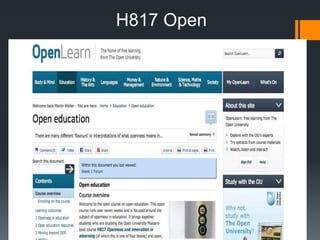
H817 Open
An open course in Open Education


 7 weeks
 Informal and formal learners
 Running in OpenLearn
 Badges
 2 ALS moderating forums
 Blog aggregator
 Collaboration-lite activity based model
 Starts March 16th
 Also an OER
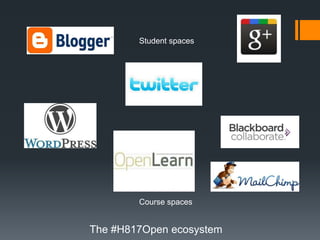
Student spaces


        Course spaces


The #H817Open ecosystem
5 reasons to
do a MOOC #1


 Raise profile


                  http://www.flickr.com/photos/jepoirrier/6703754863/
5 reasons to
do a MOOC #2


  Room to experiment


                        http://www.flickr.com/photos/robboudon/2928675554/
5 reasons to
do a MOOC #3


  Broaden Curriculum


                        http://www.flickr.com/photos/ljb/25759982/
5 reasons to
do a MOOC #4


  Students as networkers


                 http://www.flickr.com/photos/31065898@N08/8220970905/
5 reasons to
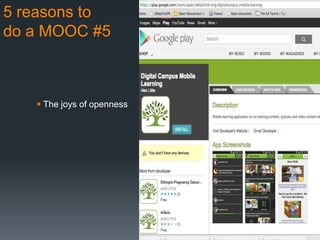
do a MOOC #5


    The joys of openness
5 reasons NOT to do a MOOC #1


Reputation risk


           http://www.flickr.com/photos/carolyncoles/2389407045/
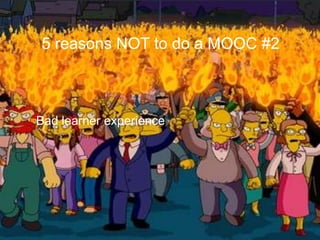
5 reasons NOT to do a MOOC #2


Bad learner experience
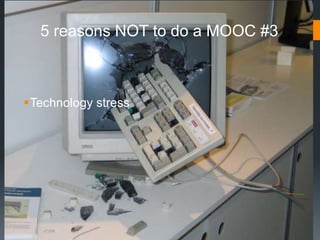
5 reasons NOT to do a MOOC #3


Technology stress
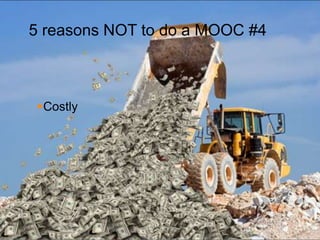
5 reasons NOT to do a MOOC #4


Costly
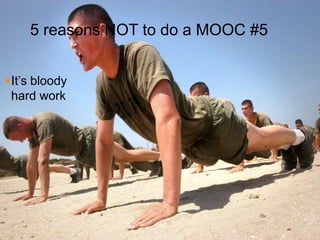
5 reasons NOT to do a MOOC #5


It’s bloody
 hard work
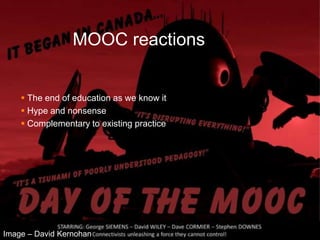
MOOC reactions


     The end of education as we know it
     Hype and nonsense
     Complementary to existing practice


Image – David Kernohan
MOOCs are your friend (?)
   Open up first 6 weeks of all courses
     Increase retention
     Widen participation
   Open boundary courses
     Shop window
     Gives students access to broader group eg Phonar
   Collaborate on MOOCs
     Higher quality
     Free up to teach what your best at
   Credit for MOOCs
     Shorter courses
     Higher retention
     Lower costs = more students?
   Experiment with curriculum
     Lower risk
     Fewer constraints
Conclusions
 MOOCing can be fun & innovative
 It carries risk
 It isn’t easy
 It isn’t for everyone
 Being MASSIVE & OPEN raises issues
 Be sure why you want to do one

5 reasons to do a MOOC & 5 reasons not to

  • 1.
    5 reasons todo a MOOC 5 reasons NOT to do a MOOC
  • 2.
    Overview  Brief historyof MOOCs  H817Open  5 Reasons to do a MOOC  5 Reasons NOT to do a MOOC  MOOC reactions  Conclusions
  • 3.
    The early MOOCers  David Wiley  George Siemens & Stephen Downes  Alec Couros  Dave Cormier  Jim Groom http://www.flickr.com/photos/happymichael/3679460209/
  • 4.
    MOOCs tended tobe..  Short – 8-10 weeks  Open to all  Use mixture of free technology  Run by individuals  Often not accredited  Combine synchronous & asynchronous  Bring in range of experts  Experimental in nature http://www.flickr.com/photos/mysnapps/2801547080/
  • 5.
    How did theyfare?  High drop-out rate • Popular  Often confusing for learners • Inspirational  Better suited to experienced • Platform for open research learners • Successful for many learners http://www.flickr.com/photos/dnnya/2559183847/
  • 6.
    Enter the bigplayers  Thrun – Stanford AI course  Becomes Udacity  EdX  Coursera http://www.flickr.com/photos/wallyg/4017680287/
  • 7.
    New wave ofMOOCs  Free, but not entirely open  Commercial basis  Institutional  Conventional in pedagogy & technology  Linked to accreditation (Pearson & EdX, badging) http://www.flickr.com/photos/barenboime/2355747124/
  • 8.
  • 9.
    An open coursein Open Education  7 weeks  Informal and formal learners  Running in OpenLearn  Badges  2 ALS moderating forums  Blog aggregator  Collaboration-lite activity based model  Starts March 16th  Also an OER
  • 10.
    Student spaces Course spaces The #H817Open ecosystem
  • 11.
    5 reasons to doa MOOC #1  Raise profile http://www.flickr.com/photos/jepoirrier/6703754863/
  • 12.
    5 reasons to doa MOOC #2  Room to experiment http://www.flickr.com/photos/robboudon/2928675554/
  • 13.
    5 reasons to doa MOOC #3  Broaden Curriculum http://www.flickr.com/photos/ljb/25759982/
  • 14.
    5 reasons to doa MOOC #4  Students as networkers http://www.flickr.com/photos/31065898@N08/8220970905/
  • 15.
    5 reasons to doa MOOC #5  The joys of openness
  • 16.
    5 reasons NOTto do a MOOC #1 Reputation risk http://www.flickr.com/photos/carolyncoles/2389407045/
  • 17.
    5 reasons NOTto do a MOOC #2 Bad learner experience
  • 18.
    5 reasons NOTto do a MOOC #3 Technology stress
  • 19.
    5 reasons NOTto do a MOOC #4 Costly
  • 20.
    5 reasons NOTto do a MOOC #5 It’s bloody hard work
  • 21.
    MOOC reactions  The end of education as we know it  Hype and nonsense  Complementary to existing practice Image – David Kernohan
  • 22.
    MOOCs are yourfriend (?)  Open up first 6 weeks of all courses  Increase retention  Widen participation  Open boundary courses  Shop window  Gives students access to broader group eg Phonar  Collaborate on MOOCs  Higher quality  Free up to teach what your best at  Credit for MOOCs  Shorter courses  Higher retention  Lower costs = more students?  Experiment with curriculum  Lower risk  Fewer constraints
  • 23.
    Conclusions  MOOCing canbe fun & innovative  It carries risk  It isn’t easy  It isn’t for everyone  Being MASSIVE & OPEN raises issues  Be sure why you want to do one

Editor's Notes

  • #9 Block of H817 on open educationYear ago I suggested do as a MOOCThey were under the radar then, I thought no-one would notice
  • #12 You don’t have to be a big name, or a big uni – you can get good international profile from running an interesting global course
  • #13 Play with curriculum, technology, pedagogy because there is a different contract with a free course
  • #14 Could accredit MOOCs from elsewhere, have pre-courses on learning to learn, share with other unisetc
  • #15 PhonarMeeting people oustide of our bubble
  • #16 Alex Little took this and made mobile versionWayne Mackintosh is adapting some activities for an open undergrad courseI’d like staff dev to use it
  • #17 If it goes wrong it does so publicly – institutional and individual
  • #18 Bad for learners – we know value of supportCould put them offCould be for experienced learners only
  • #19 It tests systems and youOpenLearn, find out stuffLess flexibility – greater time stress on MOOCs
  • #20 It takes time, new systems may be required, more multi-media, more real time involvement
  • #21 I wake most nights fretting about MOOCsI kept it smallish – not 500,00 maybe you have to distance yourself then