DEVELOPING
WORLD MOOCS:
A WORKSHOP ON MOOCS IN
AFRICA
EMERGE AFRICA
ANDREW DEACON, JANET SMALL, SUKAINA WALJI
18 June 2014
Introduction
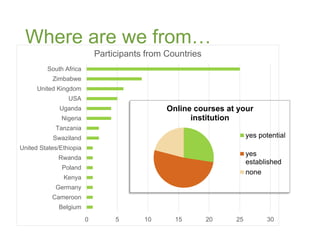
0 5 10 15 20 25 30
Belgium
Cameroon
Germany
Kenya
Poland
Rwanda
United States/Ethiopia
Swaziland
Tanzania
Nigeria
Uganda
USA
United Kingdom
Zimbabwe
South Africa
Participants from Countries
Where are we from…
Online courses at your
institution
yes potential
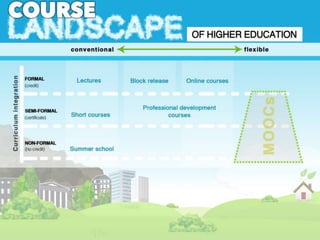
yes
established
none
0
5
10
15
20
25
30
35
40
45
50
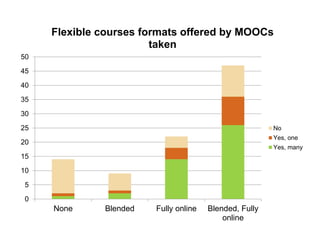
None Blended Fully online Blended, Fully
online
Flexible courses formats offered by MOOCs
taken
No
Yes, one
Yes, many
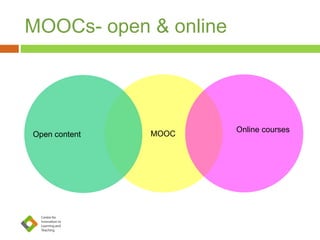
MOOCs- open & online
Online courses
Open content MOOC
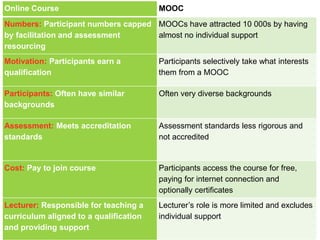
Online Course MOOC
Numbers: Participant numbers capped
by facilitation and assessment
resourcing
MOOCs have attracted 10 000s by having
almost no individual support
Motivation: Participants earn a
qualification
Participants selectively take what interests
them from a MOOC
Participants: Often have similar
backgrounds
Often very diverse backgrounds
Assessment: Meets accreditation
standards
Assessment standards less rigorous and
not accredited
Cost: Pay to join course Participants access the course for free,
paying for internet connection and
optionally certificates
Lecturer: Responsible for teaching a
curriculum aligned to a qualification
and providing support
Lecturer’s role is more limited and excludes
individual support
MOOCs didn’t just appear….
Image – Giulia Forsythe
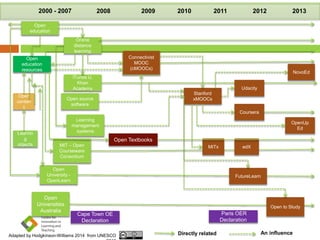
2000 - 2007 2008 2009 2010 2011 2012 2013
Open
education
Online
distance
learning
Open
education
resources
Open
conten
t
Connectivist
MOOC
(cMOOCs)
iTunes U,
Khan
Academy
Open source
software
Learning
management
systems
MIT – Open
Courseware
Consortium
Open
University -
OpenLearn
Stanford
xMOOCs
Udacity
Coursera
MITx edX
FutureLearn
NovoEd
OpenUp
Ed
Open to Study
Open
Universities
Australia
Directly related An influence
Learnin
g
objects
Open Textbooks
Adapted by Hodgkinson-Williams 2014 from UNESCO
Cape Town OE
Declaration
Paris OER
Declaration
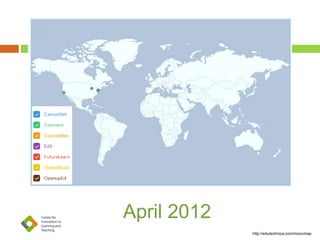
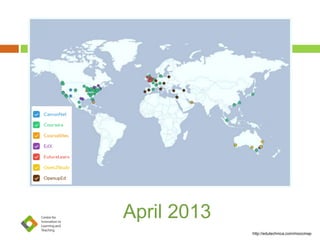
April 2012
http://edutechnica.com/moocmap
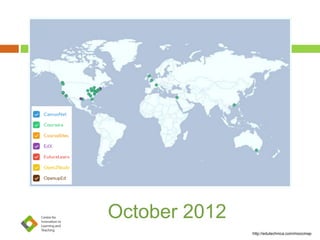
October 2012
http://edutechnica.com/moocmap
April 2013
http://edutechnica.com/moocmap
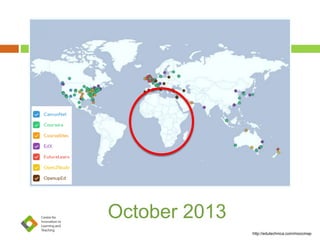
October 2013
http://edutechnica.com/moocmap
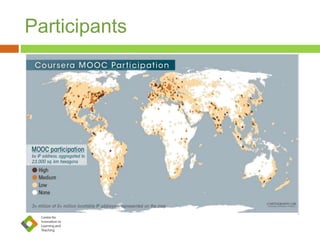
Participants
= 2522
Mapping the landscape
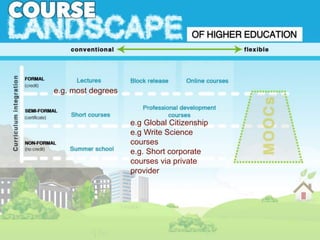
e.g Global Citizenship
e.g Write Science
courses
e.g. Short corporate
courses via private
provider
e.g. most degrees
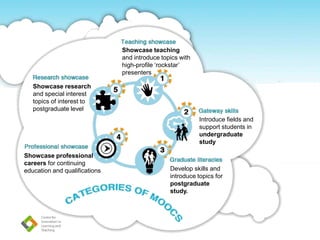
Showcase teaching
and introduce topics with
high-profile ‘rockstar’
presenters
Introduce fields and
support students in
undergraduate
study
Develop skills and
introduce topics for
postgraduate
study.
Showcase research
and special interest
topics of interest to
postgraduate level
Showcase professional
careers for continuing
education and qualifications
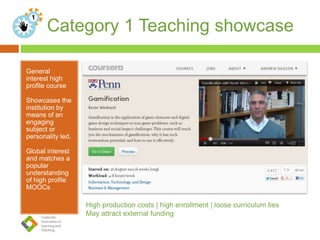
Category 1 Teaching showcase
General
interest high
profile course
Showcases the
institution by
means of an
engaging
subject or
personality led.
Global interest
and matches a
popular
understanding
of high profile
MOOCs
 n
High production costs | high enrollment | loose curriculum ties
May attract external funding
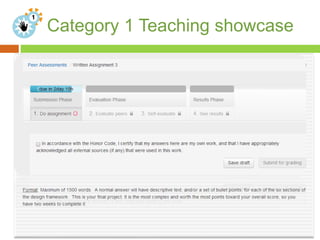
Category 1 Teaching showcase
General
interest high
profile course
Showcases the
institution by
means of an
engaging
subject or
personality led.
Global interest
and matches a
popular
understanding
of high profile
MOOCs
 n
High production costs | high enrollment | loose curriculum ties
May attract external funding
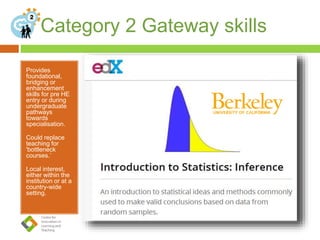
Category 2 Gateway skills
Provides
foundational,
bridging or
enhancement
skills for pre HE
entry or during
undergraduate
pathways
towards
specialisation.
Could replace
teaching for
'bottleneck
courses.’
Local interest,
either within the
institution or at a
country-wide
setting.
Moderate production costs | low enrollment | close curriculum ties
May attract external funding |
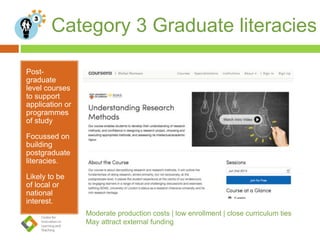
Category 3 Graduate literacies
Post-
graduate
level courses
to support
application or
programmes
of study
Focussed on
building
postgraduate
literacies.
Likely to be
of local or
national
interest.
Moderate production costs | low enrollment | close curriculum ties
May attract external funding
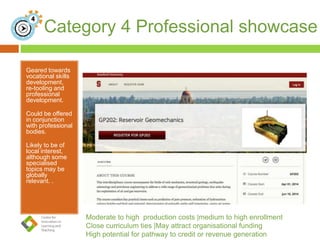
Category 4 Professional showcase
Geared towards
vocational skills
development,
re-tooling and
professional
development.
Could be offered
in conjunction
with professional
bodies.
Likely to be of
local interest,
although some
specialised
topics may be
globally
relevant. .
Moderate to high production costs |medium to high enrollment
Close curriculum ties |May attract organisational funding
High potential for pathway to credit or revenue generation
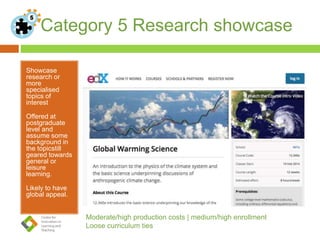
Category 5 Research showcase
Showcase
research or
more
specialised
topics of
interest
Offered at
postgraduate
level and
assume some
background in
the topicstill
geared towards
general or
leisure
learning.
Likely to have
global appeal.
Moderate/high production costs | medium/high enrollment
Loose curriculum ties
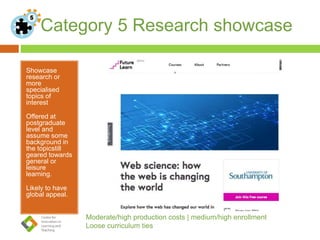
Category 5 Research showcase
Showcase
research or
more
specialised
topics of
interest
Offered at
postgraduate
level and
assume some
background in
the topicstill
geared towards
general or
leisure
learning.
Likely to have
global appeal.
Moderate/high production costs | medium/high enrollment
Loose curriculum ties
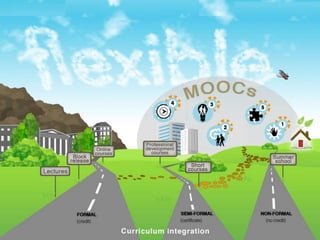
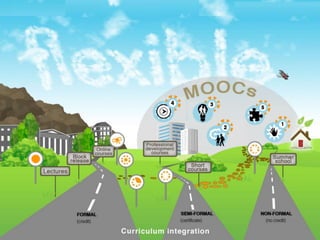
Course offered simultaneously as a formal
and as a open course.
Small private open course nested inside a
MOOC
Massive Online Course: formal course
inspired by MOOC pedagogy
Students in a course taking a MOOC with
added local support and additional material
Massive Open Online Course
Formal course with lectures and
support.
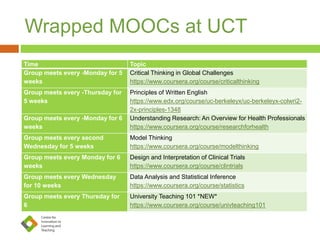
Wrapped MOOCs at UCT
Time Topic
Group meets every -Monday for 5
weeks
Critical Thinking in Global Challenges
https://www.coursera.org/course/criticalthinking
Group meets every -Thursday for
5 weeks
Principles of Written English
https://www.edx.org/course/uc-berkeleyx/uc-berkeleyx-colwri2-
2x-principles-1348
Group meets every -Monday for 6
weeks
Understanding Research: An Overview for Health Professionals
https://www.coursera.org/course/researchforhealth
Group meets every second
Wednesday for 5 weeks
Model Thinking
https://www.coursera.org/course/modelthinking
Group meets every Monday for 6
weeks
Design and Interpretation of Clinical Trials
https://www.coursera.org/course/clintrials
Group meets every Wednesday
for 10 weeks
Data Analysis and Statistical Inference
https://www.coursera.org/course/statistics
Group meets every Thursday for
6
University Teaching 101 *NEW*
https://www.coursera.org/course/univteaching101
Practicalities
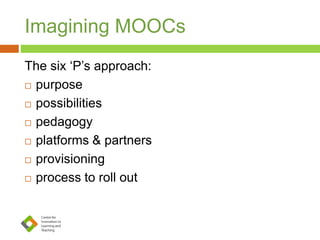
Imagining MOOCs
The six ‘P’s approach:
 purpose
 possibilities
 pedagogy
 platforms & partners
 provisioning
 process to roll out
Purpose
 Broad institutional goals
Using the MOOC categories
 Department / faculty goals
 Individual goals
Possibilities
 Having decided on audience, purpose and
category - what are the possible topics?
Make a proposal for an actual MOOC (or
variant) – develop a concept
Pedagogy
 How you want your MOOC to be taught
online? (which will depend on your target
audience, course purpose and expected
learning outcomes, as well as costs and
possibly platform affordances)
Platform and Partners
 Which platform partner will suit your MOOC
and work best for your institution?
 Other stakeholders and funders
Provisioning
 Two levels:
 1. Institutional - applies to all Massive Online
courses.
 2. Course level – applies to each course
Process & roll-out
 identifying an academic or team of academics willing
to devote the necessary time to the project
 constituting a course development team (online
learning designers, academics & student assistants
from department who will be offering course)
 initiate course design
 course production schedule
 test materials
 launch course
 Running/supporting/monitoring
 Evaluation
What to expect
 The key themes:
- sheer workload involved in planning and
developing the content,
- the resources required for video production on
top of the individuals’ ‘regular’ jobs.
- Creating effective strategies to manage the large
number of participants in the MOOC forums was
also reported as a challenge.
University of London 2013 report on MOOCs
Considerations - opportunities
 Reaching huge numbers of students
 Reaching a much broader range of students
 Bringing expertise from the student
community into the learning environment
 Learning from the experience of experimenting
with different activities and online formats
Consideration - time
 Every account from university MOOC-makers
indicates a considerable investment of time –
usually more than expected in the production
of the MOOC
 The time spent on the delivery and
management of the MOOC for the first time
was also high.
 Subsequent offerings of the same MOOC were
less demanding of time.
Considerations - risks
• adherence with copyright laws for use of all images, figures, journal
articles, etc.;
• licensing agreements for any software that is used by course-
takers;
• export control over any software or other technology that course-
takers might have access to;
• complaints or suits from course-takers who experience damages to
their computers as a result of downloading course software;
• accessibility issues (e.g., closed captioning, translation); and
• culturally-related concerns about course content (e.g., sexual,
religious, or politically-related language or images). (Univeristy of Illinois
2013 (p 16)
What we’re hoping for in this two week
workshop?
 Your ideas and perspectives
 A better understanding of other developing
country contexts and how MOOCs could be
used
 Your insights to how MOOCs and their variants
can and are being used
 Encourage the voices of developing world
educators in the debates on MOOCs
What’s next? This week
 Read the paper & engage in the first
discussion: How might institutions in Africa
respond to MOOCs?
 Look over the some of the other resources &
engage in the second discussion forum:
Should African institutions engage with
MOOCs, and if so how?
 Third discussion forum: Do MOOCs bolster
Western higher-education hegemony?
Questions arising from paper
1. How do you imagine your institution or department
might respond to or engage with MOOCs?
2. How do the MOOC categories we outline resonate
with your institutional or departmental priorities?
3. Have you ever experimented with MOOCs within your
institution? If so, in what ways? and how has that
worked? How did your students respond and relate to
the material and presentations?
4. Have you consider using MOOCs in a wrapped or
distributed flipped format? If so, how?
What’s next - week two activity
1. Can you develop the landscape of higher
education provision we have presented and and
customise it to your own context? Can you
recognise what is happening in the formal, semi-
formal and non-formal domains in your institution?
2. Can you suggest some additional categories of
MOOCs we haven’t considered that might be
appropriate to your context? What criteria might
your institution or department use to determine what
category of MOOCs
Reading list
1. Our Paper on Developing World MOOCs: a curriculum perspective (in press).
Available at Google Drive or on Emerge Africa site:
http://bit.ly/1nj7WWP
2. General reading list: presentations and reports about MOOCs
 Presentations from The MOOCs4D International Invitational
 Yuan, L., Powell, S. & Olivier, B, Beyond MOOCs: Sustainable online learning in institutions.
 Stanford Online - Review of 2013: Harnessing New Technologies and Methods to Advance Teaching and
Learning at Stanford and Beyond
 African Higher Education and Research Space (AHERS)
3. Blogs, articles and opinion perspectives
 On MOOCs as neocolonialism
 On developing country perspective
 On cultural barriers in the design of MOOCs
 On the potential to improve access to higher education
Reading list at:
https://docs.google.com/document/d/16M-dpcK0Ws8v2QtQRvbgNfIXz0dgfZEMmCJ4r9ZWGkE/edit
Please add resources and readings you have found!
Contact
 Andrew.Deacon@uct.ac.za
 Janet.Small@uct.ac.za
 Sukaina.Walji@uct.ac.za
This work is licensed under the Creative Commons Attribution-Share Alike
2.5 South Africa License. To view a copy of this license, visit
http://creativecommons.org/licenses/by-sa/2.5/za/ or send a letter to
Creative Commons, 171 Second Street, Suite 300, San Francisco,
California, 94105, USA.
Twitter:
#emergeafrica

Developing World MOOCs - A workshop on MOOCs in Africa

  • 1.
    DEVELOPING WORLD MOOCS: A WORKSHOPON MOOCS IN AFRICA EMERGE AFRICA ANDREW DEACON, JANET SMALL, SUKAINA WALJI 18 June 2014
  • 2.
  • 3.
    0 5 1015 20 25 30 Belgium Cameroon Germany Kenya Poland Rwanda United States/Ethiopia Swaziland Tanzania Nigeria Uganda USA United Kingdom Zimbabwe South Africa Participants from Countries Where are we from… Online courses at your institution yes potential yes established none
  • 4.
    0 5 10 15 20 25 30 35 40 45 50 None Blended Fullyonline Blended, Fully online Flexible courses formats offered by MOOCs taken No Yes, one Yes, many
  • 6.
    MOOCs- open &online Online courses Open content MOOC
  • 7.
    Online Course MOOC Numbers:Participant numbers capped by facilitation and assessment resourcing MOOCs have attracted 10 000s by having almost no individual support Motivation: Participants earn a qualification Participants selectively take what interests them from a MOOC Participants: Often have similar backgrounds Often very diverse backgrounds Assessment: Meets accreditation standards Assessment standards less rigorous and not accredited Cost: Pay to join course Participants access the course for free, paying for internet connection and optionally certificates Lecturer: Responsible for teaching a curriculum aligned to a qualification and providing support Lecturer’s role is more limited and excludes individual support
  • 8.
    MOOCs didn’t justappear…. Image – Giulia Forsythe
  • 9.
    2000 - 20072008 2009 2010 2011 2012 2013 Open education Online distance learning Open education resources Open conten t Connectivist MOOC (cMOOCs) iTunes U, Khan Academy Open source software Learning management systems MIT – Open Courseware Consortium Open University - OpenLearn Stanford xMOOCs Udacity Coursera MITx edX FutureLearn NovoEd OpenUp Ed Open to Study Open Universities Australia Directly related An influence Learnin g objects Open Textbooks Adapted by Hodgkinson-Williams 2014 from UNESCO Cape Town OE Declaration Paris OER Declaration
  • 10.
  • 11.
  • 12.
  • 13.
  • 14.
  • 15.
  • 17.
  • 19.
    e.g Global Citizenship e.gWrite Science courses e.g. Short corporate courses via private provider e.g. most degrees
  • 20.
    Showcase teaching and introducetopics with high-profile ‘rockstar’ presenters Introduce fields and support students in undergraduate study Develop skills and introduce topics for postgraduate study. Showcase research and special interest topics of interest to postgraduate level Showcase professional careers for continuing education and qualifications
  • 21.
    Category 1 Teachingshowcase General interest high profile course Showcases the institution by means of an engaging subject or personality led. Global interest and matches a popular understanding of high profile MOOCs  n High production costs | high enrollment | loose curriculum ties May attract external funding
  • 22.
    Category 1 Teachingshowcase General interest high profile course Showcases the institution by means of an engaging subject or personality led. Global interest and matches a popular understanding of high profile MOOCs  n High production costs | high enrollment | loose curriculum ties May attract external funding
  • 23.
    Category 2 Gatewayskills Provides foundational, bridging or enhancement skills for pre HE entry or during undergraduate pathways towards specialisation. Could replace teaching for 'bottleneck courses.’ Local interest, either within the institution or at a country-wide setting. Moderate production costs | low enrollment | close curriculum ties May attract external funding |
  • 24.
    Category 3 Graduateliteracies Post- graduate level courses to support application or programmes of study Focussed on building postgraduate literacies. Likely to be of local or national interest. Moderate production costs | low enrollment | close curriculum ties May attract external funding
  • 25.
    Category 4 Professionalshowcase Geared towards vocational skills development, re-tooling and professional development. Could be offered in conjunction with professional bodies. Likely to be of local interest, although some specialised topics may be globally relevant. . Moderate to high production costs |medium to high enrollment Close curriculum ties |May attract organisational funding High potential for pathway to credit or revenue generation
  • 26.
    Category 5 Researchshowcase Showcase research or more specialised topics of interest Offered at postgraduate level and assume some background in the topicstill geared towards general or leisure learning. Likely to have global appeal. Moderate/high production costs | medium/high enrollment Loose curriculum ties
  • 27.
    Category 5 Researchshowcase Showcase research or more specialised topics of interest Offered at postgraduate level and assume some background in the topicstill geared towards general or leisure learning. Likely to have global appeal. Moderate/high production costs | medium/high enrollment Loose curriculum ties
  • 29.
    Course offered simultaneouslyas a formal and as a open course. Small private open course nested inside a MOOC Massive Online Course: formal course inspired by MOOC pedagogy Students in a course taking a MOOC with added local support and additional material Massive Open Online Course Formal course with lectures and support.
  • 30.
    Wrapped MOOCs atUCT Time Topic Group meets every -Monday for 5 weeks Critical Thinking in Global Challenges https://www.coursera.org/course/criticalthinking Group meets every -Thursday for 5 weeks Principles of Written English https://www.edx.org/course/uc-berkeleyx/uc-berkeleyx-colwri2- 2x-principles-1348 Group meets every -Monday for 6 weeks Understanding Research: An Overview for Health Professionals https://www.coursera.org/course/researchforhealth Group meets every second Wednesday for 5 weeks Model Thinking https://www.coursera.org/course/modelthinking Group meets every Monday for 6 weeks Design and Interpretation of Clinical Trials https://www.coursera.org/course/clintrials Group meets every Wednesday for 10 weeks Data Analysis and Statistical Inference https://www.coursera.org/course/statistics Group meets every Thursday for 6 University Teaching 101 *NEW* https://www.coursera.org/course/univteaching101
  • 32.
  • 33.
    Imagining MOOCs The six‘P’s approach:  purpose  possibilities  pedagogy  platforms & partners  provisioning  process to roll out
  • 34.
    Purpose  Broad institutionalgoals Using the MOOC categories  Department / faculty goals  Individual goals
  • 35.
    Possibilities  Having decidedon audience, purpose and category - what are the possible topics? Make a proposal for an actual MOOC (or variant) – develop a concept
  • 36.
    Pedagogy  How youwant your MOOC to be taught online? (which will depend on your target audience, course purpose and expected learning outcomes, as well as costs and possibly platform affordances)
  • 37.
    Platform and Partners Which platform partner will suit your MOOC and work best for your institution?  Other stakeholders and funders
  • 38.
    Provisioning  Two levels: 1. Institutional - applies to all Massive Online courses.  2. Course level – applies to each course
  • 39.
    Process & roll-out identifying an academic or team of academics willing to devote the necessary time to the project  constituting a course development team (online learning designers, academics & student assistants from department who will be offering course)  initiate course design  course production schedule  test materials  launch course  Running/supporting/monitoring  Evaluation
  • 40.
    What to expect The key themes: - sheer workload involved in planning and developing the content, - the resources required for video production on top of the individuals’ ‘regular’ jobs. - Creating effective strategies to manage the large number of participants in the MOOC forums was also reported as a challenge. University of London 2013 report on MOOCs
  • 41.
    Considerations - opportunities Reaching huge numbers of students  Reaching a much broader range of students  Bringing expertise from the student community into the learning environment  Learning from the experience of experimenting with different activities and online formats
  • 42.
    Consideration - time Every account from university MOOC-makers indicates a considerable investment of time – usually more than expected in the production of the MOOC  The time spent on the delivery and management of the MOOC for the first time was also high.  Subsequent offerings of the same MOOC were less demanding of time.
  • 43.
    Considerations - risks •adherence with copyright laws for use of all images, figures, journal articles, etc.; • licensing agreements for any software that is used by course- takers; • export control over any software or other technology that course- takers might have access to; • complaints or suits from course-takers who experience damages to their computers as a result of downloading course software; • accessibility issues (e.g., closed captioning, translation); and • culturally-related concerns about course content (e.g., sexual, religious, or politically-related language or images). (Univeristy of Illinois 2013 (p 16)
  • 44.
    What we’re hopingfor in this two week workshop?  Your ideas and perspectives  A better understanding of other developing country contexts and how MOOCs could be used  Your insights to how MOOCs and their variants can and are being used  Encourage the voices of developing world educators in the debates on MOOCs
  • 45.
    What’s next? Thisweek  Read the paper & engage in the first discussion: How might institutions in Africa respond to MOOCs?  Look over the some of the other resources & engage in the second discussion forum: Should African institutions engage with MOOCs, and if so how?  Third discussion forum: Do MOOCs bolster Western higher-education hegemony?
  • 46.
    Questions arising frompaper 1. How do you imagine your institution or department might respond to or engage with MOOCs? 2. How do the MOOC categories we outline resonate with your institutional or departmental priorities? 3. Have you ever experimented with MOOCs within your institution? If so, in what ways? and how has that worked? How did your students respond and relate to the material and presentations? 4. Have you consider using MOOCs in a wrapped or distributed flipped format? If so, how?
  • 47.
    What’s next -week two activity 1. Can you develop the landscape of higher education provision we have presented and and customise it to your own context? Can you recognise what is happening in the formal, semi- formal and non-formal domains in your institution? 2. Can you suggest some additional categories of MOOCs we haven’t considered that might be appropriate to your context? What criteria might your institution or department use to determine what category of MOOCs
  • 48.
    Reading list 1. OurPaper on Developing World MOOCs: a curriculum perspective (in press). Available at Google Drive or on Emerge Africa site: http://bit.ly/1nj7WWP 2. General reading list: presentations and reports about MOOCs  Presentations from The MOOCs4D International Invitational  Yuan, L., Powell, S. & Olivier, B, Beyond MOOCs: Sustainable online learning in institutions.  Stanford Online - Review of 2013: Harnessing New Technologies and Methods to Advance Teaching and Learning at Stanford and Beyond  African Higher Education and Research Space (AHERS) 3. Blogs, articles and opinion perspectives  On MOOCs as neocolonialism  On developing country perspective  On cultural barriers in the design of MOOCs  On the potential to improve access to higher education Reading list at: https://docs.google.com/document/d/16M-dpcK0Ws8v2QtQRvbgNfIXz0dgfZEMmCJ4r9ZWGkE/edit Please add resources and readings you have found!
  • 49.
    Contact  Andrew.Deacon@uct.ac.za  Janet.Small@uct.ac.za Sukaina.Walji@uct.ac.za This work is licensed under the Creative Commons Attribution-Share Alike 2.5 South Africa License. To view a copy of this license, visit http://creativecommons.org/licenses/by-sa/2.5/za/ or send a letter to Creative Commons, 171 Second Street, Suite 300, San Francisco, California, 94105, USA. Twitter: #emergeafrica

Editor's Notes

  • #10 http://iite.unesco.org/pics/publications/en/files/3214722.pdf
  • #11 http://edutechnica.com/moocmap
  • #12 http://edutechnica.com/moocmap
  • #13 http://edutechnica.com/moocmap
  • #14 http://edutechnica.com/moocmap
  • #28 The types of activities in these types of MOOCs may be more activity or project-based with peer review and assessments also forming an important part of the learning experience.
  • #29 Landscape re-imagined with MOOCs and now in the picture.
  • #30 Movement between formal, semi-formal and non-formal domains allows for experimentation of course offering. Variant types of course offerings are emerging from MOOC experiments, either as a result of limitations of MOOCs or as a result of ideas emanating from MOOC pedagogy.
  • #37 Part of the concept would have to include a consideration of how we expect people to learn on this course – linked to audience needs and expected learning outcomes
  • #39  INSTITUTIONAL: (linked to platform) contract agreements with the platform partner (including licensing provisions for institution and individual academics) - regulatory environment within UCT (how it will fit within UCT short courses policy) - video & learning materials production capacity - systems for quality assurance; monitoring and evaluation (institutional research so we can learn from the process) COURSE LEVEL (linked to choices about pedagogy) funds for academic and support staff  (put in some costs - variability) Quotes about how expensive it is - negotiating academic’s time (between 200 & 500 hours during production & delivery) - dedicated course support team (eg. graduate students?) - lining up production capacity (CILT) including online curriculum developers, learning technologists, learning materials developers, video production and editing equipment and personnel - materials identification - copyright clearance of all materials - use of suitable OERs
  • #42 EdX has already enabled MIT professors to reach hundreds of thousands of students in a year… An MIT professor might reach more students in a single edX class than in a lifetime of conventional teaching. Duke University professor: Dr. Barr noted that it would typically take him 10 years or more to teach more than 300 students Bioelectricity in its usual face to face format. The instructor not only reached many more students than he would have in a campus course, but he also observed that it was a broader and deeper range of students, many with expertise in topics closely related to bioelectricity. (12 000 enrolled; 8 000 active in week 1; 1000 engaging each week)
  • #43 Over 600 hours of effort were required to build and deliver the course, including more than 420 hours of effort by the instructor. (Report on Duke’s first MOOC) time preparing before MOOC began (excluding filming), 83% of respondents spent at least 10 hours a week, the remainder working 5-10 hours each week on preparation. Once their MOOC started, majority of teams (66%) spent at least 10 hours a week managing their MOOC (University of London’s first 4 MOOCs)