Conversations in the Cloud
Strategies for Implementing Open Reflective Writing Experiences
Welcome to this three part course
• Our goal is to explore ways in which we can enable open reflective
writing and debate with our students
• You will have an opportunity to build a learning activity which makes
use of this technique
• You will have an opportunity to take part in a collaborative reflective
writing community
• We will then share our experiences implementing this within our
discipline
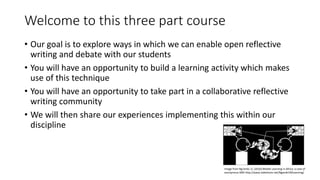
Image from Ng'ambi, D. (2010) Mobile Learning in Africa: a case of
anonymous SMS http://www.slideshare.net/Ngambi1MLearning/
What has prompted this
series?
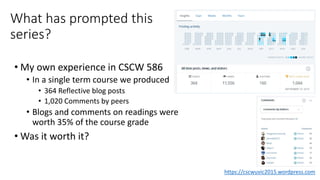
• My own experience in CSCW 586
• In a single term course we produced
• 364 Reflective blog posts
• 1,020 Comments by peers
• Blogs and comments on readings were
worth 35% of the course grade
• Was it worth it?
https://cscwuvic2015.wordpress.com
The Disposable Assignment
• These are assignments that students complain about doing and faculty
complain about grading. They’re assignments that add no value to the
world – after a student spends three hours creating it, a teacher spends 30
minutes grading it, and then the student throws it away.
• What if we changed these “disposable assignments” into activities which
actually added value to the world? Then students and faculty might feel
different about the time and effort they invested in them. I have seen time
and again that they do feel different about the efforts they make under
these circumstances.
(Wiley, 2013)
Wiley, D. (2013). What is Open Pedagogy? Iterating Toward Openness Blog, October 21, 2013.
http://opencontent.org/blog/archives/2975
Also see:
Hendricks, C. (2015). Non-Disposable Assignments in Intro To Philosophy. You're The Teacher:
Teaching & Learning, and SoTL, in Philosophy, August 18, 2015.
http://blogs.ubc.ca/chendricks/2015/08/18/non-disposable-assignments-intro-philosophy/
Questions to consider
• How do we currently access student writing?
• How do we currently facilitate student discussions?
Specifically for experiential learning
• How do students demonstrate their learning during their
placement?
• How can open reflection be used to demonstrate their
learning?
Some examples
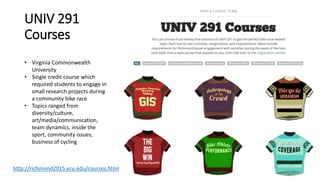
UNIV 291
Courses
• Virginia Commonwealth
University
• Single credit course which
required students to engage in
small research projects during
a community bike race
• Topics ranged from
diversity/culture,
art/media/communication,
team dynamics, inside the
sport, community issues,
business of cycling
http://richmond2015.vcu.edu/courses.html
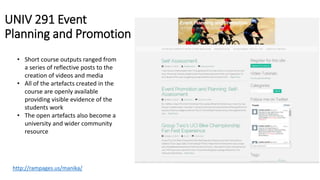
UNIV 291 Event
Planning and Promotion
• Short course outputs ranged from
a series of reflective posts to the
creation of videos and media
• All of the artefacts created in the
course are openly available
providing visible evidence of the
students work
• The open artefacts also become a
university and wider community
resource
http://rampages.us/manika/
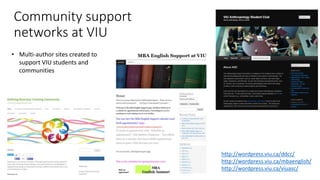
Community support
networks at VIU
http://wordpress.viu.ca/ddcc/
http://wordpress.viu.ca/mbaenglish/
http://wordpress.viu.ca/viuasc/
• Multi-author sites created to
support VIU students and
communities
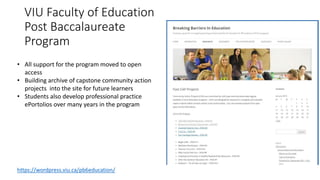
VIU Faculty of Education
Post Baccalaureate
Program
• All support for the program moved to open
access
• Building archive of capstone community action
projects into the site for future learners
• Students also develop professional practice
ePortolios over many years in the program
https://wordpress.viu.ca/pb6education/
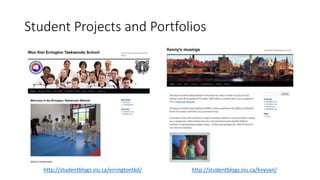
Student Projects and Portfolios
http://studentblogs.viu.ca/erringtontkd/ http://studentblogs.viu.ca/knyvan/
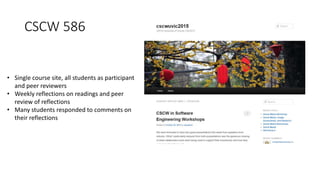
CSCW 586
• Single course site, all students as participant
and peer reviewers
• Weekly reflections on readings and peer
review of reflections
• Many students responded to comments on
their reflections
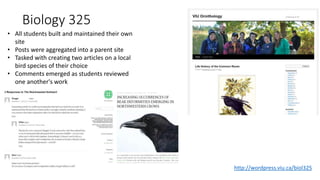
Biology 325
• All students built and maintained their own
site
• Posts were aggregated into a parent site
• Tasked with creating two articles on a local
bird species of their choice
• Comments emerged as students reviewed
one another's work
http://wordpress.viu.ca/biol325
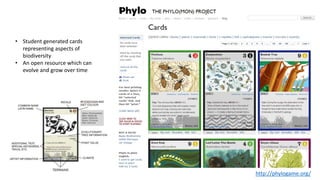
http://phylogame.org/
• Student generated cards
representing aspects of
biodiversity
• An open resource which can
evolve and grow over time
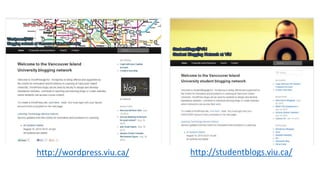
http://studentblogs.viu.ca/http://wordpress.viu.ca/
Get social
• Any direct link to a post, page or media object on a site can be
shared via social networks
• There are ways to track these interactions to see how our work is
being used
Growing Social Media | Flickr - By mkhmarketing Licensed with
Creative Commons Attribution 2.0 Generic / CC BY 2.0
Opportunities for discussion, peer review, and
feedback
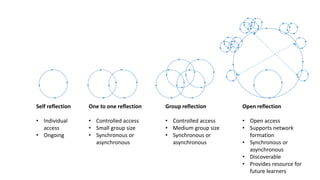
Self reflection
• Individual
access
• Ongoing
One to one reflection
• Controlled access
• Small group size
• Synchronous or
asynchronous
Group reflection
• Controlled access
• Medium group size
• Synchronous or
asynchronous
Open reflection
• Open access
• Supports network
formation
• Synchronous or
asynchronous
• Discoverable
• Provides resource for
future learners
Privacy controls
• Allow search engines to index this site – open to the world
• Visible only to registered users of this network –available only to the
VIU community
• Visible only to registered users of this site – available only to people I
add to the site
• Visible only to administrators of this site – available only to people I
add to the site as administrators
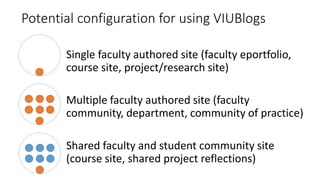
Potential configuration for using VIUBlogs
Single faculty authored site (faculty eportfolio,
course site, project/research site)
Multiple faculty authored site (faculty
community, department, community of practice)
Shared faculty and student community site
(course site, shared project reflections)
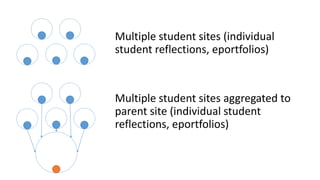
Multiple student sites (individual
student reflections, eportfolios)
Multiple student sites aggregated to
parent site (individual student
reflections, eportfolios)
Potential benefits
• Showcase VIU students in community
• Provides resources for future students
• Gives students choice in terms of how they present their work
• Provides opportunities to showcase multimedia demonstrating work
done and experiences had
• Opportunity to develop literacies around publishing on the open web
including best practices, basic copyright, and the organization of
content
• Students can take their work with them when as they advance
Next steps
• What sort of projects might we pilot together?
• What configuration for using VIUBlogs might
work best for you?
• How can open student reelections be
incorporated into your current learning
designs?
• Can we start drafting the components of a
reflective entry compilation of entries (for
experiential learning) or a significant online
discussion (for MBA)
http://wordpress.viu.ca/conversationsinthecloud/
This work is licensed under the Creative Commons Attribution 4.0
International License. To view a copy of this license, visit
http://creativecommons.org/licenses/by/4.0
Prepared by: Michael Paskevicius
Learning Technologies Application Developer
Centre for Innovation and Excellence in Learning
michael.paskevicus@viu.ca
Follow me: http://twitter.com/mpaskevi
Blog: http://wordpress.viu.ca/ciel
Presentations: http://www.slideshare.net/mpaskevi

Conversations in the Cloud: Strategies for Implementing Open Reflective Writing Experiences

  • 1.
    Conversations in theCloud Strategies for Implementing Open Reflective Writing Experiences
  • 2.
    Welcome to thisthree part course • Our goal is to explore ways in which we can enable open reflective writing and debate with our students • You will have an opportunity to build a learning activity which makes use of this technique • You will have an opportunity to take part in a collaborative reflective writing community • We will then share our experiences implementing this within our discipline Image from Ng'ambi, D. (2010) Mobile Learning in Africa: a case of anonymous SMS http://www.slideshare.net/Ngambi1MLearning/
  • 3.
    What has promptedthis series? • My own experience in CSCW 586 • In a single term course we produced • 364 Reflective blog posts • 1,020 Comments by peers • Blogs and comments on readings were worth 35% of the course grade • Was it worth it? https://cscwuvic2015.wordpress.com
  • 4.
    The Disposable Assignment •These are assignments that students complain about doing and faculty complain about grading. They’re assignments that add no value to the world – after a student spends three hours creating it, a teacher spends 30 minutes grading it, and then the student throws it away. • What if we changed these “disposable assignments” into activities which actually added value to the world? Then students and faculty might feel different about the time and effort they invested in them. I have seen time and again that they do feel different about the efforts they make under these circumstances. (Wiley, 2013) Wiley, D. (2013). What is Open Pedagogy? Iterating Toward Openness Blog, October 21, 2013. http://opencontent.org/blog/archives/2975 Also see: Hendricks, C. (2015). Non-Disposable Assignments in Intro To Philosophy. You're The Teacher: Teaching & Learning, and SoTL, in Philosophy, August 18, 2015. http://blogs.ubc.ca/chendricks/2015/08/18/non-disposable-assignments-intro-philosophy/
  • 5.
    Questions to consider •How do we currently access student writing? • How do we currently facilitate student discussions? Specifically for experiential learning • How do students demonstrate their learning during their placement? • How can open reflection be used to demonstrate their learning?
  • 6.
  • 7.
    UNIV 291 Courses • VirginiaCommonwealth University • Single credit course which required students to engage in small research projects during a community bike race • Topics ranged from diversity/culture, art/media/communication, team dynamics, inside the sport, community issues, business of cycling http://richmond2015.vcu.edu/courses.html
  • 8.
    UNIV 291 Event Planningand Promotion • Short course outputs ranged from a series of reflective posts to the creation of videos and media • All of the artefacts created in the course are openly available providing visible evidence of the students work • The open artefacts also become a university and wider community resource http://rampages.us/manika/
  • 9.
    Community support networks atVIU http://wordpress.viu.ca/ddcc/ http://wordpress.viu.ca/mbaenglish/ http://wordpress.viu.ca/viuasc/ • Multi-author sites created to support VIU students and communities
  • 10.
    VIU Faculty ofEducation Post Baccalaureate Program • All support for the program moved to open access • Building archive of capstone community action projects into the site for future learners • Students also develop professional practice ePortolios over many years in the program https://wordpress.viu.ca/pb6education/
  • 11.
    Student Projects andPortfolios http://studentblogs.viu.ca/erringtontkd/ http://studentblogs.viu.ca/knyvan/
  • 12.
    CSCW 586 • Singlecourse site, all students as participant and peer reviewers • Weekly reflections on readings and peer review of reflections • Many students responded to comments on their reflections
  • 13.
    Biology 325 • Allstudents built and maintained their own site • Posts were aggregated into a parent site • Tasked with creating two articles on a local bird species of their choice • Comments emerged as students reviewed one another's work http://wordpress.viu.ca/biol325
  • 14.
    http://phylogame.org/ • Student generatedcards representing aspects of biodiversity • An open resource which can evolve and grow over time
  • 15.
  • 16.
    Get social • Anydirect link to a post, page or media object on a site can be shared via social networks • There are ways to track these interactions to see how our work is being used Growing Social Media | Flickr - By mkhmarketing Licensed with Creative Commons Attribution 2.0 Generic / CC BY 2.0
  • 17.
    Opportunities for discussion,peer review, and feedback
  • 18.
    Self reflection • Individual access •Ongoing One to one reflection • Controlled access • Small group size • Synchronous or asynchronous Group reflection • Controlled access • Medium group size • Synchronous or asynchronous Open reflection • Open access • Supports network formation • Synchronous or asynchronous • Discoverable • Provides resource for future learners
  • 19.
    Privacy controls • Allowsearch engines to index this site – open to the world • Visible only to registered users of this network –available only to the VIU community • Visible only to registered users of this site – available only to people I add to the site • Visible only to administrators of this site – available only to people I add to the site as administrators
  • 20.
    Potential configuration forusing VIUBlogs Single faculty authored site (faculty eportfolio, course site, project/research site) Multiple faculty authored site (faculty community, department, community of practice) Shared faculty and student community site (course site, shared project reflections)
  • 21.
    Multiple student sites(individual student reflections, eportfolios) Multiple student sites aggregated to parent site (individual student reflections, eportfolios)
  • 22.
    Potential benefits • ShowcaseVIU students in community • Provides resources for future students • Gives students choice in terms of how they present their work • Provides opportunities to showcase multimedia demonstrating work done and experiences had • Opportunity to develop literacies around publishing on the open web including best practices, basic copyright, and the organization of content • Students can take their work with them when as they advance
  • 23.
    Next steps • Whatsort of projects might we pilot together? • What configuration for using VIUBlogs might work best for you? • How can open student reelections be incorporated into your current learning designs? • Can we start drafting the components of a reflective entry compilation of entries (for experiential learning) or a significant online discussion (for MBA) http://wordpress.viu.ca/conversationsinthecloud/
  • 24.
    This work islicensed under the Creative Commons Attribution 4.0 International License. To view a copy of this license, visit http://creativecommons.org/licenses/by/4.0 Prepared by: Michael Paskevicius Learning Technologies Application Developer Centre for Innovation and Excellence in Learning michael.paskevicus@viu.ca Follow me: http://twitter.com/mpaskevi Blog: http://wordpress.viu.ca/ciel Presentations: http://www.slideshare.net/mpaskevi

Editor's Notes

  • #3 Our goal is to explore ways in which we can enable open reflective writing and debate with our students I am really interested in focusing on supporting communication and student led representations of their work There are tools within VIULearn which also support discussion, but this session is really about students taking ownership of their work and representing it as they see fit Relations to experiential education - how can students in the field represent their work and practice in a digital journal, opening up spaces for commentary, formative evaluation, and further reflection We will plan a learning activity which makes use of this technique We will also take part in a collaborative reflective writing community We will then share our experiences implementing this within our discipline   Discussion: Where we come from and what our goals are?
  • #4 First I just want to share what has prompted these sessions September 2015 I took a course at UVic which took advantage of open communication platforms We were tasked with blogging on a weekly basis a reflection and synthesis of our readings In turn we then had to comment on 5 reflections made by our peers In the end we produced 364 reflective blogs posts and 1020 comments We essentially had a conversation outside of the class Personally I had the opportunity to converse with people who I never had a chance to speak with in class   The activity was motivated by a 35% grade associated with the weekly reflections While the instructor did have to review all of this weekly activity, much of the grading could be done on a pass/fail criteria - either they did it or they didn’t. There are rubrics available for marking blogs included later in this presentation   As a side note, we also used a private instant messaging system in this course so that we could have conversations via text during lectures, seminars and presentations as well as for coordinating group projects. 16000+ messages were created using he instant messaging system.
  • #5 The Disposable Assignment Assignments that students complain about doing and faculty complain about grading. They’re assignments that add no value to the world – after a student spends three hours creating it, a teacher spends 30 minutes grading it, and then the student throws it away.   What if we changed these “disposable assignments” into activities which actually added value to the world? Then students and faculty might feel different about the time and effort they invested in them. I have seen time and again that they do feel different about the efforts they make under these circumstances.   In the case of the CSCW course I shared earlier, I have made reference to and use of the work I did on the shared blog.
  • #6 Questions to consider? • How do we currently access student writing? • How do we currently facilitate student discussions? ○ Avoiding the disposable assignment - http://opencontent.org/blog/archives/2975 Specifically for experiential learning • How do students demonstrate their learning during their placement? • How can open reflection be used to demonstrate their learning? --> AM I right to assume that we can't be out visiting students in the field - need to do this digitally to support students
  • #19 I believe there is value in openly shared reflection.   While self reflection is a constant ongoing process it is internalized and thus not available for discussion or feedback.  One to one reflection provides and opportunity to share and gather feedback in a controlled one to one interaction.  This may be done synchronously through discussion or asynchronous through text.   Group reflections provide controlled access to a larger group and can again be synchronous or asynchronous.   Open reflection involves making your refection available on the open web.  In doing so you provide a searchable resources for other learners to discover.  You may even form a network by receiving a comment or discussion going around your reflection.  Your reflection may also become a valuable resource for a learner going through a similar process. Or for students looking for ideas and projects to build upon.
  • #20 Open to the world – can adjust search indexing of site Also available are post and page level privacy, via the drafts feature and password protected pages
  • #24 What sort of projects might we pilot together? I am committed to working with you to deploy this in your context throughout the next three sessions Feb 17 + Feb 24   What configuration for using VIUBlogs might work best for you? How can open student reelections be incorporated into your current learning designs? Can we start drafting the components of a reflective entry compilation of entries (for experiential learning) or a significant online discussion (for MBA) Can we move Feb 17 + Feb 24 to 2:30pm as well?
  • #25 Thank you!