Challenge the future 1 
Online Learning 
Nelson Jorge 
November 5, 2014
Challenge the future 2 
Agenda 
1. Online learning 
2. The pedagogy of the MOOC 
3. How to plan a MOOC 
4. Leveraging your MOOC 
5. Introduction to the edX platform
Challenge the future 3 
1. Online Learning 
Instead of planning how to teach for a number of class 
hours, we plan how students will learn by designing 
online learning activities for a specific period of time 
(in weeks).
Challenge the future 4 
1. Online Learning 
"Online classes can be really lonely places for students if 
they don't feel like there's a community." 
Maria Andersen, director of learning and research at Instructure (2013)
Challenge the future 5 
1. Online Learning 
Access & 
Motivation 
Online 
socialization 
Information 
exchange, 
cooperation 
Group 
discussions, 
collaboration 
Development 
Based on 5 Stage Model, Gilly Salmon
Challenge the future 6 
2. The pedagogy of the MOOC 
xMOOC 
Institutionally-focused, characterised by a pedagogy short 
on social contact and based on video-lecture content with 
automated assessment. 
cMOOC 
Driven by principles of pedagogic innovation within a 
network, disaggregated mode of social learning.
Challenge the future 7 
3. How to plan a MOOC 
Course Design process: 
1. Divide your course into Learning Units 
2. Define the specific learning objectives for each unit 
3. Design the learning activities (try to promote active learning) 
4. Specify what resources will be needed (existing or to create) 
5. Define the assessment methods
Challenge the future 8 
3. How to plan a MOOC 
Learning Objectives 
Teaching & 
Learning 
activities 
Feedback & 
Assessment 
Methods
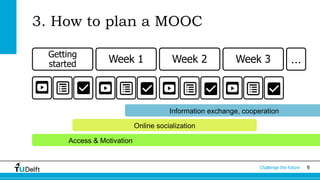
Information exchange, cooperation 
Challenge the future 9 
3. How to plan a MOOC 
Getting 
started Week 1 Week 2 Week 3 … 
Access & Motivation 
Online socialization
Challenge the future 10 
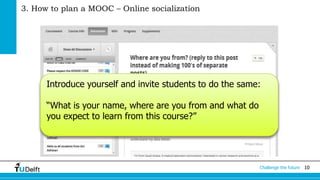
3. How to plan a MOOC – Online socialization 
Introduce yourself and invite students to do the same: 
“What is your name, where are you from and what do 
you expect to learn from this course?”
Challenge the future 11 
3. How to plan a MOOC – Student cooperation 
Plan interaction using the Discussion Forum: 
“Share your thoughts and give feedback on…” 
“Help your colleagues by replying to their questions…”
Challenge the future 12 
3. How to plan a MOOC 
Group discussions, collaboration 
Information exchange, cooperation 
Online socialization 
Access & Motivation 
Development
Challenge the future 13 
3. How to plan a MOOC 
Content development: 
1. Search for available content that can be (re)used 
2. Think of fundamental content that needs to be produced 
3. Plan content production 
4. Create content
Challenge the future 14 
3. How to plan a MOOC 
Course implementation on edX: 
1. Structure the course 
2. Upload content 
3. Add assignments 
4. Test the course
Challenge the future 15 
4. Leveraging your MOOC 
“While the [video lecture and automated quiz] model is basic and 
may not be suitable for all courses or represent leading pedagogical 
practice, it is accessible, flexible and scalable to large volumes of 
diverse students.” (p.15) 
Higher Education’s Digital Moment, UUK report (2013)
Challenge the future 16 
4. Leveraging your MOOC 
Getting 
started Week 1 Week 2 Week 3 … 
Challenges 
Sofa session, 
paperclip, 
feedback 
video 
Students share 
videos, pictures, 
schemes 
Interactions, 
discussions 
Real world 
problems, 
practical 
activities 
Welcoming 
messages 
Weekly updates
5. Introduction to the edX platform 
Challenge the future 17 
Studio edge edX
Challenge the future 18 
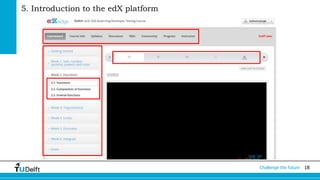
5. Introduction to the edX platform
5. Introduction to the edX platform 
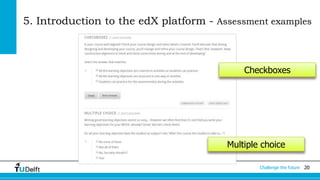
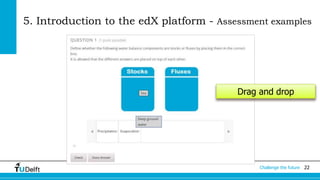
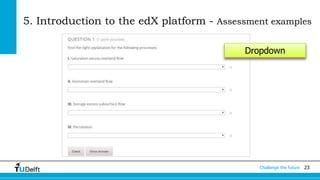
Closed response assessment: 
• Checkbox, Dropdown, Multiple choice, Drag and drop 
• Inputs: Text/Numerical, Math expression, Image mapped 
• Chemical equation, Circuit Schematic Builder 
Challenge the future 19 
Open response assessment: 
• Peer-assessment & self-assessment
5. Introduction to the edX platform - Assessment examples 
Checkboxes 
Multiple choice 
Challenge the future 20
5. Introduction to the edX platform - Assessment examples 
Numerical input 
Challenge the future 21
5. Introduction to the edX platform - Assessment examples 
Drag and drop 
Challenge the future 22
5. Introduction to the edX platform - Assessment examples 
Dropdown 
Challenge the future 23
Challenge the future 24 
Thank you 
Nelson Jorge 
e-mail: n.r.jorge@tudelft.nl 
office: IO building D-0-210 
Mon – Fri, 09:00-17:00 
Unless otherwise indicated, this presentation is licensed 
CC-BY 4.0. Please attribute TU Delft / Nelson Jorge

Online learning for MOOC team developers

  • 1.
    Challenge the future1 Online Learning Nelson Jorge November 5, 2014
  • 2.
    Challenge the future2 Agenda 1. Online learning 2. The pedagogy of the MOOC 3. How to plan a MOOC 4. Leveraging your MOOC 5. Introduction to the edX platform
  • 3.
    Challenge the future3 1. Online Learning Instead of planning how to teach for a number of class hours, we plan how students will learn by designing online learning activities for a specific period of time (in weeks).
  • 4.
    Challenge the future4 1. Online Learning "Online classes can be really lonely places for students if they don't feel like there's a community." Maria Andersen, director of learning and research at Instructure (2013)
  • 5.
    Challenge the future5 1. Online Learning Access & Motivation Online socialization Information exchange, cooperation Group discussions, collaboration Development Based on 5 Stage Model, Gilly Salmon
  • 6.
    Challenge the future6 2. The pedagogy of the MOOC xMOOC Institutionally-focused, characterised by a pedagogy short on social contact and based on video-lecture content with automated assessment. cMOOC Driven by principles of pedagogic innovation within a network, disaggregated mode of social learning.
  • 7.
    Challenge the future7 3. How to plan a MOOC Course Design process: 1. Divide your course into Learning Units 2. Define the specific learning objectives for each unit 3. Design the learning activities (try to promote active learning) 4. Specify what resources will be needed (existing or to create) 5. Define the assessment methods
  • 8.
    Challenge the future8 3. How to plan a MOOC Learning Objectives Teaching & Learning activities Feedback & Assessment Methods
  • 9.
    Information exchange, cooperation Challenge the future 9 3. How to plan a MOOC Getting started Week 1 Week 2 Week 3 … Access & Motivation Online socialization
  • 10.
    Challenge the future10 3. How to plan a MOOC – Online socialization Introduce yourself and invite students to do the same: “What is your name, where are you from and what do you expect to learn from this course?”
  • 11.
    Challenge the future11 3. How to plan a MOOC – Student cooperation Plan interaction using the Discussion Forum: “Share your thoughts and give feedback on…” “Help your colleagues by replying to their questions…”
  • 12.
    Challenge the future12 3. How to plan a MOOC Group discussions, collaboration Information exchange, cooperation Online socialization Access & Motivation Development
  • 13.
    Challenge the future13 3. How to plan a MOOC Content development: 1. Search for available content that can be (re)used 2. Think of fundamental content that needs to be produced 3. Plan content production 4. Create content
  • 14.
    Challenge the future14 3. How to plan a MOOC Course implementation on edX: 1. Structure the course 2. Upload content 3. Add assignments 4. Test the course
  • 15.
    Challenge the future15 4. Leveraging your MOOC “While the [video lecture and automated quiz] model is basic and may not be suitable for all courses or represent leading pedagogical practice, it is accessible, flexible and scalable to large volumes of diverse students.” (p.15) Higher Education’s Digital Moment, UUK report (2013)
  • 16.
    Challenge the future16 4. Leveraging your MOOC Getting started Week 1 Week 2 Week 3 … Challenges Sofa session, paperclip, feedback video Students share videos, pictures, schemes Interactions, discussions Real world problems, practical activities Welcoming messages Weekly updates
  • 17.
    5. Introduction tothe edX platform Challenge the future 17 Studio edge edX
  • 18.
    Challenge the future18 5. Introduction to the edX platform
  • 19.
    5. Introduction tothe edX platform Closed response assessment: • Checkbox, Dropdown, Multiple choice, Drag and drop • Inputs: Text/Numerical, Math expression, Image mapped • Chemical equation, Circuit Schematic Builder Challenge the future 19 Open response assessment: • Peer-assessment & self-assessment
  • 20.
    5. Introduction tothe edX platform - Assessment examples Checkboxes Multiple choice Challenge the future 20
  • 21.
    5. Introduction tothe edX platform - Assessment examples Numerical input Challenge the future 21
  • 22.
    5. Introduction tothe edX platform - Assessment examples Drag and drop Challenge the future 22
  • 23.
    5. Introduction tothe edX platform - Assessment examples Dropdown Challenge the future 23
  • 24.
    Challenge the future24 Thank you Nelson Jorge e-mail: n.r.jorge@tudelft.nl office: IO building D-0-210 Mon – Fri, 09:00-17:00 Unless otherwise indicated, this presentation is licensed CC-BY 4.0. Please attribute TU Delft / Nelson Jorge

Editor's Notes

  • #5 community is the vehicle through which online courses are most effective Huge numbers of students can mean more interaction among them, partly compensating for the limited one-on-one attention students receive from the instructor in a MOOC environment. But more students can also mean more isolation within the crowd. Ironically, the biggest obstacle preventing MOOC students from forming relationships is the feature most relied on to encourage them. Discussion forums are the number one complaint by readers and contributors of MOOC News & Reviews
  • #7 X focus on scalability, C focus on community and connections
  • #8 Course Design – detailed planning
  • #9 What should your students be able to do after your course? Specific with respect to CONTENT Phrased in terms of BEHAVIOUR Use action verbs “Students are able to apply theory x to problem y” “Students are able to describe the key features of ..”
  • #10 Course Design – detailed planning
  • #11 Think beyond the basic video broadcast model
  • #12 Think beyond the basic video broadcast model
  • #13 Think beyond the basic video broadcast model
  • #14 Think beyond the basic video broadcast model
  • #15 Think beyond the basic video broadcast model
  • #16 Think beyond the basic video broadcast model
  • #17 MOOC boosters that will engage students
  • #18 Think beyond the basic video broadcast model
  • #19 Think beyond the basic video broadcast model
  • #20 Think beyond the basic video broadcast model
  • #21 Think beyond the basic video broadcast model
  • #22 Think beyond the basic video broadcast model
  • #23 Think beyond the basic video broadcast model
  • #24 Think beyond the basic video broadcast model