1
Chapter 13 Carbohydrates
13.1
Carbohydrates
2
Carbohydrates
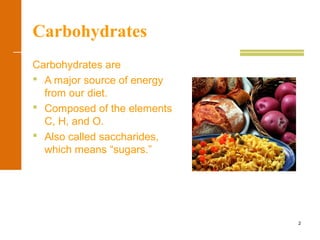
Carbohydrates are
 A major source of energy
from our diet.
 Composed of the elements
C, H, and O.
 Also called saccharides,
which means “sugars.”
3
Carbohydrates
Carbohydrates
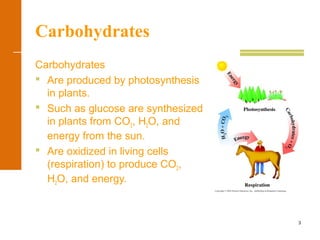
 Are produced by photosynthesis
in plants.
 Such as glucose are synthesized
in plants from CO2, H2O, and
energy from the sun.
 Are oxidized in living cells
(respiration) to produce CO2,
H2O, and energy.
4
Types of Carbohydrates
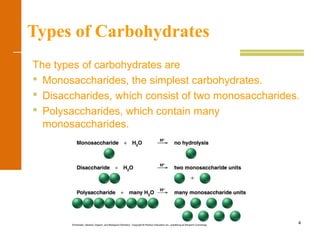
The types of carbohydrates are
 Monosaccharides, the simplest carbohydrates.
 Disaccharides, which consist of two monosaccharides.
 Polysaccharides, which contain many
monosaccharides.
5
Monosaccharides
Monosaccharides consist of
 3 to 6 carbon atoms, typically.
 A carbonyl group (aldehyde or
ketone).
 Several hydroxyl groups.
6
Aldoses
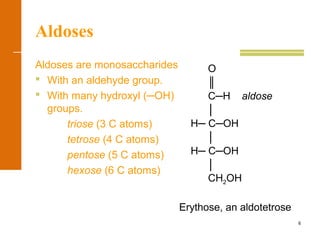
Aldoses are monosaccharides
 With an aldehyde group.
 With many hydroxyl (─OH)
groups.
triose (3 C atoms)
tetrose (4 C atoms)
pentose (5 C atoms)
hexose (6 C atoms)
O
║
C─H aldose
│
H─ C─OH
│
H─ C─OH
│
CH2OH
Erythose, an aldotetrose
7
Ketoses
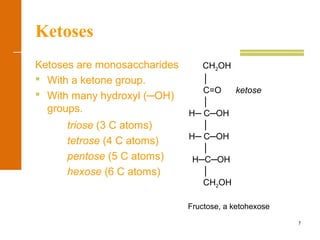
Ketoses are monosaccharides
 With a ketone group.
 With many hydroxyl (─OH)
groups.
triose (3 C atoms)
tetrose (4 C atoms)
pentose (5 C atoms)
hexose (6 C atoms)
CH2OH
│
C=O ketose
│
H─ C─OH
│
H─ C─OH
│
H─C─OH
│
CH2OH
Fructose, a ketohexose
8
Learning Check
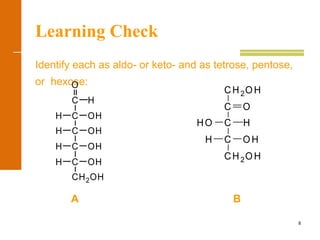
Identify each as aldo- or keto- and as tetrose, pentose,
or hexose:
A B
H
CH2OH
OHC
H
H
H
OH
OH
OH
C
C
C
HC
O
CH2OH
HHO
CH2OH
O
H OHC
C
C
9
Solution
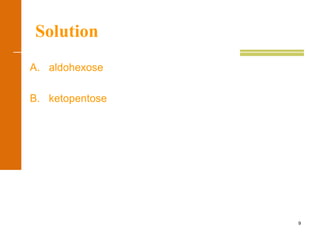
A. aldohexose
B. ketopentose
10
13.2
Structures of Monosaccharides
11
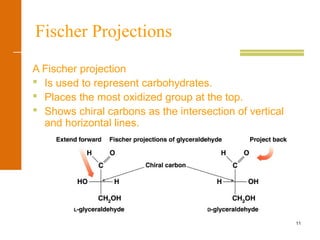
Fischer Projections
A Fischer projection
 Is used to represent carbohydrates.
 Places the most oxidized group at the top.
 Shows chiral carbons as the intersection of vertical
and horizontal lines.
12
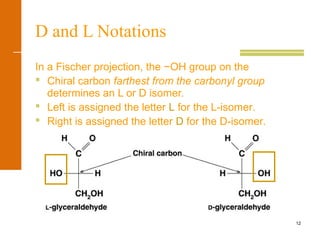
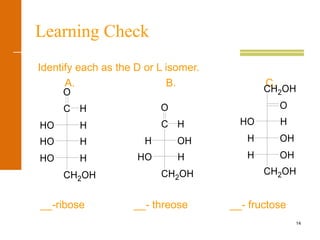
D and L Notations
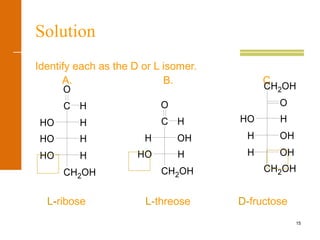
In a Fischer projection, the −OH group on the
 Chiral carbon farthest from the carbonyl group
determines an L or D isomer.
 Left is assigned the letter L for the L-isomer.
 Right is assigned the letter D for the D-isomer.
13
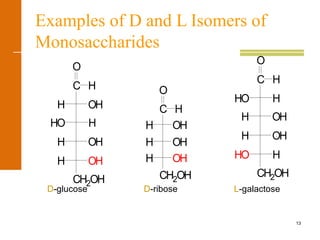
Examples of D and L Isomers of
Monosaccharides
O
CH2OH
H OH
H OH
HO H
OHH
C H
CH2OH
H OH
H OH
OHH
HC
O
H
O
CH2OH
HO H
H OH
H OH
HHO
C
D-glucose D-ribose L-galactose
14
Learning Check
Identify each as the D or L isomer.
A. B. C.
__-ribose __- threose __- fructose
CH2OH
HO H
HO H
HHO
O
C H
CH2OH
HO H
OHH
O
C H
CH2OH
H OH
H OH
HO H
O
CH2OH
15
Solution
Identify each as the D or L isomer.
A. B. C.
L-ribose L-threose D-fructose
CH2OH
HO H
HO H
HHO
O
C H
CH2OH
HO H
OHH
O
C H
CH2OH
H OH
H OH
HO H
O
CH2OH
16
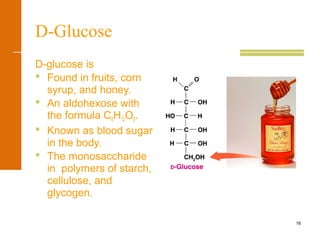
D-Glucose
D-glucose is
 Found in fruits, corn
syrup, and honey.
 An aldohexose with
the formula C6H12O6.
 Known as blood sugar
in the body.
 The monosaccharide
in polymers of starch,
cellulose, and
glycogen.
17
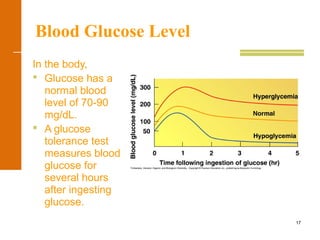
Blood Glucose Level
In the body,
 Glucose has a
normal blood
level of 70-90
mg/dL.
 A glucose
tolerance test
measures blood
glucose for
several hours
after ingesting
glucose.
18
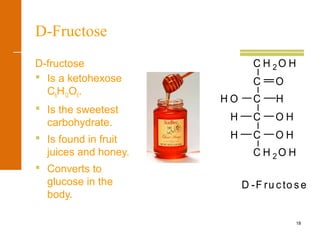
D-Fructose
D-fructose
 Is a ketohexose
C6H12O6.
 Is the sweetest
carbohydrate.
 Is found in fruit
juices and honey.
 Converts to
glucose in the
body.
H O H
C H 2 O H
C
H O
H O H
H
C
O
C
C
C H 2 O H
D -F ru cto s e
19
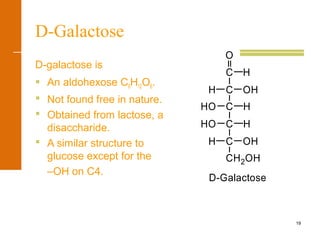
D-Galactose
D-galactose is
 An aldohexose C6H12O6.
 Not found free in nature.
 Obtained from lactose, a
disaccharide.
 A similar structure to
glucose except for the
–OH on C4.
H
H
H OH
CH2OH
C
HO
HO HC
OH
C
C
O
C H
D-Galactose
20
Learning Check
Draw the structure and Fischer projection of D-fructose.
21
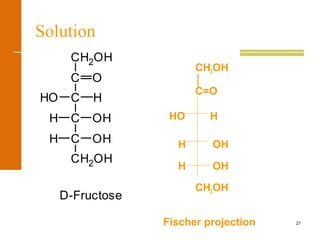
Solution
CH2OH
│
C=O
HO H
H OH
H OH
CH2OH
Fischer projection
H OH
CH2OH
C
HO
H OH
H
C
O
C
C
CH2OH
D-Fructose
22
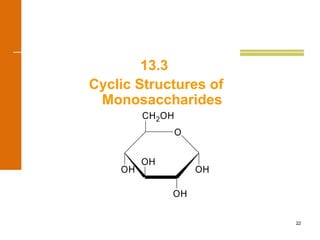
13.3
Cyclic Structures of
Monosaccharides
OH
OH
OH
OH
CH2OH
O
23
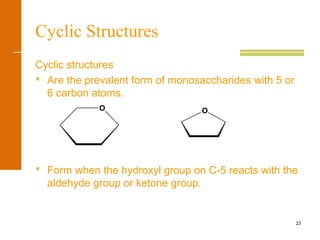
Cyclic Structures
Cyclic structures
 Are the prevalent form of monosaccharides with 5 or
6 carbon atoms.
 Form when the hydroxyl group on C-5 reacts with the
aldehyde group or ketone group.
O O
24
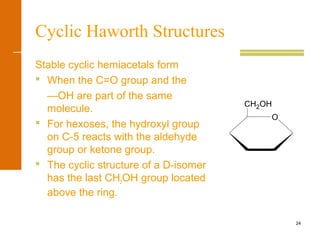
Cyclic Haworth Structures
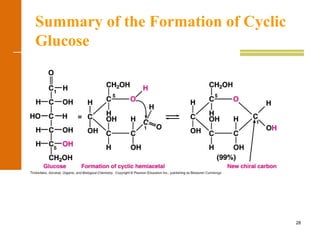
Stable cyclic hemiacetals form
 When the C=O group and the
—OH are part of the same
molecule.
 For hexoses, the hydroxyl group
on C-5 reacts with the aldehyde
group or ketone group.
 The cyclic structure of a D-isomer
has the last CH2OH group located
above the ring.
CH2OH
O
25
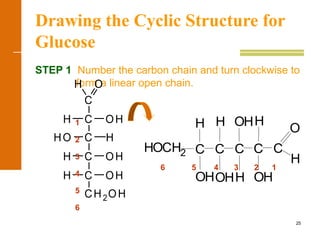
Drawing the Cyclic Structure for
Glucose
STEP 1 Number the carbon chain and turn clockwise to
form a linear open chain.
HHO
H
CH2OH
OHC
H
H
OH
OH
C
C
C
OH
C
1
2
3
4
5
6
6 5 4 3 2 1
H
OHH
OH
C
H H
OH OH
C C C
H
O
CHOCH2
26
Cyclic Structure for Glucose
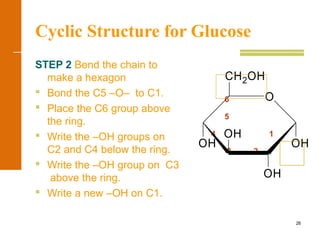
STEP 2 Bend the chain to
make a hexagon
 Bond the C5 –O– to C1.
 Place the C6 group above
the ring.
 Write the –OH groups on
C2 and C4 below the ring.
 Write the –OH group on C3
above the ring.
 Write a new –OH on C1.
6
5
4 1
3 2
OH
OH
OH
OH
CH2OH
O
27
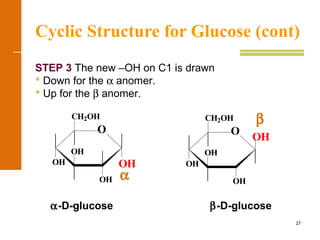
Cyclic Structure for Glucose (cont)
α-D-glucose β-D-glucose
STEP 3 The new –OH on C1 is drawn
 Down for the α anomer.
 Up for the β anomer.
O
CH2OH
OH
OH
OH
OH
O
CH2OH
OH
OH
OH
OH
β
α
28
Summary of the Formation of Cyclic
Glucose
29
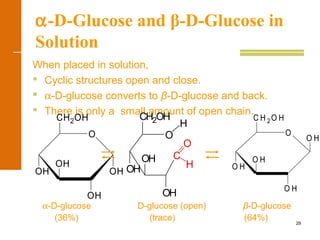
α-D-Glucose and β-D-Glucose in
Solution
When placed in solution,
 Cyclic structures open and close.
 α-D-glucose converts to β-D-glucose and back.
 There is only a small amount of open chain.
α-D-glucose D-glucose (open) β-D-glucose
(36%) (trace) (64%)
OH
OH
OH
OH
CH2OH
O O H
O H
O H
O H
C H 2O H
OO
H
CH2OH
OH
O
C
H
OH
OH
30
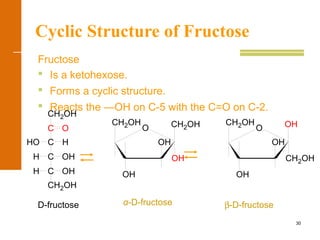
Cyclic Structure of Fructose
Fructose
 Is a ketohexose.
 Forms a cyclic structure.
 Reacts the —OH on C-5 with the C=O on C-2.
D-fructose β-D-fructoseα-D-fructose
O CH2OH
OH
OH
OH
CH2OH
O OH
CH2OH
OH
OH
CH2OH
H OH
H OH
HHO
O
CH2OH
C
C
C
C
CH2OH
31
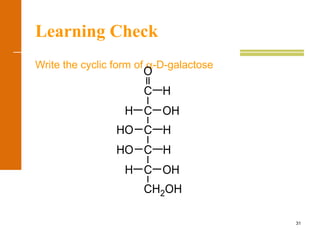
Learning Check
Write the cyclic form of α-D-galactose
H
H
H OH
CH2OH
C
HO
HO HC
OH
C
C
O
C H
32
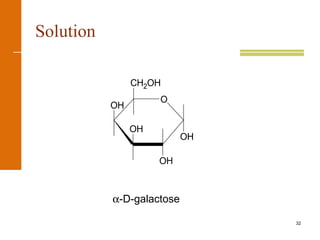
Solution
α-D-galactose
OH
OH
OH
OH
CH2OH
O
33
13.4
Chemical Properties of
Monosaccharides
34
Reducing Sugars
Reducing sugars
 Are monosaccharides with a carbonyl group that
oxidizes to give a carboxylic acid.
 Undergo reaction with Benedict’s reagent (Cu2+)
to
give the corresponding carboxylic acid.
 Include the monosaccharides glucose, galactose,
and fructose.
35
Oxidation of D-Glucose
+ Cu2O(s)
D-gluconic acidD-glucose
+ Cu2+
H OH
H OH
HHO
H OH
O
OH
CH2OH
C
C
C
C
C
H OH
H OH
HHO
H OH
O
H
CH2OH
C
C
C
C
C
[O]
Benedicts
reagent
Glucose is a reducing
sugar
Cu+
(reduced
form)
Glucose is oxidized
to a carboxylic acid
36
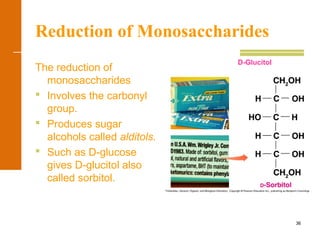
Reduction of Monosaccharides
The reduction of
monosaccharides
 Involves the carbonyl
group.
 Produces sugar
alcohols called alditols.
 Such as D-glucose
gives D-glucitol also
called sorbitol.
D-Glucitol
37
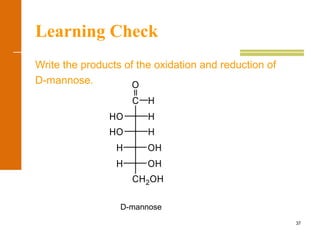
Learning Check
Write the products of the oxidation and reduction of
D-mannose.
H
O
CH2OH
H OH
H OH
HO H
HHO
C
D-mannose
38
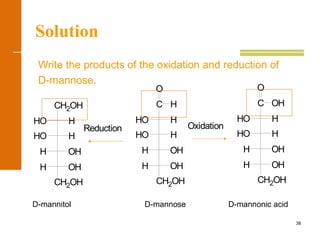
Solution
Write the products of the oxidation and reduction of
D-mannose.
H
O
CH2OH
H OH
H OH
HO H
HHO
C OH
O
CH2OH
H OH
H OH
HO H
HHO
C
CH2OH
H OH
H OH
HO H
HHO
CH2OH
Reduction Oxidation
D-mannitol D-mannose D-mannonic acid
39
13.5 Disaccharides
40
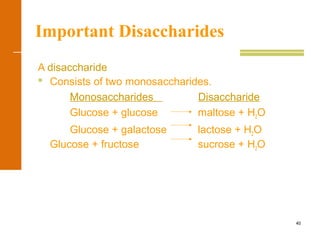
Important Disaccharides
A disaccharide
 Consists of two monosaccharides.
Monosaccharides Disaccharide
Glucose + glucose maltose + H2O
Glucose + galactose lactose + H2O
Glucose + fructose sucrose + H2O
41
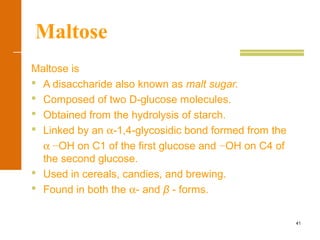
Maltose
Maltose is
 A disaccharide also known as malt sugar.
 Composed of two D-glucose molecules.
 Obtained from the hydrolysis of starch.
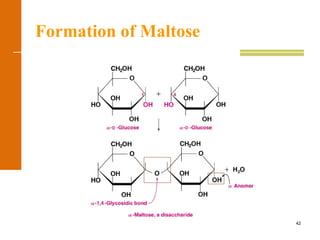
 Linked by an α-1,4-glycosidic bond formed from the
α −OH on C1 of the first glucose and −OH on C4 of
the second glucose.
 Used in cereals, candies, and brewing.
 Found in both the α- and β - forms.
42
Formation of Maltose
43
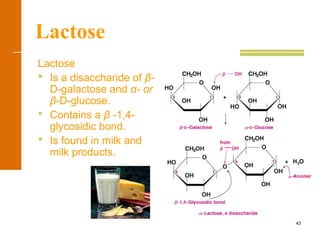
Lactose
Lactose
 Is a disaccharide of β-
D-galactose and α- or
β-D-glucose.
 Contains a β -1,4-
glycosidic bond.
 Is found in milk and
milk products.
α-form
44
Sucrose
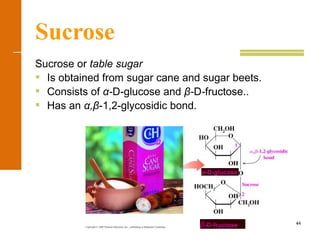
Sucrose or table sugar
 Is obtained from sugar cane and sugar beets.
 Consists of α-D-glucose and β-D-fructose..
 Has an α,β-1,2-glycosidic bond.
α-D-glucose
β-D-fructose
45
Learning Check
Write the structures and names of the two
monosaccharides that form when sucrose is
hydrolyzed.
46
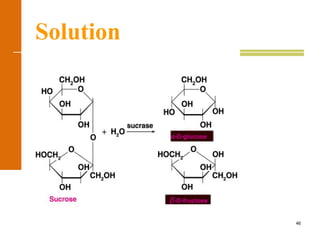
Solution
α-D-glucose
β-D-fructose
47
Sweeteners
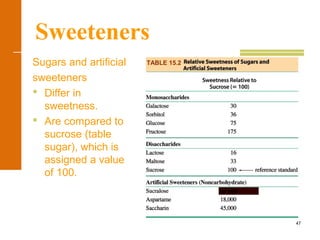
Sugars and artificial
sweeteners
 Differ in
sweetness.
 Are compared to
sucrose (table
sugar), which is
assigned a value
of 100.
TABLE 15.2
60 000
48
Learning Check
Identify the monosaccharides in each of the following:
A. lactose
(1) α-D-glucose (2) β-D-fructose (3) β-D-galactose
B. maltose
(1) α-D-glucose (2) β-D-fructose (3) β-D-galactose
C. sucrose
(1) α-D-glucose (2) β-D-fructose (3) β-D-galactose
49
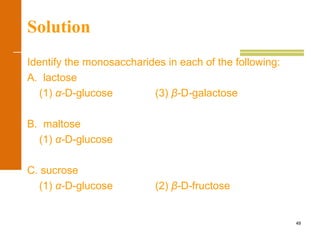
Solution
Identify the monosaccharides in each of the following:
A. lactose
(1) α-D-glucose (3) β-D-galactose
B. maltose
(1) α-D-glucose
C. sucrose
(1) α-D-glucose (2) β-D-fructose
50
13.6
Polysaccharides
51
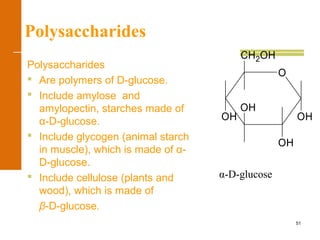
Polysaccharides
Polysaccharides
 Are polymers of D-glucose.
 Include amylose and
amylopectin, starches made of
α-D-glucose.
 Include glycogen (animal starch
in muscle), which is made of α-
D-glucose.
 Include cellulose (plants and
wood), which is made of
β-D-glucose.
α-D-glucose
O
CH2OH
OH
OH
OH
OH
52
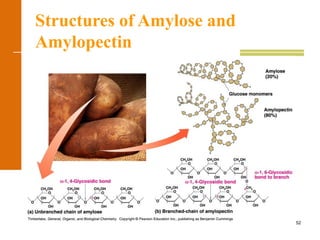
Structures of Amylose and
Amylopectin
53
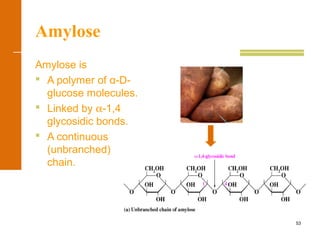
Amylose
Amylose is
 A polymer of α-D-
glucose molecules.
 Linked by α-1,4
glycosidic bonds.
 A continuous
(unbranched)
chain.
54
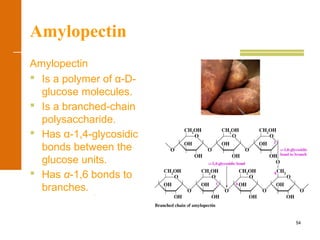
Amylopectin
Amylopectin
 Is a polymer of α-D-
glucose molecules.
 Is a branched-chain
polysaccharide.
 Has α-1,4-glycosidic
bonds between the
glucose units.
 Has α-1,6 bonds to
branches.

55
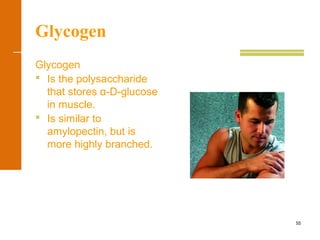
Glycogen
Glycogen
 Is the polysaccharide
that stores α-D-glucose
in muscle.
 Is similar to
amylopectin, but is
more highly branched.
56
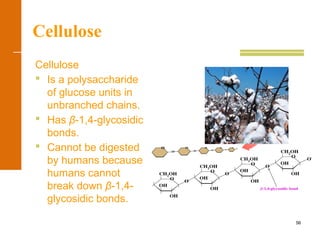
Cellulose
Cellulose
 Is a polysaccharide
of glucose units in
unbranched chains.
 Has β-1,4-glycosidic
bonds.
 Cannot be digested
by humans because
humans cannot
break down β-1,4-
glycosidic bonds.
57
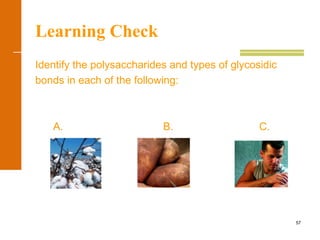
Learning Check
Identify the polysaccharides and types of glycosidic
bonds in each of the following:
A. B. C.
58
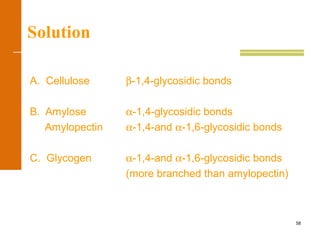
Solution
A. Cellulose β-1,4-glycosidic bonds
B. Amylose α-1,4-glycosidic bonds
Amylopectin α-1,4-and α-1,6-glycosidic bonds
C. Glycogen α-1,4-and α-1,6-glycosidic bonds
(more branched than amylopectin)

Chapter 13 carbohydrates

  • 1.
  • 2.
    2 Carbohydrates Carbohydrates are  Amajor source of energy from our diet.  Composed of the elements C, H, and O.  Also called saccharides, which means “sugars.”
  • 3.
    3 Carbohydrates Carbohydrates  Are producedby photosynthesis in plants.  Such as glucose are synthesized in plants from CO2, H2O, and energy from the sun.  Are oxidized in living cells (respiration) to produce CO2, H2O, and energy.
  • 4.
    4 Types of Carbohydrates Thetypes of carbohydrates are  Monosaccharides, the simplest carbohydrates.  Disaccharides, which consist of two monosaccharides.  Polysaccharides, which contain many monosaccharides.
  • 5.
    5 Monosaccharides Monosaccharides consist of 3 to 6 carbon atoms, typically.  A carbonyl group (aldehyde or ketone).  Several hydroxyl groups.
  • 6.
    6 Aldoses Aldoses are monosaccharides With an aldehyde group.  With many hydroxyl (─OH) groups. triose (3 C atoms) tetrose (4 C atoms) pentose (5 C atoms) hexose (6 C atoms) O ║ C─H aldose │ H─ C─OH │ H─ C─OH │ CH2OH Erythose, an aldotetrose
  • 7.
    7 Ketoses Ketoses are monosaccharides With a ketone group.  With many hydroxyl (─OH) groups. triose (3 C atoms) tetrose (4 C atoms) pentose (5 C atoms) hexose (6 C atoms) CH2OH │ C=O ketose │ H─ C─OH │ H─ C─OH │ H─C─OH │ CH2OH Fructose, a ketohexose
  • 8.
    8 Learning Check Identify eachas aldo- or keto- and as tetrose, pentose, or hexose: A B H CH2OH OHC H H H OH OH OH C C C HC O CH2OH HHO CH2OH O H OHC C C
  • 9.
  • 10.
  • 11.
    11 Fischer Projections A Fischerprojection  Is used to represent carbohydrates.  Places the most oxidized group at the top.  Shows chiral carbons as the intersection of vertical and horizontal lines.
  • 12.
    12 D and LNotations In a Fischer projection, the −OH group on the  Chiral carbon farthest from the carbonyl group determines an L or D isomer.  Left is assigned the letter L for the L-isomer.  Right is assigned the letter D for the D-isomer.
  • 13.
    13 Examples of Dand L Isomers of Monosaccharides O CH2OH H OH H OH HO H OHH C H CH2OH H OH H OH OHH HC O H O CH2OH HO H H OH H OH HHO C D-glucose D-ribose L-galactose
  • 14.
    14 Learning Check Identify eachas the D or L isomer. A. B. C. __-ribose __- threose __- fructose CH2OH HO H HO H HHO O C H CH2OH HO H OHH O C H CH2OH H OH H OH HO H O CH2OH
  • 15.
    15 Solution Identify each asthe D or L isomer. A. B. C. L-ribose L-threose D-fructose CH2OH HO H HO H HHO O C H CH2OH HO H OHH O C H CH2OH H OH H OH HO H O CH2OH
  • 16.
    16 D-Glucose D-glucose is  Foundin fruits, corn syrup, and honey.  An aldohexose with the formula C6H12O6.  Known as blood sugar in the body.  The monosaccharide in polymers of starch, cellulose, and glycogen.
  • 17.
    17 Blood Glucose Level Inthe body,  Glucose has a normal blood level of 70-90 mg/dL.  A glucose tolerance test measures blood glucose for several hours after ingesting glucose.
  • 18.
    18 D-Fructose D-fructose  Is aketohexose C6H12O6.  Is the sweetest carbohydrate.  Is found in fruit juices and honey.  Converts to glucose in the body. H O H C H 2 O H C H O H O H H C O C C C H 2 O H D -F ru cto s e
  • 19.
    19 D-Galactose D-galactose is  Analdohexose C6H12O6.  Not found free in nature.  Obtained from lactose, a disaccharide.  A similar structure to glucose except for the –OH on C4. H H H OH CH2OH C HO HO HC OH C C O C H D-Galactose
  • 20.
    20 Learning Check Draw thestructure and Fischer projection of D-fructose.
  • 21.
    21 Solution CH2OH │ C=O HO H H OH HOH CH2OH Fischer projection H OH CH2OH C HO H OH H C O C C CH2OH D-Fructose
  • 22.
  • 23.
    23 Cyclic Structures Cyclic structures Are the prevalent form of monosaccharides with 5 or 6 carbon atoms.  Form when the hydroxyl group on C-5 reacts with the aldehyde group or ketone group. O O
  • 24.
    24 Cyclic Haworth Structures Stablecyclic hemiacetals form  When the C=O group and the —OH are part of the same molecule.  For hexoses, the hydroxyl group on C-5 reacts with the aldehyde group or ketone group.  The cyclic structure of a D-isomer has the last CH2OH group located above the ring. CH2OH O
  • 25.
    25 Drawing the CyclicStructure for Glucose STEP 1 Number the carbon chain and turn clockwise to form a linear open chain. HHO H CH2OH OHC H H OH OH C C C OH C 1 2 3 4 5 6 6 5 4 3 2 1 H OHH OH C H H OH OH C C C H O CHOCH2
  • 26.
    26 Cyclic Structure forGlucose STEP 2 Bend the chain to make a hexagon  Bond the C5 –O– to C1.  Place the C6 group above the ring.  Write the –OH groups on C2 and C4 below the ring.  Write the –OH group on C3 above the ring.  Write a new –OH on C1. 6 5 4 1 3 2 OH OH OH OH CH2OH O
  • 27.
    27 Cyclic Structure forGlucose (cont) α-D-glucose β-D-glucose STEP 3 The new –OH on C1 is drawn  Down for the α anomer.  Up for the β anomer. O CH2OH OH OH OH OH O CH2OH OH OH OH OH β α
  • 28.
    28 Summary of theFormation of Cyclic Glucose
  • 29.
    29 α-D-Glucose and β-D-Glucosein Solution When placed in solution,  Cyclic structures open and close.  α-D-glucose converts to β-D-glucose and back.  There is only a small amount of open chain. α-D-glucose D-glucose (open) β-D-glucose (36%) (trace) (64%) OH OH OH OH CH2OH O O H O H O H O H C H 2O H OO H CH2OH OH O C H OH OH
  • 30.
    30 Cyclic Structure ofFructose Fructose  Is a ketohexose.  Forms a cyclic structure.  Reacts the —OH on C-5 with the C=O on C-2. D-fructose β-D-fructoseα-D-fructose O CH2OH OH OH OH CH2OH O OH CH2OH OH OH CH2OH H OH H OH HHO O CH2OH C C C C CH2OH
  • 31.
    31 Learning Check Write thecyclic form of α-D-galactose H H H OH CH2OH C HO HO HC OH C C O C H
  • 32.
  • 33.
  • 34.
    34 Reducing Sugars Reducing sugars Are monosaccharides with a carbonyl group that oxidizes to give a carboxylic acid.  Undergo reaction with Benedict’s reagent (Cu2+) to give the corresponding carboxylic acid.  Include the monosaccharides glucose, galactose, and fructose.
  • 35.
    35 Oxidation of D-Glucose +Cu2O(s) D-gluconic acidD-glucose + Cu2+ H OH H OH HHO H OH O OH CH2OH C C C C C H OH H OH HHO H OH O H CH2OH C C C C C [O] Benedicts reagent Glucose is a reducing sugar Cu+ (reduced form) Glucose is oxidized to a carboxylic acid
  • 36.
    36 Reduction of Monosaccharides Thereduction of monosaccharides  Involves the carbonyl group.  Produces sugar alcohols called alditols.  Such as D-glucose gives D-glucitol also called sorbitol. D-Glucitol
  • 37.
    37 Learning Check Write theproducts of the oxidation and reduction of D-mannose. H O CH2OH H OH H OH HO H HHO C D-mannose
  • 38.
    38 Solution Write the productsof the oxidation and reduction of D-mannose. H O CH2OH H OH H OH HO H HHO C OH O CH2OH H OH H OH HO H HHO C CH2OH H OH H OH HO H HHO CH2OH Reduction Oxidation D-mannitol D-mannose D-mannonic acid
  • 39.
  • 40.
    40 Important Disaccharides A disaccharide Consists of two monosaccharides. Monosaccharides Disaccharide Glucose + glucose maltose + H2O Glucose + galactose lactose + H2O Glucose + fructose sucrose + H2O
  • 41.
    41 Maltose Maltose is  Adisaccharide also known as malt sugar.  Composed of two D-glucose molecules.  Obtained from the hydrolysis of starch.  Linked by an α-1,4-glycosidic bond formed from the α −OH on C1 of the first glucose and −OH on C4 of the second glucose.  Used in cereals, candies, and brewing.  Found in both the α- and β - forms.
  • 42.
  • 43.
    43 Lactose Lactose  Is adisaccharide of β- D-galactose and α- or β-D-glucose.  Contains a β -1,4- glycosidic bond.  Is found in milk and milk products. α-form
  • 44.
    44 Sucrose Sucrose or tablesugar  Is obtained from sugar cane and sugar beets.  Consists of α-D-glucose and β-D-fructose..  Has an α,β-1,2-glycosidic bond. α-D-glucose β-D-fructose
  • 45.
    45 Learning Check Write thestructures and names of the two monosaccharides that form when sucrose is hydrolyzed.
  • 46.
  • 47.
    47 Sweeteners Sugars and artificial sweeteners Differ in sweetness.  Are compared to sucrose (table sugar), which is assigned a value of 100. TABLE 15.2 60 000
  • 48.
    48 Learning Check Identify themonosaccharides in each of the following: A. lactose (1) α-D-glucose (2) β-D-fructose (3) β-D-galactose B. maltose (1) α-D-glucose (2) β-D-fructose (3) β-D-galactose C. sucrose (1) α-D-glucose (2) β-D-fructose (3) β-D-galactose
  • 49.
    49 Solution Identify the monosaccharidesin each of the following: A. lactose (1) α-D-glucose (3) β-D-galactose B. maltose (1) α-D-glucose C. sucrose (1) α-D-glucose (2) β-D-fructose
  • 50.
  • 51.
    51 Polysaccharides Polysaccharides  Are polymersof D-glucose.  Include amylose and amylopectin, starches made of α-D-glucose.  Include glycogen (animal starch in muscle), which is made of α- D-glucose.  Include cellulose (plants and wood), which is made of β-D-glucose. α-D-glucose O CH2OH OH OH OH OH
  • 52.
    52 Structures of Amyloseand Amylopectin
  • 53.
    53 Amylose Amylose is  Apolymer of α-D- glucose molecules.  Linked by α-1,4 glycosidic bonds.  A continuous (unbranched) chain.
  • 54.
    54 Amylopectin Amylopectin  Is apolymer of α-D- glucose molecules.  Is a branched-chain polysaccharide.  Has α-1,4-glycosidic bonds between the glucose units.  Has α-1,6 bonds to branches. 
  • 55.
    55 Glycogen Glycogen  Is thepolysaccharide that stores α-D-glucose in muscle.  Is similar to amylopectin, but is more highly branched.
  • 56.
    56 Cellulose Cellulose  Is apolysaccharide of glucose units in unbranched chains.  Has β-1,4-glycosidic bonds.  Cannot be digested by humans because humans cannot break down β-1,4- glycosidic bonds.
  • 57.
    57 Learning Check Identify thepolysaccharides and types of glycosidic bonds in each of the following: A. B. C.
  • 58.
    58 Solution A. Cellulose β-1,4-glycosidicbonds B. Amylose α-1,4-glycosidic bonds Amylopectin α-1,4-and α-1,6-glycosidic bonds C. Glycogen α-1,4-and α-1,6-glycosidic bonds (more branched than amylopectin)