Linear Momentum Equation
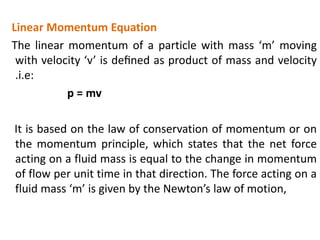
The linear momentum of a particle with mass ‘m’ moving
with velocity ‘v’ is defined as product of mass and velocity
.i.e:
p = mv
It is based on the law of conservation of momentum or on
the momentum principle, which states that the net force
acting on a fluid mass is equal to the change in momentum
of flow per unit time in that direction. The force acting on a
fluid mass ‘m’ is given by the Newton’s law of motion,
F=m*a
where a is the acceleration acting in the same direction as F.
IMPLUSE FORCE AND EQUATIONS
The impulse-momentum equation can be easily derived from
kinematics and Newton's Second Law. This equation is very closely
related to newton’s second law - in fact, it is often called the "Impulse-
Momentum form of Newton's Second Law".
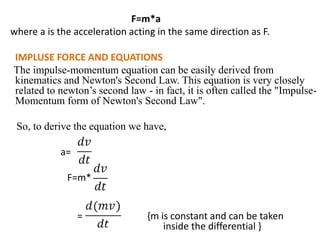
So, to derive the equation we have,
a=
F=m*
= {m is constant and can be taken
inside the differential }
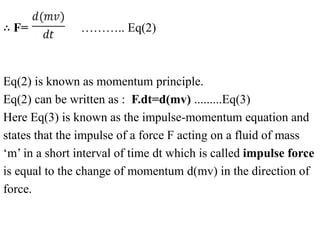
∴ F= ……….. Eq(2)
Eq(2) is known as momentum principle.
Eq(2) can be written as : F.dt=d(mv) .........Eq(3)
Here Eq(3) is known as the impulse-momentum equation and
states that the impulse of a force F acting on a fluid of mass
‘m’ in a short interval of time dt which is called impulse force
is equal to the change of momentum d(mv) in the direction of
force.
linear momentum and impulse equations

linear momentum and impulse equations

  • 2.
    Linear Momentum Equation Thelinear momentum of a particle with mass ‘m’ moving with velocity ‘v’ is defined as product of mass and velocity .i.e: p = mv It is based on the law of conservation of momentum or on the momentum principle, which states that the net force acting on a fluid mass is equal to the change in momentum of flow per unit time in that direction. The force acting on a fluid mass ‘m’ is given by the Newton’s law of motion,
  • 3.
    F=m*a where a isthe acceleration acting in the same direction as F. IMPLUSE FORCE AND EQUATIONS The impulse-momentum equation can be easily derived from kinematics and Newton's Second Law. This equation is very closely related to newton’s second law - in fact, it is often called the "Impulse- Momentum form of Newton's Second Law". So, to derive the equation we have, a= F=m* = {m is constant and can be taken inside the differential }
  • 4.
    ∴ F= ………..Eq(2) Eq(2) is known as momentum principle. Eq(2) can be written as : F.dt=d(mv) .........Eq(3) Here Eq(3) is known as the impulse-momentum equation and states that the impulse of a force F acting on a fluid of mass ‘m’ in a short interval of time dt which is called impulse force is equal to the change of momentum d(mv) in the direction of force.