TickleYourMindPhysicsWithHimanshu
Newton’s Laws of Motion
Objects at Rest
Simply put, things tend to keep on doing what they’re
already doing.
• Objects in a state of rest tend to remain at rest.
• Only a force will change that state.
Newton’s Law of Inertia
Objects in Motion
Now consider an object in motion.
• In the absence of forces, a moving object tends
to move in a straight line indefinitely.
• Toss an object from a space station located in
the vacuum of outer space, and the object will
move forever due to inertia.
Contact: +91 9867530456
TickleYourMindPhysicsWithHimanshu
Mass vs Weight
Mass Is Not Weight
Mass is often confused with weight.
• We often determine the amount of
matter in an object by measuring
its gravitational attraction to Earth.
However, mass is more
fundamental than weight.
• Mass is a measure of the amount
of material in an object. Weight,
on the other hand, is a measure
of the gravitational force acting on
the object.
Contact: +91 9867530456
TickleYourMindPhysicsWithHimanshu
Projectile Motion-Horizontal Motion
TickleYourMindPhysicsWithHimanshu
Projectile Motion-Horizontal Motion
TickleYourMindPhysicsWithHimanshu
Friction – Static and Kinetic
frictionstaticoftcoefficien
Ff
s
sNs



The Force of Static Friction
keeps a stationary object at
rest!
Once the Force of Static Friction
is overcome, the Force of Kinetic
Friction is what slows down a
moving object!
frictionkineticoftcoefficien
Ff
k
kNk




TickleYourMindPhysicsWithHimanshu
Uniform Circular Motion – Centripetal Acceleration
TickleYourMindPhysicsWithHimanshu
Impulse Momentum Theorem
TickleYourMindPhysicsWithHimanshu
Derivation of Newton's Third Law from 2nd Law
TickleYourMindPhysicsWithHimanshu
Motion of Car on level road
TickleYourMindPhysicsWithHimanshu
Motion of Car on banked road
TickleYourMindPhysicsWithHimanshu
Work Energy Theorem for Constant Force
TickleYourMindPhysicsWithHimanshu
Work Energy Theorem for Variable Force
TickleYourMindPhysicsWithHimanshu
Elastic Collision
'
1u '
2u
1u
2u
v
2v1v
'
1v '
2v







During
collision
Long
before
collision
Long
after
collision
Total linear momentum before collision =
Total linear momentum after collision
   1 1 1 2 2 2m u - v =m v -u
uur uur uur uur
By conservation of kinetic energy,
Total kinetic energy before collision = Total kinetic energy after collision
   2 2 2 2
1 1 1 2 2 2m u - v =m v -u
Relative velocity before collision = Relative velocity after collision
1 2 2
1 1 2
1 2 1 2
m - m 2m
v = u + u
m +m m +m
   
      
1 2 1
2 1 2
1 2 1 2
2m m - m
v = u + u
m +m m +m
   
      
1 1 2 2 1 1 2 2m u + m u = m v + m v
uur uur uur uur
   1 1 1 2 2 2m u - v = m v - u
uur uur uur uur
2 2
1 1 2 2
1 1
m u + m u
2 2
2 2
1 1 2 2
1 1
m v + m v
2 2
   2 2 2 2
1 1 1 2 2 2m u - v = m v - u
'
1u '
2u
1u
2u
v
2v1v
'
1v '
2v







During
collision
Long
before
collision
Long
after
collision
TickleYourMindPhysicsWithHimanshu
Inelastic Collision and Perfectly Inelastic Collision
'
1u '
2u
1u
2u
v
2v1v
'
1v '
2v







During
collision
Long
before
collision
Long
after
collision
Total linear momentum before collision =
Total linear momentum after collision
   1 1 1 2 2 2m u - v =m v -u
uur uur uur uur
By conservation of kinetic energy,
Total kinetic energy before collision is not equal to Total kinetic energy after collision
For perfectly inelastic collision, bodies stuck after colliding.
 
 
1 1 2 2
1 1 2 2 1 2
1 2
m u m u
m u m u m m v or v
m m

   

 2 2 2
1 1 2 2 1 2
1 1 1
E = m u m u m m v
2 2 2
  Loss in Energy:
TickleYourMindPhysicsWithHimanshu
Relation between angular velocity and linear velocity
TickleYourMindPhysicsWithHimanshu
Derivation of Centre of Mass Coordinates
TickleYourMindPhysicsWithHimanshu
Conservation of Angular Momentum
TickleYourMindPhysicsWithHimanshu
Theorem of Parallel Axes
TickleYourMindPhysicsWithHimanshu
Theorem of Perpendicular Axes
TickleYourMindPhysicsWithHimanshu
COM of a Rod length L
TickleYourMindPhysicsWithHimanshu
Moment of Inertia of Cylinder
TickleYourMindPhysicsWithHimanshu
Moment of Inertia of Rod of length l
TickleYourMindPhysicsWithHimanshu
Moment of Inertia of Uniform Disc
TickleYourMindPhysicsWithHimanshu
Power in Rotational Motion
TickleYourMindPhysicsWithHimanshu
Kinetic Energy in Rolling Motion Inclined Plane
TickleYourMindPhysicsWithHimanshu
Acceleration in inclined plane motion
TickleYourMindPhysicsWithHimanshu
Kepler’s Third Law
TickleYourMindPhysicsWithHimanshu
Escape Velocity
TickleYourMindPhysicsWithHimanshu
Orbital Velocity
TickleYourMindPhysicsWithHimanshu
Total Energy of Satellite
TickleYourMindPhysicsWithHimanshu
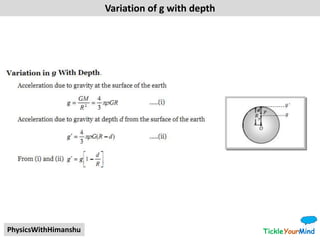
Variation of g with depth
TickleYourMindPhysicsWithHimanshu
Variation of g with height
TickleYourMindPhysicsWithHimanshu
Derivation of Gravitational Potential Energy
TickleYourMindPhysicsWithHimanshu
Stress Strain Curve
Contact: +91 9867530456
TickleYourMindPhysicsWithHimanshu
Young Modulus
TickleYourMindPhysicsWithHimanshu
Shear Modulus
Contact: +91 9867530456
TickleYourMindPhysicsWithHimanshu
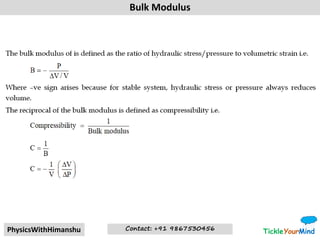
Bulk Modulus
Contact: +91 9867530456
TickleYourMindPhysicsWithHimanshu
Variation of Pressure with Height
Pressure P at a depth h below the surface of a liquid open to the atmosphere is
greater than atmospheric pressure
Contact: +91 9867530456
TickleYourMindPhysicsWithHimanshu
Buoyant Force
• Upward force that keeps things
afloat is equal to the magnitude
of the weight of fluid displaced by
the body
• Archimedes principle
• The magnitude of the buoyancy
force always equals the weight of
the fluid displaced by the object.
MggVB objectfluid  
M is the mass of the displaced fluid and not the mass of the object
TickleYourMindPhysicsWithHimanshu
Bernoulli’s Theorem
TickleYourMindPhysicsWithHimanshu
Torricelli's Law
For an open tank, the speed of liquid coming out through
a hole a distance h below the surface is equal to that
acquired by an object falling freely through a vertical
distance h.
TickleYourMindPhysicsWithHimanshu
Stokes Law
TickleYourMindPhysicsWithHimanshu
Viscosity and Reynold’s Number
TickleYourMindPhysicsWithHimanshu
Surface energy
TickleYourMindPhysicsWithHimanshu
Excess Pressure inside Drop and Bubble
TickleYourMindPhysicsWithHimanshu
Capillary Rise
TickleYourMindPhysicsWithHimanshu
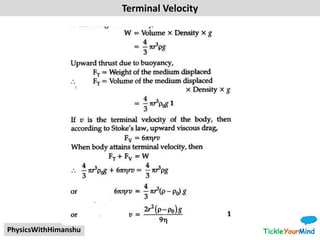
Terminal Velocity
TickleYourMindPhysicsWithHimanshu
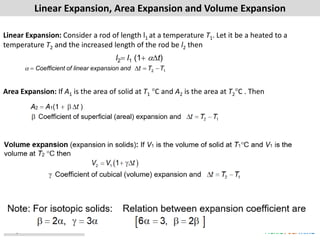
Linear Expansion, Area Expansion and Volume Expansion
Linear Expansion: Consider a rod of length l1 at a temperature T1. Let it be a heated to a
temperature T2 and the increased length of the rod be l2 then
l2 l1 (1 t)
  Coefficient of linear expansion and 2 1  t T T
Area Expansion: If A1 is the area of solid at T1 C and A2 is the area at T2C . Then
TickleYourMindPhysicsWithHimanshu
Coefficient of Volume Expansion of Gas
TickleYourMindPhysicsWithHimanshu
Relation between α, β, γ
TickleYourMindPhysicsWithHimanshu
Conduction
TickleYourMindPhysicsWithHimanshu
Thermal Stress
TickleYourMindPhysicsWithHimanshu
Density of Water vs Temperature
TickleYourMindPhysicsWithHimanshu
Heat Transfer Mechanisms
TickleYourMindPhysicsWithHimanshu
Specific Heat and Latent Heat
TickleYourMindPhysicsWithHimanshu
Graph of Change of State with Temperature
TickleYourMindPhysicsWithHimanshu
Gas Laws
 Pressure and volume are inversely related at
constant temperature.
 PV = K
 P1V1 = P2V2
Boyle’s Law
 Volume of a gas varies directly with the
absolute temperature at constant pressure.
 V = KT
 V1 / T1 = V2 / T2
Charles’ Law
At constant temperature and pressure, the volume
of a gas is directly related to the number of moles.
V = K n
V1 / n1 = V2 / n2
Avogadro’s Law
 At constant volume, pressure and
absolute temperature are directly
related.
 P = k T
 P1 / T1 = P2 / T2
Gay-Lussac Law
Dalton’s Law
 The total pressure in a container is the sum of the pressure each gas would exert
if it were alone in the container. The total pressure is the sum of the partial
pressures.
 PTotal = P1 + P2 + P3 + P4 + P5 ... (For each gas P = nRT/V)
TickleYourMindPhysicsWithHimanshu
Newton’s Law of Cooling
TickleYourMindPhysicsWithHimanshu
Work Done Isothermal Process
TickleYourMindPhysicsWithHimanshu
Work Done in Adiabatic Process
TickleYourMindPhysicsWithHimanshu
Work Done in Isobaric Process
TickleYourMindPhysicsWithHimanshu
Work Done in Isochoric Process
TickleYourMindPhysicsWithHimanshu
Relation between Cp and Cv
TickleYourMindPhysicsWithHimanshu
Synopsis of all Thermodynamic Process
TickleYourMindPhysicsWithHimanshu
Efficiency of Heat Engine
TickleYourMindPhysicsWithHimanshu
Efficiency of Heat Pump (Refrigerator)
TickleYourMindPhysicsWithHimanshu
Carnot Engine
TickleYourMindPhysicsWithHimanshu
Pressure by an ideal gas on walls of container
TickleYourMindPhysicsWithHimanshu
Law of Equipartition
TickleYourMindPhysicsWithHimanshu
Law of Equipartition
TickleYourMindPhysicsWithHimanshu
Mean Free path
TickleYourMindPhysicsWithHimanshu
Vrms, Vav, Vmp of Ideal Gas
TickleYourMindPhysicsWithHimanshu
Time Period of Spring Mass System by Force Equation
Contact: +91 9867530456
TickleYourMindPhysicsWithHimanshu
Time Period of Spring Mass System by Energy Equation
TickleYourMindPhysicsWithHimanshu
Vrms, Vav, Vmp of Ideal Gas
TickleYourMindPhysicsWithHimanshu
Conservation of Energy in SHM
TickleYourMindPhysicsWithHimanshu
Time Period of Simple Pendulum – Linear SHM
TickleYourMindPhysicsWithHimanshu
Time Period of Simple Pendulum – Rotational SHM
TickleYourMindPhysicsWithHimanshu
Damped SHM : Derivation of Energy and Amplitude
TickleYourMindPhysicsWithHimanshu
Forced Oscillations and Resonance
TickleYourMindPhysicsWithHimanshu
Derivation of Displacement Relation : Travelling Wave
TickleYourMindPhysicsWithHimanshu
Speed of a Transverse Wave on Stretched String
TickleYourMindPhysicsWithHimanshu
Speed of a Longitudinal Wave Speed of Sound
  

B
v (Where B is Bulk Modulus of the medium and v is velocity of wave)


Y
v


B
v
FOR SOLIDS, speed of sound wave is given by
Where Y is young’s modulus of the solid and p is density of solid
where B = bulk modulus of liquid.
FOR LIQUIDS, speed of sound wave is given by
TickleYourMindPhysicsWithHimanshu
Speed of Sound in Gas
TickleYourMindPhysicsWithHimanshu
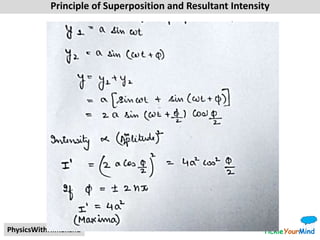
Principle of Superposition and Resultant Intensity
TickleYourMindPhysicsWithHimanshu
Reflection AND Refraction of Waves
TickleYourMindPhysicsWithHimanshu
Equation of Standing Wave
TickleYourMindPhysicsWithHimanshu
Standing Waves: Open at Both End
TickleYourMindPhysicsWithHimanshu
Standing Waves: Open at one End
TickleYourMindPhysicsWithHimanshu
String fixed at both Ends
TickleYourMindPhysicsWithHimanshu
String open at one End
TickleYourMindPhysicsWithHimanshu
Beats: Derivation of Equation
When two sound waves of same amplitude travelling in a same direction with slightly different
frequencies superimpose, then intensity varies periodically with time. This effect is called
Beats.
TickleYourMindPhysicsWithHimanshu
Beat Frequency
TickleYourMindPhysicsWithHimanshu
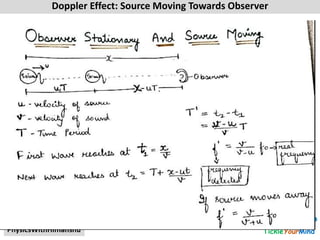
Doppler Effect: Source Moving Towards Observer
TickleYourMindPhysicsWithHimanshu
Doppler Effect: Observer Moving Towards Source
TickleYourMindPhysicsWithHimanshu
Relative motion between Source and Observer in Doppler Effect

CBSE 11 Physics Derivations