Physics 103:  Lecture 8 Work and Energy Work and Kinetic Energy Reminders: Midterm Exam I, Tuesday  February 24,  5:45 PM Material from Chapters 1-4 inclusive One page of notes (8.5” x 11”) allowed 20 multiple choice questions, 90 minutes Scantron will be used - bring #2 HB pencils + calculator 07/28/09 Physics 103, Spring 2009, U. Wisconsin
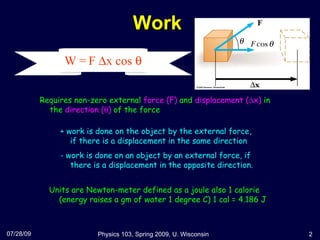
Work 07/28/09 Physics 103, Spring 2009, U. Wisconsin Requires non-zero external  force   (F)  and  displacement (  x)  in the  direction   (  )  of the force Units are Newton-meter defined as a joule also 1 calorie (energy raises a gm of water 1 degree C) 1 cal = 4.186 J + work is done on the object by the external force, if there is a displacement in the same direction - work is done on an object by an external force, if there is a displacement in the opposite direction. W =   F   x cos  
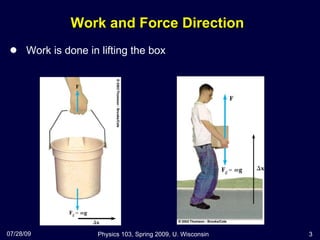
Work and Force Direction Work is done in lifting the box 07/28/09 Physics 103, Spring 2009, U. Wisconsin
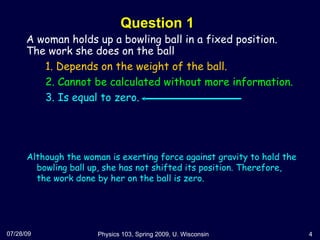
Question 1 07/28/09 Physics 103, Spring 2009, U. Wisconsin A woman holds up a bowling ball in a fixed position. The work she does on the ball 1. Depends on the weight of the ball. 2. Cannot be calculated without more information. 3. Is equal to zero.  Although the woman is exerting force against gravity to hold the bowling ball up, she has not shifted its position. Therefore, the work done by her on the ball is zero.
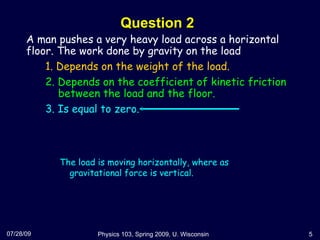
Question 2 07/28/09 Physics 103, Spring 2009, U. Wisconsin A man pushes a very heavy load across a horizontal floor. The work done by gravity on the load  1. Depends on the weight of the load. 2. Depends on the coefficient of kinetic friction   between the load and the floor. 3. Is equal to zero.  The load is moving horizontally, where as gravitational force is vertical.
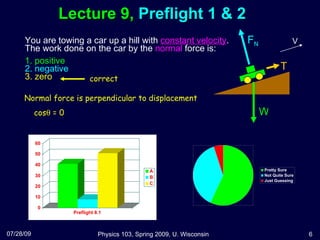
Lecture 9,  Preflight 1 & 2   You are towing a car up a hill with  constant velocity .  The work done on the car by the  normal  force is: 1. positive 2. negative 3. zero   07/28/09 Physics 103, Spring 2009, U. Wisconsin Normal force is perpendicular to displacement cos   = 0 W T F N V correct
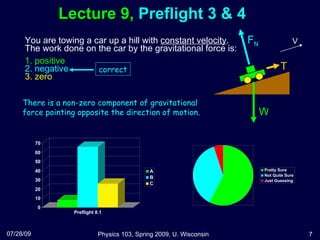
Lecture 9,  Preflight 3 & 4   You are towing a car up a hill with  constant velocity .  The work done on the car by the gravitational force is: 1. positive 2. negative 3. zero   07/28/09 Physics 103, Spring 2009, U. Wisconsin There is a non-zero component of gravitational force pointing opposite the direction of motion. W T F N V correct
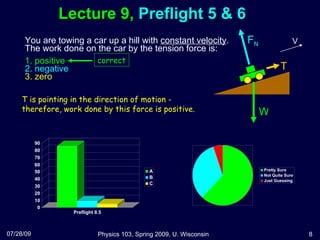
Lecture 9,  Preflight 5 & 6   You are towing a car up a hill with  constant velocity .  The work done on the car by the tension force is: 1. positive 2. negative 3. zero   07/28/09 Physics 103, Spring 2009, U. Wisconsin T is pointing in the direction of motion - therefore, work done by this force is positive. W T F N V correct
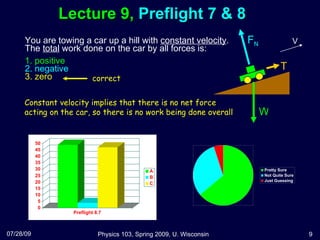
Lecture 9,  Preflight 7 & 8   You are towing a car up a hill with  constant velocity .  The  total  work done on the car by all forces is: 1. positive 2. negative 3. zero   07/28/09 Physics 103, Spring 2009, U. Wisconsin Constant velocity implies that there is no net force acting on the car, so there is no work being done overall W T F N V correct
Energy Energy is that quality of a substance or object which causes something to happen. Perhaps, one could term it the capability of exerting forces.  The vagueness of the definition is due to the fact that energy can result in many effects. 07/28/09 Physics 103, Spring 2009, U. Wisconsin It is convertible into other forms without loss ( i.e  it is conserved) Kinetic Energy Electrical Energy Solar Energy Chemical Energy Nuclear Energy Gravitational Energy ……….
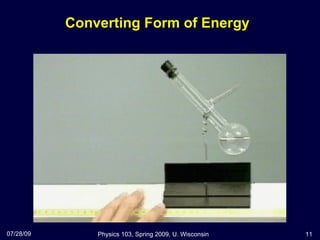
Converting Form of Energy 07/28/09 Physics 103, Spring 2009, U. Wisconsin
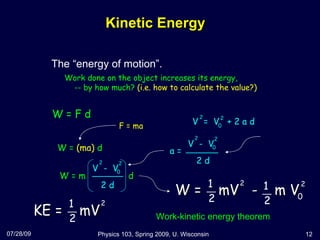
Kinetic Energy  The “energy of motion”. 07/28/09 Physics 103, Spring 2009, U. Wisconsin Work done on the object increases its energy,  -- by how much?  (i.e. how to calculate the value?) F = ma W = F d W =  (ma)  d Work-kinetic energy theorem V  =  V  + 2 a d 2 2 0 W =  mV  -  m V 1 2 1 2 2 2 0 a =  2 d V  -  V 2 2 0 2 d V  -  V 2 2 0 W = m  d KE =  mV 1 2 2
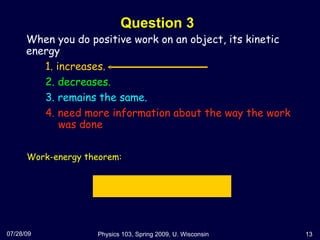
Question 3 07/28/09 Physics 103, Spring 2009, U. Wisconsin When you do positive work on an object, its kinetic energy  1. increases. 2. decreases. 3. remains the same. 4. need more information about the way the work   was done Work-energy theorem:
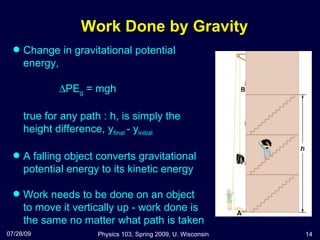
Work Done by Gravity 07/28/09 Physics 103, Spring 2009, U. Wisconsin Change in gravitational potential energy,     PE g  = mgh true for any path : h, is simply the height difference, y final  - y initial A falling object converts gravitational potential energy to its kinetic energy Work needs to be done on an object to move it vertically up - work done is the same no matter what path is taken
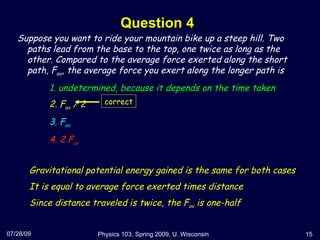
Question 4 07/28/09 Physics 103, Spring 2009, U. Wisconsin Suppose you want to ride your mountain bike up a steep hill. Two paths lead from the base to the top, one twice as long as the other. Compared to the average force exerted along the short path, F av , the average force you exert along the longer path is 1. undetermined, because it depends on the time taken 2. F av  / 2 3. F av 4. 2 F av Gravitational potential energy gained is the same for both cases It is equal to average force exerted times distance Since distance traveled is twice, the F av  is one-half correct
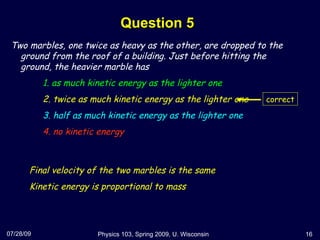
Question 5 07/28/09 Physics 103, Spring 2009, U. Wisconsin Two marbles, one twice as heavy as the other, are dropped to the ground from the roof of a building. Just before hitting the ground, the heavier marble has 1. as much kinetic energy as the lighter one 2. twice as much kinetic energy as the lighter one 3. half as much kinetic energy as the lighter one 4. no kinetic energy Final velocity of the two marbles is the same Kinetic energy is proportional to mass correct
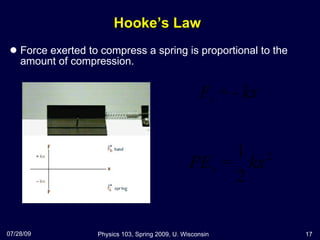
Hooke’s Law Force exerted to compress a spring is proportional to the amount of compression. 07/28/09 Physics 103, Spring 2009, U. Wisconsin
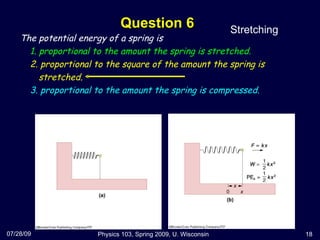
Question 6 07/28/09 Physics 103, Spring 2009, U. Wisconsin The potential energy of a spring is 1. proportional to the amount the spring is stretched. 2. proportional to the square of the amount the spring is stretched. 3. proportional to the amount the spring is compressed. Stretching
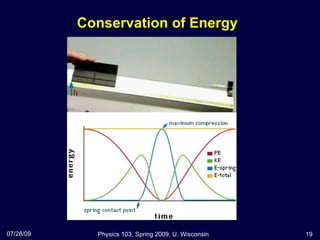
Conservation of Energy 07/28/09 Physics 103, Spring 2009, U. Wisconsin

Lect08

  • 1.
    Physics 103: Lecture 8 Work and Energy Work and Kinetic Energy Reminders: Midterm Exam I, Tuesday February 24, 5:45 PM Material from Chapters 1-4 inclusive One page of notes (8.5” x 11”) allowed 20 multiple choice questions, 90 minutes Scantron will be used - bring #2 HB pencils + calculator 07/28/09 Physics 103, Spring 2009, U. Wisconsin
  • 2.
    Work 07/28/09 Physics103, Spring 2009, U. Wisconsin Requires non-zero external force (F) and displacement (  x) in the direction (  ) of the force Units are Newton-meter defined as a joule also 1 calorie (energy raises a gm of water 1 degree C) 1 cal = 4.186 J + work is done on the object by the external force, if there is a displacement in the same direction - work is done on an object by an external force, if there is a displacement in the opposite direction. W = F  x cos 
  • 3.
    Work and ForceDirection Work is done in lifting the box 07/28/09 Physics 103, Spring 2009, U. Wisconsin
  • 4.
    Question 1 07/28/09Physics 103, Spring 2009, U. Wisconsin A woman holds up a bowling ball in a fixed position. The work she does on the ball 1. Depends on the weight of the ball. 2. Cannot be calculated without more information. 3. Is equal to zero. Although the woman is exerting force against gravity to hold the bowling ball up, she has not shifted its position. Therefore, the work done by her on the ball is zero.
  • 5.
    Question 2 07/28/09Physics 103, Spring 2009, U. Wisconsin A man pushes a very heavy load across a horizontal floor. The work done by gravity on the load 1. Depends on the weight of the load. 2. Depends on the coefficient of kinetic friction between the load and the floor. 3. Is equal to zero. The load is moving horizontally, where as gravitational force is vertical.
  • 6.
    Lecture 9, Preflight 1 & 2 You are towing a car up a hill with constant velocity . The work done on the car by the normal force is: 1. positive 2. negative 3. zero 07/28/09 Physics 103, Spring 2009, U. Wisconsin Normal force is perpendicular to displacement cos  = 0 W T F N V correct
  • 7.
    Lecture 9, Preflight 3 & 4 You are towing a car up a hill with constant velocity . The work done on the car by the gravitational force is: 1. positive 2. negative 3. zero 07/28/09 Physics 103, Spring 2009, U. Wisconsin There is a non-zero component of gravitational force pointing opposite the direction of motion. W T F N V correct
  • 8.
    Lecture 9, Preflight 5 & 6 You are towing a car up a hill with constant velocity . The work done on the car by the tension force is: 1. positive 2. negative 3. zero 07/28/09 Physics 103, Spring 2009, U. Wisconsin T is pointing in the direction of motion - therefore, work done by this force is positive. W T F N V correct
  • 9.
    Lecture 9, Preflight 7 & 8 You are towing a car up a hill with constant velocity . The total work done on the car by all forces is: 1. positive 2. negative 3. zero 07/28/09 Physics 103, Spring 2009, U. Wisconsin Constant velocity implies that there is no net force acting on the car, so there is no work being done overall W T F N V correct
  • 10.
    Energy Energy isthat quality of a substance or object which causes something to happen. Perhaps, one could term it the capability of exerting forces. The vagueness of the definition is due to the fact that energy can result in many effects. 07/28/09 Physics 103, Spring 2009, U. Wisconsin It is convertible into other forms without loss ( i.e it is conserved) Kinetic Energy Electrical Energy Solar Energy Chemical Energy Nuclear Energy Gravitational Energy ……….
  • 11.
    Converting Form ofEnergy 07/28/09 Physics 103, Spring 2009, U. Wisconsin
  • 12.
    Kinetic Energy The “energy of motion”. 07/28/09 Physics 103, Spring 2009, U. Wisconsin Work done on the object increases its energy, -- by how much? (i.e. how to calculate the value?) F = ma W = F d W = (ma) d Work-kinetic energy theorem V = V + 2 a d 2 2 0 W = mV - m V 1 2 1 2 2 2 0 a = 2 d V - V 2 2 0 2 d V - V 2 2 0 W = m d KE = mV 1 2 2
  • 13.
    Question 3 07/28/09Physics 103, Spring 2009, U. Wisconsin When you do positive work on an object, its kinetic energy 1. increases. 2. decreases. 3. remains the same. 4. need more information about the way the work was done Work-energy theorem:
  • 14.
    Work Done byGravity 07/28/09 Physics 103, Spring 2009, U. Wisconsin Change in gravitational potential energy,  PE g = mgh true for any path : h, is simply the height difference, y final - y initial A falling object converts gravitational potential energy to its kinetic energy Work needs to be done on an object to move it vertically up - work done is the same no matter what path is taken
  • 15.
    Question 4 07/28/09Physics 103, Spring 2009, U. Wisconsin Suppose you want to ride your mountain bike up a steep hill. Two paths lead from the base to the top, one twice as long as the other. Compared to the average force exerted along the short path, F av , the average force you exert along the longer path is 1. undetermined, because it depends on the time taken 2. F av / 2 3. F av 4. 2 F av Gravitational potential energy gained is the same for both cases It is equal to average force exerted times distance Since distance traveled is twice, the F av is one-half correct
  • 16.
    Question 5 07/28/09Physics 103, Spring 2009, U. Wisconsin Two marbles, one twice as heavy as the other, are dropped to the ground from the roof of a building. Just before hitting the ground, the heavier marble has 1. as much kinetic energy as the lighter one 2. twice as much kinetic energy as the lighter one 3. half as much kinetic energy as the lighter one 4. no kinetic energy Final velocity of the two marbles is the same Kinetic energy is proportional to mass correct
  • 17.
    Hooke’s Law Forceexerted to compress a spring is proportional to the amount of compression. 07/28/09 Physics 103, Spring 2009, U. Wisconsin
  • 18.
    Question 6 07/28/09Physics 103, Spring 2009, U. Wisconsin The potential energy of a spring is 1. proportional to the amount the spring is stretched. 2. proportional to the square of the amount the spring is stretched. 3. proportional to the amount the spring is compressed. Stretching
  • 19.
    Conservation of Energy07/28/09 Physics 103, Spring 2009, U. Wisconsin

Editor's Notes

  • #2 1
  • #11 The force that accompanies the “capability” takes various forms (labeling the energy). Energy (capability) can increase or decrease. That is, energy can be decreased by exerting a force that does work, and can be increased if an external force does work.