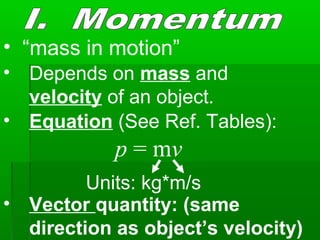
• “mass in motion”
• Depends on mass and
velocity of an object.
• Equation (See Ref. Tables):
p = mv
Units: kg*m/s
• Vector quantity: (same
direction as object’s velocity)
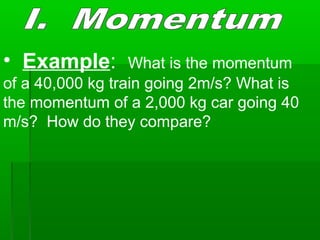
• Example: What is the momentum
of a 40,000 kg train going 2m/s? What is
the momentum of a 2,000 kg car going 40
m/s? How do they compare?
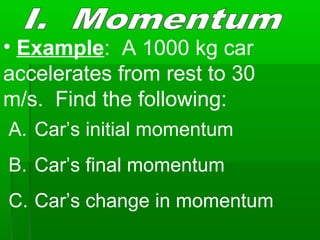
• Example: A 1000 kg car
accelerates from rest to 30
m/s. Find the following:
A. Car’s initial momentum
B. Car’s final momentum
C. Car’s change in momentum
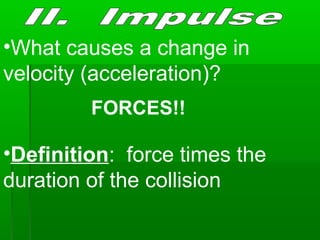
•What causes a change in
velocity (acceleration)?
FORCES!!
•Definition: force times the
duration of the collision
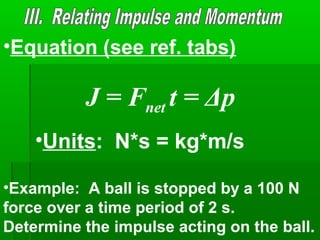
•Equation (see ref. tabs)
J = Fnet t = Δp
•Units: N*s = kg*m/s
•Example: A ball is stopped by a 100 N
force over a time period of 2 s.
Determine the impulse acting on the ball.
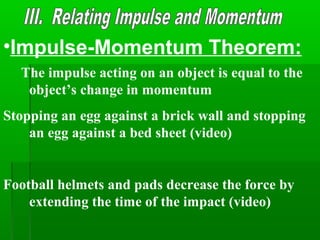
•Impulse-Momentum Theorem:
The impulse acting on an object is equal to the
object’s change in momentum
Stopping an egg against a brick wall and stopping
an egg against a bed sheet (video)
Football helmets and pads decrease the force by
extending the time of the impact (video)
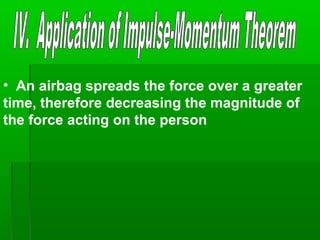
• An airbag spreads the force over a greater
time, therefore decreasing the magnitude of
the force acting on the person
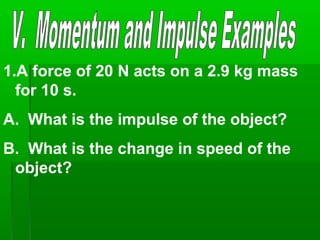
1.A force of 20 N acts on a 2.9 kg mass
for 10 s.
A. What is the impulse of the object?
B. What is the change in speed of the
object?
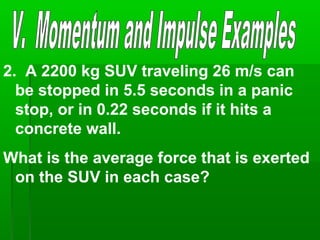
2. A 2200 kg SUV traveling 26 m/s can
be stopped in 5.5 seconds in a panic
stop, or in 0.22 seconds if it hits a
concrete wall.
What is the average force that is exerted
on the SUV in each case?

Momentum and impulse pp

  • 2.
    • “mass inmotion” • Depends on mass and velocity of an object. • Equation (See Ref. Tables): p = mv Units: kg*m/s • Vector quantity: (same direction as object’s velocity)
  • 3.
    • Example: Whatis the momentum of a 40,000 kg train going 2m/s? What is the momentum of a 2,000 kg car going 40 m/s? How do they compare?
  • 4.
    • Example: A1000 kg car accelerates from rest to 30 m/s. Find the following: A. Car’s initial momentum B. Car’s final momentum C. Car’s change in momentum
  • 5.
    •What causes achange in velocity (acceleration)? FORCES!! •Definition: force times the duration of the collision
  • 6.
    •Equation (see ref.tabs) J = Fnet t = Δp •Units: N*s = kg*m/s •Example: A ball is stopped by a 100 N force over a time period of 2 s. Determine the impulse acting on the ball.
  • 7.
    •Impulse-Momentum Theorem: The impulseacting on an object is equal to the object’s change in momentum Stopping an egg against a brick wall and stopping an egg against a bed sheet (video) Football helmets and pads decrease the force by extending the time of the impact (video)
  • 8.
    • An airbagspreads the force over a greater time, therefore decreasing the magnitude of the force acting on the person
  • 9.
    1.A force of20 N acts on a 2.9 kg mass for 10 s. A. What is the impulse of the object? B. What is the change in speed of the object?
  • 10.
    2. A 2200kg SUV traveling 26 m/s can be stopped in 5.5 seconds in a panic stop, or in 0.22 seconds if it hits a concrete wall. What is the average force that is exerted on the SUV in each case?