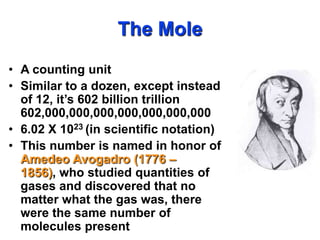
The MoleA counting unitSimilar to a dozen, except instead of 12, it’s 602 billion trillion 602,000,000,000,000,000,000,0006.02 X 1023 (in scientific notation)This number is named in honor of AmedeoAvogadro (1776 – 1856), who studied quantities of gases and discovered that no matter what the gas was, there were the same number of molecules present
Just How Big is a Mole?Enough soft drink cans to cover the surface of the earth to a depth of over 200 miles. If you had Avogadro's number of unpopped popcorn kernels, and spread them across the United States of America, the country would be covered in popcorn to a depth of over 9 miles. If we were able to count atoms at the rate of 10 million per second, it would take about 2 billion years to count the atoms in one mole.
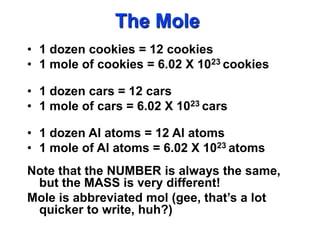
The Mole1 dozen cookies = 12 cookies1 mole of cookies = 6.02 X 10²³ cookies1 dozen cars = 12 cars1 mole of cars = 6.02 X 10²³ cars1 dozen Al atoms = 12 Al atoms1 mole of Al atoms = 6.02 X 10²³ atomsNote that the NUMBER is always the same, but the MASS is very different!Mole is abbreviated mol (gee, that’s a lot quicker to write, huh?)
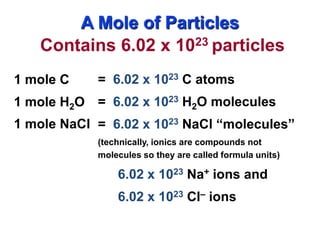
A Mole of ParticlesContains 6.02 x 10²³ particles	=  6.02 x 10²³ C atoms	=  6.02 x 10²³H2O molecules	=  6.02 x 10²³NaCl “molecules”(technically, ionics are compounds not molecules so they are called formula units)		6.02 x 10²³ Na+ ions and 6.02 x 10²³Cl– ions1 mole C1 mole H2O1 mole NaCl
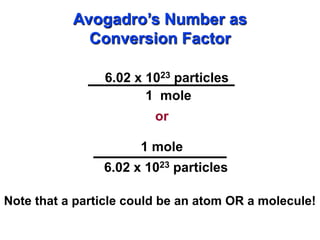
Avogadro’s Number as Conversion Factor6.02 x 1023 particles      		         1  mole		or 1 mole	6.02 x 10²³ particlesNote that a particle could be an atom OR a molecule!
Sample ProblemsHow many moles are in 7.8x1024atoms of carbon?How many atoms are in 2.76 moles of Helium?
Molar MassThe Mass of 1 mole (in grams)Equal to the numerical value of the average atomic mass (get from periodic table)1 mole of  C atoms		=  	12.0 g1 mole of Mg atoms 		=	24.3 g1 mole of Cu atoms 		=	63.5 g
Mass in grams of 1 mole equal numerically to the sum of the atomic masses1 mole of  CaCl2 	 =  111.1 g/mol 		1 mole Ca x 40.1 g/mol 	+ 2 moles Cl x 35.5 g/mol    = 71 g/mol 						    = 111.1 g/mol CaCl21 mole of N2O4 	= 92.0 g/mol	Molar Mass of Molecules and Compounds
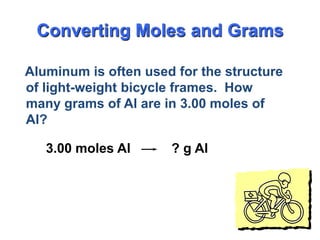
Aluminum is often used for the structure of light-weight bicycle frames.  How many grams of Al are in 3.00 moles of Al?		3.00 moles Al           ? g Al 	Converting Moles and Grams
The artificial sweetener aspartame (Nutra-Sweet) formula C14H18N2O5 is used to sweeten diet foods, coffee and soft drinks. How many moles of aspartame are present in 225 g of aspartame?Learning Check!
                   molar mass             Avogadro’s numberGrams 		         Moles                                  particlesEverything must go through Moles!!!Calculations
Atoms/Molecules and GramsHow many atoms of Cu are present in 35.4 g of Cu?35.4 g Cu        1 mol Cu       6.02 X 10²³ atoms Cu 		    63.5 g Cu	        1 mol Cu= 3.4 X 10²³ atoms Cu
Learning Check!How many atoms of K are present in 78.4 g of K?
Learning Check!What is the mass (in grams) of 1.20 X 1024 molecules of glucose (C6H12O6)?
Percent Composition	Used to describe the make up of a compound by mass percentageCompare the mass of each element present in 1 mole to the total mass of the compound
Sample ProblemPenicillin F has the formula C14H20N2SO4 What is the mass percent of each element?
Empirical vs Molecular FormulaMolecular formula = (empirical formula)nWhere n is an integerAssume a 100 g of the sampleThen each % will also be the massDetermine the number of moles Find ratio by using the smallest amountWhole numbers represent subscripits
Sample problemCaffeine contains 49.48% carbon, 5.15% hydrogen, 28.87% nitrogen and 16.49% oxygen and a molar mass of 194.2 g/mol. What is the empirical and molecular formula of caffeine?
To obtain an Empirical Formula1.	Determine the mass in grams of each element present, if necessary.2.	Calculate the number of moles of each element.3.	Divide each by the smallest number of moles to obtain the simplest whole number ratio.If whole numbers are not obtained* in step 3),  multiply through by the smallest number that will give all whole numbers*Be careful! Do not round off numbers prematurely
Calculation of the Molecular FormulaA compound has an empirical formula of NO2.  The colourless liquid, used in rocket engines has a molar mass of 92.0 g/mole.  What is the molecular formula of this substance?
Empirical Formula from % CompositionA substance has the following composition by mass: 60.80 % Na ;  28.60 % B ;  10.60 % HWhat is the empirical formula of the substance? 	Consider a sample size of 100 grams	This will contain  28.60 grams of B and 		10.60 grams H	Determine the number of moles of each	Determine the simplest whole number ratio

Moles

  • 1.
    The MoleA countingunitSimilar to a dozen, except instead of 12, it’s 602 billion trillion 602,000,000,000,000,000,000,0006.02 X 1023 (in scientific notation)This number is named in honor of AmedeoAvogadro (1776 – 1856), who studied quantities of gases and discovered that no matter what the gas was, there were the same number of molecules present
  • 2.
    Just How Bigis a Mole?Enough soft drink cans to cover the surface of the earth to a depth of over 200 miles. If you had Avogadro's number of unpopped popcorn kernels, and spread them across the United States of America, the country would be covered in popcorn to a depth of over 9 miles. If we were able to count atoms at the rate of 10 million per second, it would take about 2 billion years to count the atoms in one mole.
  • 3.
    The Mole1 dozencookies = 12 cookies1 mole of cookies = 6.02 X 10²³ cookies1 dozen cars = 12 cars1 mole of cars = 6.02 X 10²³ cars1 dozen Al atoms = 12 Al atoms1 mole of Al atoms = 6.02 X 10²³ atomsNote that the NUMBER is always the same, but the MASS is very different!Mole is abbreviated mol (gee, that’s a lot quicker to write, huh?)
  • 4.
    A Mole ofParticlesContains 6.02 x 10²³ particles = 6.02 x 10²³ C atoms = 6.02 x 10²³H2O molecules = 6.02 x 10²³NaCl “molecules”(technically, ionics are compounds not molecules so they are called formula units) 6.02 x 10²³ Na+ ions and 6.02 x 10²³Cl– ions1 mole C1 mole H2O1 mole NaCl
  • 5.
    Avogadro’s Number asConversion Factor6.02 x 1023 particles 1 mole or 1 mole 6.02 x 10²³ particlesNote that a particle could be an atom OR a molecule!
  • 6.
    Sample ProblemsHow manymoles are in 7.8x1024atoms of carbon?How many atoms are in 2.76 moles of Helium?
  • 7.
    Molar MassThe Massof 1 mole (in grams)Equal to the numerical value of the average atomic mass (get from periodic table)1 mole of C atoms = 12.0 g1 mole of Mg atoms = 24.3 g1 mole of Cu atoms = 63.5 g
  • 8.
    Mass in gramsof 1 mole equal numerically to the sum of the atomic masses1 mole of CaCl2 = 111.1 g/mol 1 mole Ca x 40.1 g/mol + 2 moles Cl x 35.5 g/mol = 71 g/mol = 111.1 g/mol CaCl21 mole of N2O4 = 92.0 g/mol Molar Mass of Molecules and Compounds
  • 9.
    Aluminum is oftenused for the structure of light-weight bicycle frames. How many grams of Al are in 3.00 moles of Al? 3.00 moles Al ? g Al Converting Moles and Grams
  • 10.
    The artificial sweeteneraspartame (Nutra-Sweet) formula C14H18N2O5 is used to sweeten diet foods, coffee and soft drinks. How many moles of aspartame are present in 225 g of aspartame?Learning Check!
  • 11.
    molar mass Avogadro’s numberGrams Moles particlesEverything must go through Moles!!!Calculations
  • 12.
    Atoms/Molecules and GramsHowmany atoms of Cu are present in 35.4 g of Cu?35.4 g Cu 1 mol Cu 6.02 X 10²³ atoms Cu 63.5 g Cu 1 mol Cu= 3.4 X 10²³ atoms Cu
  • 13.
    Learning Check!How manyatoms of K are present in 78.4 g of K?
  • 14.
    Learning Check!What isthe mass (in grams) of 1.20 X 1024 molecules of glucose (C6H12O6)?
  • 15.
    Percent Composition Used todescribe the make up of a compound by mass percentageCompare the mass of each element present in 1 mole to the total mass of the compound
  • 16.
    Sample ProblemPenicillin Fhas the formula C14H20N2SO4 What is the mass percent of each element?
  • 17.
    Empirical vs MolecularFormulaMolecular formula = (empirical formula)nWhere n is an integerAssume a 100 g of the sampleThen each % will also be the massDetermine the number of moles Find ratio by using the smallest amountWhole numbers represent subscripits
  • 18.
    Sample problemCaffeine contains49.48% carbon, 5.15% hydrogen, 28.87% nitrogen and 16.49% oxygen and a molar mass of 194.2 g/mol. What is the empirical and molecular formula of caffeine?
  • 19.
    To obtain anEmpirical Formula1. Determine the mass in grams of each element present, if necessary.2. Calculate the number of moles of each element.3. Divide each by the smallest number of moles to obtain the simplest whole number ratio.If whole numbers are not obtained* in step 3), multiply through by the smallest number that will give all whole numbers*Be careful! Do not round off numbers prematurely
  • 20.
    Calculation of theMolecular FormulaA compound has an empirical formula of NO2. The colourless liquid, used in rocket engines has a molar mass of 92.0 g/mole. What is the molecular formula of this substance?
  • 21.
    Empirical Formula from% CompositionA substance has the following composition by mass: 60.80 % Na ; 28.60 % B ; 10.60 % HWhat is the empirical formula of the substance? Consider a sample size of 100 grams This will contain 28.60 grams of B and 10.60 grams H Determine the number of moles of each Determine the simplest whole number ratio