RECOMBINANT DNA
TECHNOLOGY
NIKHIL KUMAR
M.PHARM (1 st year)
Bengal School Of
Technology
HISTORY
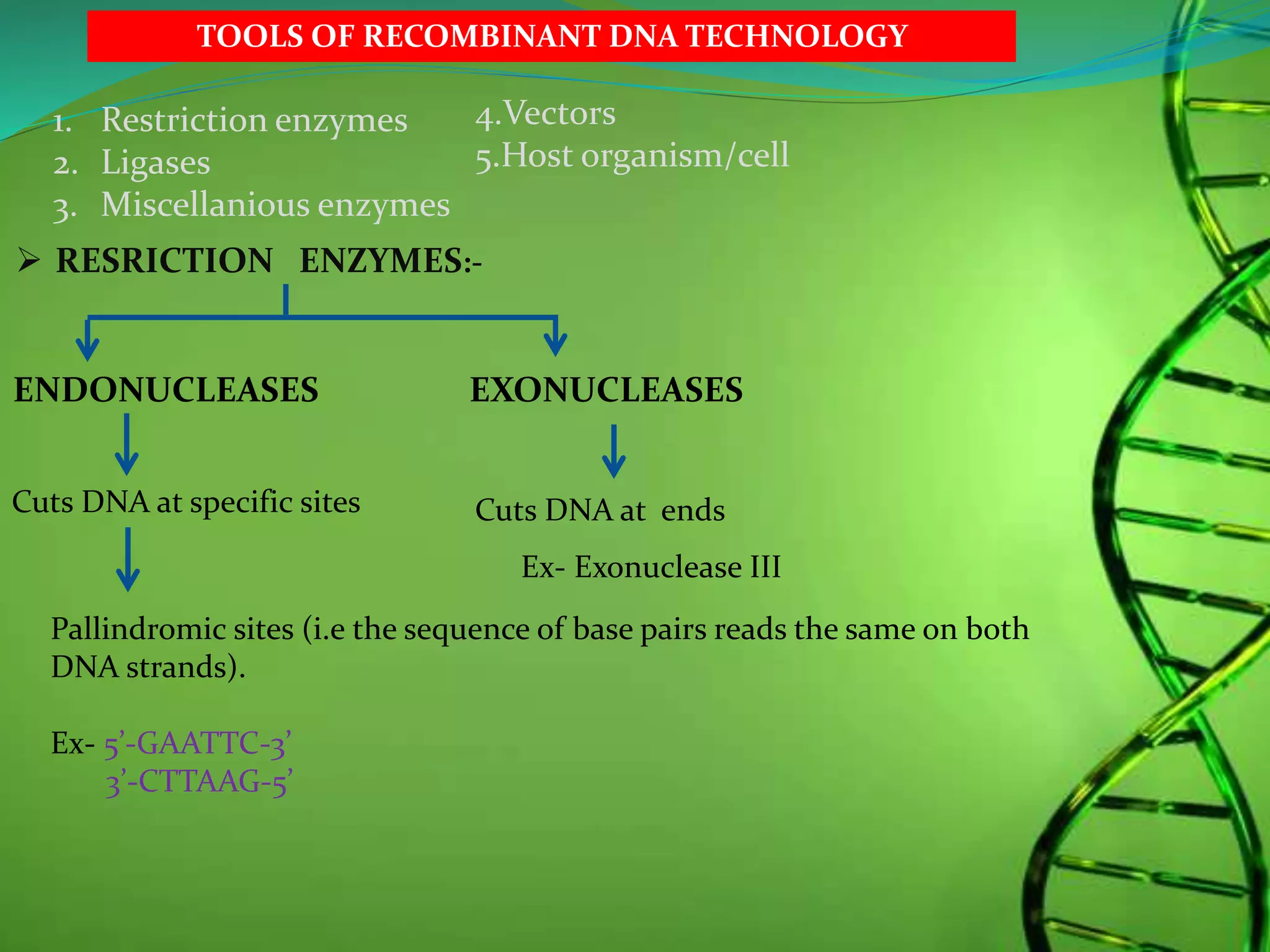
 Herbert Boyer(1936) and Stanley N. Cohen(1935) devlop
recombinant DNATecnology,showing that ther genetically
engineered DNA molecules may be Cloned in foreign cells
 THEY CONSTRUCTED 1ST RECOMBINENT DNA using
Salmonella typhimurim.
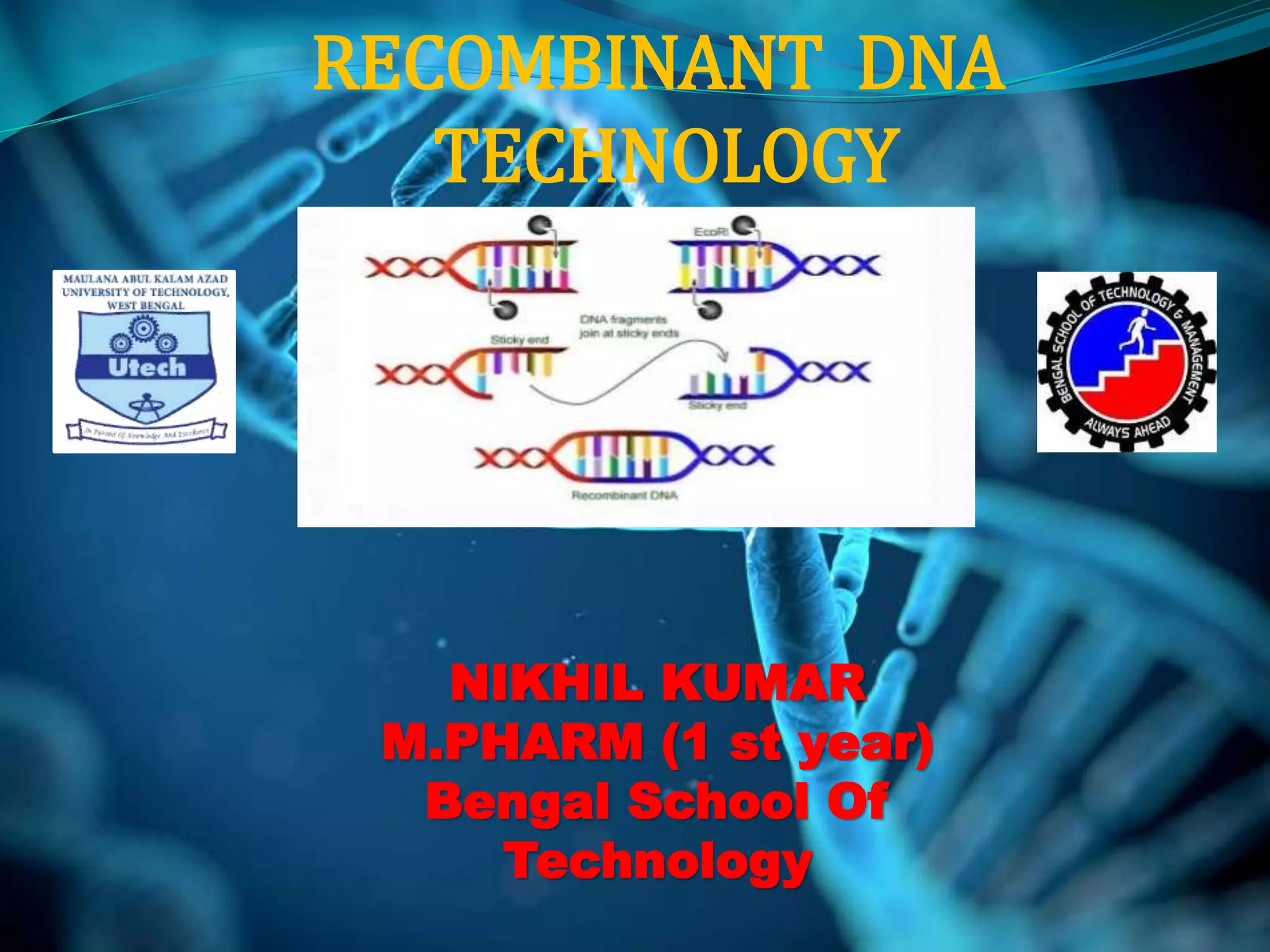
Recombinant DNA is term used to describe the combination of two DNA
Strands that are constructed artificially.Genetic scientists can do this to create
Unique DNA strand for diffrent perposes,using several type of techniques
DEFINITION:
PRINCIPLE:
Source-authorstream.com
1. Restriction enzymes
2. Ligases
3. Miscellanious enzymes
 RESRICTION ENZYMES:-
ENDONUCLEASES
Cuts DNA at ends
EXONUCLEASES
Cuts DNA at specific sites
Pallindromic sites (i.e the sequence of base pairs reads the same on both
DNA strands).
Ex- 5’-GAATTC-3’
3’-CTTAAG-5’
4.Vectors
5.Host organism/cell
Ex- Exonuclease III
TOOLS OF RECOMBINANT DNA TECHNOLOGY
1.Firstly letter derived from genus name (italics)
2.Next,two letters derived from species name (italics)
3.The Roman number show order in which the enzyme
were iosolated From bacterial strain.
Ex- EcoRI is from Escherichia (E) coli(co),
strain RY13(R) and first
endonucleases(I) to be discovered.
HindIII is from Haemophillus(H) influenzae(in),
Strain Rd(d) and the third endonucleases(III) to be
discovered.
NOMENCLATURE OF RESTRICTION ENZYMES:
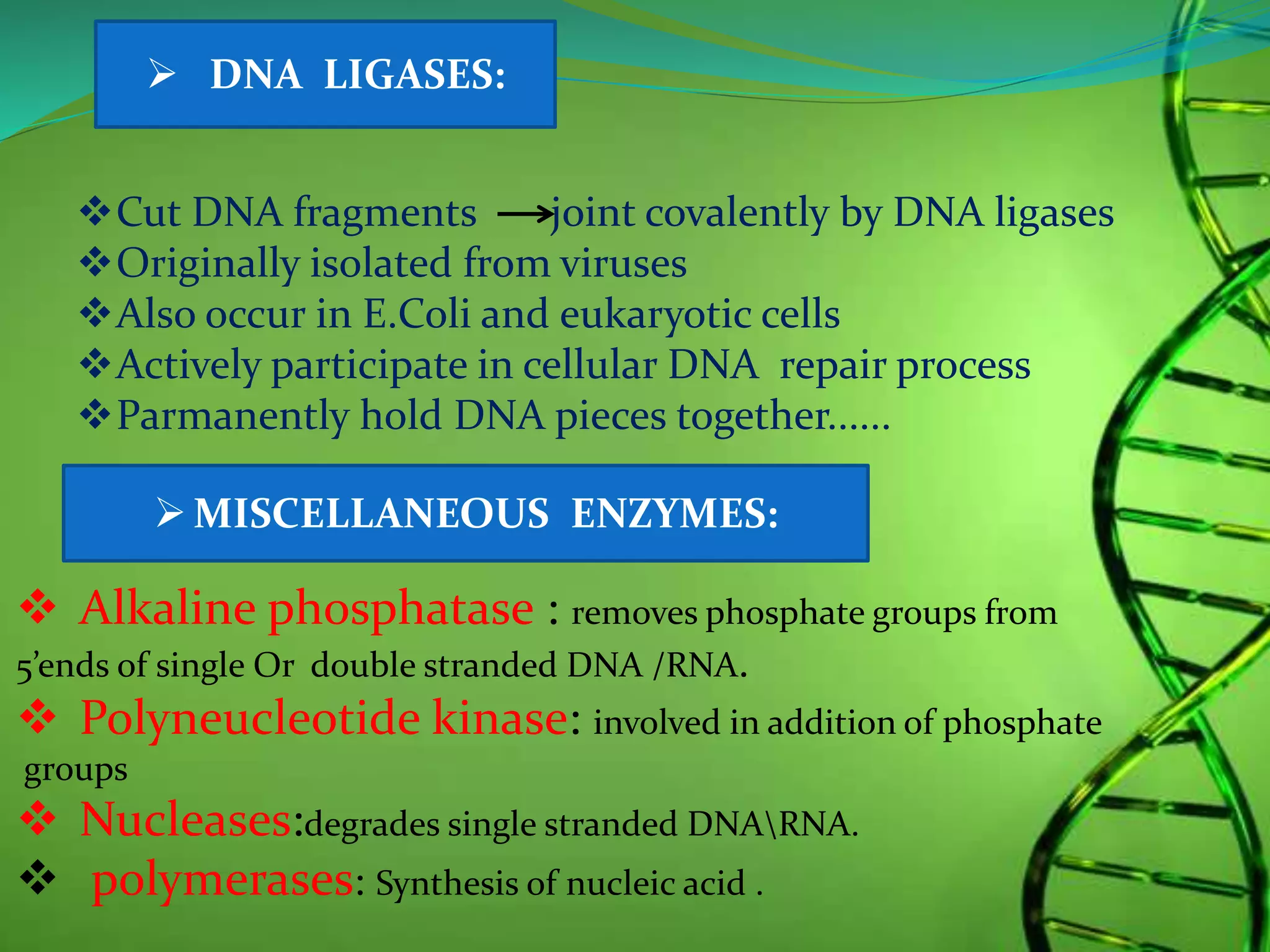
Cut DNA fragments joint covalently by DNA ligases
Originally isolated from viruses
Also occur in E.Coli and eukaryotic cells
Actively participate in cellular DNA repair process
Parmanently hold DNA pieces together......
 Alkaline phosphatase : removes phosphate groups from
5’ends of single Or double stranded DNA /RNA.
 Polyneucleotide kinase: involved in addition of phosphate
groups
 Nucleases:degrades single stranded DNARNA.
 polymerases: Synthesis of nucleic acid .
 DNA LIGASES:
MISCELLANEOUS ENZYMES:
Microbes multiply faster compared to cells of higher organism
(plants/animals) thus preffered to as host cell.
 Prokaryotic hosts include E.Coli ,Bacillus subtilis
 Eukaryotic hosts include saccharomyces cerevisiae(fungi),
Mammalian cells ,plants(protoplast)......
 Host cells:
 VECTORS:
Vectors are DNA molecules which carry a forign DNA fragment
into the Host cells
 TYPES:
 Plasmid
 Cosmid
 Phasid
 Bacteriophage
 Artificial cromosomes
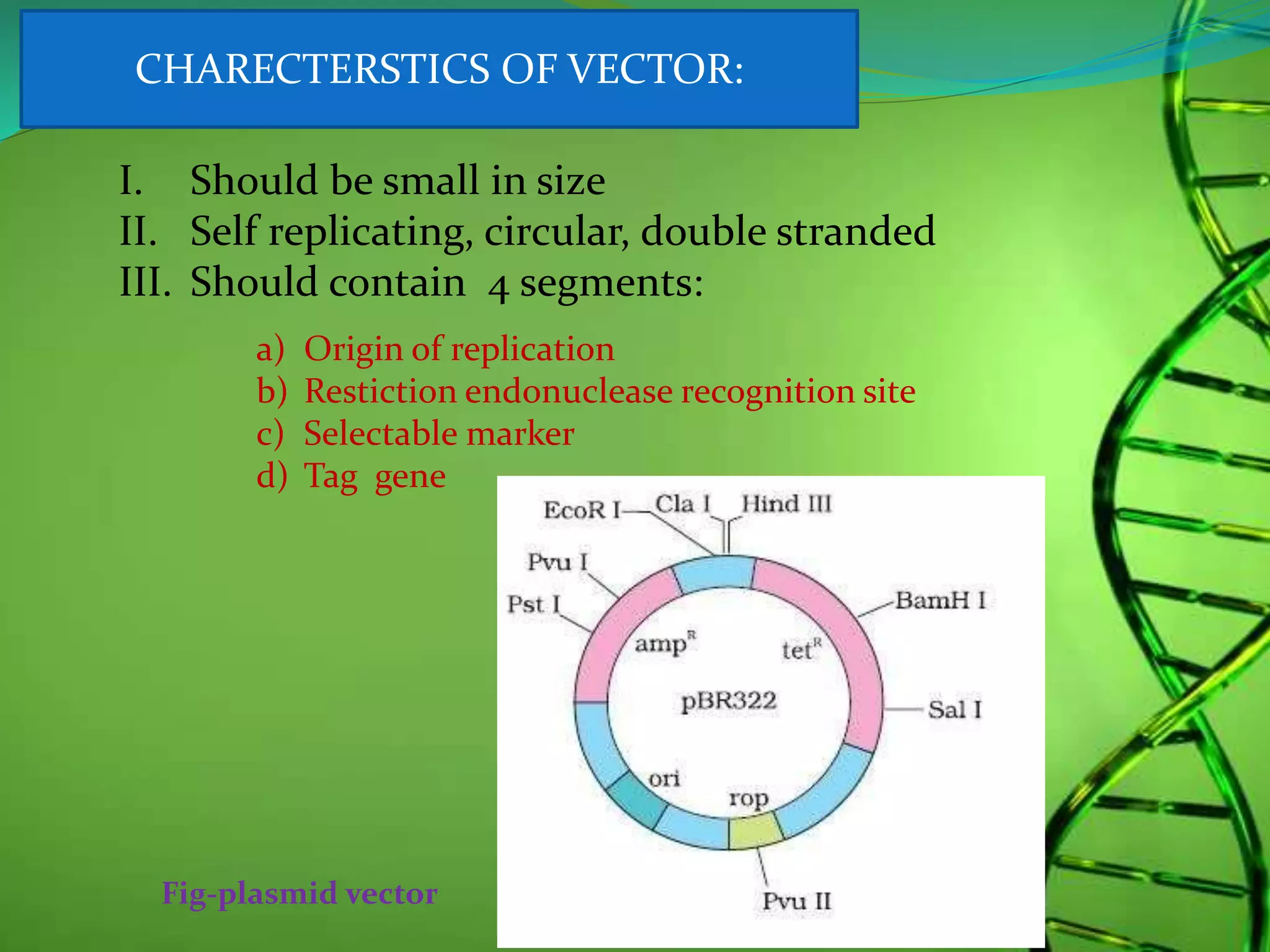
I. Should be small in size
II. Self replicating, circular, double stranded
III. Should contain 4 segments:
a) Origin of replication
b) Restiction endonuclease recognition site
c) Selectable marker
d) Tag gene
CHARECTERSTICS OF VECTOR:
Fig-plasmid vector
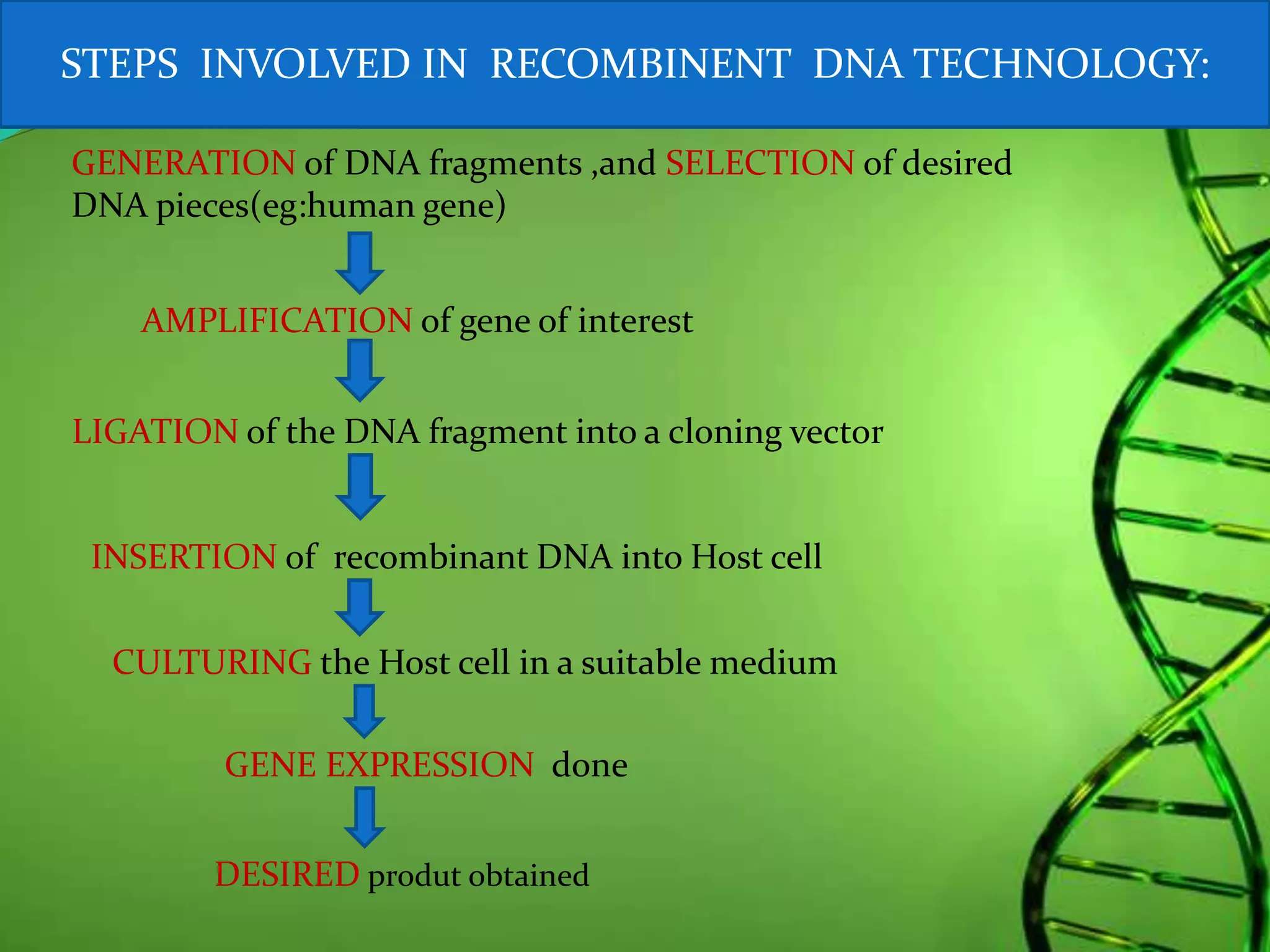
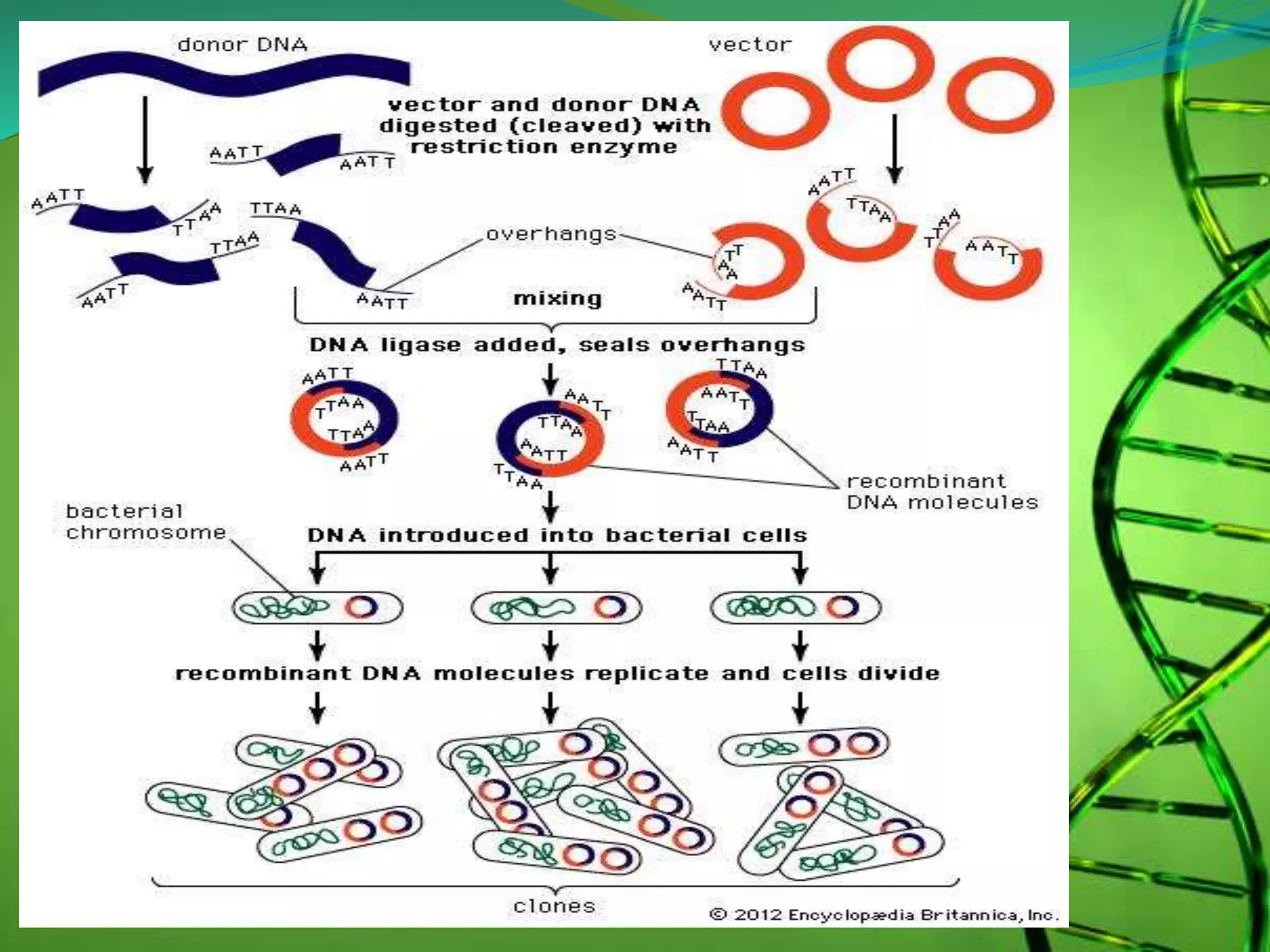
STEPS INVOLVED IN RECOMBINENT DNA TECHNOLOGY:
GENERATION of DNA fragments ,and SELECTION of desired
DNA pieces(eg:human gene)
AMPLIFICATION of gene of interest
LIGATION of the DNA fragment into a cloning vector
INSERTION of recombinant DNA into Host cell
CULTURING the Host cell in a suitable medium
GENE EXPRESSION done
DESIRED produt obtained
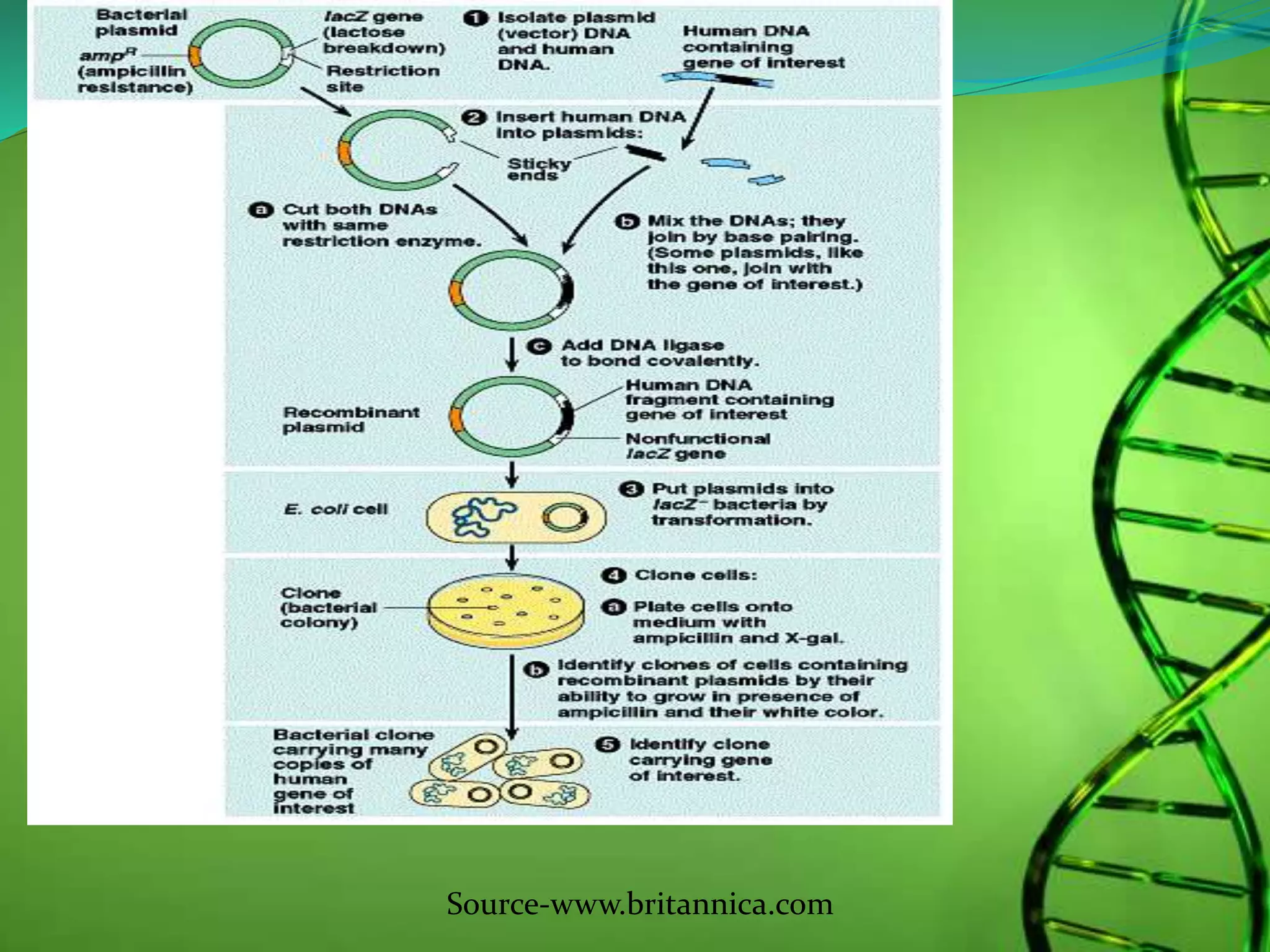
Source-www.britannica.com
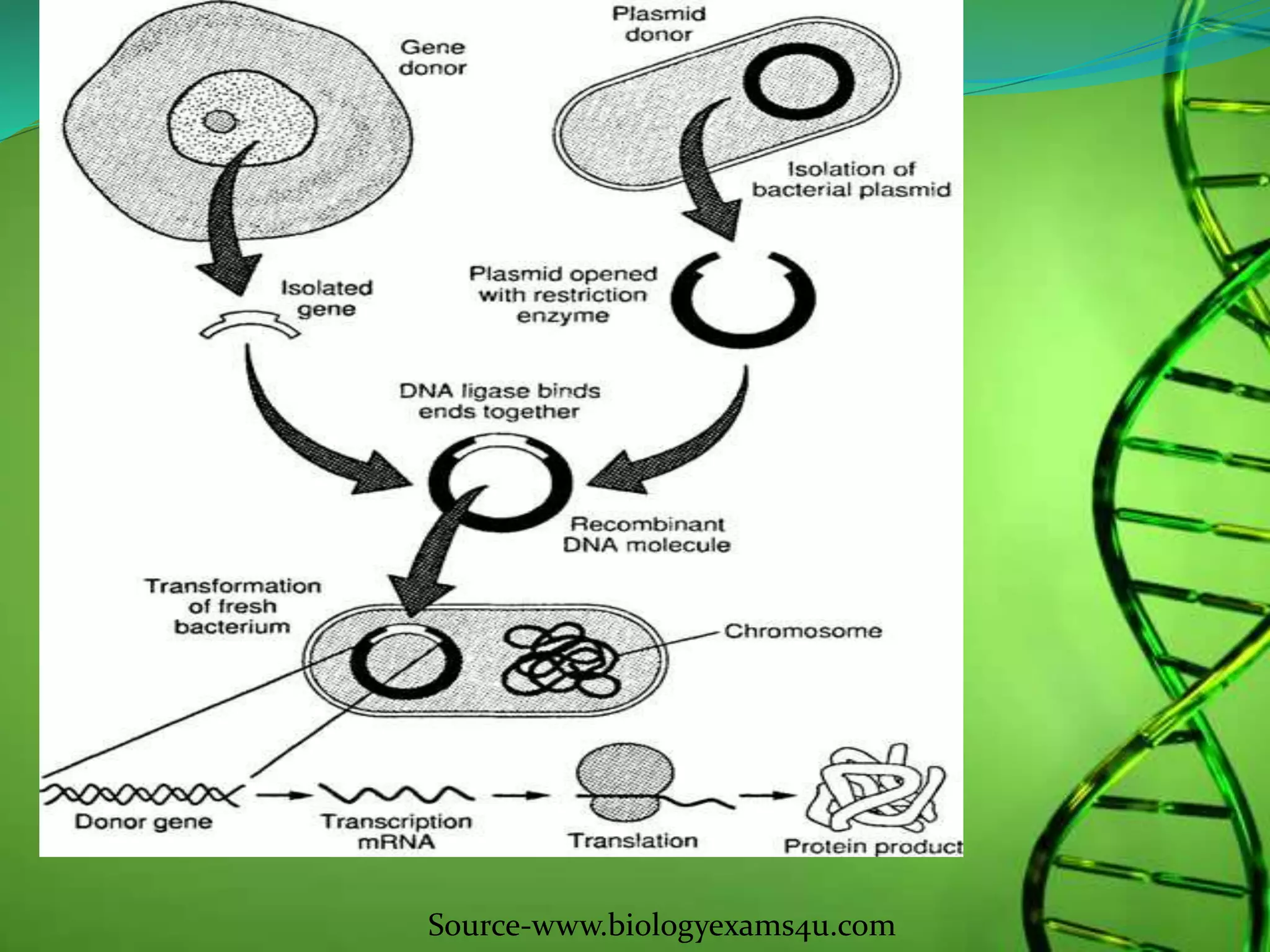
Source-www.biologyexams4u.com
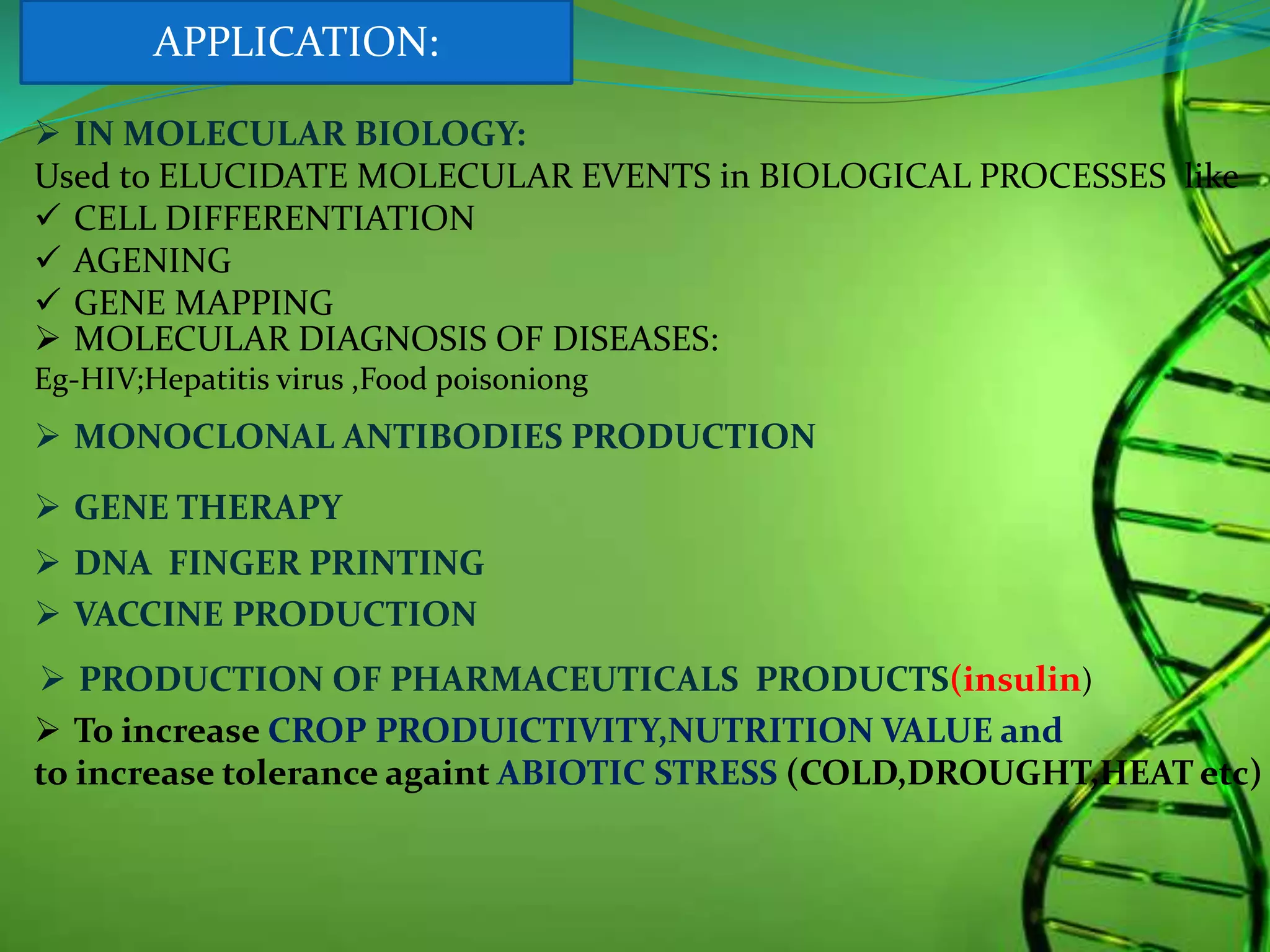
 IN MOLECULAR BIOLOGY:
Used to ELUCIDATE MOLECULAR EVENTS in BIOLOGICAL PROCESSES like
 CELL DIFFERENTIATION
 AGENING
 GENE MAPPING
 MOLECULAR DIAGNOSIS OF DISEASES:
Eg-HIV;Hepatitis virus ,Food poisoniong
 MONOCLONAL ANTIBODIES PRODUCTION
 GENE THERAPY
 DNA FINGER PRINTING
 VACCINE PRODUCTION
 PRODUCTION OF PHARMACEUTICALS PRODUCTS(insulin)
 To increase CROP PRODUICTIVITY,NUTRITION VALUE and
to increase tolerance againt ABIOTIC STRESS (COLD,DROUGHT,HEAT etc)
APPLICATION:
Recombinant dna technology

Recombinant dna technology

  • 1.
    RECOMBINANT DNA TECHNOLOGY NIKHIL KUMAR M.PHARM(1 st year) Bengal School Of Technology
  • 2.
    HISTORY  Herbert Boyer(1936)and Stanley N. Cohen(1935) devlop recombinant DNATecnology,showing that ther genetically engineered DNA molecules may be Cloned in foreign cells  THEY CONSTRUCTED 1ST RECOMBINENT DNA using Salmonella typhimurim.
  • 3.
    Recombinant DNA isterm used to describe the combination of two DNA Strands that are constructed artificially.Genetic scientists can do this to create Unique DNA strand for diffrent perposes,using several type of techniques DEFINITION: PRINCIPLE: Source-authorstream.com
  • 4.
    1. Restriction enzymes 2.Ligases 3. Miscellanious enzymes  RESRICTION ENZYMES:- ENDONUCLEASES Cuts DNA at ends EXONUCLEASES Cuts DNA at specific sites Pallindromic sites (i.e the sequence of base pairs reads the same on both DNA strands). Ex- 5’-GAATTC-3’ 3’-CTTAAG-5’ 4.Vectors 5.Host organism/cell Ex- Exonuclease III TOOLS OF RECOMBINANT DNA TECHNOLOGY
  • 5.
    1.Firstly letter derivedfrom genus name (italics) 2.Next,two letters derived from species name (italics) 3.The Roman number show order in which the enzyme were iosolated From bacterial strain. Ex- EcoRI is from Escherichia (E) coli(co), strain RY13(R) and first endonucleases(I) to be discovered. HindIII is from Haemophillus(H) influenzae(in), Strain Rd(d) and the third endonucleases(III) to be discovered. NOMENCLATURE OF RESTRICTION ENZYMES:
  • 6.
    Cut DNA fragmentsjoint covalently by DNA ligases Originally isolated from viruses Also occur in E.Coli and eukaryotic cells Actively participate in cellular DNA repair process Parmanently hold DNA pieces together......  Alkaline phosphatase : removes phosphate groups from 5’ends of single Or double stranded DNA /RNA.  Polyneucleotide kinase: involved in addition of phosphate groups  Nucleases:degrades single stranded DNARNA.  polymerases: Synthesis of nucleic acid .  DNA LIGASES: MISCELLANEOUS ENZYMES:
  • 7.
    Microbes multiply fastercompared to cells of higher organism (plants/animals) thus preffered to as host cell.  Prokaryotic hosts include E.Coli ,Bacillus subtilis  Eukaryotic hosts include saccharomyces cerevisiae(fungi), Mammalian cells ,plants(protoplast)......  Host cells:  VECTORS: Vectors are DNA molecules which carry a forign DNA fragment into the Host cells  TYPES:  Plasmid  Cosmid  Phasid  Bacteriophage  Artificial cromosomes
  • 8.
    I. Should besmall in size II. Self replicating, circular, double stranded III. Should contain 4 segments: a) Origin of replication b) Restiction endonuclease recognition site c) Selectable marker d) Tag gene CHARECTERSTICS OF VECTOR: Fig-plasmid vector
  • 9.
    STEPS INVOLVED INRECOMBINENT DNA TECHNOLOGY: GENERATION of DNA fragments ,and SELECTION of desired DNA pieces(eg:human gene) AMPLIFICATION of gene of interest LIGATION of the DNA fragment into a cloning vector INSERTION of recombinant DNA into Host cell CULTURING the Host cell in a suitable medium GENE EXPRESSION done DESIRED produt obtained
  • 10.
  • 11.
  • 12.
     IN MOLECULARBIOLOGY: Used to ELUCIDATE MOLECULAR EVENTS in BIOLOGICAL PROCESSES like  CELL DIFFERENTIATION  AGENING  GENE MAPPING  MOLECULAR DIAGNOSIS OF DISEASES: Eg-HIV;Hepatitis virus ,Food poisoniong  MONOCLONAL ANTIBODIES PRODUCTION  GENE THERAPY  DNA FINGER PRINTING  VACCINE PRODUCTION  PRODUCTION OF PHARMACEUTICALS PRODUCTS(insulin)  To increase CROP PRODUICTIVITY,NUTRITION VALUE and to increase tolerance againt ABIOTIC STRESS (COLD,DROUGHT,HEAT etc) APPLICATION: