
Recombinant DNA Technology
Hafiz.M.Zeeshan.Raza
Research Assistant_HEC_NRPU
hafizraza26@gmail.com
COMSATS UNIVERSITY SAHIWAL
Definition
• Recombinant DNA refers to the creation of
new combinations of DNA segments that are
not found together in nature.
• The isolation and manipulation of genes
allows for more precise genetic analysis as
well as practical applications in medicine,
agriculture, and industry.
The early development of genetics
• The discovery of the role of DNA was a
tremendous stimulus to genetic research, and
many famous biologists (Delbrück, Chargaff, Crick,
and Monod were among the most influential)
contributed to the second great age of genetics.
• In the 14 years between 1952 and 1966, the
• Structure of DNA was elucidated,
• The genetic code cracked, and
• The processes of transcription and
translation described.
The advent of gene cloning and the polymerase
chain reaction
• Then in the years 1971–1973 genetic research
was thrown back into gear
• A whole new methodology was developed,
enabling previously impossible experiments to be
planned and carried out, if not with ease, then at
least with success.
• These methods, referred to as recombinant DNA
technology or genetic engineering, and having at
their core the process of gene cloning, sparked
another great age of genetics.
The advent of gene cloning and the polymerase
chain reaction
• They led to rapid and efficient DNA sequencing
techniques that enabled the structures of
individual genes to be determined
• They led to procedures for studying the
regulation of individual genes, which have
allowed molecular biologists to understand
how aberrations in gene activity can result in
human diseases such as cancer.
The advent of gene cloning and the polymerase
chain reaction
• The techniques spawned modern
biotechnology, which puts genes to work in
production of proteins and other compounds
needed in medicine and industrial processes.
• According to DNA folklore, Kary Mullis
invented the polymerase chain reaction (PCR)
in 1985
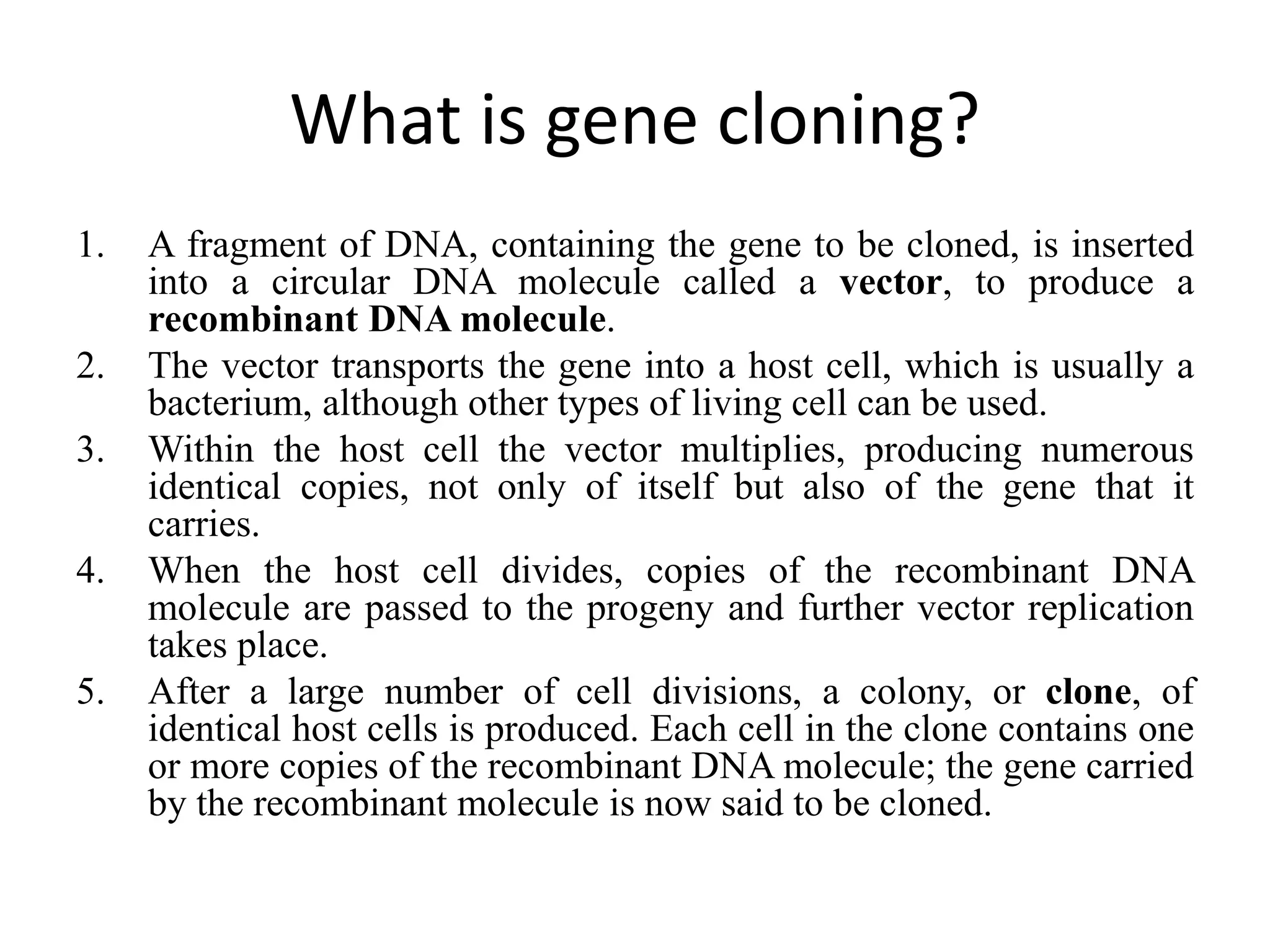
The basic steps in gene cloning.
What is gene cloning?
1. A fragment of DNA, containing the gene to be cloned, is inserted
into a circular DNA molecule called a vector, to produce a
recombinant DNA molecule.
2. The vector transports the gene into a host cell, which is usually a
bacterium, although other types of living cell can be used.
3. Within the host cell the vector multiplies, producing numerous
identical copies, not only of itself but also of the gene that it
carries.
4. When the host cell divides, copies of the recombinant DNA
molecule are passed to the progeny and further vector replication
takes place.
5. After a large number of cell divisions, a colony, or clone, of
identical host cells is produced. Each cell in the clone contains one
or more copies of the recombinant DNA molecule; the gene carried
by the recombinant molecule is now said to be cloned.
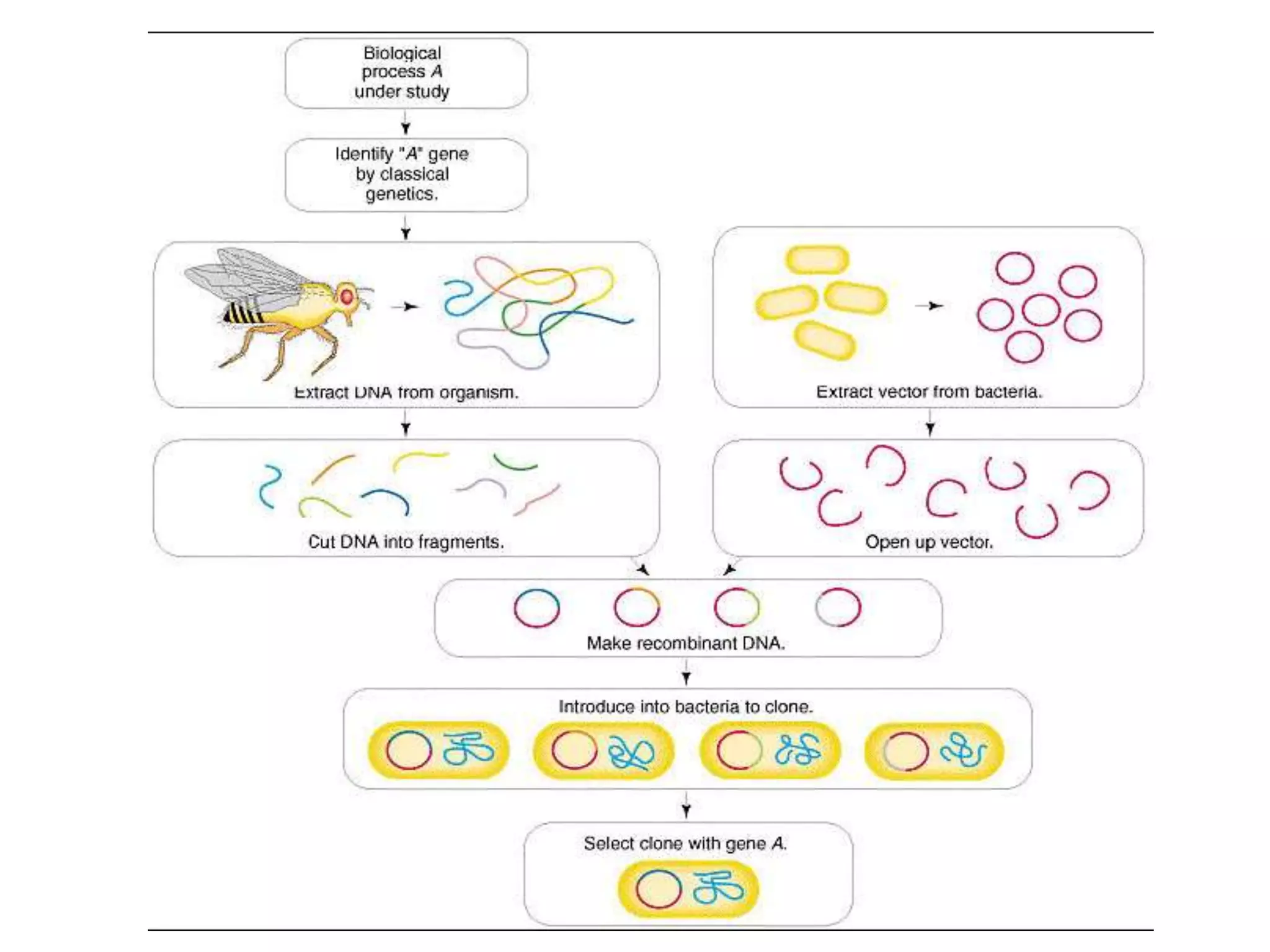
Making recombinant DNA
Overview:
• Isolate DNA
• Cut with restriction enzymes
• Ligate into cloning vector
• Transform recombinant DNA molecule into
host cell
• Each transformed cell will divide many, many
times to form a colony of millions of cells,
each of which carries the recombinant DNA
molecule (DNA clone)
A. Isolating DNA
1. Crude isolation of donor (foreign) DNA is
accomplished by isolating cells
• Disrupting lipid membranes with detergents
• Destroying proteins with phenol or proteases
• Degrading RNAs with RNase
• Leaving DNA at the end
A. Isolating DNA
2. Crude isolation of plasmid vector DNA is
accomplished by an alkaline lysis procedure or by
boiling cells which removes bacterial chromosomal
DNA from plasmid DNA.
3. To get purer DNA from either (1) or (2), crude
DNA is
a) Fractionated on a CsCl2 gradient
b) Precipitated with ethanol
c) Poured over a resin column that specifically
binds DNA
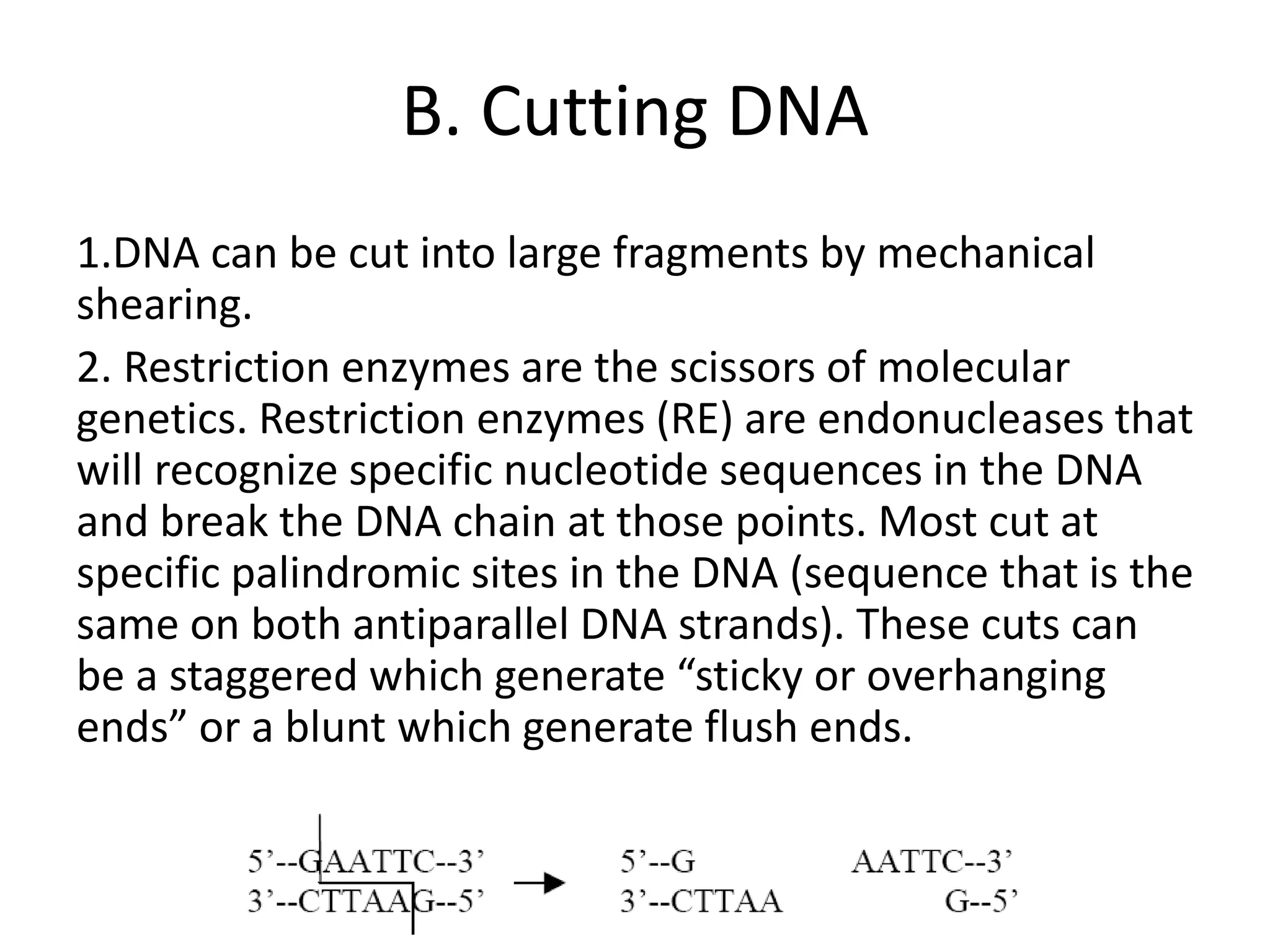
B. Cutting DNA
1.DNA can be cut into large fragments by mechanical
shearing.
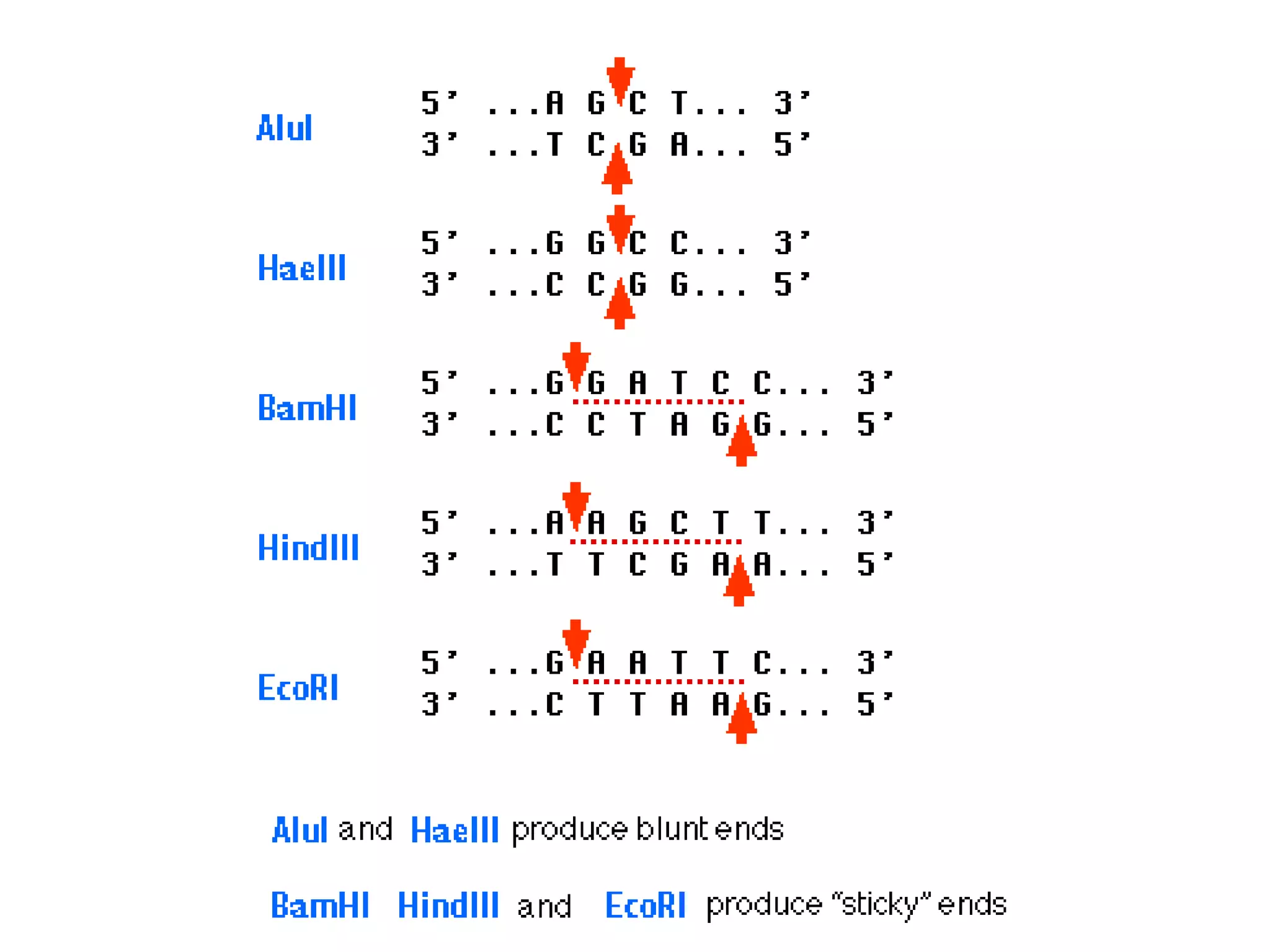
2. Restriction enzymes are the scissors of molecular
genetics. Restriction enzymes (RE) are endonucleases that
will recognize specific nucleotide sequences in the DNA
and break the DNA chain at those points. Most cut at
specific palindromic sites in the DNA (sequence that is the
same on both antiparallel DNA strands). These cuts can
be a staggered which generate “sticky or overhanging
ends” or a blunt which generate flush ends.
C. Joining DNA
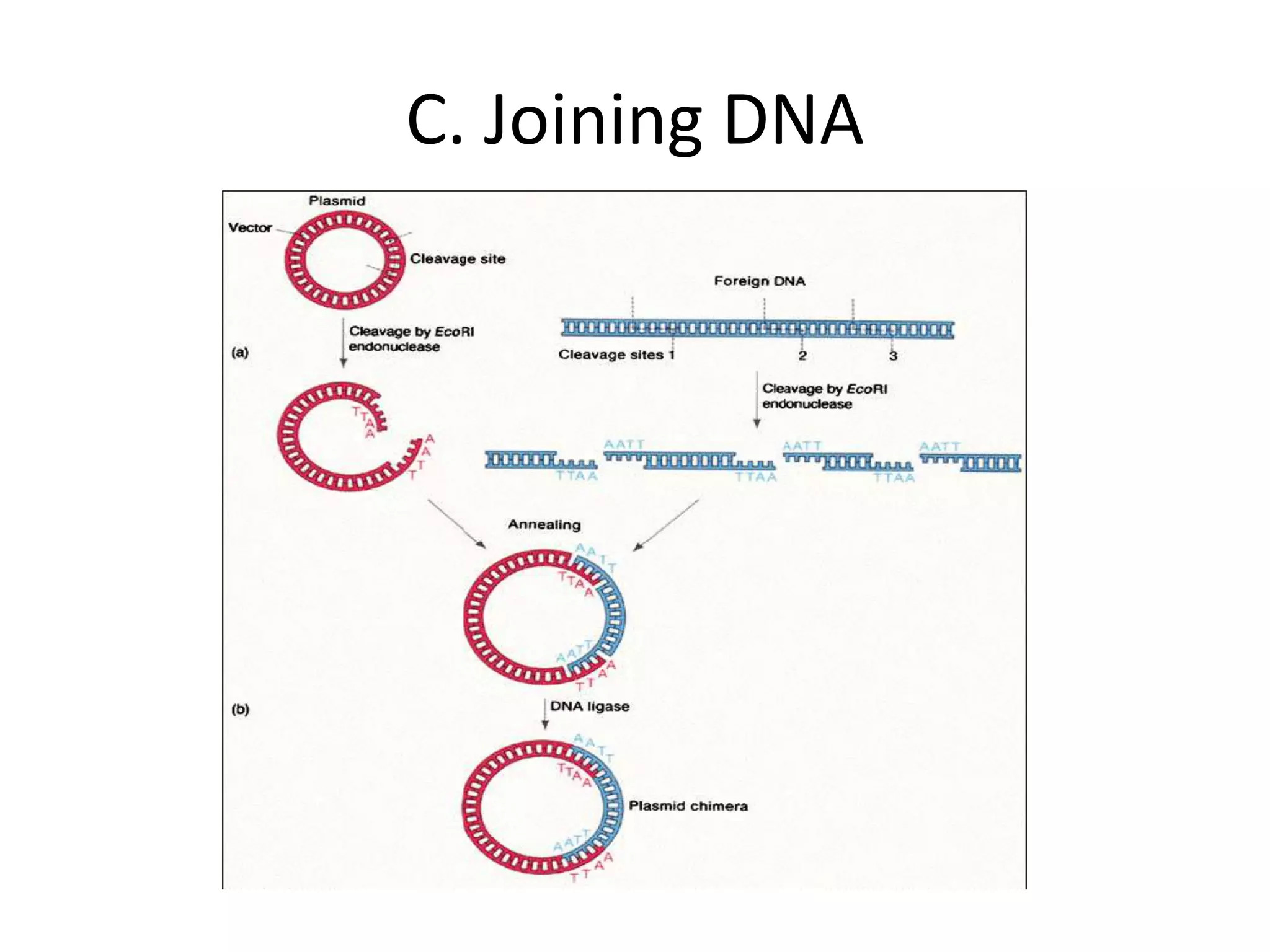
• Once you have isolated and cut the donor and
vector DNAs, they must be joined together.
• The DNAs are mixed together in a tube.
• If both have been cut with the same RE, the ends
will match up because they are sticky.
• DNA ligase is the glue of molecular genetics that
holds the ends of the DNAs together.
• DNA ligase creates a phosophodiester bond
between two DNA ends.
C. Joining DNA
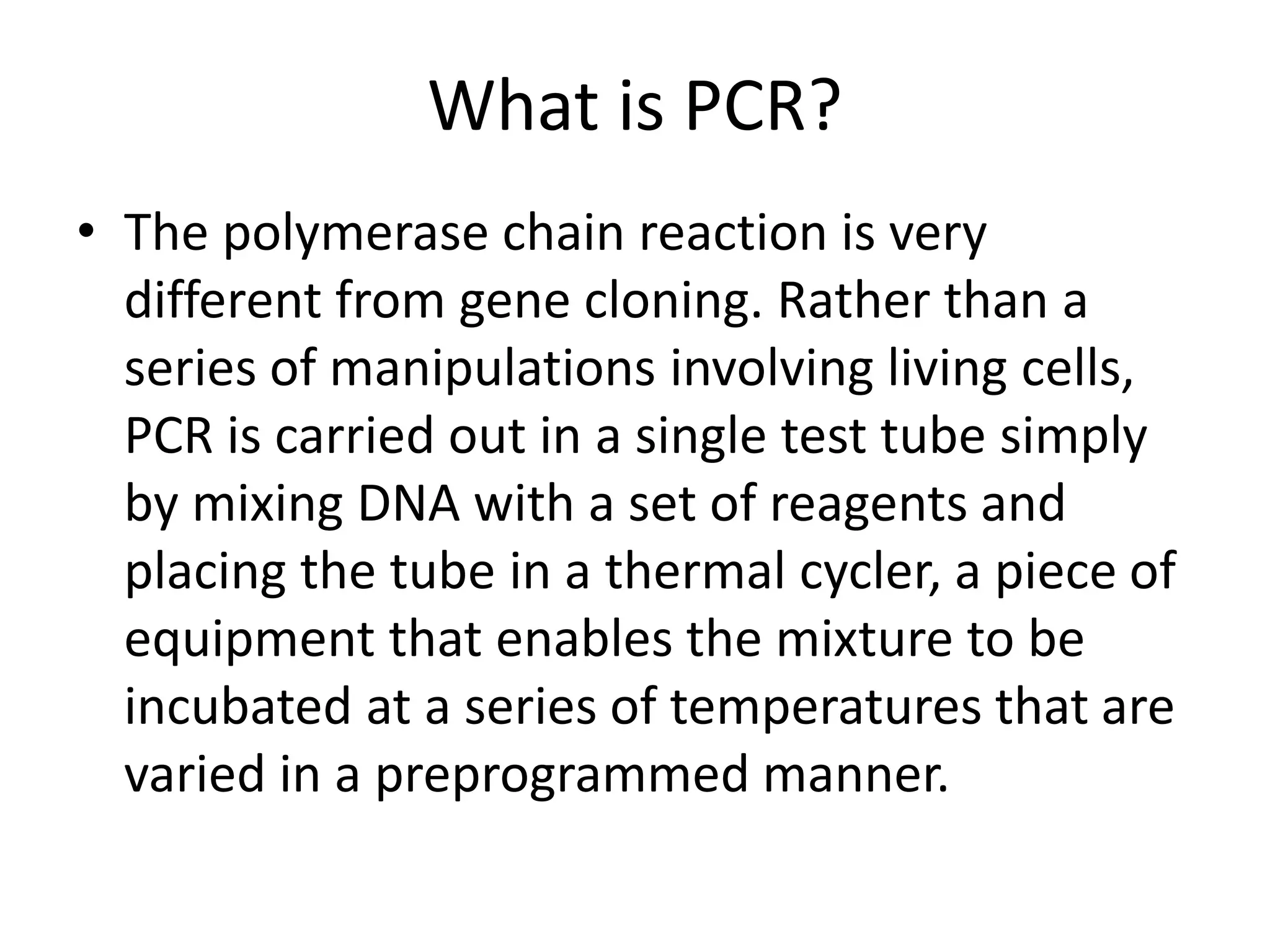
D. Amplifying the recombinant DNA
• To recover large amounts of the recombinant
DNA molecule, it must be amplified. This is
accomplished by transforming the recombinant
DNA into a bacterial host strain.
• The cells are treated with CaCl2
• DNA is added
• Cells are heat shocked at 42 C
• DNA goes into cell by a somewhat
unknown mechanism.)
D. Amplifying the recombinant DNA
• Once in a cell, the recombinant DNA will be
replicated.
• When the cell divides, the replicated
recombinant molecules go to both daughter
cells which themselves will divide later.
• Thus, the DNA is amplified.
• DNA clone = A section of DNA that has been
inserted into a vector molecule and then
replicated in a host cell to form many copies.
D. Amplifying the recombinant DNA
What is PCR?
• The polymerase chain reaction is very
different from gene cloning. Rather than a
series of manipulations involving living cells,
PCR is carried out in a single test tube simply
by mixing DNA with a set of reagents and
placing the tube in a thermal cycler, a piece of
equipment that enables the mixture to be
incubated at a series of temperatures that are
varied in a preprogrammed manner.
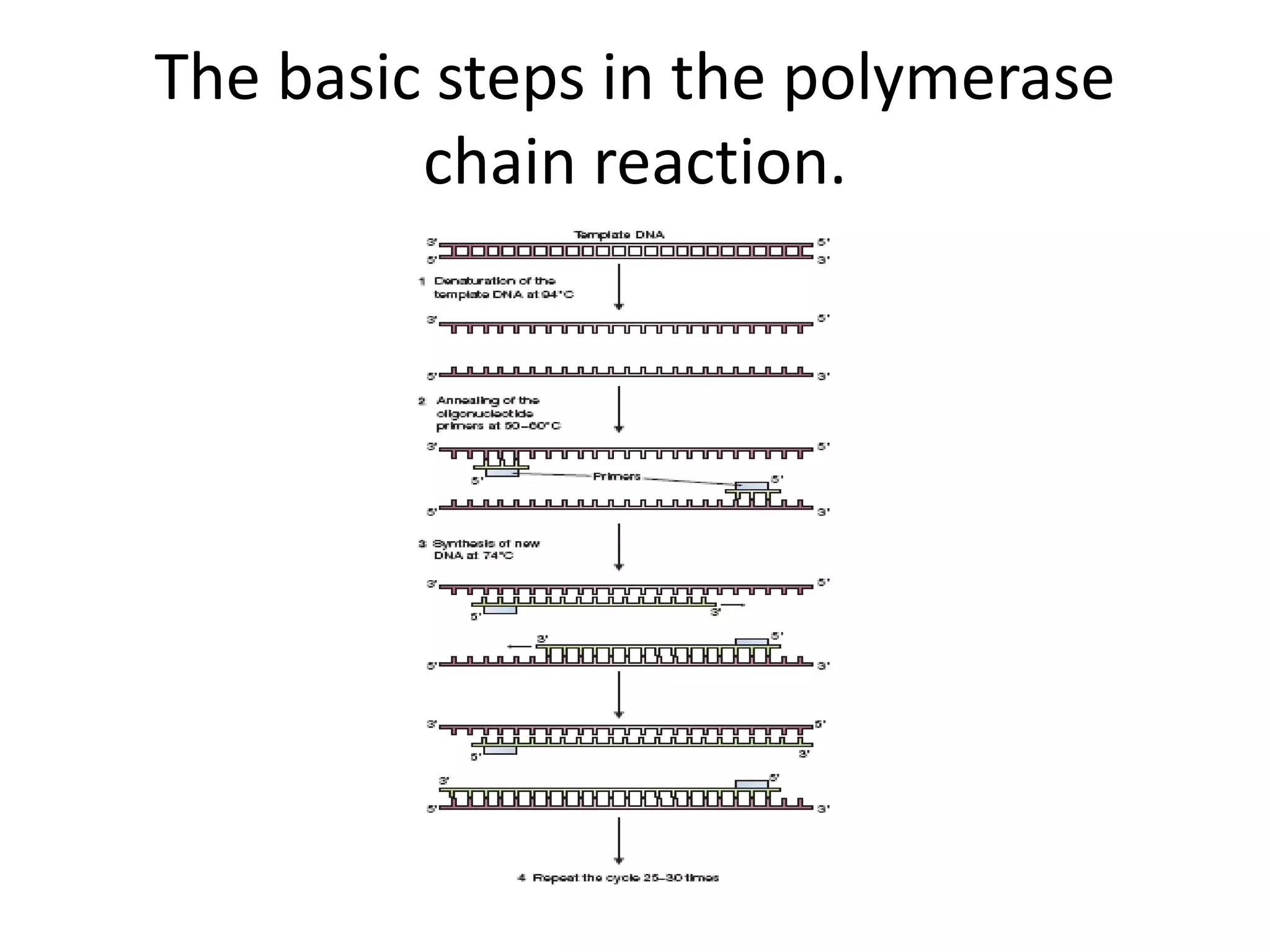
The basic steps in the polymerase
chain reaction.
The basic steps in the polymerase
chain reaction
1. The mixture is heated to 94°C, at which temperature the
hydrogen bonds that hold together the two strands of the
double-stranded DNA molecule are broken, causing the molecule
to denature.
2. The mixture is cooled down to 50–60°C. The two strands of
each molecule could join back together at this temperature, but
most do not because the mixture contains a large excess of short
DNA molecules, called oligonucleotides or primers, which
anneal to the DNA molecules at specific positions.
3. The temperature is raised to 74°C. This is a good working
temperature for the Taq DNA polymerase that is present in the
mixture. The Taq DNA polymerase attaches to one end of each
primer and synthesizes new strands of DNA, complementary to
the template DNA molecules, during this step of the PCR. Now
we have four stands of DNA instead of the two that there were
to start with.
The basic steps in the polymerase
chain reaction
4. The temperature is increased back to 94°C. The
double-stranded DNA molecules, each of which
consists of one strand of the original molecule and
one new strand of DNA, denature into single
strands. This begins a second cycle of denaturation–
annealing–synthesis, at the end of which there are
eight DNA strands. By repeating the cycle 30 times
the double-stranded molecule that we began with
is converted into over 130 million new double-
stranded molecules, each one a copy of the region
of the starting molecule delineated by the
annealing sites of the two primers.
PCR limitations
• In order for the primers to anneal to the correct
positions, either side of the gene of interest, the
sequences of these annealing sites must be
known.
• It is easy to synthesize a primer with a
predetermined sequence, but if the sequences of
the annealing sites are unknown then the
appropriate primers cannot be made.
• This means that PCR cannot be used to isolate
genes that have not been studied before
PCR limitations
• There is a limit to the length of DNA sequence
that can be copied by PCR. Five kilobases (kb)
can be copied fairly easily, and segments up to
forty kb can be dealt with by using specialized
techniques, but this is shorter than the
lengths of many genes, especially those of
humans and other vertebrates. Cloning must
be used if an intact version of a long gene is
required.
THANK YOU FOR YOUR ATTENTION

Recombinant DNA technology

  • 1.
    Recombinant DNA Technology Hafiz.M.Zeeshan.Raza ResearchAssistant_HEC_NRPU hafizraza26@gmail.com COMSATS UNIVERSITY SAHIWAL
  • 2.
    Definition • Recombinant DNArefers to the creation of new combinations of DNA segments that are not found together in nature. • The isolation and manipulation of genes allows for more precise genetic analysis as well as practical applications in medicine, agriculture, and industry.
  • 3.
    The early developmentof genetics • The discovery of the role of DNA was a tremendous stimulus to genetic research, and many famous biologists (Delbrück, Chargaff, Crick, and Monod were among the most influential) contributed to the second great age of genetics. • In the 14 years between 1952 and 1966, the • Structure of DNA was elucidated, • The genetic code cracked, and • The processes of transcription and translation described.
  • 4.
    The advent ofgene cloning and the polymerase chain reaction • Then in the years 1971–1973 genetic research was thrown back into gear • A whole new methodology was developed, enabling previously impossible experiments to be planned and carried out, if not with ease, then at least with success. • These methods, referred to as recombinant DNA technology or genetic engineering, and having at their core the process of gene cloning, sparked another great age of genetics.
  • 5.
    The advent ofgene cloning and the polymerase chain reaction • They led to rapid and efficient DNA sequencing techniques that enabled the structures of individual genes to be determined • They led to procedures for studying the regulation of individual genes, which have allowed molecular biologists to understand how aberrations in gene activity can result in human diseases such as cancer.
  • 6.
    The advent ofgene cloning and the polymerase chain reaction • The techniques spawned modern biotechnology, which puts genes to work in production of proteins and other compounds needed in medicine and industrial processes. • According to DNA folklore, Kary Mullis invented the polymerase chain reaction (PCR) in 1985
  • 7.
    The basic stepsin gene cloning.
  • 8.
    What is genecloning? 1. A fragment of DNA, containing the gene to be cloned, is inserted into a circular DNA molecule called a vector, to produce a recombinant DNA molecule. 2. The vector transports the gene into a host cell, which is usually a bacterium, although other types of living cell can be used. 3. Within the host cell the vector multiplies, producing numerous identical copies, not only of itself but also of the gene that it carries. 4. When the host cell divides, copies of the recombinant DNA molecule are passed to the progeny and further vector replication takes place. 5. After a large number of cell divisions, a colony, or clone, of identical host cells is produced. Each cell in the clone contains one or more copies of the recombinant DNA molecule; the gene carried by the recombinant molecule is now said to be cloned.
  • 9.
    Making recombinant DNA Overview: •Isolate DNA • Cut with restriction enzymes • Ligate into cloning vector • Transform recombinant DNA molecule into host cell • Each transformed cell will divide many, many times to form a colony of millions of cells, each of which carries the recombinant DNA molecule (DNA clone)
  • 11.
    A. Isolating DNA 1.Crude isolation of donor (foreign) DNA is accomplished by isolating cells • Disrupting lipid membranes with detergents • Destroying proteins with phenol or proteases • Degrading RNAs with RNase • Leaving DNA at the end
  • 12.
    A. Isolating DNA 2.Crude isolation of plasmid vector DNA is accomplished by an alkaline lysis procedure or by boiling cells which removes bacterial chromosomal DNA from plasmid DNA. 3. To get purer DNA from either (1) or (2), crude DNA is a) Fractionated on a CsCl2 gradient b) Precipitated with ethanol c) Poured over a resin column that specifically binds DNA
  • 13.
    B. Cutting DNA 1.DNAcan be cut into large fragments by mechanical shearing. 2. Restriction enzymes are the scissors of molecular genetics. Restriction enzymes (RE) are endonucleases that will recognize specific nucleotide sequences in the DNA and break the DNA chain at those points. Most cut at specific palindromic sites in the DNA (sequence that is the same on both antiparallel DNA strands). These cuts can be a staggered which generate “sticky or overhanging ends” or a blunt which generate flush ends.
  • 15.
    C. Joining DNA •Once you have isolated and cut the donor and vector DNAs, they must be joined together. • The DNAs are mixed together in a tube. • If both have been cut with the same RE, the ends will match up because they are sticky. • DNA ligase is the glue of molecular genetics that holds the ends of the DNAs together. • DNA ligase creates a phosophodiester bond between two DNA ends.
  • 16.
  • 17.
    D. Amplifying therecombinant DNA • To recover large amounts of the recombinant DNA molecule, it must be amplified. This is accomplished by transforming the recombinant DNA into a bacterial host strain. • The cells are treated with CaCl2 • DNA is added • Cells are heat shocked at 42 C • DNA goes into cell by a somewhat unknown mechanism.)
  • 18.
    D. Amplifying therecombinant DNA • Once in a cell, the recombinant DNA will be replicated. • When the cell divides, the replicated recombinant molecules go to both daughter cells which themselves will divide later. • Thus, the DNA is amplified. • DNA clone = A section of DNA that has been inserted into a vector molecule and then replicated in a host cell to form many copies.
  • 19.
    D. Amplifying therecombinant DNA
  • 20.
    What is PCR? •The polymerase chain reaction is very different from gene cloning. Rather than a series of manipulations involving living cells, PCR is carried out in a single test tube simply by mixing DNA with a set of reagents and placing the tube in a thermal cycler, a piece of equipment that enables the mixture to be incubated at a series of temperatures that are varied in a preprogrammed manner.
  • 21.
    The basic stepsin the polymerase chain reaction.
  • 22.
    The basic stepsin the polymerase chain reaction 1. The mixture is heated to 94°C, at which temperature the hydrogen bonds that hold together the two strands of the double-stranded DNA molecule are broken, causing the molecule to denature. 2. The mixture is cooled down to 50–60°C. The two strands of each molecule could join back together at this temperature, but most do not because the mixture contains a large excess of short DNA molecules, called oligonucleotides or primers, which anneal to the DNA molecules at specific positions. 3. The temperature is raised to 74°C. This is a good working temperature for the Taq DNA polymerase that is present in the mixture. The Taq DNA polymerase attaches to one end of each primer and synthesizes new strands of DNA, complementary to the template DNA molecules, during this step of the PCR. Now we have four stands of DNA instead of the two that there were to start with.
  • 23.
    The basic stepsin the polymerase chain reaction 4. The temperature is increased back to 94°C. The double-stranded DNA molecules, each of which consists of one strand of the original molecule and one new strand of DNA, denature into single strands. This begins a second cycle of denaturation– annealing–synthesis, at the end of which there are eight DNA strands. By repeating the cycle 30 times the double-stranded molecule that we began with is converted into over 130 million new double- stranded molecules, each one a copy of the region of the starting molecule delineated by the annealing sites of the two primers.
  • 24.
    PCR limitations • Inorder for the primers to anneal to the correct positions, either side of the gene of interest, the sequences of these annealing sites must be known. • It is easy to synthesize a primer with a predetermined sequence, but if the sequences of the annealing sites are unknown then the appropriate primers cannot be made. • This means that PCR cannot be used to isolate genes that have not been studied before
  • 25.
    PCR limitations • Thereis a limit to the length of DNA sequence that can be copied by PCR. Five kilobases (kb) can be copied fairly easily, and segments up to forty kb can be dealt with by using specialized techniques, but this is shorter than the lengths of many genes, especially those of humans and other vertebrates. Cloning must be used if an intact version of a long gene is required.
  • 26.
    THANK YOU FORYOUR ATTENTION