Presentation on…
Moisture Activated Dry Granulation
Technology
12/10/2016 1
By-
Pratik Swarup Das
M.Pharm (pharmaceutics)
NIET, Greater Noida.
CONTENTS
Advanced Granulation Techniques
Moisture Activated Dry Granulation Technology
Advantages
Disadvantages
12/10/2016 2
Why advanced granulation techniques?
To overcome the limitations and difficulties associated
with-
dry granulation
wet granulation
direct compression
12/10/2016 3
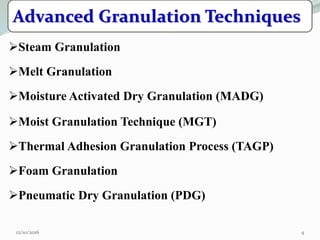
Advanced Granulation Techniques
Steam Granulation
Melt Granulation
Moisture Activated Dry Granulation (MADG)
Moist Granulation Technique (MGT)
Thermal Adhesion Granulation Process (TAGP)
Foam Granulation
Pneumatic Dry Granulation (PDG)
12/10/2016 4
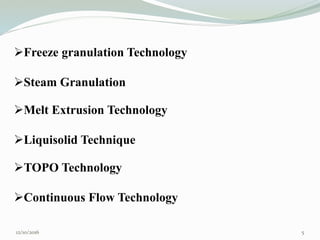
Freeze granulation Technology
Steam Granulation
Melt Extrusion Technology
Liquisolid Technique
TOPO Technology
Continuous Flow Technology
12/10/2016 5
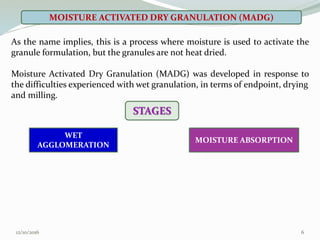
MOISTURE ACTIVATED DRY GRANULATION (MADG)
As the name implies, this is a process where moisture is used to activate the
granule formulation, but the granules are not heat dried.
Moisture Activated Dry Granulation (MADG) was developed in response to
the difficulties experienced with wet granulation, in terms of endpoint, drying
and milling.
STAGES
WET
AGGLOMERATION
MOISTURE ABSORPTION
12/10/2016 6
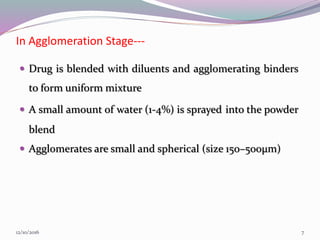
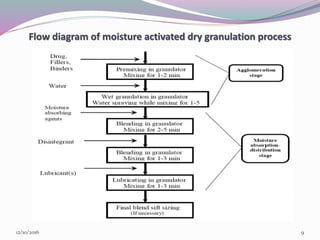
In Agglomeration Stage---
 Drug is blended with diluents and agglomerating binders
to form uniform mixture
 A small amount of water (1-4%) is sprayed into the powder
blend
 Agglomerates are small and spherical (size 150–500μm)
12/10/2016 7
In moisture absorption stage---
 Moisture absorbents like microcrystalline cellulose or
silicon dioxide, are added while mixing.
 Moisture redistribution within the mixture.
 Entire mixture becomes relatively dry.
 Granulation with uniform particle-size distribution.
12/10/2016 8
Flow diagram of moisture activated dry granulation process
12/10/2016 9
Advantages:
1.Applicable to more than 90% of the granulation need for
pharmaceutical, food and nutritional industry.
2. Short processing time.
3. Suitable for continuous processing
4. Less energy involved during processing.
12/10/2016 10
Disadvantages:
 Moisture sensitive and high moisture absorbing API are
poor candidates.
 Formulations with high drug loading are difficult to
develop.
 Could be other issues with the API, with high-drug load
formulations being particularly difficult to develop.
12/10/2016 11
THANK
YOU….
12/10/2016 12

Moisture Activated Dry Granulation Technology

  • 1.
    Presentation on… Moisture ActivatedDry Granulation Technology 12/10/2016 1 By- Pratik Swarup Das M.Pharm (pharmaceutics) NIET, Greater Noida.
  • 2.
    CONTENTS Advanced Granulation Techniques MoistureActivated Dry Granulation Technology Advantages Disadvantages 12/10/2016 2
  • 3.
    Why advanced granulationtechniques? To overcome the limitations and difficulties associated with- dry granulation wet granulation direct compression 12/10/2016 3
  • 4.
    Advanced Granulation Techniques SteamGranulation Melt Granulation Moisture Activated Dry Granulation (MADG) Moist Granulation Technique (MGT) Thermal Adhesion Granulation Process (TAGP) Foam Granulation Pneumatic Dry Granulation (PDG) 12/10/2016 4
  • 5.
    Freeze granulation Technology SteamGranulation Melt Extrusion Technology Liquisolid Technique TOPO Technology Continuous Flow Technology 12/10/2016 5
  • 6.
    MOISTURE ACTIVATED DRYGRANULATION (MADG) As the name implies, this is a process where moisture is used to activate the granule formulation, but the granules are not heat dried. Moisture Activated Dry Granulation (MADG) was developed in response to the difficulties experienced with wet granulation, in terms of endpoint, drying and milling. STAGES WET AGGLOMERATION MOISTURE ABSORPTION 12/10/2016 6
  • 7.
    In Agglomeration Stage--- Drug is blended with diluents and agglomerating binders to form uniform mixture  A small amount of water (1-4%) is sprayed into the powder blend  Agglomerates are small and spherical (size 150–500μm) 12/10/2016 7
  • 8.
    In moisture absorptionstage---  Moisture absorbents like microcrystalline cellulose or silicon dioxide, are added while mixing.  Moisture redistribution within the mixture.  Entire mixture becomes relatively dry.  Granulation with uniform particle-size distribution. 12/10/2016 8
  • 9.
    Flow diagram ofmoisture activated dry granulation process 12/10/2016 9
  • 10.
    Advantages: 1.Applicable to morethan 90% of the granulation need for pharmaceutical, food and nutritional industry. 2. Short processing time. 3. Suitable for continuous processing 4. Less energy involved during processing. 12/10/2016 10
  • 11.
    Disadvantages:  Moisture sensitiveand high moisture absorbing API are poor candidates.  Formulations with high drug loading are difficult to develop.  Could be other issues with the API, with high-drug load formulations being particularly difficult to develop. 12/10/2016 11
  • 12.