Mr. Sagar N Firke
Dept of
Pharmaceutics
Nanded Pharmacy College,
Nanded, Maharashtra
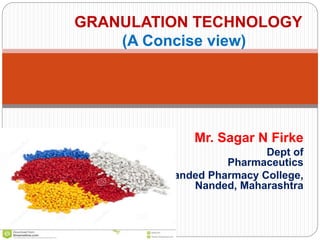
GRANULATION TECHNOLOGY
(A Concise view)
Granulation: “Granulation is the process in which
primary powder particles are made to adhere to form
larger, multiparticle entities called granules”
Why granulation?
To prevent the segregation of the constituents of the powder
mix.
 To improve the flow properties of the mix.
 To improve the compaction characteristics of the mix.
 Prevents dust formation of toxic drugs.
 Granulation may reduce cake formation of hygroscopic
substances.
 Occupy less volume per unit weight.
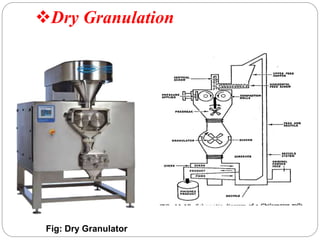
Dry Granulation
Fig: Dry Granulator
 Compression granulation involves the compaction of the components
of tablet formulation by means of tablet press and followed by milling
and screening prior to final compaction into tablet.
 Compacted mass is called as ‘slug’ and the process is called as
‘slugging’.
 Compression granulation can also be performed on a specially designed
machine called a roller compactor.
 The compaction force of the roller compactor is controlled by three
variables.
 The hydraulic pressure exerted on the compaction rolls.
 The rotational speed of the compaction roll.
 The rotational speed of the rotating screw.
Wet Granulation
 Wet granulation involves the massing of a mix of dry primary
powder particles using a granulating fluid.
 Granulating fluid consist of binder( PVP, Sucrose ,etc) & suitable
solvent( Water, alcohol, etc)
 The fluid contains a solvent which must be volatile so that it can be
removed by drying, and be non-toxic.
 Water is commonly used solvent for economical and ecological reasons.
 Water has disadvantages as a solvent, it may adversely affect drug
stability, it needs a longer drying time than do organic solvents.
 Increases the length of the process and again may affect stability because
of the extended exposure to heat.
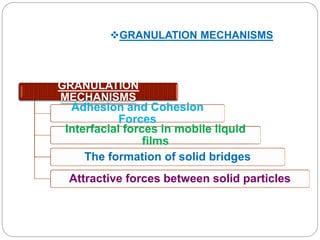
GRANULATION MECHANISMS
GRANULATION
MECHANISMS
Adhesion and Cohesion
Forces
Interfacial forces in mobile liquid
films
The formation of solid bridges
Attractive forces between solid particles
 Adhesion and Cohesion Forces.
 Sufficient liquid is present in a powder to form a very thin,
immobile layer.
 There will be decrease in interparticulate distance and an
increase in contact area between the particles.
 The bond strength between the particles will be increased
because of van-der-Waals forces.
 Films may be present as residual liquid after drying of
granules, ; these films do not contribute significantly to the
final granule strength.
Interfacial forces in mobile liquid films
 During wet granulation liquid is added to the powder mix and will
be distributed as films around and between the particles.
 Sufficient liquid is usually added to convert immobile layer into a
mobile film
 There are three states of water distribution
 Pendular
 Funicular
 Capillary
Interfacial forces in mobile liquid films
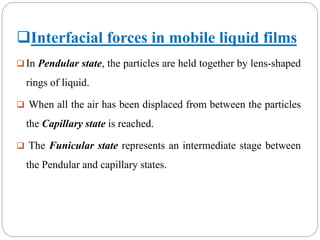
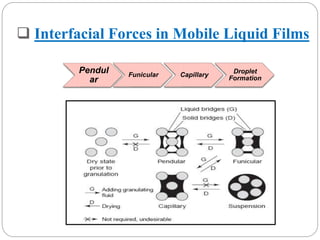
 In Pendular state, the particles are held together by lens-shaped
rings of liquid.
 When all the air has been displaced from between the particles
the Capillary state is reached.
 The Funicular state represents an intermediate stage between
the Pendular and capillary states.
 Interfacial Forces in Mobile Liquid Films
Pendul
ar
Funicular Capillary
Droplet
Formation
The formation of solid bridges
Partial melting
Hardening binders
Crystallization of
dissolved substances.
The formation of solid bridges
Partial melting
Hardening binders
Crystallization of dissolved
substances
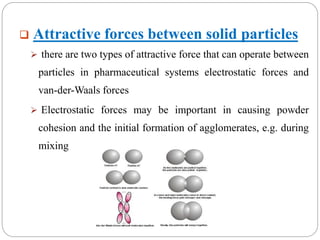
 Attractive forces between solid particles
 there are two types of attractive force that can operate between
particles in pharmaceutical systems electrostatic forces and
van-der-Waals forces
 Electrostatic forces may be important in causing powder
cohesion and the initial formation of agglomerates, e.g. during
mixing
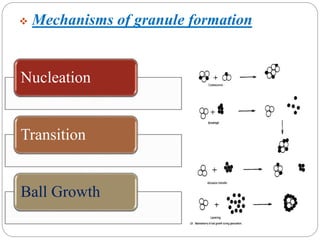
 Mechanisms of granule formation
Nucleation
Transition
Ball Growth
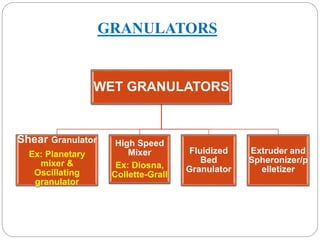
GRANULATORS
WET GRANULATORS
Shear Granulator
Ex: Planetary
mixer &
Oscillating
granulator
High Speed
Mixer
Ex: Diosna,
Collette-Grall
Fluidized
Bed
Granulator
Extruder and
Spheronizer/p
elletizer
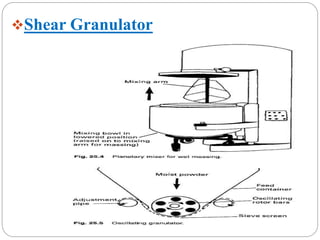
Shear Granulator
Shear Granulator
Powder mixing usually has to be performed as a separate operation
using suitable mixing equipment.
The mixed powders are fed into the bowl of the
planetary mixer and granulating liquid is added as
the paddle of the mixer agitates the powders.
The moist mass has then to be transferred to a granulator, such as an
oscillating granulator.
 The mass should be sufficiently moist to form discrete granules.
If excess liquid is added, strings of material will be formed
The granules can be collected on trays and transferred to a drying
Oven.
High-speed mixer/granulators (ex. Diosana)
 The machines have a stainless steel mixing bowl containing a three-
bladed main impeller, which revolves in the horizontal
plane, and a three-bladed auxiliary chopper.
 dry powders are placed in the bowl and mixed by the rotating impeller
for a few minutes.
 Granulating liquid is then added via a port
 The chopper is usually switched on when
the moist mass is formed
 Once a satisfactory granule has been produced,
the granular product is discharged, passing through
a wire mesh which breaks up any large aggregates,
into the bowl of a fluidized-bed drier
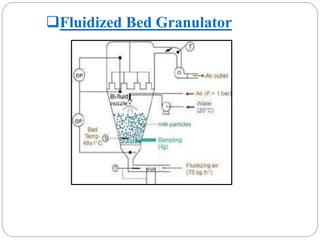
 Fluidized-bed Granulator( Aeromatic)
 FBG have similar design and operation to fluidized-bed driers,
i.e. The particles are fluidized in a stream of air.
 Heated & filtered air is blown through bed of unmixed powder
to fluidized the particles.
 Granulation fluid is sprayed from a nozzle on the bed of powder
helps to adhere the powder particles to each other.
 After sufficient size is achieved spray is turned off and continue
the air supply for the drying purpose.
 Advantages
 All the process such as mixing and granulation is done in unit
equipment. Which saves labour cost, transfer losses and time.
 Disadvantages
 Instrument is expensive
 Process optimization requires & needs extensive
developmental work.
 There are numerous apparatus, process & product parameters
need to be fixed.
Ex: Air distribution, Nozzle height, Bed load, Air flow rate ,
Type of binder, Binder solvent etc.
Fluidized Bed Granulator
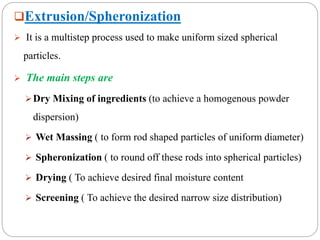
Extrusion/Spheronization
 It is a multistep process used to make uniform sized spherical
particles.
 The main steps are
Dry Mixing of ingredients (to achieve a homogenous powder
dispersion)
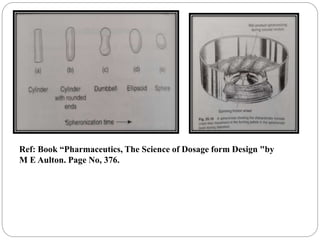
 Wet Massing ( to form rod shaped particles of uniform diameter)
 Spheronization ( to round off these rods into spherical particles)
 Drying ( To achieve desired final moisture content
 Screening ( To achieve the desired narrow size distribution)
Ref: Book “Pharmaceutics, The Science of Dosage form Design "by
M E Aulton. Page No, 376.
“An investment in knowledge pays the
best interest”.
Benjamin Franklin

Granulation Technology (A Concise View)

  • 1.
    Mr. Sagar NFirke Dept of Pharmaceutics Nanded Pharmacy College, Nanded, Maharashtra GRANULATION TECHNOLOGY (A Concise view)
  • 2.
    Granulation: “Granulation isthe process in which primary powder particles are made to adhere to form larger, multiparticle entities called granules” Why granulation? To prevent the segregation of the constituents of the powder mix.  To improve the flow properties of the mix.  To improve the compaction characteristics of the mix.  Prevents dust formation of toxic drugs.  Granulation may reduce cake formation of hygroscopic substances.  Occupy less volume per unit weight.
  • 3.
  • 4.
     Compression granulationinvolves the compaction of the components of tablet formulation by means of tablet press and followed by milling and screening prior to final compaction into tablet.  Compacted mass is called as ‘slug’ and the process is called as ‘slugging’.  Compression granulation can also be performed on a specially designed machine called a roller compactor.  The compaction force of the roller compactor is controlled by three variables.  The hydraulic pressure exerted on the compaction rolls.  The rotational speed of the compaction roll.  The rotational speed of the rotating screw.
  • 5.
    Wet Granulation  Wetgranulation involves the massing of a mix of dry primary powder particles using a granulating fluid.  Granulating fluid consist of binder( PVP, Sucrose ,etc) & suitable solvent( Water, alcohol, etc)  The fluid contains a solvent which must be volatile so that it can be removed by drying, and be non-toxic.  Water is commonly used solvent for economical and ecological reasons.  Water has disadvantages as a solvent, it may adversely affect drug stability, it needs a longer drying time than do organic solvents.  Increases the length of the process and again may affect stability because of the extended exposure to heat.
  • 6.
    GRANULATION MECHANISMS GRANULATION MECHANISMS Adhesion andCohesion Forces Interfacial forces in mobile liquid films The formation of solid bridges Attractive forces between solid particles
  • 7.
     Adhesion andCohesion Forces.  Sufficient liquid is present in a powder to form a very thin, immobile layer.  There will be decrease in interparticulate distance and an increase in contact area between the particles.  The bond strength between the particles will be increased because of van-der-Waals forces.  Films may be present as residual liquid after drying of granules, ; these films do not contribute significantly to the final granule strength.
  • 8.
    Interfacial forces inmobile liquid films  During wet granulation liquid is added to the powder mix and will be distributed as films around and between the particles.  Sufficient liquid is usually added to convert immobile layer into a mobile film  There are three states of water distribution  Pendular  Funicular  Capillary
  • 9.
    Interfacial forces inmobile liquid films  In Pendular state, the particles are held together by lens-shaped rings of liquid.  When all the air has been displaced from between the particles the Capillary state is reached.  The Funicular state represents an intermediate stage between the Pendular and capillary states.
  • 10.
     Interfacial Forcesin Mobile Liquid Films Pendul ar Funicular Capillary Droplet Formation
  • 11.
    The formation ofsolid bridges Partial melting Hardening binders Crystallization of dissolved substances.
  • 12.
    The formation ofsolid bridges Partial melting Hardening binders Crystallization of dissolved substances
  • 13.
     Attractive forcesbetween solid particles  there are two types of attractive force that can operate between particles in pharmaceutical systems electrostatic forces and van-der-Waals forces  Electrostatic forces may be important in causing powder cohesion and the initial formation of agglomerates, e.g. during mixing
  • 14.
     Mechanisms ofgranule formation Nucleation Transition Ball Growth
  • 15.
    GRANULATORS WET GRANULATORS Shear Granulator Ex:Planetary mixer & Oscillating granulator High Speed Mixer Ex: Diosna, Collette-Grall Fluidized Bed Granulator Extruder and Spheronizer/p elletizer
  • 16.
  • 17.
    Shear Granulator Powder mixingusually has to be performed as a separate operation using suitable mixing equipment. The mixed powders are fed into the bowl of the planetary mixer and granulating liquid is added as the paddle of the mixer agitates the powders. The moist mass has then to be transferred to a granulator, such as an oscillating granulator.  The mass should be sufficiently moist to form discrete granules. If excess liquid is added, strings of material will be formed The granules can be collected on trays and transferred to a drying Oven.
  • 18.
    High-speed mixer/granulators (ex.Diosana)  The machines have a stainless steel mixing bowl containing a three- bladed main impeller, which revolves in the horizontal plane, and a three-bladed auxiliary chopper.  dry powders are placed in the bowl and mixed by the rotating impeller for a few minutes.  Granulating liquid is then added via a port  The chopper is usually switched on when the moist mass is formed  Once a satisfactory granule has been produced, the granular product is discharged, passing through a wire mesh which breaks up any large aggregates, into the bowl of a fluidized-bed drier
  • 19.
     Fluidized-bed Granulator(Aeromatic)  FBG have similar design and operation to fluidized-bed driers, i.e. The particles are fluidized in a stream of air.  Heated & filtered air is blown through bed of unmixed powder to fluidized the particles.  Granulation fluid is sprayed from a nozzle on the bed of powder helps to adhere the powder particles to each other.  After sufficient size is achieved spray is turned off and continue the air supply for the drying purpose.
  • 20.
     Advantages  Allthe process such as mixing and granulation is done in unit equipment. Which saves labour cost, transfer losses and time.  Disadvantages  Instrument is expensive  Process optimization requires & needs extensive developmental work.  There are numerous apparatus, process & product parameters need to be fixed. Ex: Air distribution, Nozzle height, Bed load, Air flow rate , Type of binder, Binder solvent etc.
  • 21.
  • 22.
    Extrusion/Spheronization  It isa multistep process used to make uniform sized spherical particles.  The main steps are Dry Mixing of ingredients (to achieve a homogenous powder dispersion)  Wet Massing ( to form rod shaped particles of uniform diameter)  Spheronization ( to round off these rods into spherical particles)  Drying ( To achieve desired final moisture content  Screening ( To achieve the desired narrow size distribution)
  • 23.
    Ref: Book “Pharmaceutics,The Science of Dosage form Design "by M E Aulton. Page No, 376.
  • 24.
    “An investment inknowledge pays the best interest”. Benjamin Franklin