A Seminar onA Seminar on
CO-PROCESSED EXCIPIENTCO-PROCESSED EXCIPIENT
Noida Institute of Engineering and Technology,Pharmacy Institute
Presented by
Pratik Swarup Das
M.Pharm(Pharmaceutics),1st
yr
Co-processing
2
Co-processing is a process in which two or more
excipients interacting at the sub particle level, the
objective of which is to provide a synergy of
functionality improvements as well as masking the
undesirable properties of individual excipients.
The main aim of co processing is to obtain a product‐
with added value related to the ratio of its
functionality / price.
Need for developing Co-processed
Excipients
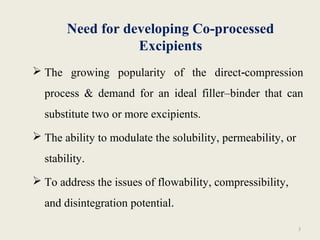
 The growing popularity of the direct compression‐
process & demand for an ideal filler–binder that can
substitute two or more excipients.
 The ability to modulate the solubility, permeability, or
stability.
 To address the issues of flowability, compressibility,
and disintegration potential.
3
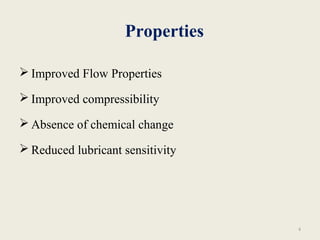
Properties
 Improved Flow Properties
 Improved compressibility
 Absence of chemical change
 Reduced lubricant sensitivity
4
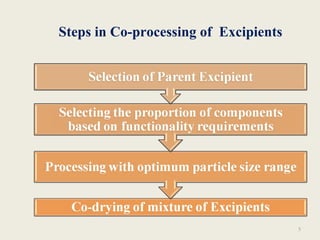
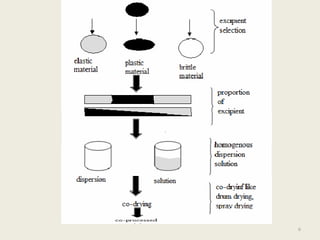
Steps in Co-processing of Excipients
5
6
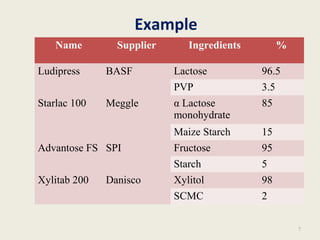
Example
Name Supplier Ingredients %
Ludipress BASF Lactose 96.5
PVP 3.5
Starlac 100 Meggle α Lactose
monohydrate
85
Maize Starch 15
Advantose FS SPI Fructose 95
Starch 5
Xylitab 200 Danisco Xylitol 98
SCMC 2
7
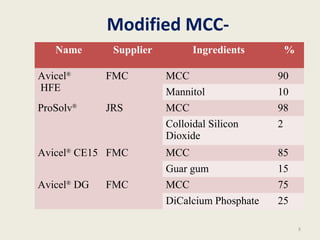
Modified MCC-
Name Supplier Ingredients %
Avicel®
HFE
FMC MCC 90
Mannitol 10
ProSolv®
JRS MCC 98
Colloidal Silicon
Dioxide
2
Avicel®
CE15 FMC MCC 85
Guar gum 15
Avicel®
DG FMC MCC 75
DiCalcium Phosphate 25
8
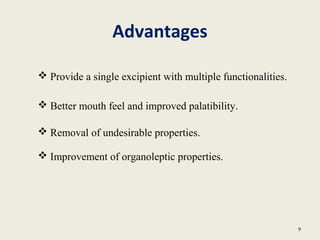
Advantages
9
 Provide a single excipient with multiple functionalities.
 Better mouth feel and improved palatibility.
 Removal of undesirable properties.
 Improvement of organoleptic properties.
Conclusion
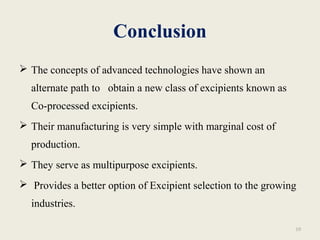
 The concepts of advanced technologies have shown an
alternate path to obtain a new class of excipients known as
Co-processed excipients.
 Their manufacturing is very simple with marginal cost of
production.
 They serve as multipurpose excipients.
 Provides a better option of Excipient selection to the growing
industries.
10
References
1. Chougule Ajay Subhash, Dikpati Amarita, Trimbake Tushar,
Formulation development technique of co-processed excipient,
Journal Of Advanced Pharmaceutical Sciences, 2012,Vol.2, 231-
249.
2. Ushari.S, Prasanthi C.H, Reassessment of novel co-processed multi-
functional excipient, International Research journal Of
Pharmaceutical and Applied Sciences,2013 ,122-128.
3. Marwaha Minakshi ,Sandhu Dipak, Marwaha Rakesh Kumar, Co-
processing of excipient: A review on excipient development for
improved tableting performance, International Journal Of Applied
Pharmaceutics, vol 2,41-47.
11
12
4. Aulton’s Michel E, The design and manufacture of
medicine,churchill livingstone elsevier, third edition, 2007,
355-356
13

Pratik swarup das

  • 1.
    A Seminar onASeminar on CO-PROCESSED EXCIPIENTCO-PROCESSED EXCIPIENT Noida Institute of Engineering and Technology,Pharmacy Institute Presented by Pratik Swarup Das M.Pharm(Pharmaceutics),1st yr
  • 2.
    Co-processing 2 Co-processing is aprocess in which two or more excipients interacting at the sub particle level, the objective of which is to provide a synergy of functionality improvements as well as masking the undesirable properties of individual excipients. The main aim of co processing is to obtain a product‐ with added value related to the ratio of its functionality / price.
  • 3.
    Need for developingCo-processed Excipients  The growing popularity of the direct compression‐ process & demand for an ideal filler–binder that can substitute two or more excipients.  The ability to modulate the solubility, permeability, or stability.  To address the issues of flowability, compressibility, and disintegration potential. 3
  • 4.
    Properties  Improved FlowProperties  Improved compressibility  Absence of chemical change  Reduced lubricant sensitivity 4
  • 5.
    Steps in Co-processingof Excipients 5
  • 6.
  • 7.
    Example Name Supplier Ingredients% Ludipress BASF Lactose 96.5 PVP 3.5 Starlac 100 Meggle α Lactose monohydrate 85 Maize Starch 15 Advantose FS SPI Fructose 95 Starch 5 Xylitab 200 Danisco Xylitol 98 SCMC 2 7
  • 8.
    Modified MCC- Name SupplierIngredients % Avicel® HFE FMC MCC 90 Mannitol 10 ProSolv® JRS MCC 98 Colloidal Silicon Dioxide 2 Avicel® CE15 FMC MCC 85 Guar gum 15 Avicel® DG FMC MCC 75 DiCalcium Phosphate 25 8
  • 9.
    Advantages 9  Provide asingle excipient with multiple functionalities.  Better mouth feel and improved palatibility.  Removal of undesirable properties.  Improvement of organoleptic properties.
  • 10.
    Conclusion  The conceptsof advanced technologies have shown an alternate path to obtain a new class of excipients known as Co-processed excipients.  Their manufacturing is very simple with marginal cost of production.  They serve as multipurpose excipients.  Provides a better option of Excipient selection to the growing industries. 10
  • 11.
    References 1. Chougule AjaySubhash, Dikpati Amarita, Trimbake Tushar, Formulation development technique of co-processed excipient, Journal Of Advanced Pharmaceutical Sciences, 2012,Vol.2, 231- 249. 2. Ushari.S, Prasanthi C.H, Reassessment of novel co-processed multi- functional excipient, International Research journal Of Pharmaceutical and Applied Sciences,2013 ,122-128. 3. Marwaha Minakshi ,Sandhu Dipak, Marwaha Rakesh Kumar, Co- processing of excipient: A review on excipient development for improved tableting performance, International Journal Of Applied Pharmaceutics, vol 2,41-47. 11
  • 12.
    12 4. Aulton’s MichelE, The design and manufacture of medicine,churchill livingstone elsevier, third edition, 2007, 355-356
  • 13.