Comparison Between Tablets Granulation Methods
Presented by
Prof. Devender Sharma
Goenka College of Pharmacy, Sikar, Rajasthan
M. Pharm
 Introduction
 How I am better than other ?
 Need of work
 Objective
 Conclusion
 Reference
2
Contents
3
ntroduction
4
What is MADG process ?
Simple process that creates granulation with very good physical properties and
finished products with satisfactory quality attributes.
Granules are producing with required amount of moisture and a granulating
binder.
It is 'one-pot' granulation process.
Advance form of conventional wet granulation process.
In this process drying, milling and screening process skip to save time and
money.
5
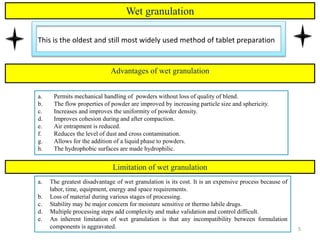
Wet granulation
This is the oldest and still most widely used method of tablet preparation
5
a. Permits mechanical handling of powders without loss of quality of blend.
b. The flow properties of powder are improved by increasing particle size and sphericity.
c. Increases and improves the uniformity of powder density.
d. Improves cohesion during and after compaction.
e. Air entrapment is reduced.
f. Reduces the level of dust and cross contamination.
g. Allows for the addition of a liquid phase to powders.
h. The hydrophobic surfaces are made hydrophilic.
Advantages of wet granulation
Limitation of wet granulation
a. The greatest disadvantage of wet granulation is its cost. It is an expensive process because of
labor, time, equipment, energy and space requirements.
b. Loss of material during various stages of processing.
c. Stability may be major concern for moisture sensitive or thermo labile drugs.
d. Multiple processing steps add complexity and make validation and control difficult.
e. An inherent limitation of wet granulation is that any incompatibility between formulation
components is aggravated.
6
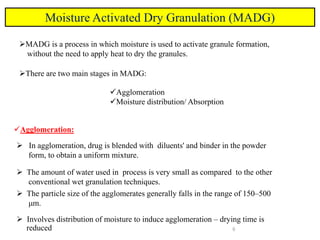
Moisture Activated Dry Granulation (MADG)
MADG is a process in which moisture is used to activate granule formation,
without the need to apply heat to dry the granules.
There are two main stages in MADG:
Agglomeration
Moisture distribution/ Absorption
Agglomeration:
 In agglomeration, drug is blended with diluents' and binder in the powder
form, to obtain a uniform mixture.
 The amount of water used in process is very small as compared to the other
conventional wet granulation techniques.
 The particle size of the agglomerates generally falls in the range of 150–500
μm.
 Involves distribution of moisture to induce agglomeration – drying time is
reduced
7
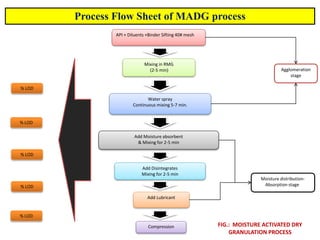
Agglomeration
stage
Moisture distribution-
Absorption stage
API + Diluents +Binder Sifting 40# mesh
Water spray
Continuous mixing 5-7 min.
Add Moisture absorbent
& Mixing for 2-5 min
Add Disintegrates
Mixing for 2-5 min
Add Lubricant
Compression
Mixing in RMG
(2-5 min)
% LOD
FIG.: MOISTURE ACTIVATED DRY
GRANULATION PROCESS
Process Flow Sheet of MADG process
% LOD
% LOD
% LOD
% LOD
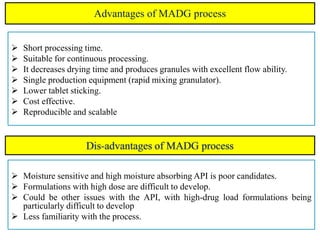
Advantages of MADG process
 Short processing time.
 Suitable for continuous processing.
 It decreases drying time and produces granules with excellent flow ability.
 Single production equipment (rapid mixing granulator).
 Lower tablet sticking.
 Cost effective.
 Reproducible and scalable
 Moisture sensitive and high moisture absorbing API is poor candidates.
 Formulations with high dose are difficult to develop.
 Could be other issues with the API, with high-drug load formulations being
particularly difficult to develop
 Less familiarity with the process.
How I am better
than other?
10
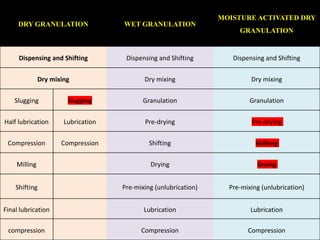
DRY GRANULATION WET GRANULATION
MOISTURE ACTIVATED DRY
GRANULATION
Dispensing and Shifting Dispensing and Shifting Dispensing and Shifting
Dry mixing Dry mixing Dry mixing
Slugging Slugging Granulation Granulation
Half lubrication Lubrication Pre-drying Pre-drying
Compression Compression Shifting Shifting
Milling Drying Drying
Shifting Pre-mixing (unlubrication) Pre-mixing (unlubrication)
Final lubrication Lubrication Lubrication
compression Compression Compression
11
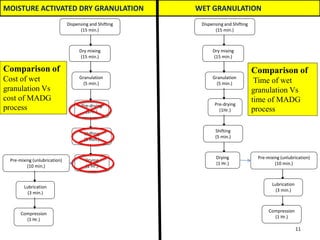
Dispensing and Shifting
(15 min.)
Dry mixing
(15 min.)
Granulation
(5 min.)
Pre-drying
(1Hr.)
Shifting
(5 min.)
Drying
(1 Hr.)
Pre-mixing (unlubrication)
(10 min.)
Lubrication
(3 min.)
Compression
(1 Hr.)
Dispensing and Shifting
(15 min.)
Dry mixing
(15 min.)
Granulation
(5 min.)
Pre-drying
(1Hr.)
Shifting
(5 min.)
Drying
(1 Hr.)
Pre-mixing (unlubrication)
(10 min.)
Lubrication
(3 min.)
Compression
(1 Hr.)
Comparison of
Cost of wet
granulation Vs
cost of MADG
process
Comparison of
Time of wet
granulation Vs
time of MADG
process
MOISTURE ACTIVATED DRY GRANULATION WET GRANULATION
12
Need and
Objective of work
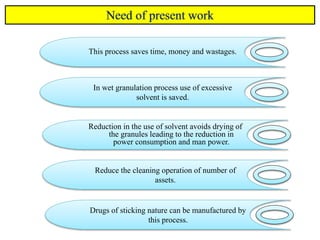
This process saves time, money and wastages.
In wet granulation process use of excessive
solvent is saved.
Reduction in the use of solvent avoids drying of
the granules leading to the reduction in
power consumption and man power.
Reduce the cleaning operation of number of
assets.
Drugs of sticking nature can be manufactured by
this process.
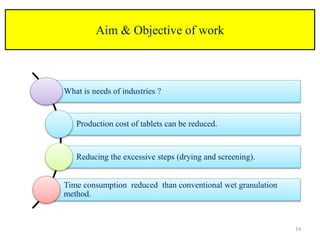
Aim & Objective of work
1414
What is needs of industries ?
Production cost of tablets can be reduced.
Reducing the excessive steps (drying and screening).
Time consumption reduced than conventional wet granulation
method.
15
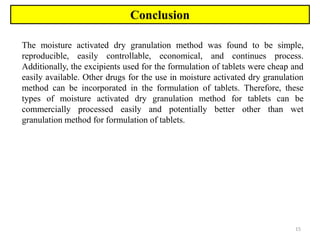
Conclusion
The moisture activated dry granulation method was found to be simple,
reproducible, easily controllable, economical, and continues process.
Additionally, the excipients used for the formulation of tablets were cheap and
easily available. Other drugs for the use in moisture activated dry granulation
method can be incorporated in the formulation of tablets. Therefore, these
types of moisture activated dry granulation method for tablets can be
commercially processed easily and potentially better other than wet
granulation method for formulation of tablets.
16
References
 Lachman L, Lieberman HA, Joseph LK. The Theory and Practice of Industrial Pharmacy, 1990;Third Edition, P.317-324.
 B.Venkateswara Reddy, K. Navaneetha, P. Sandeep. Improved tablet production by modified granulation techniques, International Journal
of research in pharmacy and life sciences, ijrpls, 2014, 2(2), pp 224-235.
 Puckhraj Chhaprel, Amit Talesara, Amit K Jain. solubility enhancement of poorly water soluble drug using spray drying technique,”
International Journal of Pharmaceutical Studies and Research, IJPSR and R-Vol. III, Issue II, April-June, 2012 pg.01-05.
 Abu T.M. Serajuddin, Solid Dispersion of Poorly Water Soluble Drugs: Early Promises, Subsequent Problems and Recent Breakthroughs,
Journal of Pharmaceutical Sciences, an American Chemical Society and American Pharmaceutical Association October, 1999 Vol.88,
No.10.
 Dr Abhijit V Gothoskar, Biopharmaceutical Classification Of Drugs Biopharmaceutical Classification Of Drugs _ Pharmainfo.net.mht.
 Dong Xun Li, Yu-Kyuong Oh, Soo-Jeong Lim, Jong Oh Kim, Ho Joon Yang, Jung Hoon Sung, Chul Soon Yong, Novel gelatin
microcapsule with bioavailability enhancement of ibuprofen using spray-drying technique, International Journal of Pharmaceutics Volume
355, Issues 1-2, 1 May 2008, Pg. 277-284.
 Remington J. Remington: The Science and Practice of Pharmacy; twenty first edition, Lippincott Williams & Wilkins, 2006, pg. 895-899.
 Michael D.Tousey, the granulation process: basic technologies for tablet making.
 N.K.Jain and S.N.Sharma, a text book of professional pharmacy, fourth edition, pg 295-296.
 larry l. augsburger, Stephen w. Hoag, pharmaceutical dosage forms: tablets 3rd addition, volume 1, pg. 303.
 Sahu Deepak, Ketawat Santosh, “Formulation design manufacture criteria requirement various types tablet” pg.-139.
 Larry l. augsburger, Stephen w. Hoag, pharmaceutical dosage forms: tablets 3rd addition, volume 2, pg 173-174.
 Himanshu.K.Solanki, Tarashankar Basuri, Jalaram H.Thakkar, “Recent advances in granulation technology, International Journal of
Pharmaceutical Sciences Review and Research, Volume 5, Issue 3, November – December 2010, Article-008, pg 48.
 www.powderpro.se/uploads/media/Brochure_Freeze_Granulation_2010.pdf
 www.technopolisonline.com
 www.excella-pharma-source.de
 United States Patent 4489504 - Steam granulation apparatus and method.
 Heng WS, Wong TW., Melt processes for oral solid dosage forms, Pharm Tech. 2003; Pg. 1-6.
 www.dow.com/dowexcipients/resources/application/app_granulation.htm
 Paul J., Shesky R., Colin K., New foam binder technology from Dow improves granulation process, Pharmaceutical Canada, June 2006;
Pg.19-22.
 Sheskey P. et al., "Foam Technology: The Development of a Novel Technique for the Delivery of Aqueous Binder Systems in High-Shear
and Fluid- Bed Wet-Granulation Applications," poster presented at AAPS Annual Meeting and Exposition, Salt Lake City, UT, Oct. 2003;
pg. 26-30.
17

Ppt for tablets granulation methods

  • 1.
    Comparison Between TabletsGranulation Methods Presented by Prof. Devender Sharma Goenka College of Pharmacy, Sikar, Rajasthan M. Pharm
  • 2.
     Introduction  HowI am better than other ?  Need of work  Objective  Conclusion  Reference 2 Contents
  • 3.
  • 4.
    4 What is MADGprocess ? Simple process that creates granulation with very good physical properties and finished products with satisfactory quality attributes. Granules are producing with required amount of moisture and a granulating binder. It is 'one-pot' granulation process. Advance form of conventional wet granulation process. In this process drying, milling and screening process skip to save time and money.
  • 5.
    5 Wet granulation This isthe oldest and still most widely used method of tablet preparation 5 a. Permits mechanical handling of powders without loss of quality of blend. b. The flow properties of powder are improved by increasing particle size and sphericity. c. Increases and improves the uniformity of powder density. d. Improves cohesion during and after compaction. e. Air entrapment is reduced. f. Reduces the level of dust and cross contamination. g. Allows for the addition of a liquid phase to powders. h. The hydrophobic surfaces are made hydrophilic. Advantages of wet granulation Limitation of wet granulation a. The greatest disadvantage of wet granulation is its cost. It is an expensive process because of labor, time, equipment, energy and space requirements. b. Loss of material during various stages of processing. c. Stability may be major concern for moisture sensitive or thermo labile drugs. d. Multiple processing steps add complexity and make validation and control difficult. e. An inherent limitation of wet granulation is that any incompatibility between formulation components is aggravated.
  • 6.
    6 Moisture Activated DryGranulation (MADG) MADG is a process in which moisture is used to activate granule formation, without the need to apply heat to dry the granules. There are two main stages in MADG: Agglomeration Moisture distribution/ Absorption Agglomeration:  In agglomeration, drug is blended with diluents' and binder in the powder form, to obtain a uniform mixture.  The amount of water used in process is very small as compared to the other conventional wet granulation techniques.  The particle size of the agglomerates generally falls in the range of 150–500 μm.  Involves distribution of moisture to induce agglomeration – drying time is reduced
  • 7.
    7 Agglomeration stage Moisture distribution- Absorption stage API+ Diluents +Binder Sifting 40# mesh Water spray Continuous mixing 5-7 min. Add Moisture absorbent & Mixing for 2-5 min Add Disintegrates Mixing for 2-5 min Add Lubricant Compression Mixing in RMG (2-5 min) % LOD FIG.: MOISTURE ACTIVATED DRY GRANULATION PROCESS Process Flow Sheet of MADG process % LOD % LOD % LOD % LOD
  • 8.
    Advantages of MADGprocess  Short processing time.  Suitable for continuous processing.  It decreases drying time and produces granules with excellent flow ability.  Single production equipment (rapid mixing granulator).  Lower tablet sticking.  Cost effective.  Reproducible and scalable  Moisture sensitive and high moisture absorbing API is poor candidates.  Formulations with high dose are difficult to develop.  Could be other issues with the API, with high-drug load formulations being particularly difficult to develop  Less familiarity with the process.
  • 9.
    How I ambetter than other?
  • 10.
    10 DRY GRANULATION WETGRANULATION MOISTURE ACTIVATED DRY GRANULATION Dispensing and Shifting Dispensing and Shifting Dispensing and Shifting Dry mixing Dry mixing Dry mixing Slugging Slugging Granulation Granulation Half lubrication Lubrication Pre-drying Pre-drying Compression Compression Shifting Shifting Milling Drying Drying Shifting Pre-mixing (unlubrication) Pre-mixing (unlubrication) Final lubrication Lubrication Lubrication compression Compression Compression
  • 11.
    11 Dispensing and Shifting (15min.) Dry mixing (15 min.) Granulation (5 min.) Pre-drying (1Hr.) Shifting (5 min.) Drying (1 Hr.) Pre-mixing (unlubrication) (10 min.) Lubrication (3 min.) Compression (1 Hr.) Dispensing and Shifting (15 min.) Dry mixing (15 min.) Granulation (5 min.) Pre-drying (1Hr.) Shifting (5 min.) Drying (1 Hr.) Pre-mixing (unlubrication) (10 min.) Lubrication (3 min.) Compression (1 Hr.) Comparison of Cost of wet granulation Vs cost of MADG process Comparison of Time of wet granulation Vs time of MADG process MOISTURE ACTIVATED DRY GRANULATION WET GRANULATION
  • 12.
  • 13.
    This process savestime, money and wastages. In wet granulation process use of excessive solvent is saved. Reduction in the use of solvent avoids drying of the granules leading to the reduction in power consumption and man power. Reduce the cleaning operation of number of assets. Drugs of sticking nature can be manufactured by this process.
  • 14.
    Aim & Objectiveof work 1414 What is needs of industries ? Production cost of tablets can be reduced. Reducing the excessive steps (drying and screening). Time consumption reduced than conventional wet granulation method.
  • 15.
    15 Conclusion The moisture activateddry granulation method was found to be simple, reproducible, easily controllable, economical, and continues process. Additionally, the excipients used for the formulation of tablets were cheap and easily available. Other drugs for the use in moisture activated dry granulation method can be incorporated in the formulation of tablets. Therefore, these types of moisture activated dry granulation method for tablets can be commercially processed easily and potentially better other than wet granulation method for formulation of tablets.
  • 16.
    16 References  Lachman L,Lieberman HA, Joseph LK. The Theory and Practice of Industrial Pharmacy, 1990;Third Edition, P.317-324.  B.Venkateswara Reddy, K. Navaneetha, P. Sandeep. Improved tablet production by modified granulation techniques, International Journal of research in pharmacy and life sciences, ijrpls, 2014, 2(2), pp 224-235.  Puckhraj Chhaprel, Amit Talesara, Amit K Jain. solubility enhancement of poorly water soluble drug using spray drying technique,” International Journal of Pharmaceutical Studies and Research, IJPSR and R-Vol. III, Issue II, April-June, 2012 pg.01-05.  Abu T.M. Serajuddin, Solid Dispersion of Poorly Water Soluble Drugs: Early Promises, Subsequent Problems and Recent Breakthroughs, Journal of Pharmaceutical Sciences, an American Chemical Society and American Pharmaceutical Association October, 1999 Vol.88, No.10.  Dr Abhijit V Gothoskar, Biopharmaceutical Classification Of Drugs Biopharmaceutical Classification Of Drugs _ Pharmainfo.net.mht.  Dong Xun Li, Yu-Kyuong Oh, Soo-Jeong Lim, Jong Oh Kim, Ho Joon Yang, Jung Hoon Sung, Chul Soon Yong, Novel gelatin microcapsule with bioavailability enhancement of ibuprofen using spray-drying technique, International Journal of Pharmaceutics Volume 355, Issues 1-2, 1 May 2008, Pg. 277-284.  Remington J. Remington: The Science and Practice of Pharmacy; twenty first edition, Lippincott Williams & Wilkins, 2006, pg. 895-899.  Michael D.Tousey, the granulation process: basic technologies for tablet making.  N.K.Jain and S.N.Sharma, a text book of professional pharmacy, fourth edition, pg 295-296.  larry l. augsburger, Stephen w. Hoag, pharmaceutical dosage forms: tablets 3rd addition, volume 1, pg. 303.  Sahu Deepak, Ketawat Santosh, “Formulation design manufacture criteria requirement various types tablet” pg.-139.  Larry l. augsburger, Stephen w. Hoag, pharmaceutical dosage forms: tablets 3rd addition, volume 2, pg 173-174.  Himanshu.K.Solanki, Tarashankar Basuri, Jalaram H.Thakkar, “Recent advances in granulation technology, International Journal of Pharmaceutical Sciences Review and Research, Volume 5, Issue 3, November – December 2010, Article-008, pg 48.  www.powderpro.se/uploads/media/Brochure_Freeze_Granulation_2010.pdf  www.technopolisonline.com  www.excella-pharma-source.de  United States Patent 4489504 - Steam granulation apparatus and method.  Heng WS, Wong TW., Melt processes for oral solid dosage forms, Pharm Tech. 2003; Pg. 1-6.  www.dow.com/dowexcipients/resources/application/app_granulation.htm  Paul J., Shesky R., Colin K., New foam binder technology from Dow improves granulation process, Pharmaceutical Canada, June 2006; Pg.19-22.  Sheskey P. et al., "Foam Technology: The Development of a Novel Technique for the Delivery of Aqueous Binder Systems in High-Shear and Fluid- Bed Wet-Granulation Applications," poster presented at AAPS Annual Meeting and Exposition, Salt Lake City, UT, Oct. 2003; pg. 26-30.
  • 17.