Chapter 4
Electronic Space Division
Switching
School of Information Science and
Engineering, Shandong University
Associate Prof., Deqiang Wang
Outline
Stored Program Control
Centralized SPC
Distributed SPC
Software Architecture
Application Software
Enhanced Services
Two-Stage Networks
Three-Stage Networks
N-Stage Networks
Introduction
Efforts to improve the speed of control
and signaling
Late 1940s and early 1950s. Use of
vacuum tubes, transistors, gas diodes,
magnetic drums and cathode ray tubes.
Arrival of modern electronic digital
computers.
The registers and translators of common
control systems can be replaced by a
single digital computer.
4.1 Stored Program Control
Stored Program Control (SPC)
Carrying out the exchange control
functions through programs stored
in the memory of a computer.
Consequence
Full-scale automation of exchange
functions
Introduction of a variety of new
services
4.1 Stored Program Control
New features possible for SPC
Common Channel Signaling (CCS)
Centralized maintenance
Automatic fault diagnosis
Interactive human-machine interface
Special Requirements of SPC
Operating without interruption
Fault tolerant hardware and software
4.1 Stored Program Control
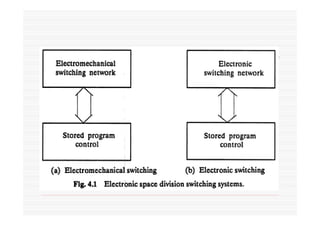
Two types of SPC switching system
Electromechanical Switching
SPC+Electromechanical switching network
Electronic Switching
SPC+Electronic switching network
4.1 Stored Program Control
Organization of SPC
Centralized SPC
Broadly used in early SPC switching systems.
Distributed SPC
Gaining popularity in modern switching
systems.
4.2 Centralized SPC
Concept
All the control equipment is
replaced by a single powerful
processor.
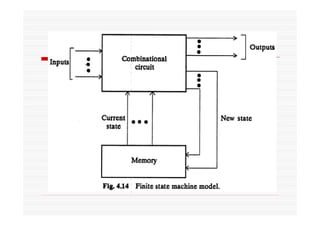
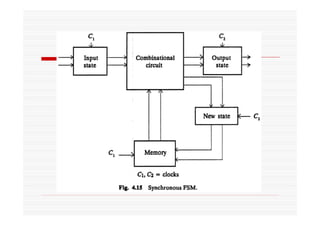
Configuration of centralized SPC
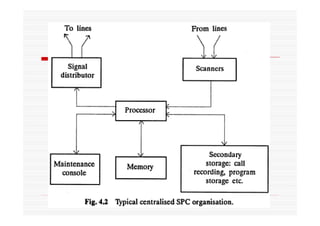
Typical organization
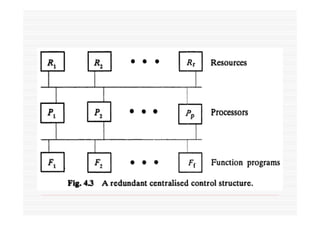
Redundant configuration
4.2 Centralized SPC
Operation modes in redundant
configuration (e.g. dual processor)
Standby (备用) mode
Synchronous duplex (同步双机) mode
Load sharing (负荷分担) mode
Standby mode
How does it work?
All processors have the same capability
to control the switching procedure.
One processor is active and the other is
on standby, both hardware and software
wise.
The standby processor is brought online
only when the active processor fails.
Standby mode
How does the standby processor take
over the control properly?
State of the exchange system should be
clear to the standby processor as its
starting point.
Which of the subscribers are busy or
free?
Which of the trunks are busy or free?
Which of the paths are connected
through the switching network?
So on
Standby mode
Reconstitution of the state
Scanning:
The standby processor scans all status
signals as soon as it is brought into
operation.
Only the calls which are being established
at the time of failure are disturbed.
Only feasible for small exchanges.
Shared secondary storage: popular.
Standby mode
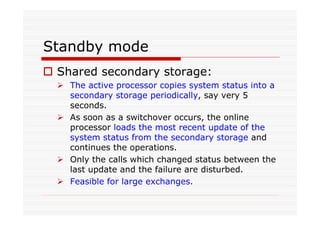
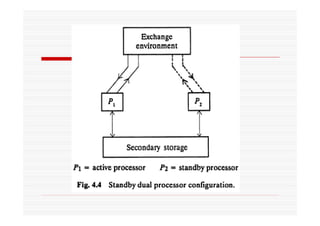
Shared secondary storage:
The active processor copies system status into a
secondary storage periodically, say very 5
seconds.
As soon as a switchover occurs, the online
processor loads the most recent update of the
system status from the secondary storage and
continues the operations.
Only the calls which changed status between the
last update and the failure are disturbed.
Feasible for large exchanges.
Synchronous duplex mode
How does it work?
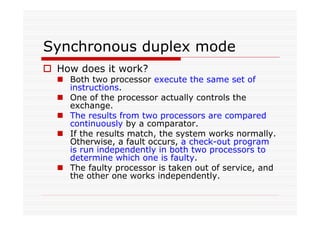
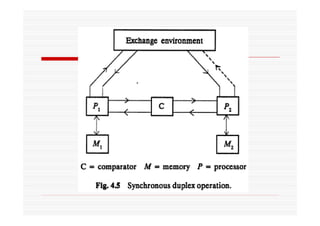
Both two processor execute the same set of
instructions.
One of the processor actually controls the
exchange.
The results from two processors are compared
continuously by a comparator.
If the results match, the system works normally.
Otherwise, a fault occurs, a check-out program
is run independently in both two processors to
determine which one is faulty.
The faulty processor is taken out of service, and
the other one works independently.
Synchronous duplex mode
In case of transient failure of
comparator, there are three
possibilities exist:
Continue with both processors.
Take out the active processor and continue
with other processor.
Continue with the active processor but
remove the other processor from service.
Load sharing mode
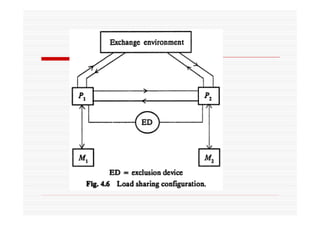
How does it work?
Both two processors have access to entire
exchange environment. Each of them has
independent memories for redundancy purpose.
Both two processors are active simultaneously
and share the load and the resources
dynamically.
An incoming call is assigned randomly or in a
predefined order to one of the processors which
then handles the call right through completion.
Inter-processor links are configured for
processors to exchange information needed for
mutual coordination and verifying the ‘state of
health’ of the other.
Load sharing mode
If a processor fails, the other
processor takes over the entire load
including the calls already set up by
the failing processor.
Exclusion mechanism in resource
sharing
The processors should not seek the same
resource at the same time.
Implementation: hardware & software
Load sharing mode
Traffic distribution between processors
Load sharing increases the effective
traffic capacity by 30 percent
compared with synchronous duplex.
Availability of system
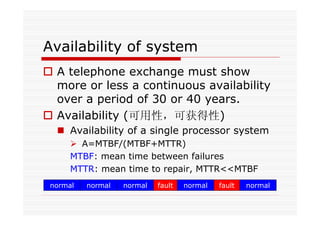
A telephone exchange must show
more or less a continuous availability
over a period of 30 or 40 years.
Availability (可用性,可获得性)
Availability of a single processor system
A=MTBF/(MTBF+MTTR)
MTBF: mean time between failures
MTTR: mean time to repair, MTTR<<MTBF
normal faultnormal normal normal normalfault
Availability of system
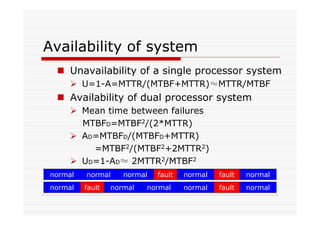
Unavailability of a single processor system
U=1-A=MTTR/(MTBF+MTTR)≈MTTR/MTBF
Availability of dual processor system
Mean time between failures
MTBFD=MTBF2/(2*MTTR)
AD=MTBFD/(MTBFD+MTTR)
=MTBF2/(MTBF2+2MTTR2)
UD=1-AD≈ 2MTTR2/MTBF2
normal faultnormal normal normal normalfault
normal fault normalnormal normal normalfault
Availability of system
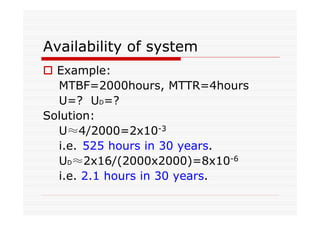
Example:
MTBF=2000hours, MTTR=4hours
U=? UD=?
Solution:
U≈4/2000=2x10-3
i.e. 525 hours in 30 years.
UD≈2x16/(2000x2000)=8x10-6
i.e. 2.1 hours in 30 years.
Coordination of functions
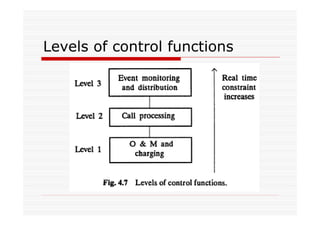
Priority of Control functions(控制功能优先级)
Level 1: O&M and charging
Level 2: Call processing
Level 3: Event monitoring and distribution
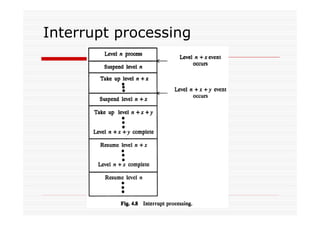
Interrupt processing
Vectored interrupt (矢量化中断)
The interrupting source supplies branch address
information to the processor.
Nonvectored interrupt(非矢量化中断)
A main interrupt service routine scans the
interrupt signals and decides on the appropriate
routine to service the specific interrupt.
Levels of control functions
Interrupt processing
4.3 Distributed SPC
Concept of distributed SPC
The control functions are shared by
many processors within the exchanges.
Background
Low cost processors
Advantages
Better Availability (可用性)
Better Reliability (可靠性)
4.3 Distributed SPC
Decomposition of Control Functions
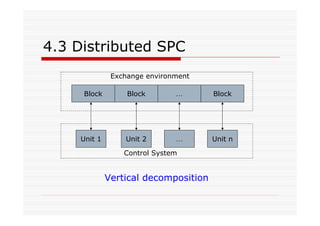
Vertical decomposition (垂直分解)
The exchange environment is divided into
several blocks.
Each block is assigned to a processor.
A processor performs all control functions
related to the corresponding block.
The processor in each block may be duplicated
for redundancy purposes.
Obviously, the control system consists of a
number of control units.
The modular structure is flexible for system
expanding.
4.3 Distributed SPC
Block Block … Block
Unit 1 Unit 2 … Unit n
Exchange environment
Control System
Vertical decomposition
4.3 Distributed SPC
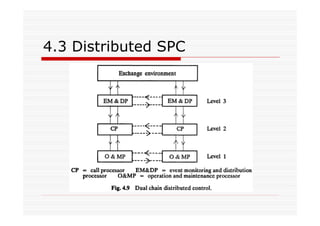
Horizontal decomposition (水平分解)
The control functions are divided into
groups, e.g. event monitoring, call
processing, and O&M functions.
Each processor performs only one or some
of the exchange control functions.
A chain of processors are used to perform
the entire control of the exchange.
The entire chain may be duplicated to
provide redundancy.
4.3 Distributed SPC
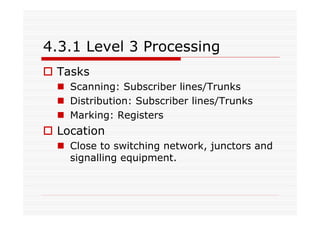
4.3.1 Level 3 Processing
Tasks
Scanning: Subscriber lines/Trunks
Distribution: Subscriber lines/Trunks
Marking: Registers
Location
Close to switching network, junctors and
signalling equipment.
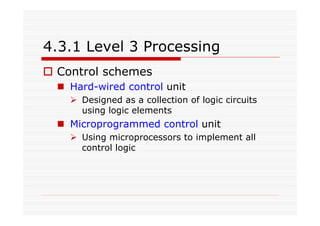
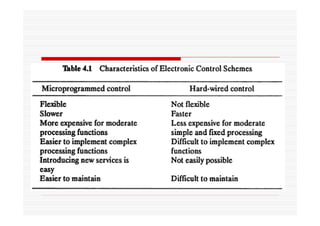
4.3.1 Level 3 Processing
Control schemes
Hard-wired control unit
Designed as a collection of logic circuits
using logic elements
Microprogrammed control unit
Using microprocessors to implement all
control logic
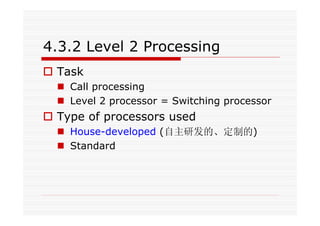
4.3.2 Level 2 Processing
Task
Call processing
Level 2 processor = Switching processor
Type of processors used
House-developed (自主研发的、定制的)
Standard
4.3.2 Level 2 Processing
Specific characteristics of Switching
processors
Efficiently designed instructions
Special instructions
Special architecture for availability, fault
tolerance and security
Special peripherals for telephones
Special communication link for remote
control
4.3.2 Level 2 Processing
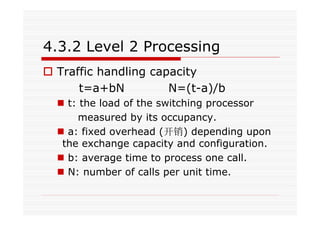
Traffic handling capacity
t=a+bN N=(t-a)/b
t: the load of the switching processor
measured by its occupancy.
a: fixed overhead (开销) depending upon
the exchange capacity and configuration.
b: average time to process one call.
N: number of calls per unit time.
4.3.3 Level 1 Processing
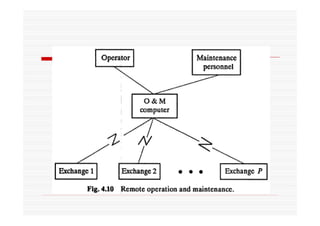
Q&M functions involved
Administer the exchange hardware and software.
Add, modify or delete information in translation
tables.
Change subscriber class of services.
Put a new line or trunk into operation.
Monitor traffic.
Detect and locate faults and errors.
Run diagnostic and test programs.
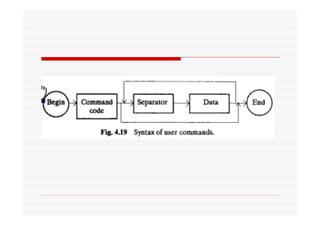
Man-machine interaction.
4.4 Software Architecture
Software of SPC systems
System software
Application software
We focus on the call processing
software systems.
Operating system of Call processing
Multiprogramming (多道程序) Feature
Call processing is event oriented.
Call setup involves a series of separated
processing actions, each action is
triggered by an event occurring at a
subscriber line or trunk.
There are many calls being processed
simultaneously, each handled by a
process.
Process(进程): a program in execution.
Process states and transitions
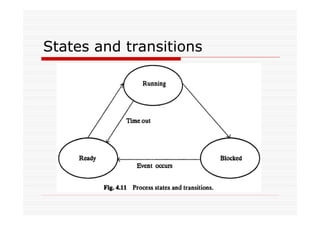
States of a process
Running state: currently possessing the CPU
resources.
A CPU can be allocated to only one process at
any instant of time.
Ready state: waiting for availability of the CPU.
All processes in ready state are ordered
according to some priority.
The first process in the ordered queue is the
next which will receive the CPU.
A timer is employed to prevent any process
from monopolising the CPU.
Blocked state: waiting for some event to occur.
States and transitions
Representation of a process
Process Control Block (PCB)
PCB is a data structure containing relevant
information of a process
Current state of the process
Process priority and CPU scheduling parameters
Register save area to save the contents of the
CPU registers when an interrupt occurs
Memory allocated to the process
Process account like the CPU time limits and
usage, process number etc.
Status of events and I/O resources associated
with the process.
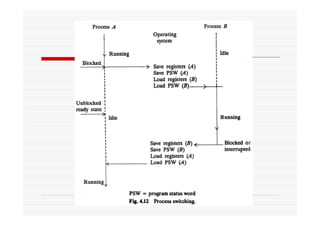
Process switching (进程切换)
Process switching occurs in following
cases:
The current running process becomes
blocked;
An event or interrupt triggers a high
priority process.
Process switching implies PCB saving
and loading.
Mutual exclusion of processes in
accessing shared data
Data sharing in switching system
Processes share common variables,
update common tables, write into
common files, and so on.
Mutual exclusion(互斥): When one
process accesses a shared table, all
other processes want to access the same
table are kept waiting.
Software production
Basic factors associated with switching
software
Complexity and size of the software
Long working life required
Real time operation
Stringent reliability and availability
Software portability(可移植性)
Four stages in software production
Functional specification
Formal description and detailed
specification
Coding and verification
Testing and debugging
CCITT standards on language
Z.100
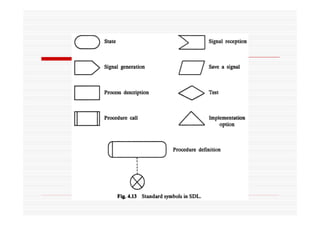
specification description language (SDL)
Z.200
CCITT high level language (CHILL)
Z.300
Man-machine language (MML)
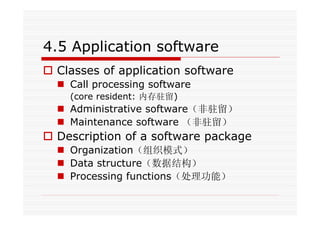
4.5 Application software
Classes of application software
Call processing software
(core resident: 内存驻留)
Administrative software(非驻留)
Maintenance software (非驻留)
Description of a software package
Organization(组织模式)
Data structure(数据结构)
Processing functions(处理功能)
Organization of switching software
Modular organization(模块化组织模式)
The software package is divided into program
modules.
Each module deals with a specific task.
The size of each module varies depending on the
task.
Modules exchange data through interfaces or
data table.
Modules are grouped together to constitute
independent functional units.
A functional unit runs as a separate process.
Organization of switching software
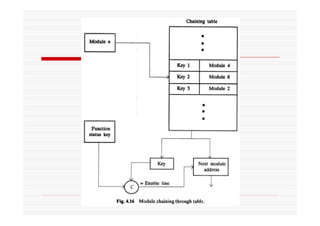
How to string up modules within a process?
Special program
Chaining table(链表)
Each entry consists of a key and a module
number
When a module completes execution, entries in
the chaining table are scanned and the keys are
compared with a function status key.
The matched module is executed next.
Flexibility for modifying a functional unit:
adding or removing modules.
Data structure of switching software
Parameters
System parameters
Afford flexibility at the overall system level,
such as signalling time delays, fault
thresholds, etc.
Office parameters
Define program execution limits at specific
exchanges, such as the number of
subscribers, the maximum number of
simultaneous calls etc.
Data structure of switching software
Data type and storage
Semipermanent data:
e.g. hardware parameters
Updated rather infrequently
Stored as files
Temporary data
e.g. information specific to a process
Have a lifetime equal to the process they
pertain to
Stored as tables
Data structure of switching software
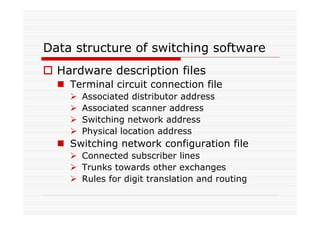
Hardware description files
Terminal circuit connection file
Associated distributor address
Associated scanner address
Switching network address
Physical location address
Switching network configuration file
Connected subscriber lines
Trunks towards other exchanges
Rules for digit translation and routing
Data structure of switching software
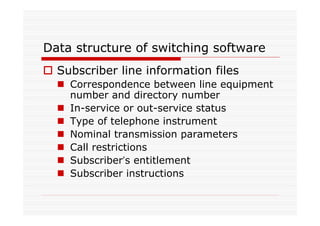
Subscriber line information files
Correspondence between line equipment
number and directory number
In-service or out-service status
Type of telephone instrument
Nominal transmission parameters
Call restrictions
Subscriber’s entitlement
Subscriber instructions
Data structure of switching software
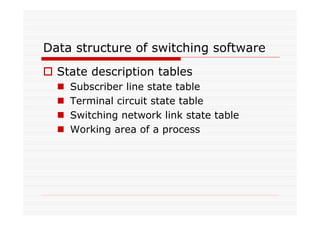
State description tables
Subscriber line state table
Terminal circuit state table
Switching network link state table
Working area of a process
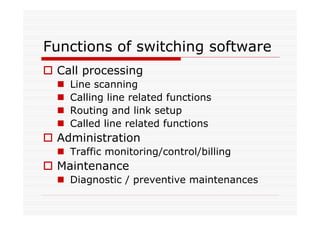
Functions of switching software
Call processing
Line scanning
Calling line related functions
Routing and link setup
Called line related functions
Administration
Traffic monitoring/control/billing
Maintenance
Diagnostic / preventive maintenances
4.6 Enhanced Services
Categories of enhanced services
1. Services associated with the calling
subscriber and designed to reduce the
time spent on dialing and the number of
dialing errors.
2. Services associated with the called
subscriber and designed to increase the
call completion rate.
3. Services involving more than two parties.
4. Miscellaneous services.
Category 1
Abbreviated dialing (缩位拨号)
Recorded number calls or no dialing
calls (无拨号呼叫)
Call back when free (遇忙回呼)
Category 2
Call forwarding (呼叫前转)
Operator answer
Category 3
Calling number record (主叫号码记录)
Call waiting(呼叫等待)
Consultation hold(呼叫保持)
Conference calls(会议电话)
Category 4
Automatic alarm(自动闹钟)
STD barring(直拨禁用)
Malicious call tracing(恶意呼叫追踪)
STD:subscriber trunk dialing
4.7 Two-Stage Networks
Theorem
For any single stage network, there
exists an equivalent multistage network.
Simple Two-stage NxN network
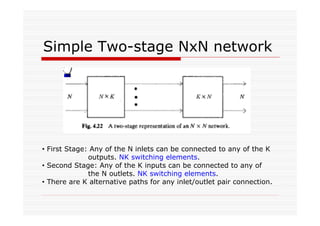
A NxN single stage network with a
switching capacity of K connections can
be realized by a two-stage network of
NxK and KxN.
Simple Two-stage NxN network
• First Stage: Any of the N inlets can be connected to any of the K
outputs. NK switching elements.
• Second Stage: Any of the K inputs can be connected to any of
the N outlets. NK switching elements.
• There are K alternative paths for any inlet/outlet pair connection.
Simple Two-stage NxN network
Full connectivity/full availability
Any of the N inlets can be connected to
any of the N outlets.
Example
Assume 10% of the subscribers to be
active on average. Set K to be N/16. The
number of switching elements is S=N2/8.
For N=1024, we have K=64, S=131072.
Note: Feasibility & Flexibility
4.7 Two-Stage Networks
Single stage vs. Multistage networks
Inlet to outlet connection
Quality of link
Utility of cross-points
Establishment of a specific connection
Cross-point & path Redundancy
Number of cross-points
Capacitive loading problem
Blocking feature
Call establishing time
General two-stage networks
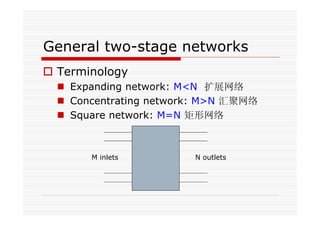
Terminology
Expanding network: M<N 扩展网络
Concentrating network: M>N 汇聚网络
Square network: M=N 矩形网络
M inlets N outlets
General two-stage networks
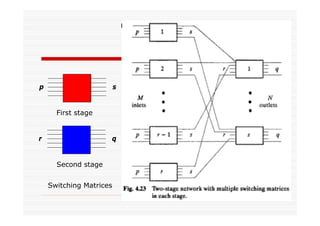
Architecture of General two-stage networks
Multiple small size matrices are used in each
stage.
Easy to be realized in practice.
Flexible in system design.
MxN two-stage network design
Decomposition: M = p x r, N = q x s
Switching matrices: p x s and r x q
Full availability: There must be at least one out
let from each block in the first stage terminating
as inlet on every block of the second stage.
p s
r q
Switching Matrices
First stage
Second stage
General two-stage networks
Parameters
Number of switching elements
S=psr+qrs=Ms+Nr
Switching Capacity
i.e., the number of links between the first
and the second stages.
SC=sr
General two-stage networks
Parameters
Blocking probability
Blocking condition 1
There are rxs calls in progress, and the (rs+1)-th
call arrives;
The blocking probability PB is dependent on the
traffic statistics.
Blocking condition 2
There is a call in progress from I-th block in the first
stage to the J-th block in the second stage, and
another call originating in the I-th block destined to
the J-th block.
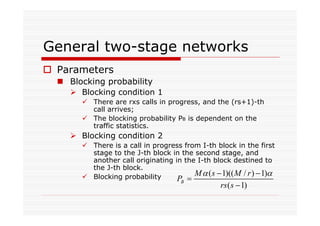
Blocking probability ( 1)(( / ) 1)
( 1)
B
M s M r
P
rs s
α α− −
=
−
General two-stage networks
How to choose values of r and s?
Both S and SC are proportional to r & s.
Blocking probability PB is reversely
proportional to r & s.
Strategy: Tradeoffs should be made
between cost and quality of service.
The values of r & s should be as small as
possible but give sufficient links to provide
a reasonable grade of service to subscribers.
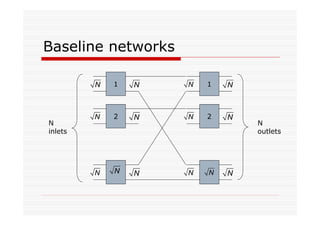
Square two-stage networks
Baseline networks
Square switching matrices are used as building
blocks.
p=r=s=q=N1/2
There are N1/2 blocks, each block is a switching
matrix of N1/2xN1/2 inlets and outlets.
Switching elements: S=2NxN1/2
Switching capacity: SC=N
Support N simultaneous calls only if the traffic is
uniformly distributed.
Baseline networks
N N
N
1
N 2 N
N N
N 1 N
N 2 N
N NN
N
inlets
N
outlets
Square two-stage networks
Nonblocking networks
Why does blocking occur?
Only one link exists between a pair of first stage
and second stage blocks.
How to reduce the probability of blocking?
Provide more links between the first stage and
second stage blocks.
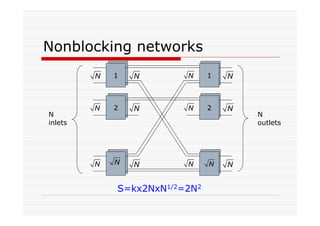
How many links should be provided?
A group of k=N1/2 links should be provided for
each pair of first stage and second stage blocks.
S=2N2.
In comparison with single stage network, the
number of switching elements is doubled.
1
1
1
1
1
1
Nonblocking networks
N N
N
1
N 2 N
N N
N 1 N
N 2 N
N NN
N
inlets
N
outlets
S=kx2NxN1/2=2N2
Remarks on two-stage networks
A standard way of designing blocking
networks with full availability.
The expanding and concentrating network
structures of small size can be implemented
easily.
Alternative paths for establishing a
connection can be provided by two-stage
networks, but with more switching
elements in nonblocking design.
Question
Is there any way to implement
blocking & nonblocking networks with
even less switching elements?
Solution: three-stage or multi-stage ~
4.8 Three-Stage networks
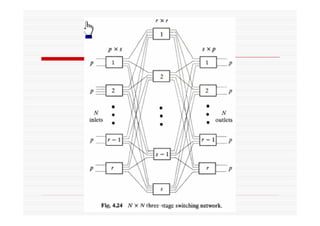
General structure of an NxN three-
stage blocking network
Stage 1: p x s switching matrices
Stage 2: r x r switching matrices
Stage 3: s x p switching matrices
N=pxr, s is changable
Compared with a two-stage network,
there are s alternative paths between a
pair of inlet and outlet.
NxN three-stage blocking network
Number of switching elements
S=rps+sr2+spr=2Ns+sr2=s(2N+r2)
If square matrices are used in both the first and
third stages, then p=s=N/r and S=2N2/r+Nr.
For a given value of N, there exists an optimal
value of r which minimizes the value of S.
The optimal value of r is r=(2N)1/2 and the
corresponding minimum of S is Smin=2N (2N)1/2
p=N/r=(N/2)1/2
How about the switching capacity?
NxN three-stage blocking network
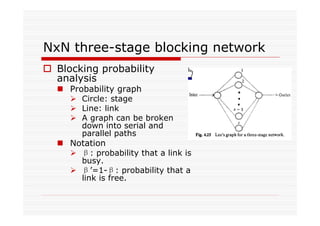
Blocking probability
analysis
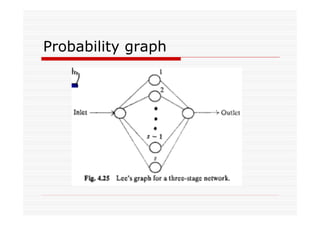
Probability graph
Circle: stage
Line: link
A graph can be broken
down into serial and
parallel paths
Notation
β: probability that a link is
busy.
β’=1-β: probability that a
link is free.
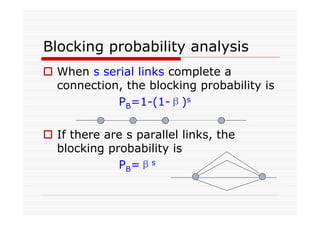
Blocking probability analysis
When s serial links complete a
connection, the blocking probability is
PB=1-(1-β)s
If there are s parallel links, the
blocking probability is
PB=βs
Blocking probability analysis
The blocking probability of NxN three-stage
network
If α denotes the probability that a inlet at the
first stage is busy, then β=αp/s = α/k, where k=s/p
There are s parallel paths
Each path consists of two serial links
Blocking probability of each path is
1-(1-β)2=1-(1- α/k)2
Total Blocking probability is
PB=[1-(1-β)2]s=[1-(1- α/k)2]s
What is
the
meaning
of k?
Probability graph
Remarks on PB of three-stage ~
The notation k=s/p represents either
space expansion (k>1) or
concentration (k<1).
Low PB requests small α/ k
In case of small α, e.g. end offices and
PBX, k can be small. It means
concentration can be used in first stage.
In case of large α, e.g. transit exchanges,
k should be large. It implies that
expansion should be used in first stage.
Nonblocking three-stage networks
C. Clos: pioneer researcher of multistage
nonblocking networks.
Clos networks
Multistage nonblocking and fully availabile
networks.
Much less switching elements are used than that
in single stage networks.
Design strategy
Providing adequate number of blocks in middle
stages. For three-stage networks, the value of s
should be large enough.
Three-stage nonblocking configuration
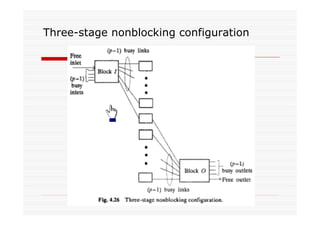
Worst situation for blocking
p-1 inlets in a block I in the first stage are busy;
p-1 outlets in a block O in the third stage are
busy;
The p-1 second-stage blocks, on which the p-1
outlets from block I are terminated on, are
different from the p-1 second-stage blocks from
which the links are established to the block O.
The free inlet of block I needs to be terminated
on the free outlet of block O.
How big should s be to avoid occurrence of
blocking?
Three-stage nonblocking configuration
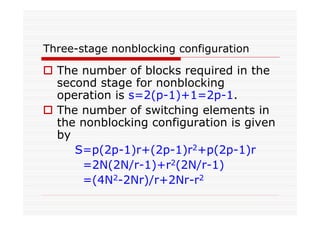
The number of blocks required in the
second stage for nonblocking
operation is s=2(p-1)+1=2p-1.
The number of switching elements in
the nonblocking configuration is given
by
S=p(2p-1)r+(2p-1)r2+p(2p-1)r
=2N(2N/r-1)+r2(2N/r-1)
=(4N2-2Nr)/r+2Nr-r2
Three-stage nonblocking configuration
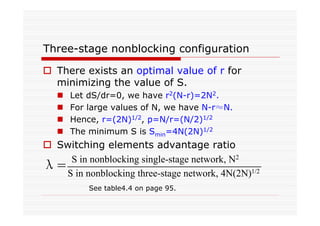
There exists an optimal value of r for
minimizing the value of S.
Let dS/dr=0, we have r2(N-r)=2N2.
For large values of N, we have N-r≈N.
Hence, r=(2N)1/2, p=N/r=(N/2)1/2
The minimum S is Smin=4N(2N)1/2
Switching elements advantage ratio
S in nonblocking single-stage network, N2
S in nonblocking three-stage network, 4N(2N)1/2λ=
See table4.4 on page 95.
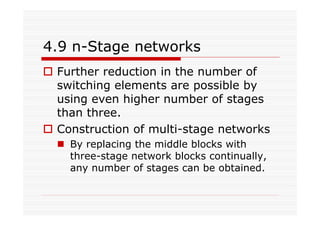
4.9 n-Stage networks
Further reduction in the number of
switching elements are possible by
using even higher number of stages
than three.
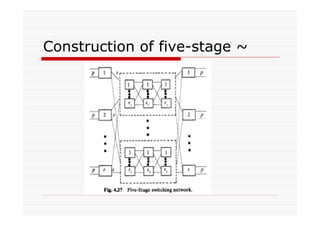
Construction of multi-stage networks
By replacing the middle blocks with
three-stage network blocks continually,
any number of stages can be obtained.
Construction of five-stage ~
Assignments
Ex.11
Ex.15

Module3 part1

  • 1.
    Chapter 4 Electronic SpaceDivision Switching School of Information Science and Engineering, Shandong University Associate Prof., Deqiang Wang
  • 2.
    Outline Stored Program Control CentralizedSPC Distributed SPC Software Architecture Application Software Enhanced Services Two-Stage Networks Three-Stage Networks N-Stage Networks
  • 3.
    Introduction Efforts to improvethe speed of control and signaling Late 1940s and early 1950s. Use of vacuum tubes, transistors, gas diodes, magnetic drums and cathode ray tubes. Arrival of modern electronic digital computers. The registers and translators of common control systems can be replaced by a single digital computer.
  • 4.
    4.1 Stored ProgramControl Stored Program Control (SPC) Carrying out the exchange control functions through programs stored in the memory of a computer. Consequence Full-scale automation of exchange functions Introduction of a variety of new services
  • 5.
    4.1 Stored ProgramControl New features possible for SPC Common Channel Signaling (CCS) Centralized maintenance Automatic fault diagnosis Interactive human-machine interface Special Requirements of SPC Operating without interruption Fault tolerant hardware and software
  • 6.
    4.1 Stored ProgramControl Two types of SPC switching system Electromechanical Switching SPC+Electromechanical switching network Electronic Switching SPC+Electronic switching network
  • 8.
    4.1 Stored ProgramControl Organization of SPC Centralized SPC Broadly used in early SPC switching systems. Distributed SPC Gaining popularity in modern switching systems.
  • 9.
    4.2 Centralized SPC Concept Allthe control equipment is replaced by a single powerful processor. Configuration of centralized SPC Typical organization Redundant configuration
  • 12.
    4.2 Centralized SPC Operationmodes in redundant configuration (e.g. dual processor) Standby (备用) mode Synchronous duplex (同步双机) mode Load sharing (负荷分担) mode
  • 13.
    Standby mode How doesit work? All processors have the same capability to control the switching procedure. One processor is active and the other is on standby, both hardware and software wise. The standby processor is brought online only when the active processor fails.
  • 14.
    Standby mode How doesthe standby processor take over the control properly? State of the exchange system should be clear to the standby processor as its starting point. Which of the subscribers are busy or free? Which of the trunks are busy or free? Which of the paths are connected through the switching network? So on
  • 15.
    Standby mode Reconstitution ofthe state Scanning: The standby processor scans all status signals as soon as it is brought into operation. Only the calls which are being established at the time of failure are disturbed. Only feasible for small exchanges. Shared secondary storage: popular.
  • 16.
    Standby mode Shared secondarystorage: The active processor copies system status into a secondary storage periodically, say very 5 seconds. As soon as a switchover occurs, the online processor loads the most recent update of the system status from the secondary storage and continues the operations. Only the calls which changed status between the last update and the failure are disturbed. Feasible for large exchanges.
  • 18.
    Synchronous duplex mode Howdoes it work? Both two processor execute the same set of instructions. One of the processor actually controls the exchange. The results from two processors are compared continuously by a comparator. If the results match, the system works normally. Otherwise, a fault occurs, a check-out program is run independently in both two processors to determine which one is faulty. The faulty processor is taken out of service, and the other one works independently.
  • 20.
    Synchronous duplex mode Incase of transient failure of comparator, there are three possibilities exist: Continue with both processors. Take out the active processor and continue with other processor. Continue with the active processor but remove the other processor from service.
  • 21.
    Load sharing mode Howdoes it work? Both two processors have access to entire exchange environment. Each of them has independent memories for redundancy purpose. Both two processors are active simultaneously and share the load and the resources dynamically. An incoming call is assigned randomly or in a predefined order to one of the processors which then handles the call right through completion. Inter-processor links are configured for processors to exchange information needed for mutual coordination and verifying the ‘state of health’ of the other.
  • 22.
    Load sharing mode Ifa processor fails, the other processor takes over the entire load including the calls already set up by the failing processor. Exclusion mechanism in resource sharing The processors should not seek the same resource at the same time. Implementation: hardware & software
  • 24.
    Load sharing mode Trafficdistribution between processors Load sharing increases the effective traffic capacity by 30 percent compared with synchronous duplex.
  • 25.
    Availability of system Atelephone exchange must show more or less a continuous availability over a period of 30 or 40 years. Availability (可用性,可获得性) Availability of a single processor system A=MTBF/(MTBF+MTTR) MTBF: mean time between failures MTTR: mean time to repair, MTTR<<MTBF normal faultnormal normal normal normalfault
  • 26.
    Availability of system Unavailabilityof a single processor system U=1-A=MTTR/(MTBF+MTTR)≈MTTR/MTBF Availability of dual processor system Mean time between failures MTBFD=MTBF2/(2*MTTR) AD=MTBFD/(MTBFD+MTTR) =MTBF2/(MTBF2+2MTTR2) UD=1-AD≈ 2MTTR2/MTBF2 normal faultnormal normal normal normalfault normal fault normalnormal normal normalfault
  • 27.
    Availability of system Example: MTBF=2000hours,MTTR=4hours U=? UD=? Solution: U≈4/2000=2x10-3 i.e. 525 hours in 30 years. UD≈2x16/(2000x2000)=8x10-6 i.e. 2.1 hours in 30 years.
  • 28.
    Coordination of functions Priorityof Control functions(控制功能优先级) Level 1: O&M and charging Level 2: Call processing Level 3: Event monitoring and distribution Interrupt processing Vectored interrupt (矢量化中断) The interrupting source supplies branch address information to the processor. Nonvectored interrupt(非矢量化中断) A main interrupt service routine scans the interrupt signals and decides on the appropriate routine to service the specific interrupt.
  • 29.
  • 30.
  • 31.
    4.3 Distributed SPC Conceptof distributed SPC The control functions are shared by many processors within the exchanges. Background Low cost processors Advantages Better Availability (可用性) Better Reliability (可靠性)
  • 32.
    4.3 Distributed SPC Decompositionof Control Functions Vertical decomposition (垂直分解) The exchange environment is divided into several blocks. Each block is assigned to a processor. A processor performs all control functions related to the corresponding block. The processor in each block may be duplicated for redundancy purposes. Obviously, the control system consists of a number of control units. The modular structure is flexible for system expanding.
  • 33.
    4.3 Distributed SPC BlockBlock … Block Unit 1 Unit 2 … Unit n Exchange environment Control System Vertical decomposition
  • 34.
    4.3 Distributed SPC Horizontaldecomposition (水平分解) The control functions are divided into groups, e.g. event monitoring, call processing, and O&M functions. Each processor performs only one or some of the exchange control functions. A chain of processors are used to perform the entire control of the exchange. The entire chain may be duplicated to provide redundancy.
  • 35.
  • 36.
    4.3.1 Level 3Processing Tasks Scanning: Subscriber lines/Trunks Distribution: Subscriber lines/Trunks Marking: Registers Location Close to switching network, junctors and signalling equipment.
  • 37.
    4.3.1 Level 3Processing Control schemes Hard-wired control unit Designed as a collection of logic circuits using logic elements Microprogrammed control unit Using microprocessors to implement all control logic
  • 39.
    4.3.2 Level 2Processing Task Call processing Level 2 processor = Switching processor Type of processors used House-developed (自主研发的、定制的) Standard
  • 40.
    4.3.2 Level 2Processing Specific characteristics of Switching processors Efficiently designed instructions Special instructions Special architecture for availability, fault tolerance and security Special peripherals for telephones Special communication link for remote control
  • 41.
    4.3.2 Level 2Processing Traffic handling capacity t=a+bN N=(t-a)/b t: the load of the switching processor measured by its occupancy. a: fixed overhead (开销) depending upon the exchange capacity and configuration. b: average time to process one call. N: number of calls per unit time.
  • 42.
    4.3.3 Level 1Processing Q&M functions involved Administer the exchange hardware and software. Add, modify or delete information in translation tables. Change subscriber class of services. Put a new line or trunk into operation. Monitor traffic. Detect and locate faults and errors. Run diagnostic and test programs. Man-machine interaction.
  • 44.
    4.4 Software Architecture Softwareof SPC systems System software Application software We focus on the call processing software systems.
  • 45.
    Operating system ofCall processing Multiprogramming (多道程序) Feature Call processing is event oriented. Call setup involves a series of separated processing actions, each action is triggered by an event occurring at a subscriber line or trunk. There are many calls being processed simultaneously, each handled by a process. Process(进程): a program in execution.
  • 46.
    Process states andtransitions States of a process Running state: currently possessing the CPU resources. A CPU can be allocated to only one process at any instant of time. Ready state: waiting for availability of the CPU. All processes in ready state are ordered according to some priority. The first process in the ordered queue is the next which will receive the CPU. A timer is employed to prevent any process from monopolising the CPU. Blocked state: waiting for some event to occur.
  • 47.
  • 48.
    Representation of aprocess Process Control Block (PCB) PCB is a data structure containing relevant information of a process Current state of the process Process priority and CPU scheduling parameters Register save area to save the contents of the CPU registers when an interrupt occurs Memory allocated to the process Process account like the CPU time limits and usage, process number etc. Status of events and I/O resources associated with the process.
  • 49.
    Process switching (进程切换) Processswitching occurs in following cases: The current running process becomes blocked; An event or interrupt triggers a high priority process. Process switching implies PCB saving and loading.
  • 51.
    Mutual exclusion ofprocesses in accessing shared data Data sharing in switching system Processes share common variables, update common tables, write into common files, and so on. Mutual exclusion(互斥): When one process accesses a shared table, all other processes want to access the same table are kept waiting.
  • 52.
    Software production Basic factorsassociated with switching software Complexity and size of the software Long working life required Real time operation Stringent reliability and availability Software portability(可移植性)
  • 53.
    Four stages insoftware production Functional specification Formal description and detailed specification Coding and verification Testing and debugging
  • 54.
    CCITT standards onlanguage Z.100 specification description language (SDL) Z.200 CCITT high level language (CHILL) Z.300 Man-machine language (MML)
  • 58.
    4.5 Application software Classesof application software Call processing software (core resident: 内存驻留) Administrative software(非驻留) Maintenance software (非驻留) Description of a software package Organization(组织模式) Data structure(数据结构) Processing functions(处理功能)
  • 59.
    Organization of switchingsoftware Modular organization(模块化组织模式) The software package is divided into program modules. Each module deals with a specific task. The size of each module varies depending on the task. Modules exchange data through interfaces or data table. Modules are grouped together to constitute independent functional units. A functional unit runs as a separate process.
  • 60.
    Organization of switchingsoftware How to string up modules within a process? Special program Chaining table(链表) Each entry consists of a key and a module number When a module completes execution, entries in the chaining table are scanned and the keys are compared with a function status key. The matched module is executed next. Flexibility for modifying a functional unit: adding or removing modules.
  • 62.
    Data structure ofswitching software Parameters System parameters Afford flexibility at the overall system level, such as signalling time delays, fault thresholds, etc. Office parameters Define program execution limits at specific exchanges, such as the number of subscribers, the maximum number of simultaneous calls etc.
  • 63.
    Data structure ofswitching software Data type and storage Semipermanent data: e.g. hardware parameters Updated rather infrequently Stored as files Temporary data e.g. information specific to a process Have a lifetime equal to the process they pertain to Stored as tables
  • 64.
    Data structure ofswitching software Hardware description files Terminal circuit connection file Associated distributor address Associated scanner address Switching network address Physical location address Switching network configuration file Connected subscriber lines Trunks towards other exchanges Rules for digit translation and routing
  • 65.
    Data structure ofswitching software Subscriber line information files Correspondence between line equipment number and directory number In-service or out-service status Type of telephone instrument Nominal transmission parameters Call restrictions Subscriber’s entitlement Subscriber instructions
  • 66.
    Data structure ofswitching software State description tables Subscriber line state table Terminal circuit state table Switching network link state table Working area of a process
  • 68.
    Functions of switchingsoftware Call processing Line scanning Calling line related functions Routing and link setup Called line related functions Administration Traffic monitoring/control/billing Maintenance Diagnostic / preventive maintenances
  • 69.
    4.6 Enhanced Services Categoriesof enhanced services 1. Services associated with the calling subscriber and designed to reduce the time spent on dialing and the number of dialing errors. 2. Services associated with the called subscriber and designed to increase the call completion rate. 3. Services involving more than two parties. 4. Miscellaneous services.
  • 71.
    Category 1 Abbreviated dialing(缩位拨号) Recorded number calls or no dialing calls (无拨号呼叫) Call back when free (遇忙回呼)
  • 72.
    Category 2 Call forwarding(呼叫前转) Operator answer
  • 73.
    Category 3 Calling numberrecord (主叫号码记录) Call waiting(呼叫等待) Consultation hold(呼叫保持) Conference calls(会议电话)
  • 74.
    Category 4 Automatic alarm(自动闹钟) STDbarring(直拨禁用) Malicious call tracing(恶意呼叫追踪) STD:subscriber trunk dialing
  • 75.
    4.7 Two-Stage Networks Theorem Forany single stage network, there exists an equivalent multistage network. Simple Two-stage NxN network A NxN single stage network with a switching capacity of K connections can be realized by a two-stage network of NxK and KxN.
  • 76.
    Simple Two-stage NxNnetwork • First Stage: Any of the N inlets can be connected to any of the K outputs. NK switching elements. • Second Stage: Any of the K inputs can be connected to any of the N outlets. NK switching elements. • There are K alternative paths for any inlet/outlet pair connection.
  • 77.
    Simple Two-stage NxNnetwork Full connectivity/full availability Any of the N inlets can be connected to any of the N outlets. Example Assume 10% of the subscribers to be active on average. Set K to be N/16. The number of switching elements is S=N2/8. For N=1024, we have K=64, S=131072. Note: Feasibility & Flexibility
  • 78.
    4.7 Two-Stage Networks Singlestage vs. Multistage networks Inlet to outlet connection Quality of link Utility of cross-points Establishment of a specific connection Cross-point & path Redundancy Number of cross-points Capacitive loading problem Blocking feature Call establishing time
  • 79.
    General two-stage networks Terminology Expandingnetwork: M<N 扩展网络 Concentrating network: M>N 汇聚网络 Square network: M=N 矩形网络 M inlets N outlets
  • 80.
    General two-stage networks Architectureof General two-stage networks Multiple small size matrices are used in each stage. Easy to be realized in practice. Flexible in system design. MxN two-stage network design Decomposition: M = p x r, N = q x s Switching matrices: p x s and r x q Full availability: There must be at least one out let from each block in the first stage terminating as inlet on every block of the second stage.
  • 81.
    p s r q SwitchingMatrices First stage Second stage
  • 82.
    General two-stage networks Parameters Numberof switching elements S=psr+qrs=Ms+Nr Switching Capacity i.e., the number of links between the first and the second stages. SC=sr
  • 83.
    General two-stage networks Parameters Blockingprobability Blocking condition 1 There are rxs calls in progress, and the (rs+1)-th call arrives; The blocking probability PB is dependent on the traffic statistics. Blocking condition 2 There is a call in progress from I-th block in the first stage to the J-th block in the second stage, and another call originating in the I-th block destined to the J-th block. Blocking probability ( 1)(( / ) 1) ( 1) B M s M r P rs s α α− − = −
  • 84.
    General two-stage networks Howto choose values of r and s? Both S and SC are proportional to r & s. Blocking probability PB is reversely proportional to r & s. Strategy: Tradeoffs should be made between cost and quality of service. The values of r & s should be as small as possible but give sufficient links to provide a reasonable grade of service to subscribers.
  • 85.
    Square two-stage networks Baselinenetworks Square switching matrices are used as building blocks. p=r=s=q=N1/2 There are N1/2 blocks, each block is a switching matrix of N1/2xN1/2 inlets and outlets. Switching elements: S=2NxN1/2 Switching capacity: SC=N Support N simultaneous calls only if the traffic is uniformly distributed.
  • 86.
    Baseline networks N N N 1 N2 N N N N 1 N N 2 N N NN N inlets N outlets
  • 87.
    Square two-stage networks Nonblockingnetworks Why does blocking occur? Only one link exists between a pair of first stage and second stage blocks. How to reduce the probability of blocking? Provide more links between the first stage and second stage blocks. How many links should be provided? A group of k=N1/2 links should be provided for each pair of first stage and second stage blocks. S=2N2. In comparison with single stage network, the number of switching elements is doubled.
  • 88.
    1 1 1 1 1 1 Nonblocking networks N N N 1 N2 N N N N 1 N N 2 N N NN N inlets N outlets S=kx2NxN1/2=2N2
  • 89.
    Remarks on two-stagenetworks A standard way of designing blocking networks with full availability. The expanding and concentrating network structures of small size can be implemented easily. Alternative paths for establishing a connection can be provided by two-stage networks, but with more switching elements in nonblocking design.
  • 90.
    Question Is there anyway to implement blocking & nonblocking networks with even less switching elements? Solution: three-stage or multi-stage ~
  • 91.
    4.8 Three-Stage networks Generalstructure of an NxN three- stage blocking network Stage 1: p x s switching matrices Stage 2: r x r switching matrices Stage 3: s x p switching matrices N=pxr, s is changable Compared with a two-stage network, there are s alternative paths between a pair of inlet and outlet.
  • 93.
    NxN three-stage blockingnetwork Number of switching elements S=rps+sr2+spr=2Ns+sr2=s(2N+r2) If square matrices are used in both the first and third stages, then p=s=N/r and S=2N2/r+Nr. For a given value of N, there exists an optimal value of r which minimizes the value of S. The optimal value of r is r=(2N)1/2 and the corresponding minimum of S is Smin=2N (2N)1/2 p=N/r=(N/2)1/2 How about the switching capacity?
  • 94.
    NxN three-stage blockingnetwork Blocking probability analysis Probability graph Circle: stage Line: link A graph can be broken down into serial and parallel paths Notation β: probability that a link is busy. β’=1-β: probability that a link is free.
  • 95.
    Blocking probability analysis Whens serial links complete a connection, the blocking probability is PB=1-(1-β)s If there are s parallel links, the blocking probability is PB=βs
  • 96.
    Blocking probability analysis Theblocking probability of NxN three-stage network If α denotes the probability that a inlet at the first stage is busy, then β=αp/s = α/k, where k=s/p There are s parallel paths Each path consists of two serial links Blocking probability of each path is 1-(1-β)2=1-(1- α/k)2 Total Blocking probability is PB=[1-(1-β)2]s=[1-(1- α/k)2]s What is the meaning of k?
  • 97.
  • 98.
    Remarks on PBof three-stage ~ The notation k=s/p represents either space expansion (k>1) or concentration (k<1). Low PB requests small α/ k In case of small α, e.g. end offices and PBX, k can be small. It means concentration can be used in first stage. In case of large α, e.g. transit exchanges, k should be large. It implies that expansion should be used in first stage.
  • 99.
    Nonblocking three-stage networks C.Clos: pioneer researcher of multistage nonblocking networks. Clos networks Multistage nonblocking and fully availabile networks. Much less switching elements are used than that in single stage networks. Design strategy Providing adequate number of blocks in middle stages. For three-stage networks, the value of s should be large enough.
  • 100.
    Three-stage nonblocking configuration Worstsituation for blocking p-1 inlets in a block I in the first stage are busy; p-1 outlets in a block O in the third stage are busy; The p-1 second-stage blocks, on which the p-1 outlets from block I are terminated on, are different from the p-1 second-stage blocks from which the links are established to the block O. The free inlet of block I needs to be terminated on the free outlet of block O. How big should s be to avoid occurrence of blocking?
  • 101.
  • 102.
    Three-stage nonblocking configuration Thenumber of blocks required in the second stage for nonblocking operation is s=2(p-1)+1=2p-1. The number of switching elements in the nonblocking configuration is given by S=p(2p-1)r+(2p-1)r2+p(2p-1)r =2N(2N/r-1)+r2(2N/r-1) =(4N2-2Nr)/r+2Nr-r2
  • 103.
    Three-stage nonblocking configuration Thereexists an optimal value of r for minimizing the value of S. Let dS/dr=0, we have r2(N-r)=2N2. For large values of N, we have N-r≈N. Hence, r=(2N)1/2, p=N/r=(N/2)1/2 The minimum S is Smin=4N(2N)1/2 Switching elements advantage ratio S in nonblocking single-stage network, N2 S in nonblocking three-stage network, 4N(2N)1/2λ= See table4.4 on page 95.
  • 104.
    4.9 n-Stage networks Furtherreduction in the number of switching elements are possible by using even higher number of stages than three. Construction of multi-stage networks By replacing the middle blocks with three-stage network blocks continually, any number of stages can be obtained.
  • 105.
  • 106.