Assessing risks
Assessing risks
Assessing risks
What is risk?
Assessing risks
Assessing risks
Assessing risks
Assessing risks
What do we really mean by risk?
Assessing risks
Assessing risks
Assessing risks
Assessing risks
Assessing risks
Assessing risks
Assessing risks
To ensure a safe work environment, you
need to understand the definition
of risk.
To define risk, we first
need to take a look at a
few basic terms…
Assessing risks
A hazard is anything that has the
potential to cause harm
Assessing risks
For a hazard to cause harm, a
hazardous event must happen
Assessing risks
For a hazard to cause harm, a
hazardous event must happen
Assessing risks
For a hazard to cause harm, a
hazardous event must happen
Assessing risks
The likelihood is the chance that the
hazardous event will occur
Assessing risks
Consequence is the outcome of the
hazardous event
Assessing risks
Risk is the combination of the
likelihood of a hazardous event occurring,
and the consequence of the event
Risk = Likelihood x Consequence
Assessing risks
Assessing risks
Assessing risks
Assessing risks
Assessing risks
What is a risk assessment?
Assessing risks
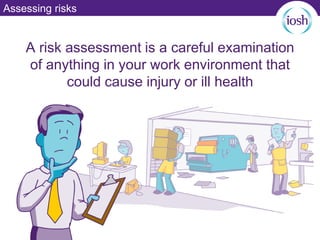
A risk assessment is a careful examination
of anything in your work environment that
could cause injury or ill health
Assessing risks
A risk assessment helps to protect:
• you
• your workforce and others
• your business
Assessing risks
How are risk assessments
carried out?
Assessing risks
Assessing risks
Assessing risks
Assessing risks
Assessing risks
Assessing risks
Assessing risks
Assessing risks
Assessing risks
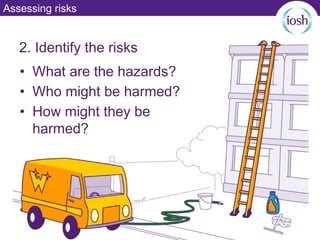
2. Identify the risks
Assessing risks
2. Identify the risks
Assessing risks
2. Identify the risks
Assessing risks
2. Identify the risks
• What are the hazards?
• Who might be harmed?
• How might they be
harmed?
Assessing risks
Assessing risks
3. Estimate the risk
You need to consider two things:
• how likely is it that something
could go wrong?
• how serious would the
outcome be?
Assessing risks
Assessing risks
Assessing risks
Assessing risks
Assessing risks
Assessing risks
Assessing risks
Assessing risks
Assessing risks
Assessing risks
Assessing risks
Assessing risks
Assessing risks
Assessing risks
Assessing risks
Assessing risks
Assessing risks
Assessing risks
Assessing risks
Assessing risks
Assessing risks
Assessing risks
Assessing risks
Assessing risks
Assessing risks
4. Evaluate the risk
Now that you’ve
estimated the risk,
what are you going
to do about it?
Assessing risks
3-4 Tolerable
Look to improve
6-9 Unacceptable
Take immediate action
1-2 Acceptable
No further action, but
ensure controls are
maintained
4. Evaluate the risk
Assessing risks
4. Evaluate the risk
Assessing risks
Likelihood:
1 – Very unlikely
2 – Unlikely
3 – Fairly likely
4 – Likely
5 – Very likely
4. Evaluate the risk
Assessing risks
Consequence:
1 – Insignificant
2 – Minor
3 – Moderate
4 – Major
5 – Catastrophic
4. Evaluate the risk
Assessing risks
4. Evaluate the risk
5-9 Adequate
Look to improve at next review
10-16 Tolerable
Look to improve within
specified timescale
1-4 Acceptable
No further action, but ensure
controls are maintained
17-25 Unacceptable
Stop activity and make
immediate improvements
Assessing risks
4. Evaluate the risk
Assessing risks
5. Record your findings
• hazards and risk levels
• risk controls
• assessor’s details
• review date
• date and time
• the location, activity and
equipment being assessed
Assessing risks
When changes occur (personnel, equipment
or activities), you should review your risk
assessments.
6. Review your findings
It’s a legal requirement
to review assessments
regularly
Assessing risks
• Make sure it’s suitable and sufficient
• Better data helps make better judgements
• Involve the people it’s likely to affect
• Conditions may vary from site to site
• Consider “on the spot” assessments
Tips to improve your risk assessment:
Assessing risks
Put risk assessment into practice
Assessing risks
Assessing risks
Assessing risks
Assessing risks
• What is risk?
• What is a risk assessment?
• How are risk assessments
carried out?
Key learning points:

module2.pdf