Chemical Reaction
Engineering
 Introduction and basic concepts.
 Chapter no 1 and 2
Dr. Muhammad Shahbaz
Subject Code: Ch.E-325
Cr.hrs: (3-1) 4
Lecturer objective
Introduction of chemical reaction engineering
Basic Concepts of reaction and reactor design
Why Chemical reaction engineering
Recommended books
Element of chemical Reaction Engineering
by H.Scot Fogler (3rd or fourth edition )
Chemical reaction Engineering by
Octave Levenspiel (3rd edition )
An Introduction to Engineering kinetics and
Reactor Design by Charles G.Hill
Introduction:
 Chemical Reaction Engineering (CRE) is the field
that studies the rates and mechanisms of chemical
reactions and the design of the reactors in which they
take place.
 Chemical reaction engineering is at the heart of
every chemical process. It separates the chemical
engineer from other engineers.
Industries that Draw Heavily on Chemical Reaction
Engineering (CRE) are:
CPI (Chemical Process Industries), Etmad, Aner flex,
Dow, DuPont, Amoco, Chevron , Alpha Laval, Descon,
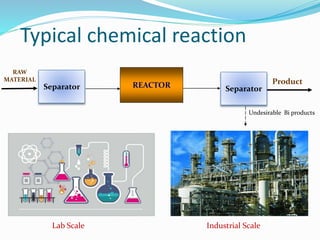
Typical chemical reaction
RAW
MATERIAL
REACTOR
Undesirable Bi products
Separator Separator
Lab Scale Industrial Scale
Product
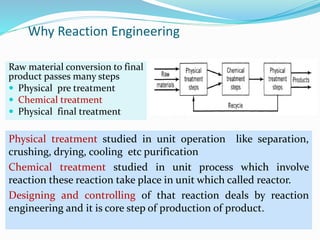
Why Reaction Engineering
Raw material conversion to final
product passes many steps
 Physical pre treatment
 Chemical treatment
 Physical final treatment
Physical treatment studied in unit operation like separation,
crushing, drying, cooling etc purification
Chemical treatment studied in unit process which involve
reaction these reaction take place in unit which called reactor.
Designing and controlling of that reaction deals by reaction
engineering and it is core step of production of product.
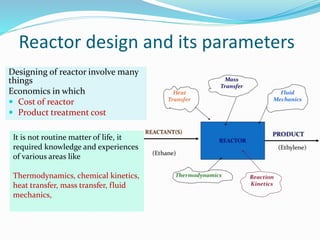
Reactor design and its parameters
Designing of reactor involve many
things
Economics in which
 Cost of reactor
 Product treatment cost
It is not routine matter of life, it
required knowledge and experiences
of various areas like
Thermodynamics, chemical kinetics,
heat transfer, mass transfer, fluid
mechanics,
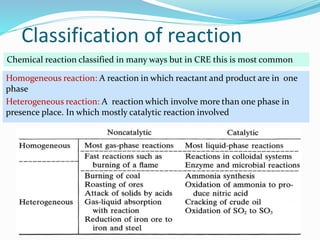
Classification of reaction
Homogeneous reaction: A reaction in which reactant and product are in one
phase
Heterogeneous reaction: A reaction which involve more than one phase in
presence place. In which mostly catalytic reaction involved
Chemical reaction classified in many ways but in CRE this is most common
Chemical Identity
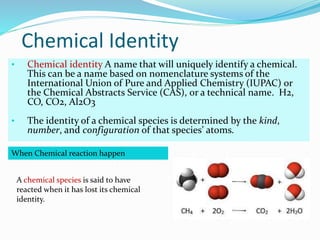
• Chemical identity A name that will uniquely identify a chemical.
This can be a name based on nomenclature systems of the
International Union of Pure and Applied Chemistry (IUPAC) or
the Chemical Abstracts Service (CAS), or a technical name. H2,
CO, CO2, Al2O3
• The identity of a chemical species is determined by the kind,
number, and configuration of that species’ atoms.
A chemical species is said to have
reacted when it has lost its chemical
identity.
When Chemical reaction happen
Chemical change
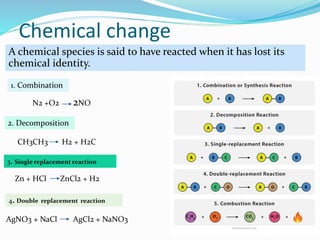
A chemical species is said to have reacted when it has lost its
chemical identity.
1. Combination
2. Decomposition
3. Single replacement reaction
Zn + HCl ZnCl2 + H2
CH3CH3 H2 + H2C
N2 +O2 2NO
AgNO3 + NaCl AgCl2 + NaNO3
4. Double replacement reaction
Reaction Rate
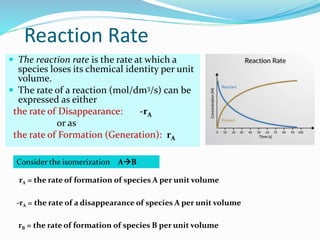
 The reaction rate is the rate at which a
species loses its chemical identity per unit
volume.
 The rate of a reaction (mol/dm3/s) can be
expressed as either
the rate of Disappearance: -rA
or as
the rate of Formation (Generation): rA
rA = the rate of formation of species A per unit volume
-rA = the rate of a disappearance of species A per unit volume
rB = the rate of formation of species B per unit volume
Consider the isomerization AB
Reaction Rate
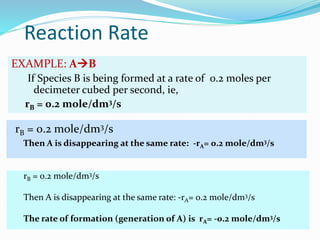
EXAMPLE: AB
If Species B is being formed at a rate of 0.2 moles per
decimeter cubed per second, ie,
rB = 0.2 mole/dm3/s
rB = 0.2 mole/dm3/s
Then A is disappearing at the same rate: -rA= 0.2 mole/dm3/s
rB = 0.2 mole/dm3/s
Then A is disappearing at the same rate: -rA= 0.2 mole/dm3/s
The rate of formation (generation of A) is rA= -0.2 mole/dm3/s
CRE-!-Lec.pptx

CRE-!-Lec.pptx

  • 1.
    Chemical Reaction Engineering  Introductionand basic concepts.  Chapter no 1 and 2 Dr. Muhammad Shahbaz Subject Code: Ch.E-325 Cr.hrs: (3-1) 4
  • 2.
    Lecturer objective Introduction ofchemical reaction engineering Basic Concepts of reaction and reactor design Why Chemical reaction engineering
  • 3.
    Recommended books Element ofchemical Reaction Engineering by H.Scot Fogler (3rd or fourth edition ) Chemical reaction Engineering by Octave Levenspiel (3rd edition ) An Introduction to Engineering kinetics and Reactor Design by Charles G.Hill
  • 4.
    Introduction:  Chemical ReactionEngineering (CRE) is the field that studies the rates and mechanisms of chemical reactions and the design of the reactors in which they take place.  Chemical reaction engineering is at the heart of every chemical process. It separates the chemical engineer from other engineers. Industries that Draw Heavily on Chemical Reaction Engineering (CRE) are: CPI (Chemical Process Industries), Etmad, Aner flex, Dow, DuPont, Amoco, Chevron , Alpha Laval, Descon,
  • 5.
    Typical chemical reaction RAW MATERIAL REACTOR UndesirableBi products Separator Separator Lab Scale Industrial Scale Product
  • 6.
    Why Reaction Engineering Rawmaterial conversion to final product passes many steps  Physical pre treatment  Chemical treatment  Physical final treatment Physical treatment studied in unit operation like separation, crushing, drying, cooling etc purification Chemical treatment studied in unit process which involve reaction these reaction take place in unit which called reactor. Designing and controlling of that reaction deals by reaction engineering and it is core step of production of product.
  • 7.
    Reactor design andits parameters Designing of reactor involve many things Economics in which  Cost of reactor  Product treatment cost It is not routine matter of life, it required knowledge and experiences of various areas like Thermodynamics, chemical kinetics, heat transfer, mass transfer, fluid mechanics,
  • 8.
    Classification of reaction Homogeneousreaction: A reaction in which reactant and product are in one phase Heterogeneous reaction: A reaction which involve more than one phase in presence place. In which mostly catalytic reaction involved Chemical reaction classified in many ways but in CRE this is most common
  • 9.
    Chemical Identity • Chemicalidentity A name that will uniquely identify a chemical. This can be a name based on nomenclature systems of the International Union of Pure and Applied Chemistry (IUPAC) or the Chemical Abstracts Service (CAS), or a technical name. H2, CO, CO2, Al2O3 • The identity of a chemical species is determined by the kind, number, and configuration of that species’ atoms. A chemical species is said to have reacted when it has lost its chemical identity. When Chemical reaction happen
  • 10.
    Chemical change A chemicalspecies is said to have reacted when it has lost its chemical identity. 1. Combination 2. Decomposition 3. Single replacement reaction Zn + HCl ZnCl2 + H2 CH3CH3 H2 + H2C N2 +O2 2NO AgNO3 + NaCl AgCl2 + NaNO3 4. Double replacement reaction
  • 11.
    Reaction Rate  Thereaction rate is the rate at which a species loses its chemical identity per unit volume.  The rate of a reaction (mol/dm3/s) can be expressed as either the rate of Disappearance: -rA or as the rate of Formation (Generation): rA rA = the rate of formation of species A per unit volume -rA = the rate of a disappearance of species A per unit volume rB = the rate of formation of species B per unit volume Consider the isomerization AB
  • 12.
    Reaction Rate EXAMPLE: AB IfSpecies B is being formed at a rate of 0.2 moles per decimeter cubed per second, ie, rB = 0.2 mole/dm3/s rB = 0.2 mole/dm3/s Then A is disappearing at the same rate: -rA= 0.2 mole/dm3/s rB = 0.2 mole/dm3/s Then A is disappearing at the same rate: -rA= 0.2 mole/dm3/s The rate of formation (generation of A) is rA= -0.2 mole/dm3/s