Evolving Safety Culture
by
Behaviour Based Safety
Observations / Intervention
1
Safety BBS observation is a structured and
planned pro-active two way safety conversation with
people at their work place to achieve positive
change in people’s behaviour towards safety -
No BBS observation without Conversation
Safety BBS observation / Intervention
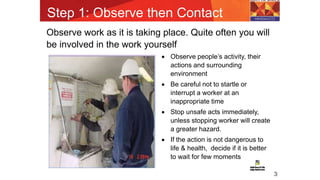
Step 1: Observe then Contact
3
Observe work as it is taking place. Quite often you will
be involved in the work yourself
 Observe people’s activity, their
actions and surrounding
environment
 Be careful not to startle or
interrupt a worker at an
inappropriate time
 Stop unsafe acts immediately,
unless stopping worker will create
a greater hazard.
 If the action is not dangerous to
life & health, decide if it is better
to wait for few moments
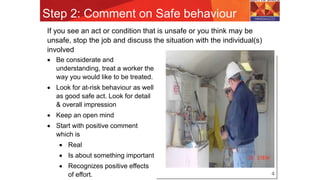
Step 2: Comment on Safe behaviour
4
If you see an act or condition that is unsafe or you think may be
unsafe, stop the job and discuss the situation with the individual(s)
involved
 Be considerate and
understanding, treat a worker the
way you would like to be treated.
 Look for at-risk behaviour as well
as good safe act. Look for detail
& overall impression
 Keep an open mind
 Start with positive comment
which is
 Real
 Is about something important
 Recognizes positive effects
of effort.
Step 3: Discuss
5
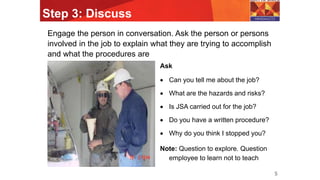
Engage the person in conversation. Ask the person or persons
involved in the job to explain what they are trying to accomplish
and what the procedures are
Ask
 Can you tell me about the job?
 What are the hazards and risks?
 Is JSA carried out for the job?
 Do you have a written procedure?
 Why do you think I stopped you?
Note: Question to explore. Question
employee to learn not to teach
Step 4: Emotional Touch
6
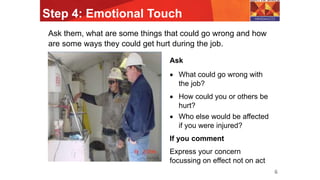
Ask them, what are some things that could go wrong and how
are some ways they could get hurt during the job.
Ask
 What could go wrong with
the job?
 How could you or others be
hurt?
 Who else would be affected
if you were injured?
If you comment
Express your concern
focussing on effect not on act
Step 5: Seek information to do the job safely
7
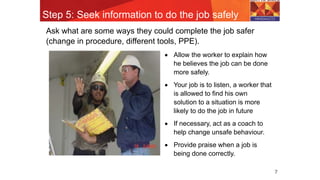
Ask what are some ways they could complete the job safer
(change in procedure, different tools, PPE).
 Allow the worker to explain how
he believes the job can be done
more safely.
 Your job is to listen, a worker that
is allowed to find his own
solution to a situation is more
likely to do the job in future
 If necessary, act as a coach to
help change unsafe behaviour.
 Provide praise when a job is
being done correctly.
Step 6: Agreement for future
8
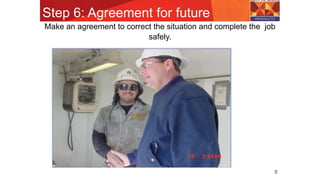
Make an agreement to correct the situation and complete the job
safely.
1. Observe; decide how to get the person’s attention;
stop the unsafe act (safely).
2. Comment on what the employee was doing safely.
3. Discuss with the employee
• The possible consequences of the unsafe act.
• Safer ways to do the job.
4. Discuss other safety issues of the job.
5. Get the employee’s agreement to work safely in the
future.
6. Thank the employee.
Six Step Safety Observation Process
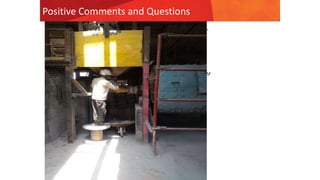
Positive Comments and Questions
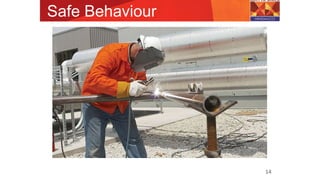
Talking with Employees Who Are Working Safely...
Look at the photo of a person working safely
Develop one comment that you would make to the person
Then identify two or three questions you would ask him / her
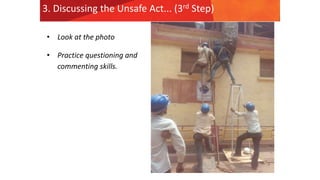
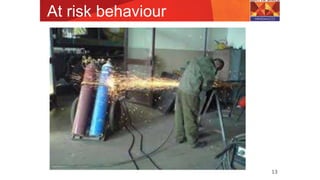
3. Discussing the Unsafe Act... (3rd Step)
• Look at the photo
• Practice questioning and
commenting skills.
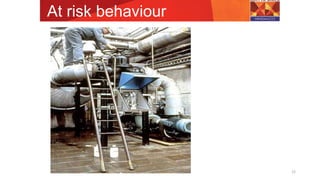
At risk behaviour
12
At risk behaviour
13
Safe Behaviour
14
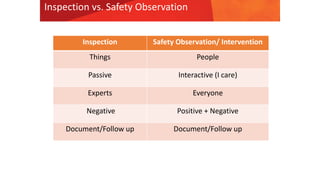
Inspection vs. Safety Observation
Inspection Safety Observation/ Intervention
Things People
Passive Interactive (I care)
Experts Everyone
Negative Positive + Negative
Document/Follow up Document/Follow up
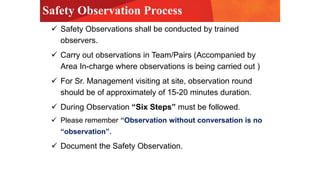
Safety Observation Process
 Safety Observations shall be conducted by trained
observers.
 Carry out observations in Team/Pairs (Accompanied by
Area In-charge where observations is being carried out )
 For Sr. Management visiting at site, observation round
should be of approximately of 15-20 minutes duration.
 During Observation “Six Steps” must be followed.
 Please remember “Observation without conversation is no
“observation”.
 Document the Safety Observation.
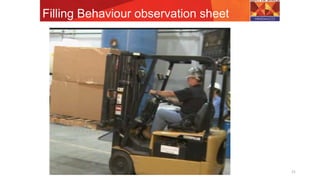
Filling Behaviour Observation Sheet
17
Complete the behaviour observation format. Be sure
to mark all the required boxes and provide a summary
of the unsafe act & corrective action
 Be specific and check the appropriate category and box(s) that
apply.
 Give brief description of observation in comment section
 List any corrective actions and date they are to be completed
 Provide name of the person(s) completing the observation
 Submit duly filled form for review & processing
 Data can be tracked and trended for management to improve
Observation Category
18
1. Reactions of People (RP)
Are people modifying their behaviour (unsafe to safe) when they see a
Leader/ Manager in the area? Employees may sometimes react to being
observed and change their body position, adjust their PPE, switch to the
correct tool etc.
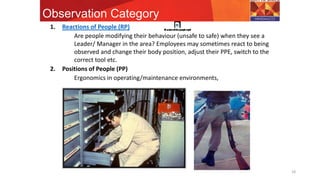
2. Positions of People (PP)
Ergonomics in operating/maintenance environments,
Observation Category
19
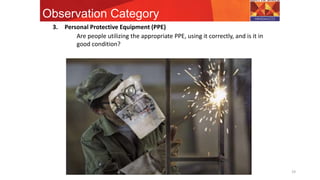
3. Personal Protective Equipment (PPE)
Are people utilizing the appropriate PPE, using it correctly, and is it in
good condition?
Observation Category
20
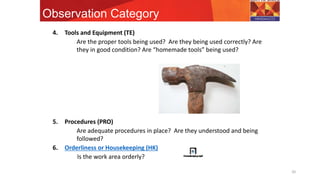
4. Tools and Equipment (TE)
Are the proper tools being used? Are they being used correctly? Are
they in good condition? Are “homemade tools” being used?
5. Procedures (PRO)
Are adequate procedures in place? Are they understood and being
followed?
6. Orderliness or Housekeeping (HK)
Is the work area orderly?
Filling Behaviour observation sheet
21
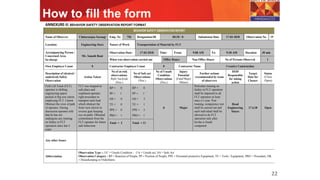
How to fill the form
22
ANNEXURE-II: BEHAVIOR SAFETY OBSERVATION REPORT FORMAT
BEHAVIOR SAFETY OBSERVATION REPORT
Name of Observer Chittaranjan Sarangi Emp. No 756 Designation/JB DGM / 8 Submission Date 17-03-2018 Observation No 15
Location: Engineering Store Nature of Work Transportation of Material by FLT
Accompanying Person /
Concerned Area
In-charge
Mr. Sanath Rout
Observation Date: 17-03-2018 Time: From: 9:00 AM To: 9:30 AM Duration 30 min
When was observation carried out Office Hours Non Office Hours No of Persons Observed 1
Own Employee Count 0 Contractor Employee Count 0 Contractor Name Creative Construction
Description of (desired /
undesired) Safety
Observation
Action Taken
No of at-risk
observations.
Refer backside
(Nos.)
No of Safe act
Observations
(Nos.)
No of Unsafe
Condition
Observations
(Nos.)
Injury
Potential
(Fatal/Major
/Minor)
Further actions
recommended by team
of observers
HOD
Responsible
for taking
action
Target
Date for
Closure
Status
(Close
/Open)
Fork Lift Truck (FLT)
operator is shifting
engineering spares
packed in big size carton
employing FLT. Carton
Obstruct the view of path
of operator. During
discussion operator told
that he has not
undergone any training
on Safety in FLT
operation since last 3
years
FLT was stopped at
safe place and
explained operator
right procedure to
transport such load
which obstruct the
front view (travel in
reverse gear keeping
eye on path). Obtained
commitment from the
FLT operator for future
safe behaviour
RP = 0
PP = 1
OS = 0
TE = 0
PPE = 0
PRO = 1
RP = 0
PP = 1
OS = 5
TE = 1
PPE = 3
PRO = 1
0 Major
Refresher training on
Safety in FLT operation
shall be imparted to all
FLT operators at least
once a 3 year. Post
training, competency test
shall be carried out and
each individual shall be
allowed to do FLT
operation only after
he/she is found
competent
Head
Engineering
Stores
17.4.18 Open
Total = 2 Total = 11
Any other Issues
Abbreviation
Observation Type :- UC = Unsafe Condition ; UA = Unsafe act; SA = Safe Act
Observation Category : RP = Reaction of People, PP = Position of People, PPE = Personnel protective Equipment, TE = Tools / Equipment, PRO = Procedure, HK
= Housekeeping or Orderliness
Thank You
24

BBS Six step PPT.pptx..............................................

  • 1.
    Evolving Safety Culture by BehaviourBased Safety Observations / Intervention 1
  • 2.
    Safety BBS observationis a structured and planned pro-active two way safety conversation with people at their work place to achieve positive change in people’s behaviour towards safety - No BBS observation without Conversation Safety BBS observation / Intervention
  • 3.
    Step 1: Observethen Contact 3 Observe work as it is taking place. Quite often you will be involved in the work yourself  Observe people’s activity, their actions and surrounding environment  Be careful not to startle or interrupt a worker at an inappropriate time  Stop unsafe acts immediately, unless stopping worker will create a greater hazard.  If the action is not dangerous to life & health, decide if it is better to wait for few moments
  • 4.
    Step 2: Commenton Safe behaviour 4 If you see an act or condition that is unsafe or you think may be unsafe, stop the job and discuss the situation with the individual(s) involved  Be considerate and understanding, treat a worker the way you would like to be treated.  Look for at-risk behaviour as well as good safe act. Look for detail & overall impression  Keep an open mind  Start with positive comment which is  Real  Is about something important  Recognizes positive effects of effort.
  • 5.
    Step 3: Discuss 5 Engagethe person in conversation. Ask the person or persons involved in the job to explain what they are trying to accomplish and what the procedures are Ask  Can you tell me about the job?  What are the hazards and risks?  Is JSA carried out for the job?  Do you have a written procedure?  Why do you think I stopped you? Note: Question to explore. Question employee to learn not to teach
  • 6.
    Step 4: EmotionalTouch 6 Ask them, what are some things that could go wrong and how are some ways they could get hurt during the job. Ask  What could go wrong with the job?  How could you or others be hurt?  Who else would be affected if you were injured? If you comment Express your concern focussing on effect not on act
  • 7.
    Step 5: Seekinformation to do the job safely 7 Ask what are some ways they could complete the job safer (change in procedure, different tools, PPE).  Allow the worker to explain how he believes the job can be done more safely.  Your job is to listen, a worker that is allowed to find his own solution to a situation is more likely to do the job in future  If necessary, act as a coach to help change unsafe behaviour.  Provide praise when a job is being done correctly.
  • 8.
    Step 6: Agreementfor future 8 Make an agreement to correct the situation and complete the job safely.
  • 9.
    1. Observe; decidehow to get the person’s attention; stop the unsafe act (safely). 2. Comment on what the employee was doing safely. 3. Discuss with the employee • The possible consequences of the unsafe act. • Safer ways to do the job. 4. Discuss other safety issues of the job. 5. Get the employee’s agreement to work safely in the future. 6. Thank the employee. Six Step Safety Observation Process
  • 10.
    Positive Comments andQuestions Talking with Employees Who Are Working Safely... Look at the photo of a person working safely Develop one comment that you would make to the person Then identify two or three questions you would ask him / her
  • 11.
    3. Discussing theUnsafe Act... (3rd Step) • Look at the photo • Practice questioning and commenting skills.
  • 12.
  • 13.
  • 14.
  • 15.
    Inspection vs. SafetyObservation Inspection Safety Observation/ Intervention Things People Passive Interactive (I care) Experts Everyone Negative Positive + Negative Document/Follow up Document/Follow up
  • 16.
    Safety Observation Process Safety Observations shall be conducted by trained observers.  Carry out observations in Team/Pairs (Accompanied by Area In-charge where observations is being carried out )  For Sr. Management visiting at site, observation round should be of approximately of 15-20 minutes duration.  During Observation “Six Steps” must be followed.  Please remember “Observation without conversation is no “observation”.  Document the Safety Observation.
  • 17.
    Filling Behaviour ObservationSheet 17 Complete the behaviour observation format. Be sure to mark all the required boxes and provide a summary of the unsafe act & corrective action  Be specific and check the appropriate category and box(s) that apply.  Give brief description of observation in comment section  List any corrective actions and date they are to be completed  Provide name of the person(s) completing the observation  Submit duly filled form for review & processing  Data can be tracked and trended for management to improve
  • 18.
    Observation Category 18 1. Reactionsof People (RP) Are people modifying their behaviour (unsafe to safe) when they see a Leader/ Manager in the area? Employees may sometimes react to being observed and change their body position, adjust their PPE, switch to the correct tool etc. 2. Positions of People (PP) Ergonomics in operating/maintenance environments,
  • 19.
    Observation Category 19 3. PersonalProtective Equipment (PPE) Are people utilizing the appropriate PPE, using it correctly, and is it in good condition?
  • 20.
    Observation Category 20 4. Toolsand Equipment (TE) Are the proper tools being used? Are they being used correctly? Are they in good condition? Are “homemade tools” being used? 5. Procedures (PRO) Are adequate procedures in place? Are they understood and being followed? 6. Orderliness or Housekeeping (HK) Is the work area orderly?
  • 21.
  • 22.
    How to fillthe form 22 ANNEXURE-II: BEHAVIOR SAFETY OBSERVATION REPORT FORMAT BEHAVIOR SAFETY OBSERVATION REPORT Name of Observer Chittaranjan Sarangi Emp. No 756 Designation/JB DGM / 8 Submission Date 17-03-2018 Observation No 15 Location: Engineering Store Nature of Work Transportation of Material by FLT Accompanying Person / Concerned Area In-charge Mr. Sanath Rout Observation Date: 17-03-2018 Time: From: 9:00 AM To: 9:30 AM Duration 30 min When was observation carried out Office Hours Non Office Hours No of Persons Observed 1 Own Employee Count 0 Contractor Employee Count 0 Contractor Name Creative Construction Description of (desired / undesired) Safety Observation Action Taken No of at-risk observations. Refer backside (Nos.) No of Safe act Observations (Nos.) No of Unsafe Condition Observations (Nos.) Injury Potential (Fatal/Major /Minor) Further actions recommended by team of observers HOD Responsible for taking action Target Date for Closure Status (Close /Open) Fork Lift Truck (FLT) operator is shifting engineering spares packed in big size carton employing FLT. Carton Obstruct the view of path of operator. During discussion operator told that he has not undergone any training on Safety in FLT operation since last 3 years FLT was stopped at safe place and explained operator right procedure to transport such load which obstruct the front view (travel in reverse gear keeping eye on path). Obtained commitment from the FLT operator for future safe behaviour RP = 0 PP = 1 OS = 0 TE = 0 PPE = 0 PRO = 1 RP = 0 PP = 1 OS = 5 TE = 1 PPE = 3 PRO = 1 0 Major Refresher training on Safety in FLT operation shall be imparted to all FLT operators at least once a 3 year. Post training, competency test shall be carried out and each individual shall be allowed to do FLT operation only after he/she is found competent Head Engineering Stores 17.4.18 Open Total = 2 Total = 11 Any other Issues Abbreviation Observation Type :- UC = Unsafe Condition ; UA = Unsafe act; SA = Safe Act Observation Category : RP = Reaction of People, PP = Position of People, PPE = Personnel protective Equipment, TE = Tools / Equipment, PRO = Procedure, HK = Housekeeping or Orderliness
  • 23.