Module:1
Introduction to Robotics &
Automation
Nagesh Shenoy
nagesh.shenoy9401@gmail.com
1
2
About
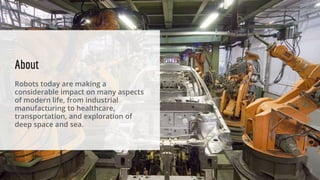
Robots today are making a
considerable impact on many aspects
of modern life, from industrial
manufacturing to healthcare,
transportation, and exploration of
deep space and sea.
Definitions
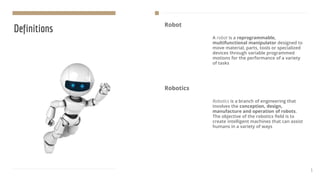
Robot
A robot is a reprogrammable,
multifunctional manipulator designed to
move material, parts, tools or specialized
devices through variable programmed
motions for the performance of a variety
of tasks
Robotics
Robotics is a branch of engineering that
involves the conception, design,
manufacture and operation of robots.
The objective of the robotics field is to
create intelligent machines that can assist
humans in a variety of ways
3
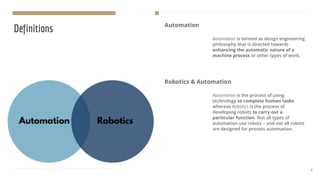
Definitions Automation
Automation is termed as design engineering
philosophy that is directed towards
enhancing the automatic nature of a
machine process or other types of work.
Robotics & Automation
Automation is the process of using
technology to complete human tasks
whereas Robotics is the process of
developing robots to carry out a
particular function. Not all types of
automation use robots – and not all robots
are designed for process automation.
4
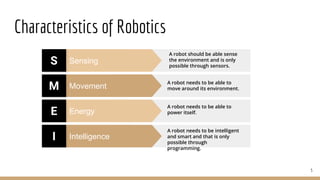
Characteristics of Robotics
Intelligence
I
Sensing
S
Movement
M
Energy
E
A robot should be able sense
the environment and is only
possible through sensors.
A robot needs to be able to
move around its environment.
A robot needs to be able to
power itself.
A robot needs to be intelligent
and smart and that is only
possible through
programming.
5
Principle of Robotics
Asimov’s 3 Laws of Robotics
Law l:
A robot may not injure a human being or through inaction, allow a human being to come to harm.
Law 2:
A robot must obey orders given to it by human beings, except where such orders would
conflict with the first law.
Law 3:
A robot must protect its own existence
6
Need for Robotics
● To carry out dangerous work which human can't do
● To perform boring and repetitive work
● To carry out high precision and high speed work
7
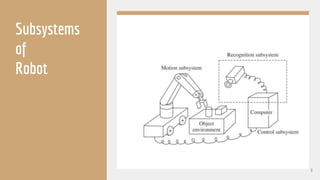
Subsystems
of
Robot
8
9
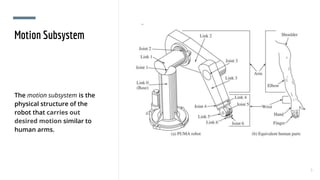
Motion Subsystem
The motion subsystem is the
physical structure of the
robot that carries out
desired motion similar to
human arms.
11
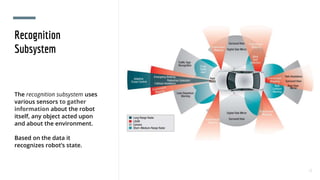
Recognition
Subsystem
The recognition subsystem uses
various sensors to gather
information about the robot
itself, any object acted upon
and about the environment.
Based on the data it
recognizes robot’s state.
12
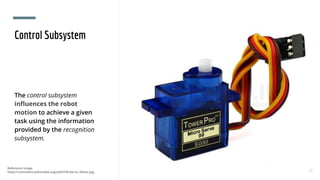
Control Subsystem
The control subsystem
influences the robot
motion to achieve a given
task using the information
provided by the recognition
subsystem.
Reference image
https://commons.wikimedia.org/wiki/File:Servo_Motor.jpg
Robot
Specification
s
1. Payload
2. Reach
3. Repeatability
4. Accuracy
5. Resolution
6. Speed
7. DOF
13
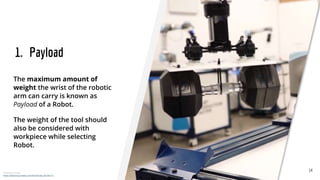
1. Payload
The maximum amount of
weight the wrist of the robotic
arm can carry is known as
Payload of a Robot.
The weight of the tool should
also be considered with
workpiece while selecting
Robot.
14
Reference Image
https://elearning.robotiq.com/enrol/index.php?id=13
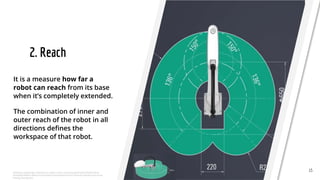
2. Reach
It is a measure how far a
robot can reach from its base
when it’s completely extended.
The combination of inner and
outer reach of the robot in all
directions defines the
workspace of that robot.
15
Reference Image https://aradmin.en.made-in-china.com/product/rdeTpFDOZQAb/China-
Air6sc600-600mm-Reach-4-Axis-Robot-Scara-Robot-for-Pick-Place-for-Robotics-Arm-Food-
Picking-Placing.html
Reference image
https://blog.robotiq.com/what-are-accuracy-and-repeatability-in-industrial-robots
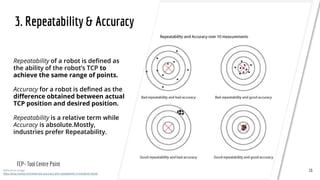
3. Repeatability & Accuracy
Repeatability of a robot is defined as
the ability of the robot’s TCP to
achieve the same range of points.
Accuracy for a robot is defined as the
difference obtained between actual
TCP position and desired position.
Repeatability is a relative term while
Accuracy is absolute.Mostly,
industries prefer Repeatability.
16
TCP- Tool Centre Point
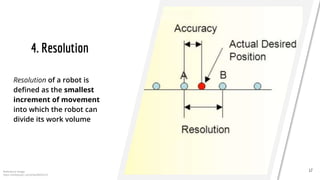
4. Resolution
Resolution of a robot is
defined as the smallest
increment of movement
into which the robot can
divide its work volume
17
Reference image
https://slideplayer.com/slide/6854012/
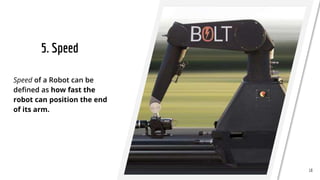
5. Speed
Speed of a Robot can be
defined as how fast the
robot can position the end
of its arm.
18
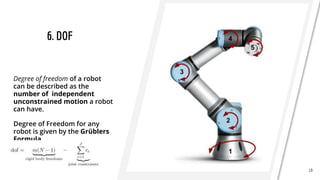
6. DOF
Degree of freedom of a robot
can be described as the
number of independent
unconstrained motion a robot
can have.
Degree of Freedom for any
robot is given by the Grüblers
Formula.
19
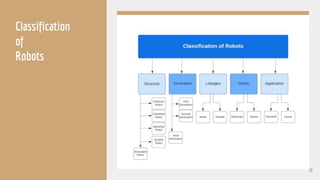
Classification
of
Robots
20
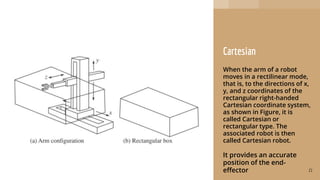
Cartesian
When the arm of a robot
moves in a rectilinear mode,
that is, to the directions of x,
y, and z coordinates of the
rectangular right-handed
Cartesian coordinate system,
as shown in Figure, it is
called Cartesian or
rectangular type. The
associated robot is then
called Cartesian robot.
It provides an accurate
position of the end-
effector 21
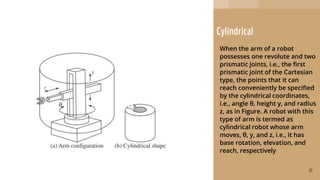
Cylindrical
When the arm of a robot
possesses one revolute and two
prismatic joints, i.e., the first
prismatic joint of the Cartesian
type, the points that it can
reach conveniently be specified
by the cylindrical coordinates,
i.e., angle θ, height y, and radius
z, as in Figure. A robot with this
type of arm is termed as
cylindrical robot whose arm
moves, θ, y, and z, i.e., it has
base rotation, elevation, and
reach, respectively
22
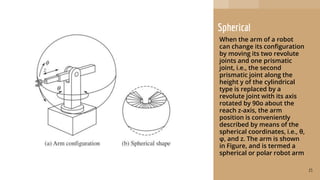
Spherical
When the arm of a robot
can change its configuration
by moving its two revolute
joints and one prismatic
joint, i.e., the second
prismatic joint along the
height y of the cylindrical
type is replaced by a
revolute joint with its axis
rotated by 90o about the
reach z-axis, the arm
position is conveniently
described by means of the
spherical coordinates, i.e., θ,
φ, and z. The arm is shown
in Figure, and is termed a
spherical or polar robot arm
23
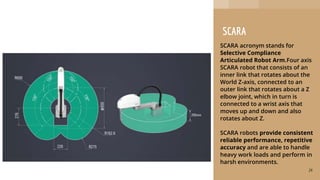
SCARA
SCARA acronym stands for
Selective Compliance
Articulated Robot Arm.Four axis
SCARA robot that consists of an
inner link that rotates about the
World Z-axis, connected to an
outer link that rotates about a Z
elbow joint, which in turn is
connected to a wrist axis that
moves up and down and also
rotates about Z.
SCARA robots provide consistent
reliable performance, repetitive
accuracy and are able to handle
heavy work loads and perform in
harsh environments.
24
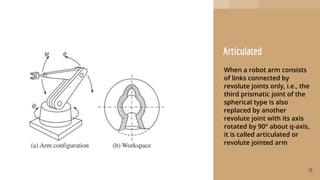
Articulated
When a robot arm consists
of links connected by
revolute joints only, i.e., the
third prismatic joint of the
spherical type is also
replaced by another
revolute joint with its axis
rotated by 90° about q-axis,
it is called articulated or
revolute jointed arm
25
Based on Linkages
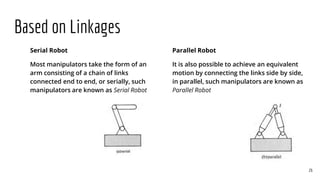
Serial Robot
Most manipulators take the form of an
arm consisting of a chain of links
connected end to end, or serially, such
manipulators are known as Serial Robot
26
Parallel Robot
It is also possible to achieve an equivalent
motion by connecting the links side by side,
in parallel, such manipulators are known as
Parallel Robot
Some Application
of Robots
in the
Industry
27
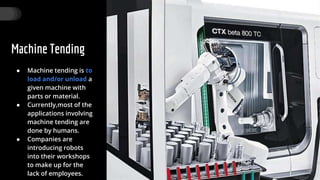
Machine Tending
● Machine tending is to
load and/or unload a
given machine with
parts or material.
● Currently,most of the
applications involving
machine tending are
done by humans.
● Companies are
introducing robots
into their workshops
to make up for the
lack of employees.
28
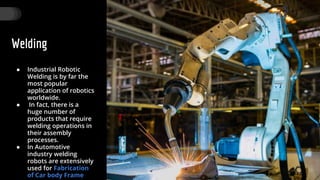
Welding
● Industrial Robotic
Welding is by far the
most popular
application of robotics
worldwide.
● In fact, there is a
huge number of
products that require
welding operations in
their assembly
processes.
● In Automotive
industry welding
robots are extensively
used for Fabrication
of Car body Frame
29
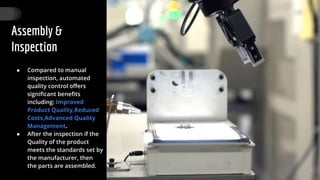
Assembly &
Inspection
● Compared to manual
inspection, automated
quality control offers
significant benefits
including: Improved
Product Quality,Reduced
Costs,Advanced Quality
Management.
● After the inspection if the
Quality of the product
meets the standards set by
the manufacturer, then
the parts are assembled.
30
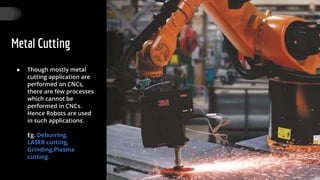
Metal Cutting
● Though mostly metal
cutting application are
performed on CNCs,
there are few processes
which cannot be
performed in CNCs.
Hence Robots are used
in such applications.
Eg. Deburring,
LASER cutting,
Grinding,Plasma
cutting.
31
Painting
● Painting Robots are
increasingly employed
in the manufacturing,
construction, and
automotive industries.
● Painting robots are
majorly used in
Automotive industry to
paint the body of the
car.
32

Module_1 Introduction to Robotics & Automation.pptx

  • 1.
    Module:1 Introduction to Robotics& Automation Nagesh Shenoy nagesh.shenoy9401@gmail.com 1
  • 2.
    2 About Robots today aremaking a considerable impact on many aspects of modern life, from industrial manufacturing to healthcare, transportation, and exploration of deep space and sea.
  • 3.
    Definitions Robot A robot isa reprogrammable, multifunctional manipulator designed to move material, parts, tools or specialized devices through variable programmed motions for the performance of a variety of tasks Robotics Robotics is a branch of engineering that involves the conception, design, manufacture and operation of robots. The objective of the robotics field is to create intelligent machines that can assist humans in a variety of ways 3
  • 4.
    Definitions Automation Automation istermed as design engineering philosophy that is directed towards enhancing the automatic nature of a machine process or other types of work. Robotics & Automation Automation is the process of using technology to complete human tasks whereas Robotics is the process of developing robots to carry out a particular function. Not all types of automation use robots – and not all robots are designed for process automation. 4
  • 5.
    Characteristics of Robotics Intelligence I Sensing S Movement M Energy E Arobot should be able sense the environment and is only possible through sensors. A robot needs to be able to move around its environment. A robot needs to be able to power itself. A robot needs to be intelligent and smart and that is only possible through programming. 5
  • 6.
    Principle of Robotics Asimov’s3 Laws of Robotics Law l: A robot may not injure a human being or through inaction, allow a human being to come to harm. Law 2: A robot must obey orders given to it by human beings, except where such orders would conflict with the first law. Law 3: A robot must protect its own existence 6
  • 7.
    Need for Robotics ●To carry out dangerous work which human can't do ● To perform boring and repetitive work ● To carry out high precision and high speed work 7
  • 8.
  • 9.
    9 Motion Subsystem The motionsubsystem is the physical structure of the robot that carries out desired motion similar to human arms.
  • 10.
    11 Recognition Subsystem The recognition subsystemuses various sensors to gather information about the robot itself, any object acted upon and about the environment. Based on the data it recognizes robot’s state.
  • 11.
    12 Control Subsystem The controlsubsystem influences the robot motion to achieve a given task using the information provided by the recognition subsystem. Reference image https://commons.wikimedia.org/wiki/File:Servo_Motor.jpg
  • 12.
    Robot Specification s 1. Payload 2. Reach 3.Repeatability 4. Accuracy 5. Resolution 6. Speed 7. DOF 13
  • 13.
    1. Payload The maximumamount of weight the wrist of the robotic arm can carry is known as Payload of a Robot. The weight of the tool should also be considered with workpiece while selecting Robot. 14 Reference Image https://elearning.robotiq.com/enrol/index.php?id=13
  • 14.
    2. Reach It isa measure how far a robot can reach from its base when it’s completely extended. The combination of inner and outer reach of the robot in all directions defines the workspace of that robot. 15 Reference Image https://aradmin.en.made-in-china.com/product/rdeTpFDOZQAb/China- Air6sc600-600mm-Reach-4-Axis-Robot-Scara-Robot-for-Pick-Place-for-Robotics-Arm-Food- Picking-Placing.html
  • 15.
    Reference image https://blog.robotiq.com/what-are-accuracy-and-repeatability-in-industrial-robots 3. Repeatability& Accuracy Repeatability of a robot is defined as the ability of the robot’s TCP to achieve the same range of points. Accuracy for a robot is defined as the difference obtained between actual TCP position and desired position. Repeatability is a relative term while Accuracy is absolute.Mostly, industries prefer Repeatability. 16 TCP- Tool Centre Point
  • 16.
    4. Resolution Resolution ofa robot is defined as the smallest increment of movement into which the robot can divide its work volume 17 Reference image https://slideplayer.com/slide/6854012/
  • 17.
    5. Speed Speed ofa Robot can be defined as how fast the robot can position the end of its arm. 18
  • 18.
    6. DOF Degree offreedom of a robot can be described as the number of independent unconstrained motion a robot can have. Degree of Freedom for any robot is given by the Grüblers Formula. 19
  • 19.
  • 20.
    Cartesian When the armof a robot moves in a rectilinear mode, that is, to the directions of x, y, and z coordinates of the rectangular right-handed Cartesian coordinate system, as shown in Figure, it is called Cartesian or rectangular type. The associated robot is then called Cartesian robot. It provides an accurate position of the end- effector 21
  • 21.
    Cylindrical When the armof a robot possesses one revolute and two prismatic joints, i.e., the first prismatic joint of the Cartesian type, the points that it can reach conveniently be specified by the cylindrical coordinates, i.e., angle θ, height y, and radius z, as in Figure. A robot with this type of arm is termed as cylindrical robot whose arm moves, θ, y, and z, i.e., it has base rotation, elevation, and reach, respectively 22
  • 22.
    Spherical When the armof a robot can change its configuration by moving its two revolute joints and one prismatic joint, i.e., the second prismatic joint along the height y of the cylindrical type is replaced by a revolute joint with its axis rotated by 90o about the reach z-axis, the arm position is conveniently described by means of the spherical coordinates, i.e., θ, φ, and z. The arm is shown in Figure, and is termed a spherical or polar robot arm 23
  • 23.
    SCARA SCARA acronym standsfor Selective Compliance Articulated Robot Arm.Four axis SCARA robot that consists of an inner link that rotates about the World Z-axis, connected to an outer link that rotates about a Z elbow joint, which in turn is connected to a wrist axis that moves up and down and also rotates about Z. SCARA robots provide consistent reliable performance, repetitive accuracy and are able to handle heavy work loads and perform in harsh environments. 24
  • 24.
    Articulated When a robotarm consists of links connected by revolute joints only, i.e., the third prismatic joint of the spherical type is also replaced by another revolute joint with its axis rotated by 90° about q-axis, it is called articulated or revolute jointed arm 25
  • 25.
    Based on Linkages SerialRobot Most manipulators take the form of an arm consisting of a chain of links connected end to end, or serially, such manipulators are known as Serial Robot 26 Parallel Robot It is also possible to achieve an equivalent motion by connecting the links side by side, in parallel, such manipulators are known as Parallel Robot
  • 26.
  • 27.
    Machine Tending ● Machinetending is to load and/or unload a given machine with parts or material. ● Currently,most of the applications involving machine tending are done by humans. ● Companies are introducing robots into their workshops to make up for the lack of employees. 28
  • 28.
    Welding ● Industrial Robotic Weldingis by far the most popular application of robotics worldwide. ● In fact, there is a huge number of products that require welding operations in their assembly processes. ● In Automotive industry welding robots are extensively used for Fabrication of Car body Frame 29
  • 29.
    Assembly & Inspection ● Comparedto manual inspection, automated quality control offers significant benefits including: Improved Product Quality,Reduced Costs,Advanced Quality Management. ● After the inspection if the Quality of the product meets the standards set by the manufacturer, then the parts are assembled. 30
  • 30.
    Metal Cutting ● Thoughmostly metal cutting application are performed on CNCs, there are few processes which cannot be performed in CNCs. Hence Robots are used in such applications. Eg. Deburring, LASER cutting, Grinding,Plasma cutting. 31
  • 31.
    Painting ● Painting Robotsare increasingly employed in the manufacturing, construction, and automotive industries. ● Painting robots are majorly used in Automotive industry to paint the body of the car. 32

Editor's Notes

  • #15 https://blog.robotiq.com/what-are-accuracy-and-repeatability-in-industrial-robots
  • #16 https://aradmin.en.made-in-china.com/product/rdeTpFDOZQAb/China-Air6sc600-600mm-Reach-4-Axis-Robot-Scara-Robot-for-Pick-Place-for-Robotics-Arm-Food-Picking-Placing.html
  • #17 https://blog.robotiq.com/what-are-accuracy-and-repeatability-in-industrial-robots
  • #18 https://slideplayer.com/slide/6854012/
  • #19 Reference image https://globalfilmz.com/cinebot-robotic-camera-arm-rental/
  • #20 https://www.smlease.com/entries/mechanism/what-is-degree-of-freedom-dof-in-mechanics/
  • #28 In today’s world robotics is used across the industries and is playing a key role for the development.