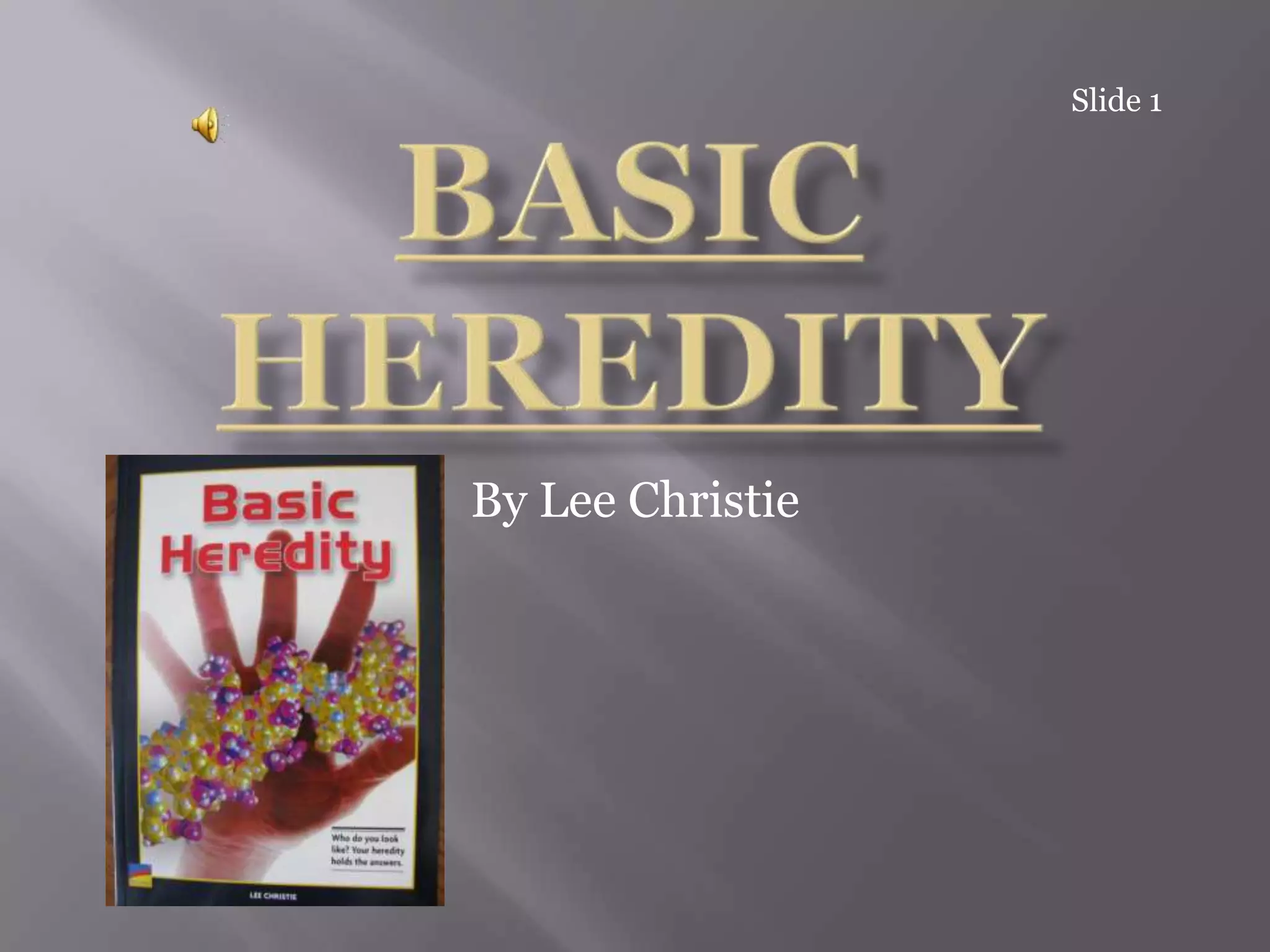
Basic HeredityBy Lee ChristieSlide 1
Part 1Introduction and MaterialsIntroduction: This book will introduce you to the wonders of our genes. Materials: Basic HeredityVirtual reading journalSlide 2
Part 2Introduction and Background KnowledgeThink about what traits you have inherited from your parents. Do you have the same color eyes or hair? Do you laugh the same way? List some of the characteristics you have inherited on the class blog.Slide 3
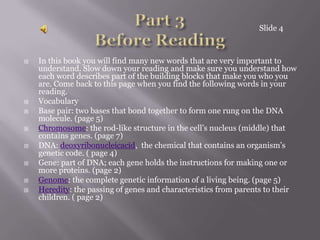
Part 3Before ReadingIn this book you will find many new words that are very important to understand. Slow down your reading and make sure you understand how each word describes part of the building blocks that make you who you are. Come back to this page when you find the following words in your reading.VocabularyBase pair: two bases that bond together to form one rung on the DNA molecule. (page 5)Chromosome: the rod-like structure in the cell’s nucleus (middle) that contains genes. (page 7)DNA: deoxyribonucleicacid,  the chemical that contains an organism’s genetic code. ( page 4)Gene: part of DNA; each gene holds the instructions for making one or more proteins. (page 2)Genome: the complete genetic information of a living being. (page 5)Heredity: the passing of genes and characteristics from parents to their children. ( page 2)Slide 4
Slide 5View the following videos to gain some initial understanding of DNASimple Science DNAHow DNA Works
During ReadingRead Chapter 1 pages 1-11. Monitor your reading speed. With informational text you need to read slower and think about the information given. Question yourself as to whether you understand the new vocabulary and how it fits into the main subject of heredity. Review  vocabulary  from slide 4 as you come to each vocabulary word.Slide 6
During ReadingFollow the directions for “Talk About It” on page 7. The direction is, “Review the information you have read so far. Then tell a partner the difference between DNA, genes, and chromosomes. After you have finished your discussion, write the main differences in your virtual reading journal. Copy and paste the next slide into your journal and record your ideas. To do this take a screen capture of the next slide, open a word document, and then press paste.Slide 7
Slide 8Add to Your Virtual Reading JournalList at least one difference under each word. Use the definitions of the words to help you.DNAGenesChromosomes
Slide 9Back to the BookYou are now going to get ready to read chapter 2. Please review the vocabulary on the next slide before reading.As you read chapter 2 you will find that plants have DNA and genetic codes as well.
Vocabulary for Chapter 2Allele: one of several forms a gene can take. (page 19)Dominant: an allele with a dominant trait always shows up in the person.Genotype: the actual genetic makeup of an organism. (page 16)Imprinting: the way the same genes can cause one type of disease if passed down from the father and another type of disease if passed down from the mother. (page 15)Mutation: a random change to one or more base pairs or genes. ( page 12)Phenotype: the observable display of a trait in a living thing, in other words, the traits you can see on the outside. (page 16)Recessive: an allele that expresses its trait in the next generation only if there are two copies. In other words: if both parents pass on the same recessive gene their child could have that trait.Slide 10
Slide 11Chapter 2Read chapter 2, pages 12-21.
After Reading Chapter 2This chapter gives a great deal of information, but probably raises some questions as well. 1. List 2 questions in your virtual reading journal.2. Choose 1 question to post to our class blog and post it.3. Read the questions other students have written and respond to one of the questions. (Can be an answer, your thoughts on the question, or confirming that you have the same question.)Slide 12
Chapter 3In the last chapter you will find out about some scientific experiments that have been conducted, and some real people and how their genetics have effected them. You will also find out about how your environment plays a big part in who you are.Slide 13
Slide 14Vocabulary for Chapter 3Genetics: the study of genes and heredity. (page 26).
Slide 15Read Chapter 3Read chapter 3, pages 22-29.
Slide 16After ReadingReview the questions and answers on our class blog.Review the major ideas of the book in your virtual reading journal. Copy and paste the following slide into your journal.
Slide 17SummarizeSummarize the main points of this book. Be sure to include the following words in your description. Refer back to your book if needed.HeredityGenesDNATraits
Slide 18Beyond ReadingHere are some activities you can do if time allows:Create your own model of DNA. Some examples are listed at the website below.http://dnamazing.com/media/how-to-make-a-dna-model.pdfCreate a lesson teaching someone else about heredity. Save the presentation to your personal digital file.

Basic heredity

  • 1.
    Basic HeredityBy LeeChristieSlide 1
  • 2.
    Part 1Introduction andMaterialsIntroduction: This book will introduce you to the wonders of our genes. Materials: Basic HeredityVirtual reading journalSlide 2
  • 3.
    Part 2Introduction andBackground KnowledgeThink about what traits you have inherited from your parents. Do you have the same color eyes or hair? Do you laugh the same way? List some of the characteristics you have inherited on the class blog.Slide 3
  • 4.
    Part 3Before ReadingInthis book you will find many new words that are very important to understand. Slow down your reading and make sure you understand how each word describes part of the building blocks that make you who you are. Come back to this page when you find the following words in your reading.VocabularyBase pair: two bases that bond together to form one rung on the DNA molecule. (page 5)Chromosome: the rod-like structure in the cell’s nucleus (middle) that contains genes. (page 7)DNA: deoxyribonucleicacid, the chemical that contains an organism’s genetic code. ( page 4)Gene: part of DNA; each gene holds the instructions for making one or more proteins. (page 2)Genome: the complete genetic information of a living being. (page 5)Heredity: the passing of genes and characteristics from parents to their children. ( page 2)Slide 4
  • 5.
    Slide 5View thefollowing videos to gain some initial understanding of DNASimple Science DNAHow DNA Works
  • 6.
    During ReadingRead Chapter1 pages 1-11. Monitor your reading speed. With informational text you need to read slower and think about the information given. Question yourself as to whether you understand the new vocabulary and how it fits into the main subject of heredity. Review vocabulary from slide 4 as you come to each vocabulary word.Slide 6
  • 7.
    During ReadingFollow thedirections for “Talk About It” on page 7. The direction is, “Review the information you have read so far. Then tell a partner the difference between DNA, genes, and chromosomes. After you have finished your discussion, write the main differences in your virtual reading journal. Copy and paste the next slide into your journal and record your ideas. To do this take a screen capture of the next slide, open a word document, and then press paste.Slide 7
  • 8.
    Slide 8Add toYour Virtual Reading JournalList at least one difference under each word. Use the definitions of the words to help you.DNAGenesChromosomes
  • 9.
    Slide 9Back tothe BookYou are now going to get ready to read chapter 2. Please review the vocabulary on the next slide before reading.As you read chapter 2 you will find that plants have DNA and genetic codes as well.
  • 10.
    Vocabulary for Chapter2Allele: one of several forms a gene can take. (page 19)Dominant: an allele with a dominant trait always shows up in the person.Genotype: the actual genetic makeup of an organism. (page 16)Imprinting: the way the same genes can cause one type of disease if passed down from the father and another type of disease if passed down from the mother. (page 15)Mutation: a random change to one or more base pairs or genes. ( page 12)Phenotype: the observable display of a trait in a living thing, in other words, the traits you can see on the outside. (page 16)Recessive: an allele that expresses its trait in the next generation only if there are two copies. In other words: if both parents pass on the same recessive gene their child could have that trait.Slide 10
  • 11.
    Slide 11Chapter 2Readchapter 2, pages 12-21.
  • 12.
    After Reading Chapter2This chapter gives a great deal of information, but probably raises some questions as well. 1. List 2 questions in your virtual reading journal.2. Choose 1 question to post to our class blog and post it.3. Read the questions other students have written and respond to one of the questions. (Can be an answer, your thoughts on the question, or confirming that you have the same question.)Slide 12
  • 13.
    Chapter 3In thelast chapter you will find out about some scientific experiments that have been conducted, and some real people and how their genetics have effected them. You will also find out about how your environment plays a big part in who you are.Slide 13
  • 14.
    Slide 14Vocabulary forChapter 3Genetics: the study of genes and heredity. (page 26).
  • 15.
    Slide 15Read Chapter3Read chapter 3, pages 22-29.
  • 16.
    Slide 16After ReadingReviewthe questions and answers on our class blog.Review the major ideas of the book in your virtual reading journal. Copy and paste the following slide into your journal.
  • 17.
    Slide 17SummarizeSummarize themain points of this book. Be sure to include the following words in your description. Refer back to your book if needed.HeredityGenesDNATraits
  • 18.
    Slide 18Beyond ReadingHereare some activities you can do if time allows:Create your own model of DNA. Some examples are listed at the website below.http://dnamazing.com/media/how-to-make-a-dna-model.pdfCreate a lesson teaching someone else about heredity. Save the presentation to your personal digital file.