EVOLUTION
CONVERSATONS IN EVOLUTION THEORY
SP18-BSI-B18
PROBLEMS THAT FACED BY DARWIN
IN 1854
• Charles Darwin, the 19th century naturalist, is given credit for the theory, not because he was
the first person to suggest evolution occurs, but because he proposed (in his seminal 1859
text, On the Origin of Species) a mechanism that explains the process of change.
• In 1854 he solved his last major problem, the forking of genera to produce new evolutionary
branches. He used an industrial analogy familiar from the Wedgwood factories, the division
of labour: competition in nature’s overcrowded marketplace would favour variants that could
exploit different aspects of a niche.
• Species would diverge on the spot, like tradesmen in the same tenement. Through 1855
Darwin experimented with seeds in seawater, to prove that they could survive ocean
crossings to start the process of speciation on islands. Then he kept fancy pigeons, to see if
the chicks were more like the ancestral rock dove than their own bizarre parents. Darwin
perfected his analogy of natural selection with the fancier’s “artificial selection,” as he called
it. He was preparing his rhetorical strategy, ready to present his theory.
A LOT OF QUESTIONS RAISING???
• Why Haven't All Primates Evolved into Humans?
• How a new species of ancestors is changing our theory of human evolution ?
• Four billion years of evolution in six minutes?
• What explains the rise of humans?
• Are we ready for neo-evolution?
• Human intelligence: have we reached the limit of knowledge?
• Would standing on the first butterfly really change the history of evolution?
• If we were like mice we could live to 400 – but we’re not, so we don’t?
•
GREGOR MENDEL IN 1865
• The second major component to the theory is the nature of inheritance, which
follows the insights made by Gregor Mendel in 1865 and has advanced considerably
since then due to our understanding of genes, DNA and the molecular processes of
life.
• When natural selection was first formulated by Darwin, the nature of inheritance was
not understood. Our current understanding of inheritance is very sophisticated and
includes the precise mechanisms for passing genes on to the next generation, how
genes are modified by mutation and how they are shared among sexual species.
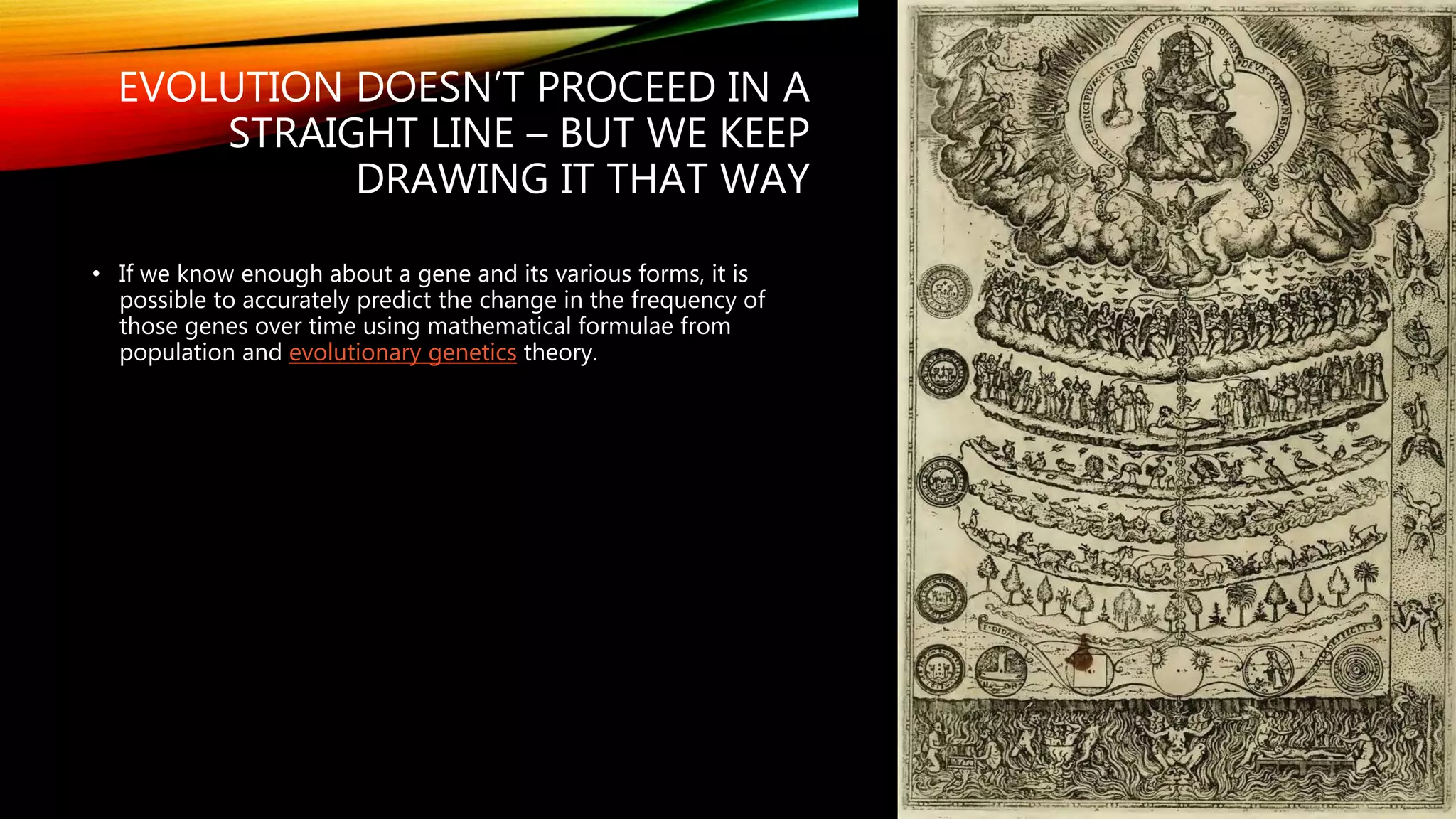
EVOLUTION DOESN’T PROCEED IN A
STRAIGHT LINE – BUT WE KEEP
DRAWING IT THAT WAY
• If we know enough about a gene and its various forms, it is
possible to accurately predict the change in the frequency of
those genes over time using mathematical formulae from
population and evolutionary genetics theory.
GRADUAL
CHANGES, IN
EVERY DIRECTION
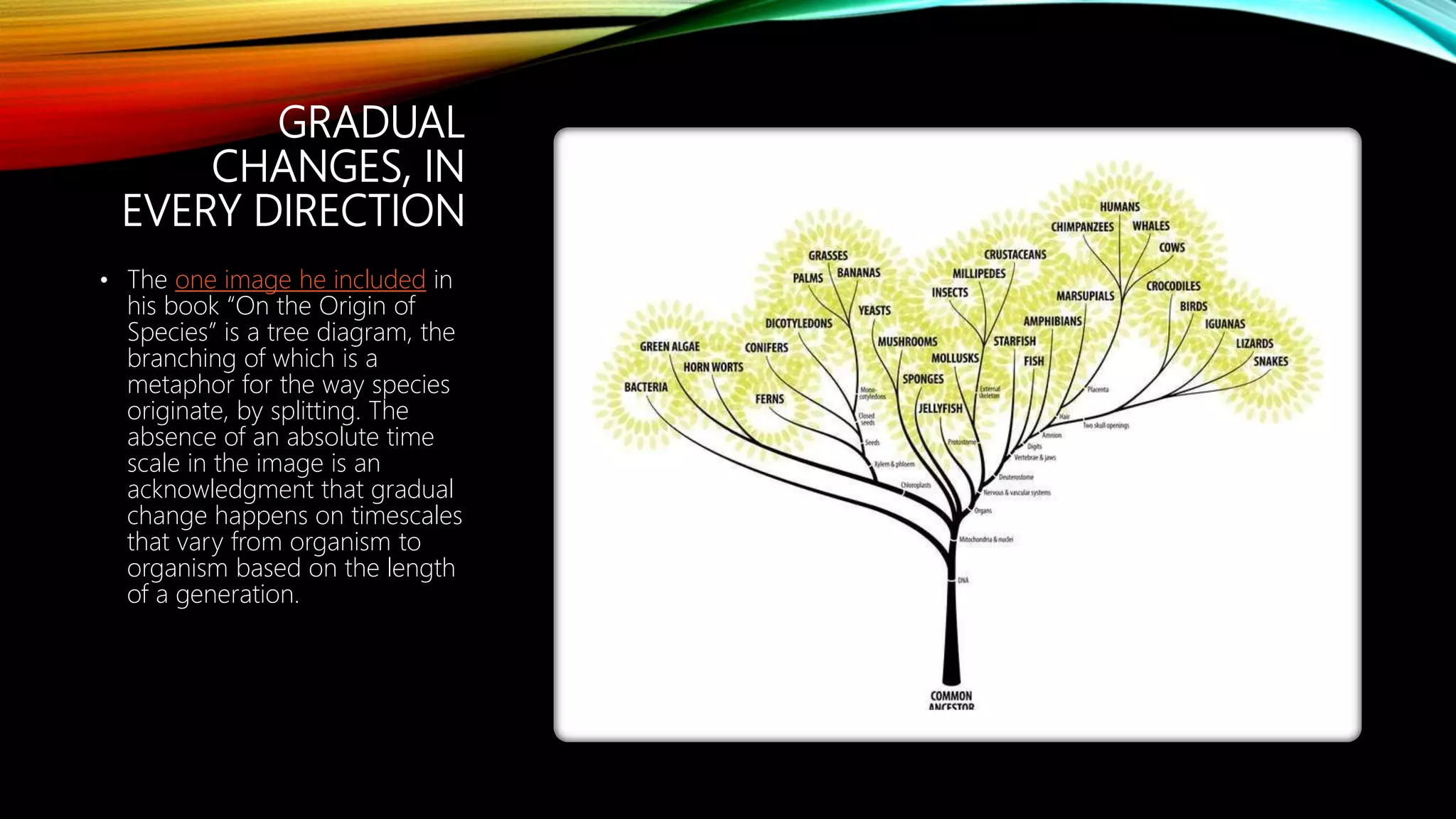
• The one image he included in
his book “On the Origin of
Species” is a tree diagram, the
branching of which is a
metaphor for the way species
originate, by splitting. The
absence of an absolute time
scale in the image is an
acknowledgment that gradual
change happens on timescales
that vary from organism to
organism based on the length
of a generation.
COMMON MISTAKES AND
MISCONCEPTIONS
• Evolution is not the same as adaptation or natural selection. Natural selection is
a mechanism, or cause, of evolution. Adaptations are physical or behavioral traits
that make an organism better suited to its environment.
• Natural selection acts on existing heritable variation. Natural selection needs
some starting material, and that starting material is heritable variation. For natural
selection to act on a feature, there must already be variation, and that variation
must be able to be passed on to offspring.
• Natural selection depends on the environment. Natural selection doesn't favor
traits that are somehow inherently superior. Instead, it favors traits that are
beneficial in a specific environment. Traits that are helpful in one environment might
actually be harmful in another.
DARWIN WAS
WRONG
• Darwin lived in a different time. He constructed the
theory of Natural Selection from observing the finches
in the Galapagos Islands and many other species
across the world.
• Genes was an unfamiliar term to that world.
• Cells were seen but not manipulated.
• Darwin’s mechanism continues to unify all biology – a
contribution comparable to those of Newton or
Einstein.
• Today we define evaluation as changes in allelic
frequency over time.
• If we map different forms of genes (alleles) of a
population and after a few generations the frequency
changes, evolution has occurred.
• This description is the best to date that captures the
over-changing living world.
THE EVIDENCE FOR EVOLUTION
• Darwin thought of evolution as "descent with
modification," a process in which species change and give rise
to new species over many generations. He proposed that the
evolutionary history of life forms a branching tree with many
levels.
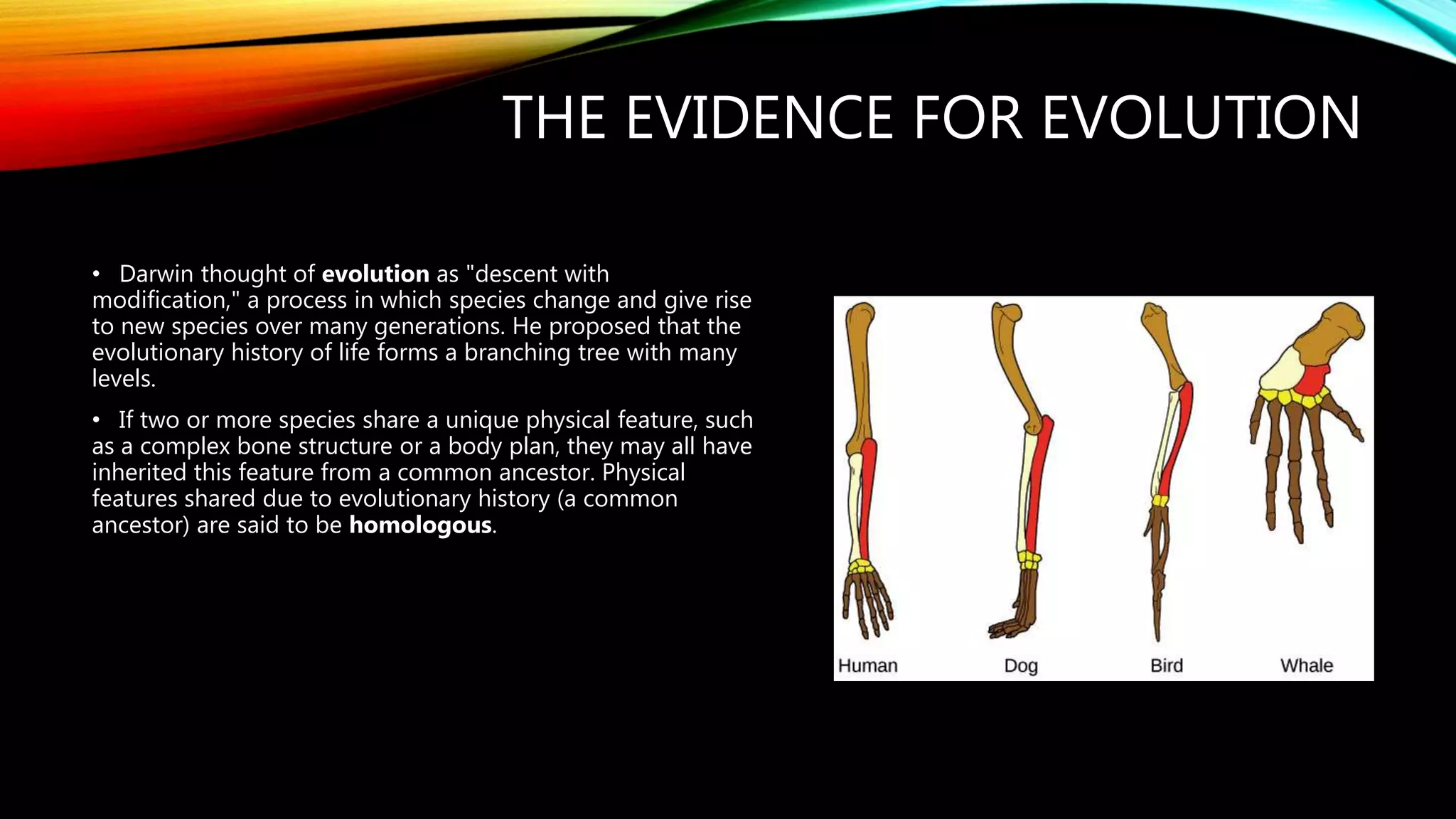
• If two or more species share a unique physical feature, such
as a complex bone structure or a body plan, they may all have
inherited this feature from a common ancestor. Physical
features shared due to evolutionary history (a common
ancestor) are said to be homologous.
SUMMARY
• Multiple types of evidence support the theory of evolution:
• Homologous structures provide evidence for common ancestry, while analogous
structures show that similar selective pressures can produce similar adaptations
(beneficial features).
• Similarities and differences among biological molecules (e.g., in the DNA sequence
of genes) can be used to determine species' relatedness.
• Biogeographical patterns provide clues about how species are related to each other.
• The fossil record, though incomplete, provides information about what species
existed at particular times of Earth’s history.
• Some populations, like those of microbes and some insects, evolve over relatively
short time periods and can observed directly.

EVOLUTION / CONVERSATONS IN EVOLUTION THEORY 

  • 1.
  • 2.
    PROBLEMS THAT FACEDBY DARWIN IN 1854 • Charles Darwin, the 19th century naturalist, is given credit for the theory, not because he was the first person to suggest evolution occurs, but because he proposed (in his seminal 1859 text, On the Origin of Species) a mechanism that explains the process of change. • In 1854 he solved his last major problem, the forking of genera to produce new evolutionary branches. He used an industrial analogy familiar from the Wedgwood factories, the division of labour: competition in nature’s overcrowded marketplace would favour variants that could exploit different aspects of a niche. • Species would diverge on the spot, like tradesmen in the same tenement. Through 1855 Darwin experimented with seeds in seawater, to prove that they could survive ocean crossings to start the process of speciation on islands. Then he kept fancy pigeons, to see if the chicks were more like the ancestral rock dove than their own bizarre parents. Darwin perfected his analogy of natural selection with the fancier’s “artificial selection,” as he called it. He was preparing his rhetorical strategy, ready to present his theory.
  • 3.
    A LOT OFQUESTIONS RAISING??? • Why Haven't All Primates Evolved into Humans? • How a new species of ancestors is changing our theory of human evolution ? • Four billion years of evolution in six minutes? • What explains the rise of humans? • Are we ready for neo-evolution? • Human intelligence: have we reached the limit of knowledge? • Would standing on the first butterfly really change the history of evolution? • If we were like mice we could live to 400 – but we’re not, so we don’t? •
  • 4.
    GREGOR MENDEL IN1865 • The second major component to the theory is the nature of inheritance, which follows the insights made by Gregor Mendel in 1865 and has advanced considerably since then due to our understanding of genes, DNA and the molecular processes of life. • When natural selection was first formulated by Darwin, the nature of inheritance was not understood. Our current understanding of inheritance is very sophisticated and includes the precise mechanisms for passing genes on to the next generation, how genes are modified by mutation and how they are shared among sexual species.
  • 5.
    EVOLUTION DOESN’T PROCEEDIN A STRAIGHT LINE – BUT WE KEEP DRAWING IT THAT WAY • If we know enough about a gene and its various forms, it is possible to accurately predict the change in the frequency of those genes over time using mathematical formulae from population and evolutionary genetics theory.
  • 6.
    GRADUAL CHANGES, IN EVERY DIRECTION •The one image he included in his book “On the Origin of Species” is a tree diagram, the branching of which is a metaphor for the way species originate, by splitting. The absence of an absolute time scale in the image is an acknowledgment that gradual change happens on timescales that vary from organism to organism based on the length of a generation.
  • 7.
    COMMON MISTAKES AND MISCONCEPTIONS •Evolution is not the same as adaptation or natural selection. Natural selection is a mechanism, or cause, of evolution. Adaptations are physical or behavioral traits that make an organism better suited to its environment. • Natural selection acts on existing heritable variation. Natural selection needs some starting material, and that starting material is heritable variation. For natural selection to act on a feature, there must already be variation, and that variation must be able to be passed on to offspring. • Natural selection depends on the environment. Natural selection doesn't favor traits that are somehow inherently superior. Instead, it favors traits that are beneficial in a specific environment. Traits that are helpful in one environment might actually be harmful in another.
  • 8.
    DARWIN WAS WRONG • Darwinlived in a different time. He constructed the theory of Natural Selection from observing the finches in the Galapagos Islands and many other species across the world. • Genes was an unfamiliar term to that world. • Cells were seen but not manipulated. • Darwin’s mechanism continues to unify all biology – a contribution comparable to those of Newton or Einstein. • Today we define evaluation as changes in allelic frequency over time. • If we map different forms of genes (alleles) of a population and after a few generations the frequency changes, evolution has occurred. • This description is the best to date that captures the over-changing living world.
  • 9.
    THE EVIDENCE FOREVOLUTION • Darwin thought of evolution as "descent with modification," a process in which species change and give rise to new species over many generations. He proposed that the evolutionary history of life forms a branching tree with many levels. • If two or more species share a unique physical feature, such as a complex bone structure or a body plan, they may all have inherited this feature from a common ancestor. Physical features shared due to evolutionary history (a common ancestor) are said to be homologous.
  • 10.
    SUMMARY • Multiple typesof evidence support the theory of evolution: • Homologous structures provide evidence for common ancestry, while analogous structures show that similar selective pressures can produce similar adaptations (beneficial features). • Similarities and differences among biological molecules (e.g., in the DNA sequence of genes) can be used to determine species' relatedness. • Biogeographical patterns provide clues about how species are related to each other. • The fossil record, though incomplete, provides information about what species existed at particular times of Earth’s history. • Some populations, like those of microbes and some insects, evolve over relatively short time periods and can observed directly.

Editor's Notes

  • #3 The niche concept A species' niche is its ecological role or "way of life," which is defined by the full set of conditions, resources, and interactions it needs (or can make use of)^11start superscript, 1, end superscript. Each species fits into an ecological community in its own special way and has its own tolerable ranges for many environmental factors. For example, a fish species' niche might be defined partly by ranges of salinity (saltiness), pH (acidity), and temperature it can tolerate, as well as the types of food it can eat.
  • #4 Genetics provided the answer of how variation is maintained. Population genetics created the mathematical basis upon which 20th-century evolutionary biology developed, becoming the “Neo-Darwinian Synthesis.” When skeptics of evolution assert that “Darwinism” is in disrepute, they are really talking about challenges to the Neo-Darwinian Synthesis, not Darwin’s original insights. There are two major strands of evolution skepticism. One involves direct critiques of accepted ideas such as common ancestry of life on earth, descent with modification, and the power of natural selection to produce “irreducible complexity.” These views, including Behe’s, have been litigated for decades now in the public forum.
  • #7 According to Darwin, all current organisms are equally evolved and are all still affected by natural selection. So, a starfish and a person, for example, are both at the forefront of the evolution of their particular building plans. And they happen to share a common ancestor that lived about 580 million years ago.