


ENVIRONMENTAL
SCIENCE
Module 2: Energy & The Environment
Topic: Renewable Energy Sources (Solar
Energy)
Institution: Montego Bay Community College
Lecturer: Mrs. S. Desouza
GROUP 3
SOLAR ENERGY
 Solar energy can be defined as energy
obtained from radiation emitted by the sun.
(Encarta Dictionary, 2001)
 Solar power is the conversion of the energy
from the sun to usable electricity. (Oxford
Dictionary 2006)
SOLAR ENERGY:
HARNESSING AND USE
PHOTOVOLTAIC CELLS
 A photovoltaic cell is a type of photoelectric
cell that detects and measures light intensity
using potential difference that arises between
dissimilar materials when they are exposed
to electromagnetic radiation.
 Solar (or photovoltaic) cells convert the sun’s
energy into electricity.
HOW DO THEY WORK?
 The key component of photovoltaic cells is
silicon (semi-conductor). As photons of light hit
silicon atoms they transfer their energy to loose
electrons, knocking them off the atom. An
electrical imbalance is then created which is
maintained by silicon. These electrons are
transferred between silicon atoms in the solar
panel to create a DC electricity. This DC
electricity travels to an inverter which converts
this energy to produce alternating current which
can be used in the infrastructure.
HOW DO THEY WORK? (VIDEO)
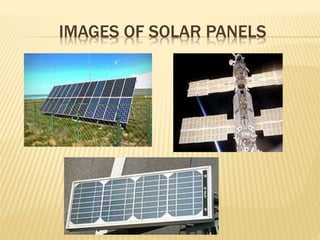
IMAGES OF SOLAR PANELS
PASSIVE SOLAR TECHNOLOGY
 Passive solar technology produces a
cooler or warmer air temperature in a
building by using the sun’s energy without
any electrical equipment (such as solar
panels).
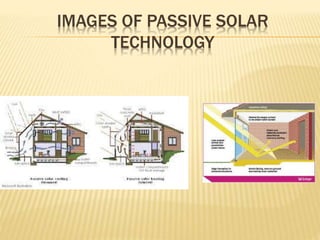
 There are three main components of to an
effective passive solar design: 1) direct gain,
2) thermal mass and 3) insulation.
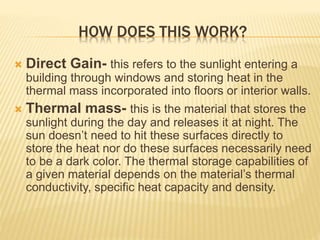
HOW DOES THIS WORK?
 Direct Gain- this refers to the sunlight entering a
building through windows and storing heat in the
thermal mass incorporated into floors or interior walls.
 Thermal mass- this is the material that stores the
sunlight during the day and releases it at night. The
sun doesn’t need to hit these surfaces directly to
store the heat nor do these surfaces necessarily need
to be a dark color. The thermal storage capabilities of
a given material depends on the material’s thermal
conductivity, specific heat capacity and density.
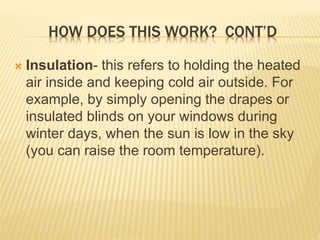
HOW DOES THIS WORK? CONT’D
 Insulation- this refers to holding the heated
air inside and keeping cold air outside. For
example, by simply opening the drapes or
insulated blinds on your windows during
winter days, when the sun is low in the sky
(you can raise the room temperature).
HOW DOES THIS WORK? (VIDEO)
IMAGES OF PASSIVE SOLAR
TECHNOLOGY
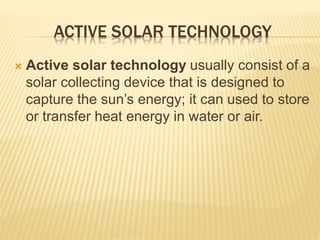
ACTIVE SOLAR TECHNOLOGY
 Active solar technology usually consist of a
solar collecting device that is designed to
capture the sun’s energy; it can used to store
or transfer heat energy in water or air.
HOW DOES THIS WORK? (BY FLUID)
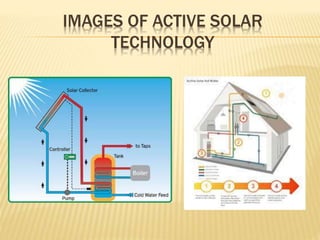
 Flat plate solar collectors are situated on the roof of the
house to collect as much solar energy as possible. Pipes
connected to the top and bottom of the plate array force
water continually through the plates, heating the water.
The water leaving the plates is pumped into a reservoir.
This reservoir may be connected to the hot water heater
in the house to allow the heated water to be used for
laundry, bathing and other household needs. The water is
pumped from the reservoir into the home and heats it
through several possible methods. The water could be
pumped beneath the floors of the house. This is the most
effective method, but requires the pipes to be installed
during the house's construction. It may also be sent into
heated baseboards or old-fashioned radiators.
HOW DOES THIS WORK? (AIR)
 Active solar heating with air is more effective in large
structures such as apartment complexes or office
buildings as central air conditioning systems and air ducts
are required. Instead of flat plate solar collectors being
used, row after row of black, heat absorbing air-tight
rubberized tubes are installed on the roof. Air is pumped
through these tubes, heating it significantly. The air is then
taken directly to the center of the house's heating system
and released through the heating ducts. This is not a
continuous system as it has no reservoir. It is turned on
as it is needed. An air compressor does the job of
pumping air through the pipes on the roof.
HOW DOES THIS WORK? (VIDEO)
IMAGES OF ACTIVE SOLAR
TECHNOLOGY
EFFICIENCY OF SOLAR
TECHNOLOGY
EFFICIENCY
 The efficiency is the most commonly used
parameter to compare the performance of
one solar cell to another. Efficiency is defined
as the ratio of energy output from the solar
cell to input energy from the sun. In addition
to reflecting the performance of the solar cell
itself, the efficiency depends on the spectrum
and intensity of the incident sunlight and the
temperature of the solar cell.
ADVANTAGES AND
DISADVANTAGES OF
SOLAR TECHNOLOGY
ADVANTAGES
 Solar power helps to slow/stop global
warming. Global warming threatens the
survival of human society, as well as the
survival of countless species. Solar power is
clearly one of the most important solutions to
this issue as it uses energy from the sun
rather that burning fossil fuels.
ADVANTAGES
 Solar power provides energy reliability.
The rising and setting of the sun is extremely
consistent. All across the world, we know
exactly when it will rise and set everyday of
the year. While clouds may be a bit less
predictable, we do also have a fairly good
seasonal and daily projections for the
amount of sunlight that will be received in
different locations. All in all, this makes solar
power an extremely reliable source of
energy.
ADVANTAGES
 Solar power provides energy security. On
top of the above reliability benefit, no one can
go and buy the sun or turn sunlight into a
monopoly. You install your solar panels and
‘plug into the sun’ and when there is no sunlight,
then the energy stored in generators can be
used. (This is something the U.S military has
pointed out for years and a major reason why it
is also putting a lot of its money into the
development and installation of solar power
systems) #natgeo
ADVANTAGES
 Solar energy provides energy
independence. Again the ‘fuel’ for solar
panels cannot be bought or monopolized. It
is free to all to use. Once you have solar
panels on your roof, you have an essentially
independent source of electricity that is all
yours.
ADVANTAGES
 Solar power creates jobs. Solar power is a
job-creating powerhouse. Money invested in
solar technology creates two to three times
more jobs that money invested in coal or
natural gas.
ADVANTAGES
 Solar energy can be used in remote areas
where it is too expensive to extend the
electricity power grid.
 Doesn’t cause pollution
 The materials used to create solar
technology can be recycled
DISADVANTAGES
 Solar energy can only be harnessed when
it is daytime and sunny. The sun doesn’t
shine 24 hours a day, when the sun goes
down or is heavily shaded, solar PV panels
stop producing electricity. If we need
electricity at that time, we have to get it from
some other source. In other words, we
couldn’t be 100% powered by solar panels.
At the very least, we need batteries to store
electricity produced by solar panels for use
sometime later.
DISADVANTAGES
 Solar technology is expensive. The initial
cost and installation of solar technology is
expensive. Estimated values exceed $1.2
million (Jamaican)
 Batteries used to store energy requires
storage space. Solar power is used to charge
batteries so that solar powered devices can be
used at night. However, the batteries are large
and heavy and need storage space. They also
need replacing from time to time.

Solar energy

  • 1.
    ENVIRONMENTAL SCIENCE Module 2: Energy& The Environment Topic: Renewable Energy Sources (Solar Energy) Institution: Montego Bay Community College Lecturer: Mrs. S. Desouza
  • 2.
  • 3.
    SOLAR ENERGY  Solarenergy can be defined as energy obtained from radiation emitted by the sun. (Encarta Dictionary, 2001)  Solar power is the conversion of the energy from the sun to usable electricity. (Oxford Dictionary 2006)
  • 4.
  • 5.
    PHOTOVOLTAIC CELLS  Aphotovoltaic cell is a type of photoelectric cell that detects and measures light intensity using potential difference that arises between dissimilar materials when they are exposed to electromagnetic radiation.  Solar (or photovoltaic) cells convert the sun’s energy into electricity.
  • 6.
    HOW DO THEYWORK?  The key component of photovoltaic cells is silicon (semi-conductor). As photons of light hit silicon atoms they transfer their energy to loose electrons, knocking them off the atom. An electrical imbalance is then created which is maintained by silicon. These electrons are transferred between silicon atoms in the solar panel to create a DC electricity. This DC electricity travels to an inverter which converts this energy to produce alternating current which can be used in the infrastructure.
  • 7.
    HOW DO THEYWORK? (VIDEO)
  • 8.
  • 9.
    PASSIVE SOLAR TECHNOLOGY Passive solar technology produces a cooler or warmer air temperature in a building by using the sun’s energy without any electrical equipment (such as solar panels).  There are three main components of to an effective passive solar design: 1) direct gain, 2) thermal mass and 3) insulation.
  • 10.
    HOW DOES THISWORK?  Direct Gain- this refers to the sunlight entering a building through windows and storing heat in the thermal mass incorporated into floors or interior walls.  Thermal mass- this is the material that stores the sunlight during the day and releases it at night. The sun doesn’t need to hit these surfaces directly to store the heat nor do these surfaces necessarily need to be a dark color. The thermal storage capabilities of a given material depends on the material’s thermal conductivity, specific heat capacity and density.
  • 11.
    HOW DOES THISWORK? CONT’D  Insulation- this refers to holding the heated air inside and keeping cold air outside. For example, by simply opening the drapes or insulated blinds on your windows during winter days, when the sun is low in the sky (you can raise the room temperature).
  • 12.
    HOW DOES THISWORK? (VIDEO)
  • 13.
    IMAGES OF PASSIVESOLAR TECHNOLOGY
  • 14.
    ACTIVE SOLAR TECHNOLOGY Active solar technology usually consist of a solar collecting device that is designed to capture the sun’s energy; it can used to store or transfer heat energy in water or air.
  • 15.
    HOW DOES THISWORK? (BY FLUID)  Flat plate solar collectors are situated on the roof of the house to collect as much solar energy as possible. Pipes connected to the top and bottom of the plate array force water continually through the plates, heating the water. The water leaving the plates is pumped into a reservoir. This reservoir may be connected to the hot water heater in the house to allow the heated water to be used for laundry, bathing and other household needs. The water is pumped from the reservoir into the home and heats it through several possible methods. The water could be pumped beneath the floors of the house. This is the most effective method, but requires the pipes to be installed during the house's construction. It may also be sent into heated baseboards or old-fashioned radiators.
  • 16.
    HOW DOES THISWORK? (AIR)  Active solar heating with air is more effective in large structures such as apartment complexes or office buildings as central air conditioning systems and air ducts are required. Instead of flat plate solar collectors being used, row after row of black, heat absorbing air-tight rubberized tubes are installed on the roof. Air is pumped through these tubes, heating it significantly. The air is then taken directly to the center of the house's heating system and released through the heating ducts. This is not a continuous system as it has no reservoir. It is turned on as it is needed. An air compressor does the job of pumping air through the pipes on the roof.
  • 17.
    HOW DOES THISWORK? (VIDEO)
  • 18.
    IMAGES OF ACTIVESOLAR TECHNOLOGY
  • 19.
  • 20.
    EFFICIENCY  The efficiencyis the most commonly used parameter to compare the performance of one solar cell to another. Efficiency is defined as the ratio of energy output from the solar cell to input energy from the sun. In addition to reflecting the performance of the solar cell itself, the efficiency depends on the spectrum and intensity of the incident sunlight and the temperature of the solar cell.
  • 21.
  • 22.
    ADVANTAGES  Solar powerhelps to slow/stop global warming. Global warming threatens the survival of human society, as well as the survival of countless species. Solar power is clearly one of the most important solutions to this issue as it uses energy from the sun rather that burning fossil fuels.
  • 23.
    ADVANTAGES  Solar powerprovides energy reliability. The rising and setting of the sun is extremely consistent. All across the world, we know exactly when it will rise and set everyday of the year. While clouds may be a bit less predictable, we do also have a fairly good seasonal and daily projections for the amount of sunlight that will be received in different locations. All in all, this makes solar power an extremely reliable source of energy.
  • 24.
    ADVANTAGES  Solar powerprovides energy security. On top of the above reliability benefit, no one can go and buy the sun or turn sunlight into a monopoly. You install your solar panels and ‘plug into the sun’ and when there is no sunlight, then the energy stored in generators can be used. (This is something the U.S military has pointed out for years and a major reason why it is also putting a lot of its money into the development and installation of solar power systems) #natgeo
  • 25.
    ADVANTAGES  Solar energyprovides energy independence. Again the ‘fuel’ for solar panels cannot be bought or monopolized. It is free to all to use. Once you have solar panels on your roof, you have an essentially independent source of electricity that is all yours.
  • 26.
    ADVANTAGES  Solar powercreates jobs. Solar power is a job-creating powerhouse. Money invested in solar technology creates two to three times more jobs that money invested in coal or natural gas.
  • 27.
    ADVANTAGES  Solar energycan be used in remote areas where it is too expensive to extend the electricity power grid.  Doesn’t cause pollution  The materials used to create solar technology can be recycled
  • 28.
    DISADVANTAGES  Solar energycan only be harnessed when it is daytime and sunny. The sun doesn’t shine 24 hours a day, when the sun goes down or is heavily shaded, solar PV panels stop producing electricity. If we need electricity at that time, we have to get it from some other source. In other words, we couldn’t be 100% powered by solar panels. At the very least, we need batteries to store electricity produced by solar panels for use sometime later.
  • 29.
    DISADVANTAGES  Solar technologyis expensive. The initial cost and installation of solar technology is expensive. Estimated values exceed $1.2 million (Jamaican)  Batteries used to store energy requires storage space. Solar power is used to charge batteries so that solar powered devices can be used at night. However, the batteries are large and heavy and need storage space. They also need replacing from time to time.

Editor's Notes

  • #10 >Check for better definition of passive solar technology
  • #21 Le-Jay: this slide can be edited