
Meetings
Definition
– In common word a meeting is an assembly of two or more people for reaching a
decision through discussion. It is one of the major media of oral
communication.
– According to Oxford Dictionary “A meeting is an occasion when people come to
gather to discuss or decide something”
Purpose of Meeting
– A meeting is called to discuss various issues of interest. Such issues vary considering the
purpose of an entity or concern. The following is the general purposes to call a meeting.
 Meeting is held to notify the vision, mission or objective of any organization.
 Meeting is called to announce the performance or progress of any activity or work.
 Meeting is held for reviewing the progress of any project or program.
 Meeting is called to share dialogue with the members of the organization or with the people of a
society.
 Meeting is held to announce any innovation, development or changes related to product, service or
activities.
 Meeting are called to celebrate any success and to share the achievement with the members who are
entitled.
Types of Meeting
Formal meeting: When any meeting is
arranged by following official formalities,
rules and decorum then it is called formal
meeting.
Informal meeting: When any meeting is arranged
without maintaining official rules and regulation, it
is called informal meeting. Such meeting can be
called upon by giving short notice using informal
media. This type of meeting is very common in the
workplace.
Private meeting: Private meeting is called for
discussing confidential and restricted issues
where general people have prohibition to
access. Only selected people are allowed to
attend the meeting.
Public meeting: When meeting is held in a
public place to discuss issues regarding public
interests, it is called public meeting. Here,
general people are cordially invited.
Company meeting: When a meeting is called by the
general manager, director or secretary (Who has power of
attorney) of a company to discuss issues or affairs of a
company, it is called company meeting, e.g. Annual general
meeting. Statutory meeting, Directors’ meeting which are
required to be called by abiding company law.
Committee meeting: When the chief of the
committee calls a meeting on certain issues
for which the committee is formed, it is called
committee meeting. Only members of the
committee can take part in such meeting.
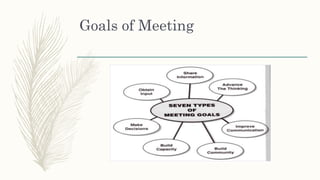
Goals of Meeting
Conduct of Meeting
Formal meeting has a great role in every corporate
business, but it should be effective and here we discuss
how to conduct a formal meeting in effective way:
Activities before conducting the meeting
Activities during conducting the meeting
Activities after conducting the meeting
Activities before conducting the
Meeting
– Determine the objective
The necessity to call a meeting should be clearly set. If the objective is clear, then it
is easy to conduct a meeting.
– Invite the Actual Participants
Those members whose presence is essential should be invited to attend the
meeting.
– Make proper notification
The time, venue and date of meeting should be notified to every member before
the meeting through proper media.
– Select and distribute agenda
An agenda is a road map which should be determined before the meeting and must
be distributed to the every member before the meeting.
Activities during conducting the
Meeting
– Starting the meeting
The chairman should greet the members and should open the meeting.
– Discussion
The chairman will highlight about agenda and will welcome the members to deliver
speech for discussion.
– Point of order
If any point does not belong to legal issue or aspect can cause any member to raise
question on point of order.
– Point of Information
If any member has any query can ask for clarification, which is known as point of
information
– Speaking through the chair
If any member wants to contribute in the discussion can get opportunity if the chairman permits.
– Ruling from the chair
If any controversy is found during discussion, then the chairman can provide ruling on that and stop
the discussion. His ruling is final and binding.
– Point out the decision taken
The decision reached should be clearly stated to every member to avoid any confusion.
– State the course of action
The chairman should clearly state the action to be implemented. Here, the consent of the members
is must.
– Close the meeting
When the meeting is over, the chairman declares the closing of the meeting and thanks the
members for attending and contributing.
Activities After conducting the
Meeting
– The Proper recording of the minutes and thereafter its
distribution to the members should be ensured by the
chairman.

Meetings

  • 1.
  • 2.
    Definition – In commonword a meeting is an assembly of two or more people for reaching a decision through discussion. It is one of the major media of oral communication. – According to Oxford Dictionary “A meeting is an occasion when people come to gather to discuss or decide something”
  • 3.
    Purpose of Meeting –A meeting is called to discuss various issues of interest. Such issues vary considering the purpose of an entity or concern. The following is the general purposes to call a meeting.  Meeting is held to notify the vision, mission or objective of any organization.  Meeting is called to announce the performance or progress of any activity or work.  Meeting is held for reviewing the progress of any project or program.  Meeting is called to share dialogue with the members of the organization or with the people of a society.  Meeting is held to announce any innovation, development or changes related to product, service or activities.  Meeting are called to celebrate any success and to share the achievement with the members who are entitled.
  • 4.
    Types of Meeting Formalmeeting: When any meeting is arranged by following official formalities, rules and decorum then it is called formal meeting.
  • 5.
    Informal meeting: Whenany meeting is arranged without maintaining official rules and regulation, it is called informal meeting. Such meeting can be called upon by giving short notice using informal media. This type of meeting is very common in the workplace.
  • 6.
    Private meeting: Privatemeeting is called for discussing confidential and restricted issues where general people have prohibition to access. Only selected people are allowed to attend the meeting.
  • 7.
    Public meeting: Whenmeeting is held in a public place to discuss issues regarding public interests, it is called public meeting. Here, general people are cordially invited.
  • 8.
    Company meeting: Whena meeting is called by the general manager, director or secretary (Who has power of attorney) of a company to discuss issues or affairs of a company, it is called company meeting, e.g. Annual general meeting. Statutory meeting, Directors’ meeting which are required to be called by abiding company law.
  • 9.
    Committee meeting: Whenthe chief of the committee calls a meeting on certain issues for which the committee is formed, it is called committee meeting. Only members of the committee can take part in such meeting.
  • 10.
  • 11.
    Conduct of Meeting Formalmeeting has a great role in every corporate business, but it should be effective and here we discuss how to conduct a formal meeting in effective way: Activities before conducting the meeting Activities during conducting the meeting Activities after conducting the meeting
  • 12.
    Activities before conductingthe Meeting – Determine the objective The necessity to call a meeting should be clearly set. If the objective is clear, then it is easy to conduct a meeting. – Invite the Actual Participants Those members whose presence is essential should be invited to attend the meeting. – Make proper notification The time, venue and date of meeting should be notified to every member before the meeting through proper media. – Select and distribute agenda An agenda is a road map which should be determined before the meeting and must be distributed to the every member before the meeting.
  • 13.
    Activities during conductingthe Meeting – Starting the meeting The chairman should greet the members and should open the meeting. – Discussion The chairman will highlight about agenda and will welcome the members to deliver speech for discussion. – Point of order If any point does not belong to legal issue or aspect can cause any member to raise question on point of order. – Point of Information If any member has any query can ask for clarification, which is known as point of information
  • 14.
    – Speaking throughthe chair If any member wants to contribute in the discussion can get opportunity if the chairman permits. – Ruling from the chair If any controversy is found during discussion, then the chairman can provide ruling on that and stop the discussion. His ruling is final and binding. – Point out the decision taken The decision reached should be clearly stated to every member to avoid any confusion. – State the course of action The chairman should clearly state the action to be implemented. Here, the consent of the members is must. – Close the meeting When the meeting is over, the chairman declares the closing of the meeting and thanks the members for attending and contributing.
  • 15.
    Activities After conductingthe Meeting – The Proper recording of the minutes and thereafter its distribution to the members should be ensured by the chairman.