ECG Rhythm Interpretation
Sinus Rhythms and
Premature Beats
Course Objectives
• To recognize the normal rhythm of the
heart - “Normal Sinus Rhythm.”
• To recognize the 13 most common
rhythm disturbances.
• To recognize an acute myocardial
infarction on a 12-lead ECG.
Learning Modules
• ECG Basics
• How to Analyze a Rhythm
• Normal Sinus Rhythm
• Heart Arrhythmias
• Diagnosing a Myocardial Infarction
Arrhythmias
• Sinus Rhythms
• Premature Beats
• Supraventricular Arrhythmias
• Ventricular Arrhythmias
• AV Junctional Blocks
Sinus Rhythms
• Sinus Bradycardia
• Sinus Tachycardia
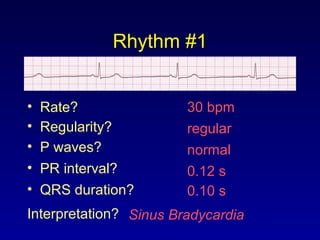
Rhythm #1
30 bpm• Rate?
• Regularity? regular
normal
0.10 s
• P waves?
• PR interval? 0.12 s
• QRS duration?
Interpretation? Sinus Bradycardia
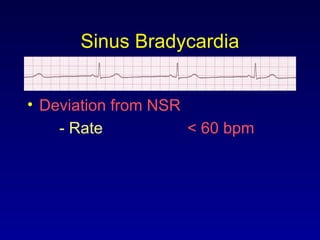
Sinus Bradycardia
• Deviation from NSR
- Rate < 60 bpm
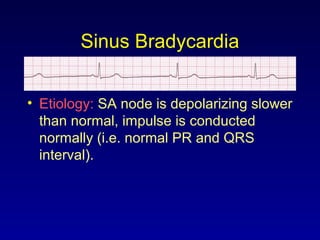
Sinus Bradycardia
• Etiology: SA node is depolarizing slower
than normal, impulse is conducted
normally (i.e. normal PR and QRS
interval).
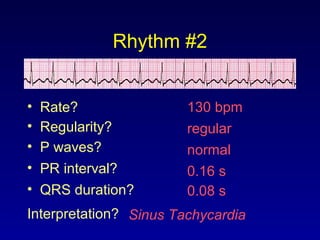
Rhythm #2
130 bpm• Rate?
• Regularity? regular
normal
0.08 s
• P waves?
• PR interval? 0.16 s
• QRS duration?
Interpretation? Sinus Tachycardia
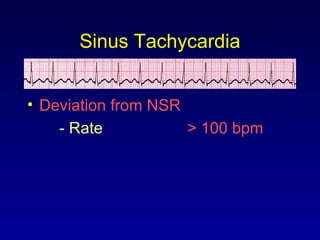
Sinus Tachycardia
• Deviation from NSR
- Rate > 100 bpm
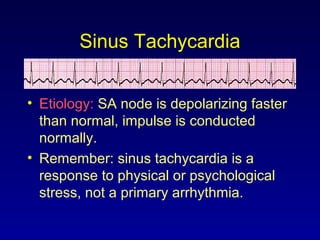
Sinus Tachycardia
• Etiology: SA node is depolarizing faster
than normal, impulse is conducted
normally.
• Remember: sinus tachycardia is a
response to physical or psychological
stress, not a primary arrhythmia.
Premature Beats
• Premature Atrial Contractions
(PACs)
• Premature Ventricular Contractions
(PVCs)
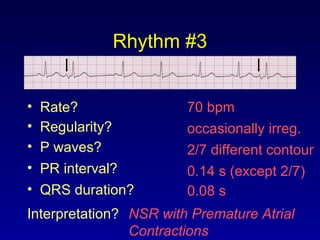
Rhythm #3
70 bpm• Rate?
• Regularity? occasionally irreg.
2/7 different contour
0.08 s
• P waves?
• PR interval? 0.14 s (except 2/7)
• QRS duration?
Interpretation? NSR with Premature Atrial
Contractions
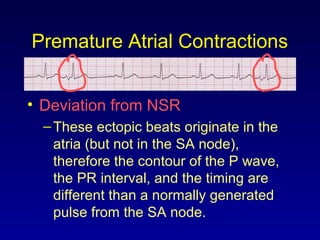
Premature Atrial Contractions
• Deviation from NSR
–These ectopic beats originate in the
atria (but not in the SA node),
therefore the contour of the P wave,
the PR interval, and the timing are
different than a normally generated
pulse from the SA node.
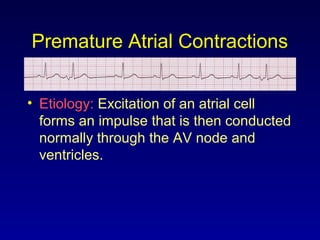
Premature Atrial Contractions
• Etiology: Excitation of an atrial cell
forms an impulse that is then conducted
normally through the AV node and
ventricles.
Teaching Moment
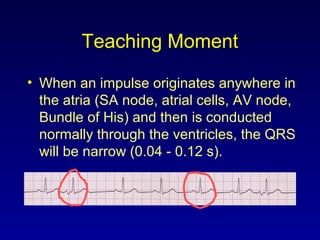
• When an impulse originates anywhere in
the atria (SA node, atrial cells, AV node,
Bundle of His) and then is conducted
normally through the ventricles, the QRS
will be narrow (0.04 - 0.12 s).
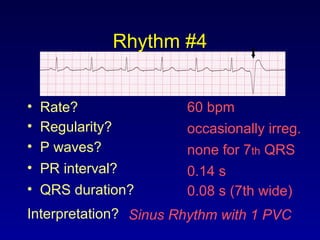
Rhythm #4
60 bpm• Rate?
• Regularity? occasionally irreg.
none for 7th QRS
0.08 s (7th wide)
• P waves?
• PR interval? 0.14 s
• QRS duration?
Interpretation? Sinus Rhythm with 1 PVC
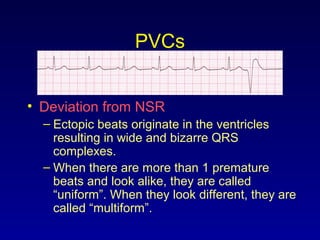
PVCs
• Deviation from NSR
– Ectopic beats originate in the ventricles
resulting in wide and bizarre QRS
complexes.
– When there are more than 1 premature
beats and look alike, they are called
“uniform”. When they look different, they are
called “multiform”.
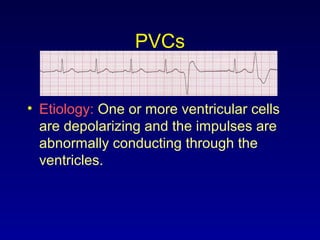
PVCs
• Etiology: One or more ventricular cells
are depolarizing and the impulses are
abnormally conducting through the
ventricles.
Teaching Moment
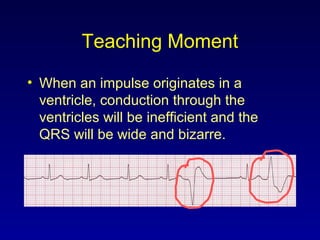
• When an impulse originates in a
ventricle, conduction through the
ventricles will be inefficient and the
QRS will be wide and bizarre.
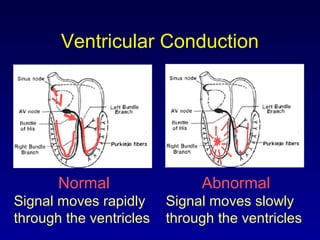
Ventricular Conduction
Normal
Signal moves rapidly
through the ventricles
Abnormal
Signal moves slowly
through the ventricles

ECG PART 4

  • 1.
    ECG Rhythm Interpretation SinusRhythms and Premature Beats
  • 2.
    Course Objectives • Torecognize the normal rhythm of the heart - “Normal Sinus Rhythm.” • To recognize the 13 most common rhythm disturbances. • To recognize an acute myocardial infarction on a 12-lead ECG.
  • 3.
    Learning Modules • ECGBasics • How to Analyze a Rhythm • Normal Sinus Rhythm • Heart Arrhythmias • Diagnosing a Myocardial Infarction
  • 4.
    Arrhythmias • Sinus Rhythms •Premature Beats • Supraventricular Arrhythmias • Ventricular Arrhythmias • AV Junctional Blocks
  • 5.
    Sinus Rhythms • SinusBradycardia • Sinus Tachycardia
  • 6.
    Rhythm #1 30 bpm•Rate? • Regularity? regular normal 0.10 s • P waves? • PR interval? 0.12 s • QRS duration? Interpretation? Sinus Bradycardia
  • 7.
    Sinus Bradycardia • Deviationfrom NSR - Rate < 60 bpm
  • 8.
    Sinus Bradycardia • Etiology:SA node is depolarizing slower than normal, impulse is conducted normally (i.e. normal PR and QRS interval).
  • 9.
    Rhythm #2 130 bpm•Rate? • Regularity? regular normal 0.08 s • P waves? • PR interval? 0.16 s • QRS duration? Interpretation? Sinus Tachycardia
  • 10.
    Sinus Tachycardia • Deviationfrom NSR - Rate > 100 bpm
  • 11.
    Sinus Tachycardia • Etiology:SA node is depolarizing faster than normal, impulse is conducted normally. • Remember: sinus tachycardia is a response to physical or psychological stress, not a primary arrhythmia.
  • 12.
    Premature Beats • PrematureAtrial Contractions (PACs) • Premature Ventricular Contractions (PVCs)
  • 13.
    Rhythm #3 70 bpm•Rate? • Regularity? occasionally irreg. 2/7 different contour 0.08 s • P waves? • PR interval? 0.14 s (except 2/7) • QRS duration? Interpretation? NSR with Premature Atrial Contractions
  • 14.
    Premature Atrial Contractions •Deviation from NSR –These ectopic beats originate in the atria (but not in the SA node), therefore the contour of the P wave, the PR interval, and the timing are different than a normally generated pulse from the SA node.
  • 15.
    Premature Atrial Contractions •Etiology: Excitation of an atrial cell forms an impulse that is then conducted normally through the AV node and ventricles.
  • 16.
    Teaching Moment • Whenan impulse originates anywhere in the atria (SA node, atrial cells, AV node, Bundle of His) and then is conducted normally through the ventricles, the QRS will be narrow (0.04 - 0.12 s).
  • 17.
    Rhythm #4 60 bpm•Rate? • Regularity? occasionally irreg. none for 7th QRS 0.08 s (7th wide) • P waves? • PR interval? 0.14 s • QRS duration? Interpretation? Sinus Rhythm with 1 PVC
  • 18.
    PVCs • Deviation fromNSR – Ectopic beats originate in the ventricles resulting in wide and bizarre QRS complexes. – When there are more than 1 premature beats and look alike, they are called “uniform”. When they look different, they are called “multiform”.
  • 19.
    PVCs • Etiology: Oneor more ventricular cells are depolarizing and the impulses are abnormally conducting through the ventricles.
  • 20.
    Teaching Moment • Whenan impulse originates in a ventricle, conduction through the ventricles will be inefficient and the QRS will be wide and bizarre.
  • 21.
    Ventricular Conduction Normal Signal movesrapidly through the ventricles Abnormal Signal moves slowly through the ventricles