ECG Rhythm Interpretation
AV Junctional Blocks
Course Objectives
• To recognize the normal rhythm of the
heart - “Normal Sinus Rhythm.”
• To recognize the 13 most common
rhythm disturbances.
• To recognize an acute myocardial
infarction on a 12-lead ECG.
Learning Modules
• ECG Basics
• How to Analyze a Rhythm
• Normal Sinus Rhythm
• Heart Arrhythmias
• Diagnosing a Myocardial Infarction
• Advanced 12-Lead Interpretation
Arrhythmias
• Sinus Rhythms
• Premature Beats
• Supraventricular Arrhythmias
• Ventricular Arrhythmias
• AV Junctional Blocks
AV Nodal Blocks
• 1st Degree AV Block
• 2nd Degree AV Block, Type I
• 2nd Degree AV Block, Type II
• 3rd Degree AV Block
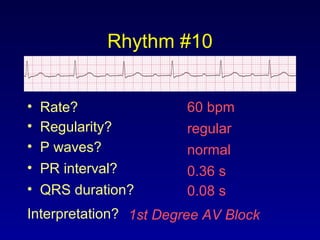
Rhythm #10
60 bpm• Rate?
• Regularity? regular
normal
0.08 s
• P waves?
• PR interval? 0.36 s
• QRS duration?
Interpretation? 1st Degree AV Block
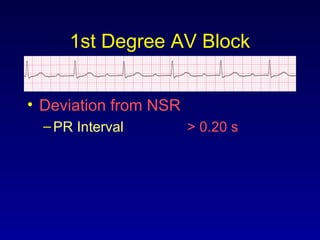
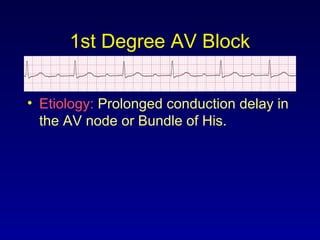
1st Degree AV Block
• Deviation from NSR
–PR Interval > 0.20 s
1st Degree AV Block
• Etiology: Prolonged conduction delay in
the AV node or Bundle of His.
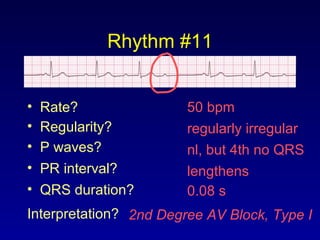
Rhythm #11
50 bpm• Rate?
• Regularity? regularly irregular
nl, but 4th no QRS
0.08 s
• P waves?
• PR interval? lengthens
• QRS duration?
Interpretation? 2nd Degree AV Block, Type I
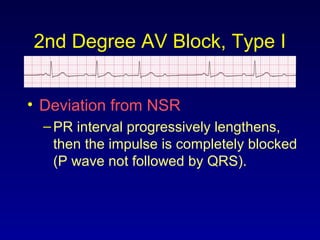
2nd Degree AV Block, Type I
• Deviation from NSR
–PR interval progressively lengthens,
then the impulse is completely blocked
(P wave not followed by QRS).
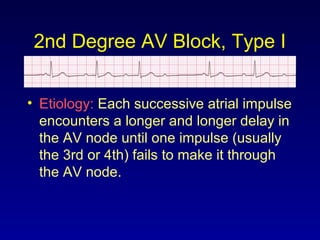
2nd Degree AV Block, Type I
• Etiology: Each successive atrial impulse
encounters a longer and longer delay in
the AV node until one impulse (usually
the 3rd or 4th) fails to make it through
the AV node.
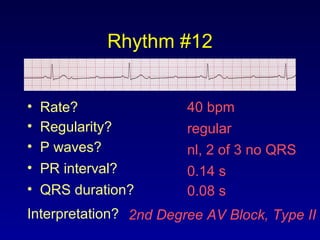
Rhythm #12
40 bpm• Rate?
• Regularity? regular
nl, 2 of 3 no QRS
0.08 s
• P waves?
• PR interval? 0.14 s
• QRS duration?
Interpretation? 2nd Degree AV Block, Type II
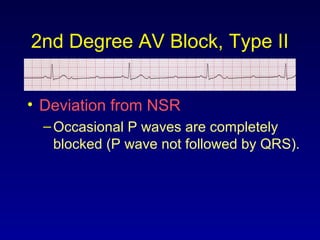
2nd Degree AV Block, Type II
• Deviation from NSR
–Occasional P waves are completely
blocked (P wave not followed by QRS).
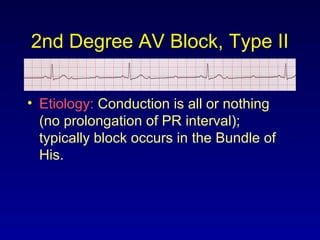
2nd Degree AV Block, Type II
• Etiology: Conduction is all or nothing
(no prolongation of PR interval);
typically block occurs in the Bundle of
His.
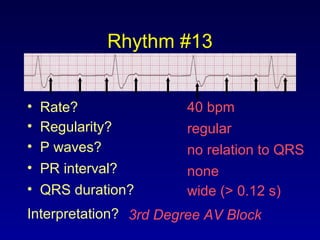
Rhythm #13
40 bpm• Rate?
• Regularity? regular
no relation to QRS
wide (> 0.12 s)
• P waves?
• PR interval? none
• QRS duration?
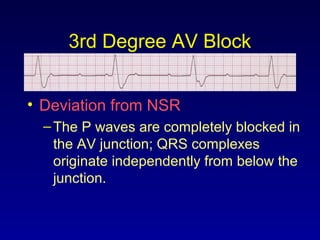
Interpretation? 3rd Degree AV Block
3rd Degree AV Block
• Deviation from NSR
–The P waves are completely blocked in
the AV junction; QRS complexes
originate independently from below the
junction.
3rd Degree AV Block
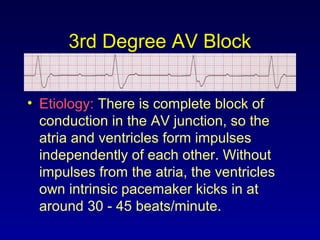
• Etiology: There is complete block of
conduction in the AV junction, so the
atria and ventricles form impulses
independently of each other. Without
impulses from the atria, the ventricles
own intrinsic pacemaker kicks in at
around 30 - 45 beats/minute.
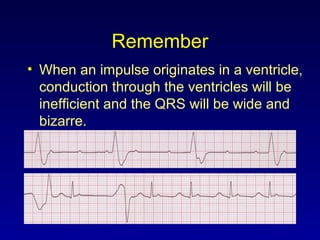
Remember
• When an impulse originates in a ventricle,
conduction through the ventricles will be
inefficient and the QRS will be wide and
bizarre.

ECG PART 6

  • 1.
  • 2.
    Course Objectives • Torecognize the normal rhythm of the heart - “Normal Sinus Rhythm.” • To recognize the 13 most common rhythm disturbances. • To recognize an acute myocardial infarction on a 12-lead ECG.
  • 3.
    Learning Modules • ECGBasics • How to Analyze a Rhythm • Normal Sinus Rhythm • Heart Arrhythmias • Diagnosing a Myocardial Infarction • Advanced 12-Lead Interpretation
  • 4.
    Arrhythmias • Sinus Rhythms •Premature Beats • Supraventricular Arrhythmias • Ventricular Arrhythmias • AV Junctional Blocks
  • 5.
    AV Nodal Blocks •1st Degree AV Block • 2nd Degree AV Block, Type I • 2nd Degree AV Block, Type II • 3rd Degree AV Block
  • 6.
    Rhythm #10 60 bpm•Rate? • Regularity? regular normal 0.08 s • P waves? • PR interval? 0.36 s • QRS duration? Interpretation? 1st Degree AV Block
  • 7.
    1st Degree AVBlock • Deviation from NSR –PR Interval > 0.20 s
  • 8.
    1st Degree AVBlock • Etiology: Prolonged conduction delay in the AV node or Bundle of His.
  • 9.
    Rhythm #11 50 bpm•Rate? • Regularity? regularly irregular nl, but 4th no QRS 0.08 s • P waves? • PR interval? lengthens • QRS duration? Interpretation? 2nd Degree AV Block, Type I
  • 10.
    2nd Degree AVBlock, Type I • Deviation from NSR –PR interval progressively lengthens, then the impulse is completely blocked (P wave not followed by QRS).
  • 11.
    2nd Degree AVBlock, Type I • Etiology: Each successive atrial impulse encounters a longer and longer delay in the AV node until one impulse (usually the 3rd or 4th) fails to make it through the AV node.
  • 12.
    Rhythm #12 40 bpm•Rate? • Regularity? regular nl, 2 of 3 no QRS 0.08 s • P waves? • PR interval? 0.14 s • QRS duration? Interpretation? 2nd Degree AV Block, Type II
  • 13.
    2nd Degree AVBlock, Type II • Deviation from NSR –Occasional P waves are completely blocked (P wave not followed by QRS).
  • 14.
    2nd Degree AVBlock, Type II • Etiology: Conduction is all or nothing (no prolongation of PR interval); typically block occurs in the Bundle of His.
  • 15.
    Rhythm #13 40 bpm•Rate? • Regularity? regular no relation to QRS wide (> 0.12 s) • P waves? • PR interval? none • QRS duration? Interpretation? 3rd Degree AV Block
  • 16.
    3rd Degree AVBlock • Deviation from NSR –The P waves are completely blocked in the AV junction; QRS complexes originate independently from below the junction.
  • 17.
    3rd Degree AVBlock • Etiology: There is complete block of conduction in the AV junction, so the atria and ventricles form impulses independently of each other. Without impulses from the atria, the ventricles own intrinsic pacemaker kicks in at around 30 - 45 beats/minute.
  • 18.
    Remember • When animpulse originates in a ventricle, conduction through the ventricles will be inefficient and the QRS will be wide and bizarre.