MEKELLE UNIVERSTY
COLLEGE OF HEALTH SCIENCE
AYDER REFERRAL HOSPITAL
OPHALMOLOGY UNIT
SEMINAR ON TRACHOMA
PREPARED BY GIRMAWI.M
CONTENT
•
•
•
•
•
•
•

Definition
Epidemiology
Etiology
Risk factor
Clinical presentation
Diagnosis
Treatment
TRACHOMA
• one of the major blinding diseases
• most common infectious cause of blindness.
EPIDEMILOGY
• The WHO estimates that 84 million people
suffer from active trachoma and most of these
are under 15 years of age.

• over 7 million have trichiasis (ingrown
eyelashes
• Up to 1.3 million are thought to be blind due
to the eye disease
CONT’D
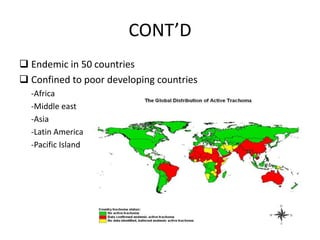
 Endemic in 50 countries
 Confined to poor developing countries
-Africa
-Middle east
-Asia
-Latin America
-Pacific Island
ETIOLOGY
• Trachoma is caused by the organism
Chlamydia trachomatis which is a
- highly infectious
- subdivided into a number of serotype
serotype( A,B,C) - associated with eye to
eye infection

serotype (D-K) - associated with genital
tract infection and ophthalmic neonatrem(newborn
conjunctivitis)
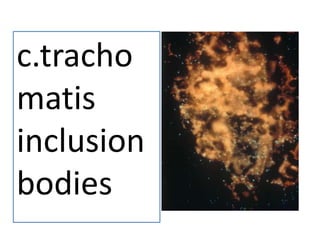
c.tracho
matis
inclusion
bodies
TRANSMISION
By direct contact with
Eye secretion
Nasal secretion
Throat affected secretion

By contact with fomites such as
Hand kerchiefs
Towels or
wash cloths contaminated with these secretion
 Eye seeking flies
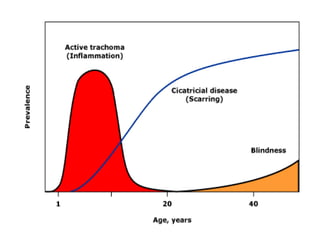
• Episodes of infection usually begin in
childhood, while blindness from corneal
scarring occurs after repeated infection,
untreated inflammation,scarring of the
eyelids, distortion of the eyelashes, associated
trauma and secondary bacterial infection.
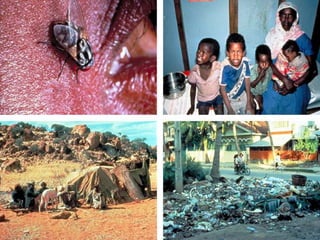
Risk Factors for Trachoma
• Environmental factors
-lacks effective sanitation, and adequate
fresh water supplies
-presence of animals kept near to
dwellings and piles of animal dung provide
breeding places for flies
- Flies are attracted to red eyes with
discharge, and carry the organism Chlamydia
trachomatis to the eyes of others within a family
or a community, both children and adults
Risk factor
o Dry
o Dusty
o Dirty
o Dung
o Discharge
o Density (overcrowding in the home
factors which influence transmission of
infection
-Flies
-Faeces
-Faces
-Fingers
-Fomites (contaminated material or
objects such as clothing or towels)
CLINICAL MANIFESTATION
• The clinical manifestations of trachoma can be
divided into two phases:
1- active trachoma and
2- cicatricial trachoma
ACTIVE TRACHOMA
Active trachoma
- mostly seen in young children
-majority are asymptomatic
-cause mild self limited follicular
conjunctivitis
- Mild irritation
-Red eyes
CONT’D
-Discharge - 2ry bacterial infection
-Eyelid or Conjunctival edema
-Pain and photophobia
-Blurring of vision
 Physical finding of active trachoma is
- follicle on upper tarsal conjunctiva
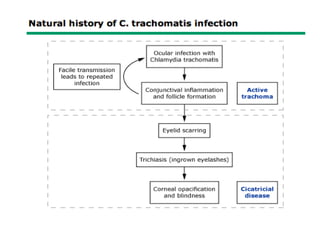
CIACATRICIAL DISEASE
• Commonly seen in adult
 Repeated episodes of infection cause marked conjunctival
inflammation


leading to eyelid scarring→Eyelid scar tissue eventually
contracts



distort the lid margin leading to entropion (inward rolling of
the eyelid) and



subsequent trichiasis (ingrown eyelashes).
CONT’D
 Eyelash abrasion on the cornea leads to
corneal edema,
ulceration and
scarring.
 If untreated, corneal pannus (inflammatory
vascular tissue) eventually develops followed
by corneal opacification, and loss of vision.
WHO TRACHOMA GRADING SYSTEM
TF- Trachomatous Inflammation – Follicular
TI – Trachomatous Inflammation – Intense
TS –Trachomatous Scarring
TT – Trachomatous Trichiasis
CO –Corneal Opacity
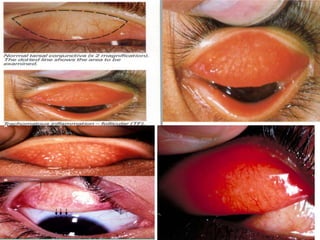
TF-FOLLICULAR
• Cxed by
- presence of 5 or more follicle
-each 0.5 mm in diameter
-Rounded
-Slightly raised
-Usually paler than the remaining conjunctiva
surface
-on the flat surface of the upper tarsal
conjunctiva
- which are tiny accumulation of lymphoid cell
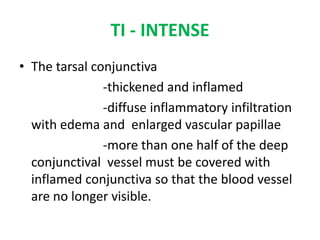
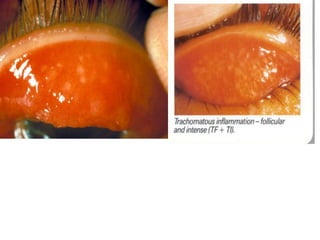
TI - INTENSE
• The tarsal conjunctiva
-thickened and inflamed
-diffuse inflammatory infiltration
with edema and enlarged vascular papillae
-more than one half of the deep
conjunctival vessel must be covered with
inflamed conjunctiva so that the blood vessel
are no longer visible.
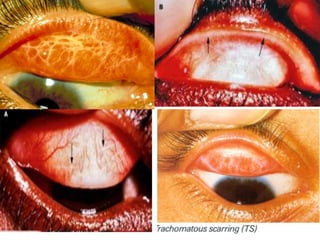
Trachomatous Scarring
• Presence of scarring and fibrosis in the tarsal
conjunctiva.
• Appear as white lines.
• Common in the older pts.
• Causes distortion of the upper eyelid.
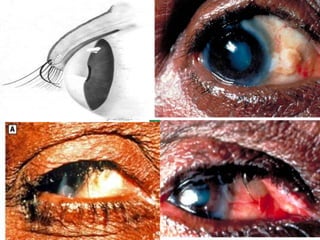
Trachomatous Trichiasis
• Trichiasis is defined as 1 or more eyelashes
rubbing against the eyeball or evidence of lash
removal.
• Common in women and starts at adolescence.
• Due to advanced conjunctival scarring and the
distortion of the upper eyelid.
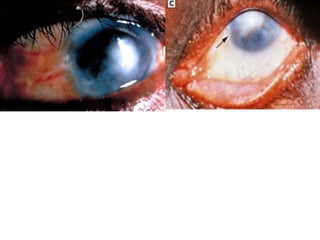
Corneal Opacity
• This is when the scarring is central and very
dense enough to obscure part of the pupil
margin.
• Usually after 20 yrs.
• Reduced vision.
• Much improvement is not expected even after
treatment.
DDX
•
•
•
•
•

Allergic conjunctivitis
Bacterial conjunctivitis
Neonatal conjunctivitis
Viral conjunctivitis
Trichiasis
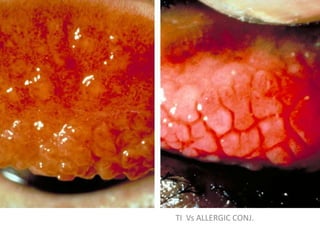
Allergic conjunctivitis
 Usually Present in children and is a chronic
condition
 Particularly common spring and summer
- itching , red eyes, irritable
-In the florid state, papillae appear on
the tarsal conj. ---Cobblestone appearance.
Thickening of tissue at the CSM helps
distinguish it from trachoma.
TI Vs ALLERGIC CONJ.
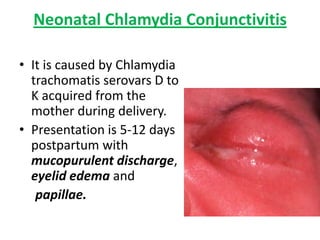
Neonatal Chlamydia Conjunctivitis
• It is caused by Chlamydia
trachomatis serovars D to
K acquired from the
mother during delivery.
• Presentation is 5-12 days
postpartum with
mucopurulent discharge,
eyelid edema and
papillae.
TREATMENT OF TRACHOMA
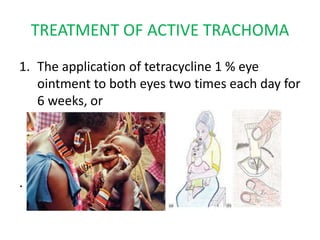
TREATMENT OF ACTIVE TRACHOMA
1. The application of tetracycline 1 % eye
ointment to both eyes two times each day for
6 weeks, or

.
CONT’D
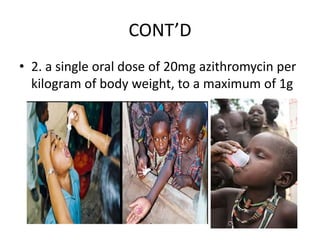
• 2. a single oral dose of 20mg azithromycin per
kilogram of body weight, to a maximum of 1g
Do antibiotics improve all grades of
trachoma?
CONT’D
NO
Azithromycin or tetracycline ointment are
effective only against active trachoma,
particularly follicular trachoma (TF) and intense
inflammatory trachoma (TI).
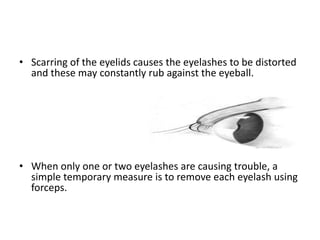
• Scarring of the eyelids causes the eyelashes to be distorted
and these may constantly rub against the eyeball.

• When only one or two eyelashes are causing trouble, a
simple temporary measure is to remove each eyelash using
forceps.
CONT’D
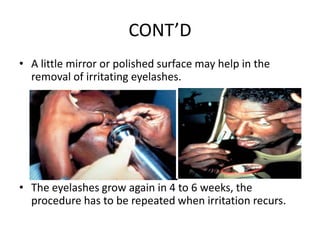
• A little mirror or polished surface may help in the
removal of irritating eyelashes.

• The eyelashes grow again in 4 to 6 weeks, the
procedure has to be repeated when irritation recurs.
CONT’D
• A more permanent method of dealing with an
isolated ingrowing eyelash is to apply
electrolysis, after injecting local anesthetic
into the eyelid at the base of the eyelash.
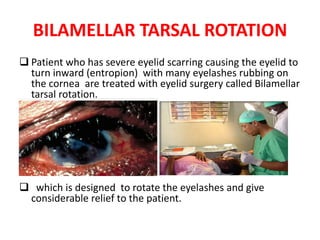
BILAMELLAR TARSAL ROTATION
 Patient who has severe eyelid scarring causing the eyelid to
turn inward (entropion) with many eyelashes rubbing on
the cornea are treated with eyelid surgery called Bilamellar
tarsal rotation.

 which is designed to rotate the eyelashes and give
considerable relief to the patient.
Can we improve vision after corneal scarring?
 If the cornea is considerably scarred, then it is seldom
possible to improve the eyesight. Corneal grafting is
not usually successful in these eyes.

 However, if there is an area of one cornea which does
remains clear, where the scarring effects of trachoma
involve the cornea in each eye, an optical iridectomy
may be considered.
• In this surgical procedure, the pupil of the eye
is made bigger so that the patient can look
through the widened pupil which has been
surgically enlarged behind the clear area of
cornea.
PREVENTION OF TRACHOMA
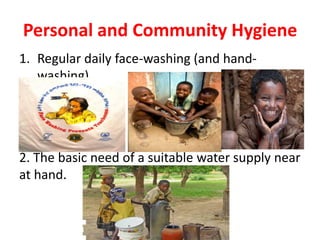
Personal and Community Hygiene
1. Regular daily face-washing (and handwashing).

2. The basic need of a suitable water supply near
at hand.
Cont’d
3. Ventilated pit latrines to improve community
hygiene.

4. Animals, especially cattle, housed, if possible,
some distance from the family home.
Cont’d
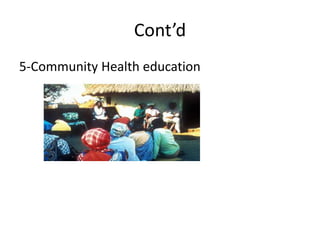
5-Community Health education
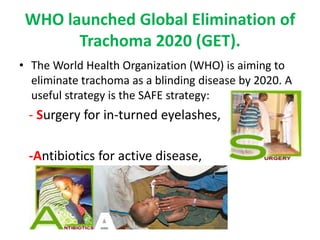
WHO launched Global Elimination of
Trachoma 2020 (GET).
• The World Health Organization (WHO) is aiming to
eliminate trachoma as a blinding disease by 2020. A
useful strategy is the SAFE strategy:

- Surgery for in-turned eyelashes,
-Antibiotics for active disease,
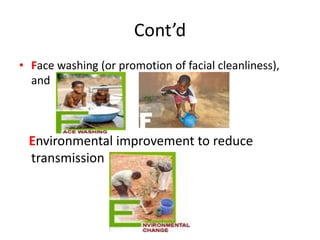
Cont’d
• Face washing (or promotion of facial cleanliness),
and

Environmental improvement to reduce
transmission
THANK YOU

Trachoma

  • 1.
    MEKELLE UNIVERSTY COLLEGE OFHEALTH SCIENCE AYDER REFERRAL HOSPITAL OPHALMOLOGY UNIT SEMINAR ON TRACHOMA PREPARED BY GIRMAWI.M
  • 2.
  • 3.
    TRACHOMA • one ofthe major blinding diseases • most common infectious cause of blindness.
  • 4.
    EPIDEMILOGY • The WHOestimates that 84 million people suffer from active trachoma and most of these are under 15 years of age. • over 7 million have trichiasis (ingrown eyelashes • Up to 1.3 million are thought to be blind due to the eye disease
  • 5.
    CONT’D  Endemic in50 countries  Confined to poor developing countries -Africa -Middle east -Asia -Latin America -Pacific Island
  • 6.
    ETIOLOGY • Trachoma iscaused by the organism Chlamydia trachomatis which is a - highly infectious - subdivided into a number of serotype serotype( A,B,C) - associated with eye to eye infection serotype (D-K) - associated with genital tract infection and ophthalmic neonatrem(newborn conjunctivitis)
  • 7.
  • 8.
    TRANSMISION By direct contactwith Eye secretion Nasal secretion Throat affected secretion By contact with fomites such as Hand kerchiefs Towels or wash cloths contaminated with these secretion  Eye seeking flies
  • 9.
    • Episodes ofinfection usually begin in childhood, while blindness from corneal scarring occurs after repeated infection, untreated inflammation,scarring of the eyelids, distortion of the eyelashes, associated trauma and secondary bacterial infection.
  • 11.
    Risk Factors forTrachoma • Environmental factors -lacks effective sanitation, and adequate fresh water supplies -presence of animals kept near to dwellings and piles of animal dung provide breeding places for flies - Flies are attracted to red eyes with discharge, and carry the organism Chlamydia trachomatis to the eyes of others within a family or a community, both children and adults
  • 12.
    Risk factor o Dry oDusty o Dirty o Dung o Discharge o Density (overcrowding in the home
  • 14.
    factors which influencetransmission of infection -Flies -Faeces -Faces -Fingers -Fomites (contaminated material or objects such as clothing or towels)
  • 16.
    CLINICAL MANIFESTATION • Theclinical manifestations of trachoma can be divided into two phases: 1- active trachoma and 2- cicatricial trachoma
  • 17.
    ACTIVE TRACHOMA Active trachoma -mostly seen in young children -majority are asymptomatic -cause mild self limited follicular conjunctivitis - Mild irritation -Red eyes
  • 18.
    CONT’D -Discharge - 2rybacterial infection -Eyelid or Conjunctival edema -Pain and photophobia -Blurring of vision  Physical finding of active trachoma is - follicle on upper tarsal conjunctiva
  • 19.
    CIACATRICIAL DISEASE • Commonlyseen in adult  Repeated episodes of infection cause marked conjunctival inflammation  leading to eyelid scarring→Eyelid scar tissue eventually contracts  distort the lid margin leading to entropion (inward rolling of the eyelid) and  subsequent trichiasis (ingrown eyelashes).
  • 20.
    CONT’D  Eyelash abrasionon the cornea leads to corneal edema, ulceration and scarring.  If untreated, corneal pannus (inflammatory vascular tissue) eventually develops followed by corneal opacification, and loss of vision.
  • 21.
    WHO TRACHOMA GRADINGSYSTEM TF- Trachomatous Inflammation – Follicular TI – Trachomatous Inflammation – Intense TS –Trachomatous Scarring TT – Trachomatous Trichiasis CO –Corneal Opacity
  • 22.
    TF-FOLLICULAR • Cxed by -presence of 5 or more follicle -each 0.5 mm in diameter -Rounded -Slightly raised -Usually paler than the remaining conjunctiva surface -on the flat surface of the upper tarsal conjunctiva - which are tiny accumulation of lymphoid cell
  • 24.
    TI - INTENSE •The tarsal conjunctiva -thickened and inflamed -diffuse inflammatory infiltration with edema and enlarged vascular papillae -more than one half of the deep conjunctival vessel must be covered with inflamed conjunctiva so that the blood vessel are no longer visible.
  • 26.
    Trachomatous Scarring • Presenceof scarring and fibrosis in the tarsal conjunctiva. • Appear as white lines. • Common in the older pts. • Causes distortion of the upper eyelid.
  • 28.
    Trachomatous Trichiasis • Trichiasisis defined as 1 or more eyelashes rubbing against the eyeball or evidence of lash removal. • Common in women and starts at adolescence. • Due to advanced conjunctival scarring and the distortion of the upper eyelid.
  • 30.
    Corneal Opacity • Thisis when the scarring is central and very dense enough to obscure part of the pupil margin. • Usually after 20 yrs. • Reduced vision. • Much improvement is not expected even after treatment.
  • 32.
  • 33.
    Allergic conjunctivitis  UsuallyPresent in children and is a chronic condition  Particularly common spring and summer - itching , red eyes, irritable -In the florid state, papillae appear on the tarsal conj. ---Cobblestone appearance. Thickening of tissue at the CSM helps distinguish it from trachoma.
  • 34.
  • 35.
    Neonatal Chlamydia Conjunctivitis •It is caused by Chlamydia trachomatis serovars D to K acquired from the mother during delivery. • Presentation is 5-12 days postpartum with mucopurulent discharge, eyelid edema and papillae.
  • 36.
  • 37.
    TREATMENT OF ACTIVETRACHOMA 1. The application of tetracycline 1 % eye ointment to both eyes two times each day for 6 weeks, or .
  • 38.
    CONT’D • 2. asingle oral dose of 20mg azithromycin per kilogram of body weight, to a maximum of 1g
  • 39.
    Do antibiotics improveall grades of trachoma?
  • 40.
    CONT’D NO Azithromycin or tetracyclineointment are effective only against active trachoma, particularly follicular trachoma (TF) and intense inflammatory trachoma (TI).
  • 41.
    • Scarring ofthe eyelids causes the eyelashes to be distorted and these may constantly rub against the eyeball. • When only one or two eyelashes are causing trouble, a simple temporary measure is to remove each eyelash using forceps.

  • 42.
    CONT’D • A littlemirror or polished surface may help in the removal of irritating eyelashes. • The eyelashes grow again in 4 to 6 weeks, the procedure has to be repeated when irritation recurs.
  • 43.
    CONT’D • A morepermanent method of dealing with an isolated ingrowing eyelash is to apply electrolysis, after injecting local anesthetic into the eyelid at the base of the eyelash.
  • 44.
    BILAMELLAR TARSAL ROTATION Patient who has severe eyelid scarring causing the eyelid to turn inward (entropion) with many eyelashes rubbing on the cornea are treated with eyelid surgery called Bilamellar tarsal rotation.  which is designed to rotate the eyelashes and give considerable relief to the patient.
  • 45.
    Can we improvevision after corneal scarring?
  • 46.
     If thecornea is considerably scarred, then it is seldom possible to improve the eyesight. Corneal grafting is not usually successful in these eyes.  However, if there is an area of one cornea which does remains clear, where the scarring effects of trachoma involve the cornea in each eye, an optical iridectomy may be considered.
  • 47.
    • In thissurgical procedure, the pupil of the eye is made bigger so that the patient can look through the widened pupil which has been surgically enlarged behind the clear area of cornea.
  • 48.
  • 49.
    Personal and CommunityHygiene 1. Regular daily face-washing (and handwashing). 2. The basic need of a suitable water supply near at hand.
  • 50.
    Cont’d 3. Ventilated pitlatrines to improve community hygiene. 4. Animals, especially cattle, housed, if possible, some distance from the family home.
  • 51.
  • 52.
    WHO launched GlobalElimination of Trachoma 2020 (GET). • The World Health Organization (WHO) is aiming to eliminate trachoma as a blinding disease by 2020. A useful strategy is the SAFE strategy: - Surgery for in-turned eyelashes, -Antibiotics for active disease,
  • 53.
    Cont’d • Face washing(or promotion of facial cleanliness), and Environmental improvement to reduce transmission
  • 54.