1
2
Title…
4.2
4.3
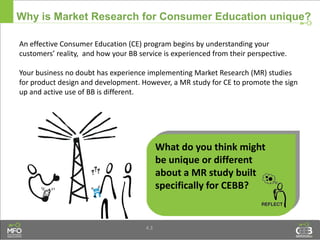
Why is Market Research for Consumer Education unique?
An effective Consumer Education (CE) program begins by understanding your
customers’ reality, and how your BB service is experienced from their perspective.
Your business no doubt has experience implementing Market Research (MR) studies
for product design and development. However, a MR study for CE to promote the sign
up and active use of BB is different.
What do you think might
be unique or different
about a MR study built
specifically for CEBB?
4.4
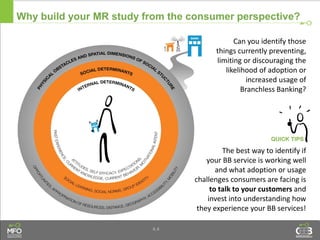
Why build your MR study from the consumer perspective?
Can you identify those
things currently preventing,
limiting or discouraging the
likelihood of adoption or
increased usage of
Branchless Banking?
The best way to identify if
your BB service is working well
and what adoption or usage
challenges consumers are facing is
to talk to your customers and
invest into understanding how
they experience your BB services!
4.5
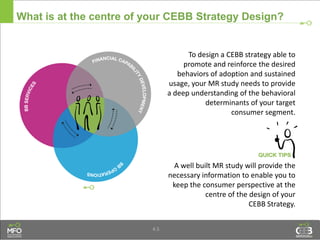
What is at the centre of your CEBB Strategy Design?
A well built MR study will provide the
necessary information to enable you to
keep the consumer perspective at the
centre of the design of your
CEBB Strategy.
To design a CEBB strategy able to
promote and reinforce the desired
behaviors of adoption and sustained
usage, your MR study needs to provide
a deep understanding of the behavioral
determinants of your target
consumer segment.
4.6
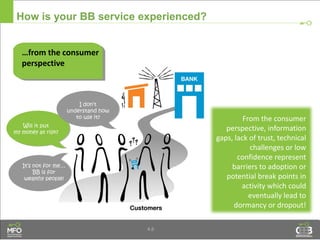
How is your BB service experienced?
…from the consumer
perspective
Will it put
my money at risk?
I don’t
understand how
to use it? From the consumer
perspective, information
gaps, lack of trust, technical
challenges or low
confidence represent
barriers to adoption or
potential break points in
activity which could
eventually lead to
dormancy or dropout!
It’s not for me…
BB is for
wealthy people!
4.7
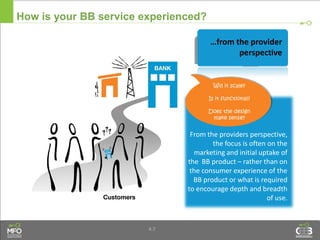
How is your BB service experienced?
…from the provider
perspective
Will it scale?
Is it functional?
Does the design
make sense?
From the providers perspective,
the focus is often on the
marketing and initial uptake of
the BB product – rather than on
the consumer experience of the
BB product or what is required
to encourage depth and breadth
of use.
4.8
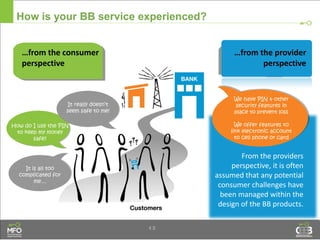
How is your BB service experienced?
…from the consumer
perspective
How do I use the PIN
to keep my money
safe?
It really doesn’t
seem safe to me!
…from the provider
perspective
It is all too
complicated for
me…
From the providers
perspective, it is often
assumed that any potential
consumer challenges have
been managed within the
design of the BB products.
We have PIN & other
security features in
place to prevent loss
We offer features to
link electronic account
to cell phone or card
4.9
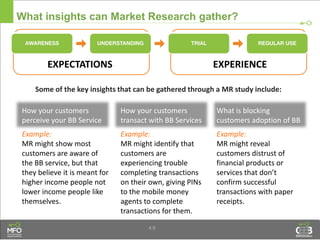
What insights can Market Research gather?
EXPECTATIONS EXPERIENCE
Some of the key insights that can be gathered through a MR study include:
How your customers
perceive your BB Service
Example:
MR might show most
customers are aware of
the BB service, but that
they believe it is meant for
higher income people not
lower income people like
themselves.
How your customers
transact with BB Services
Example:
MR might identify that
customers are
experiencing trouble
completing transactions
on their own, giving PINs
to the mobile money
agents to complete
transactions for them.
What is blocking
customers adoption of BB
Example:
MR might reveal
customers distrust of
financial products or
services that don’t
confirm successful
transactions with paper
receipts.
4.10
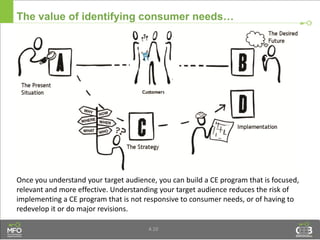
The value of identifying consumer needs…
Once you understand your target audience, you can build a CE program that is focused,
relevant and more effective. Understanding your target audience reduces the risk of
implementing a CE program that is not responsive to consumer needs, or of having to
redevelop it or do major revisions.
11
Why do you think it is important
to invest in identifying consumer
needs before you design and
develop your CEBB Strategy?
4.11
12
Title…
4.12
4.13
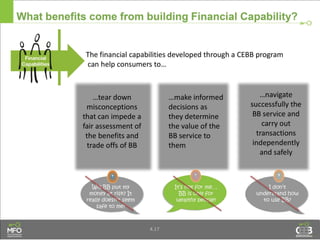
What information do you gather through the MR study?
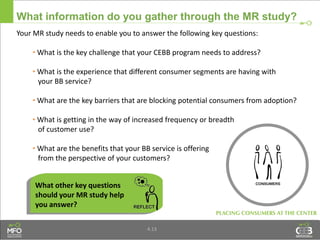
Your MR study needs to enable you to answer the following key questions:
• What is the key challenge that your CEBB program needs to address?
• What is the experience that different consumer segments are having with
your BB service?
• What are the key barriers that are blocking potential consumers from adoption?
• What is getting in the way of increased frequency or breadth
of customer use?
• What are the benefits that your BB service is offering
from the perspective of your customers?
What other key questions
should your MR study help
you answer?
4.14
What information do you gather through the MR study?
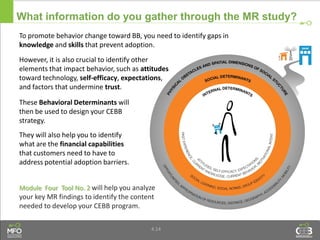
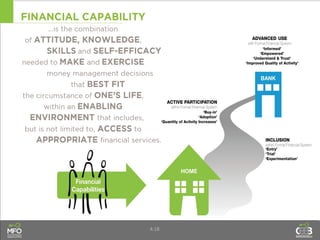
To promote behavior change toward BB, you need to identify gaps in
knowledge and skills that prevent adoption.
These Behavioral Determinants will
then be used to design your CEBB
strategy.
They will also help you to identify
what are the financial capabilities
that customers need to have to
address potential adoption barriers.
However, it is also crucial to identify other
elements that impact behavior, such as attitudes
toward technology, self-efficacy, expectations,
and factors that undermine trust.
Module Four Tool No. 2 will help you analyze
your key MR findings to identify the content
needed to develop your CEBB program.
4.15
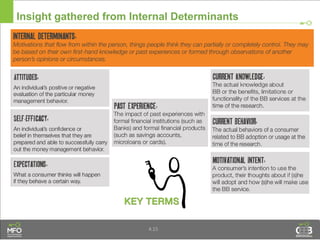
Insight gathered from Internal Determinants
4.16
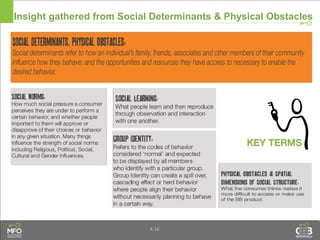
Insight gathered from Social Determinants & Physical Obstacles
4.18
19
What are some of the behavioral
determinants that are preventing
the adoption of your BB service?
4.19
20
4.20
4.21
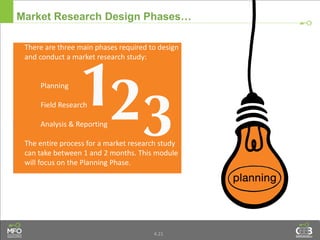
Market Research Design Phases…
There are three main phases required to design
and conduct a market research study:
Planning
Field Research
Analysis & Reporting
The entire process for a market research study
can take between 1 and 2 months. This module
will focus on the Planning Phase.
4.22
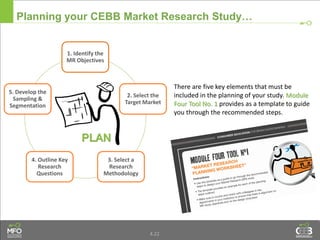
Planning your CEBB Market Research Study…
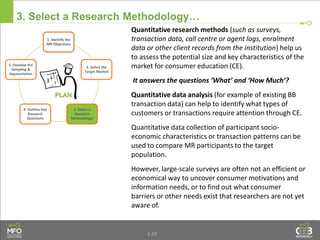
There are five key elements that must be
included in the planning of your study. Module
Four Tool No. 1 provides as a template to guide
you through the recommended steps.
1. Identify the
MR Objectives
2. Select the
Target Market
3. Select a
Research
Methodology
4. Outline Key
Research
Questions
5. Develop the
Sampling &
Segmentation
4.23
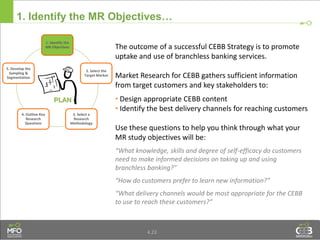
1. Identify the MR Objectives…
The outcome of a successful CEBB Strategy is to promote
uptake and use of branchless banking services.
Market Research for CEBB gathers sufficient information
from target customers and key stakeholders to:
• Design appropriate CEBB content
• Identify the best delivery channels for reaching customers
Use these questions to help you think through what your
MR study objectives will be:
“What knowledge, skills and degree of self-efficacy do customers
need to make informed decisions on taking up and using
branchless banking?”
“How do customers prefer to learn new information?”
“What delivery channels would be most appropriate for the CEBB
to use to reach these customers?”
1. Identify the
MR Objectives
2. Select the
Target Market
3. Select a
Research
Methodology
4. Outline Key
Research
Questions
5. Develop the
Sampling &
Segmentation
4.24
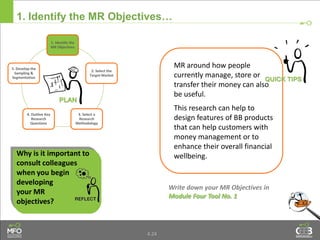
1. Identify the MR Objectives…
Write down your MR Objectives in
Module Four Tool No. 1
MR around how people
currently manage, store or
transfer their money can also
be useful.
This research can help to
design features of BB products
that can help customers with
money management or to
enhance their overall financial
wellbeing.Why is it important to
consult colleagues
when you begin
developing
your MR
objectives?
1. Identify the
MR Objectives
2. Select the
Target Market
3. Select a
Research
Methodology
4. Outline Key
Research
Questions
5. Develop the
Sampling &
Segmentation
4.25
2. Select the Target Market…
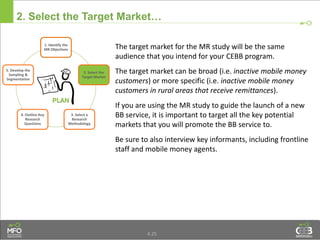
The target market for the MR study will be the same
audience that you intend for your CEBB program.
The target market can be broad (i.e. inactive mobile money
customers) or more specific (i.e. inactive mobile money
customers in rural areas that receive remittances).
If you are using the MR study to guide the launch of a new
BB service, it is important to target all the key potential
markets that you will promote the BB service to.
Be sure to also interview key informants, including frontline
staff and mobile money agents.
1. Identify the
MR Objectives
2. Select the
Target Market
3. Select a
Research
Methodology
4. Outline Key
Research
Questions
5. Develop the
Sampling &
Segmentation
4.26
2. Select the Target Market…
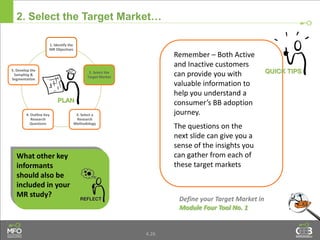
Remember – Both Active
and Inactive customers
can provide you with
valuable information to
help you understand a
consumer’s BB adoption
journey.
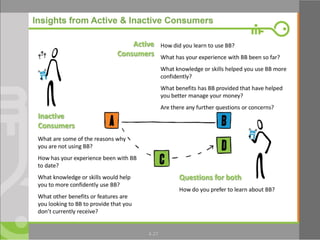
The questions on the
next slide can give you a
sense of the insights you
can gather from each of
these target markets
Define your Target Market in
Module Four Tool No. 1
What other key
informants
should also be
included in your
MR study?
1. Identify the
MR Objectives
2. Select the
Target Market
3. Select a
Research
Methodology
4. Outline Key
Research
Questions
5. Develop the
Sampling &
Segmentation
4.28
3. Select a Research Methodology…
What research
methodology does
your institution
value most?
Why?
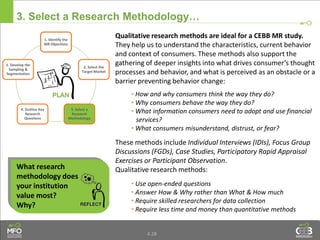
Qualitative research methods are ideal for a CEBB MR study.
They help us to understand the characteristics, current behavior
and context of consumers. These methods also support the
gathering of deeper insights into what drives consumer’s thought
processes and behavior, and what is perceived as an obstacle or a
barrier preventing behavior change:
• How and why consumers think the way they do?
• Why consumers behave the way they do?
• What information consumers need to adopt and use financial
services?
• What consumers misunderstand, distrust, or fear?
These methods include Individual Interviews (IDIs), Focus Group
Discussions (FGDs), Case Studies, Participatory Rapid Appraisal
Exercises or Participant Observation.
Qualitative research methods:
• Use open-ended questions
• Answer How & Why rather than What & How much
• Require skilled researchers for data collection
• Require less time and money than quantitative methods
1. Identify the
MR Objectives
2. Select the
Target Market
3. Select a
Research
Methodology
4. Outline Key
Research
Questions
5. Develop the
Sampling &
Segmentation
4.29
3. Select a Research Methodology…
Quantitative research methods (such as surveys,
transaction data, call centre or agent logs, enrolment
data or other client records from the institution) help us
to assess the potential size and key characteristics of the
market for consumer education (CE).
It answers the questions ‘What’ and ‘How Much’?
Quantitative data analysis (for example of existing BB
transaction data) can help to identify what types of
customers or transactions require attention through CE.
Quantitative data collection of participant socio-
economic characteristics or transaction patterns can be
used to compare MR participants to the target
population.
However, large-scale surveys are often not an efficient or
economical way to uncover consumer motivations and
information needs, or to find out what consumer
barriers or other needs exist that researchers are not yet
aware of.
1. Identify the
MR Objectives
2. Select the
Target Market
3. Select a
Research
Methodology
4. Outline Key
Research
Questions
5. Develop the
Sampling &
Segmentation
4.30
3. Select a Research Methodology…
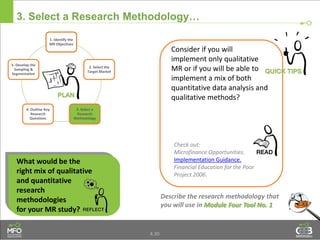
Consider if you will
implement only qualitative
MR or if you will be able to
implement a mix of both
quantitative data analysis and
qualitative methods?
Describe the research methodology that
you will use in Module Four Tool No. 1
What would be the
right mix of qualitative
and quantitative
research
methodologies
for your MR study?
Check out:
Microfinance Opportunities.
Implementation Guidance.
Financial Education for the Poor
Project 2006.
1. Identify the
MR Objectives
2. Select the
Target Market
3. Select a
Research
Methodology
4. Outline Key
Research
Questions
5. Develop the
Sampling &
Segmentation
4.31
4. Outline Key Research Questions…
Manageable
Useful
Essential
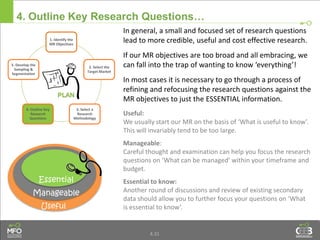
In general, a small and focused set of research questions
lead to more credible, useful and cost effective research.
If our MR objectives are too broad and all embracing, we
can fall into the trap of wanting to know ‘everything’!
In most cases it is necessary to go through a process of
refining and refocusing the research questions against the
MR objectives to just the ESSENTIAL information.
Useful:
We usually start our MR on the basis of ‘What is useful to know’.
This will invariably tend to be too large.
Manageable:
Careful thought and examination can help you focus the research
questions on ‘What can be managed’ within your timeframe and
budget.
Essential to know:
Another round of discussions and review of existing secondary
data should allow you to further focus your questions on ‘What
is essential to know’.
1. Identify the
MR Objectives
2. Select the
Target Market
3. Select a
Research
Methodology
4. Outline Key
Research
Questions
5. Develop the
Sampling &
Segmentation
4.32
4. Outline Key Research Questions…
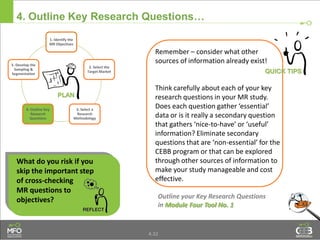
Remember – consider what other
sources of information already exist!
Think carefully about each of your key
research questions in your MR study.
Does each question gather ‘essential’
data or is it really a secondary question
that gathers ‘nice-to-have’ or ‘useful’
information? Eliminate secondary
questions that are ‘non-essential’ for the
CEBB program or that can be explored
through other sources of information to
make your study manageable and cost
effective.
Outline your Key Research Questions
in Module Four Tool No. 1
What do you risk if you
skip the important step
of cross-checking
MR questions to
objectives?
1. Identify the
MR Objectives
2. Select the
Target Market
3. Select a
Research
Methodology
4. Outline Key
Research
Questions
5. Develop the
Sampling &
Segmentation
4.33
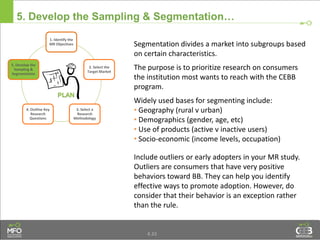
5. Develop the Sampling & Segmentation…
Segmentation divides a market into subgroups based
on certain characteristics.
The purpose is to prioritize research on consumers
the institution most wants to reach with the CEBB
program.
Widely used bases for segmenting include:
• Geography (rural v urban)
• Demographics (gender, age, etc)
• Use of products (active v inactive users)
• Socio-economic (income levels, occupation)
Include outliers or early adopters in your MR study.
Outliers are consumers that have very positive
behaviors toward BB. They can help you identify
effective ways to promote adoption. However, do
consider that their behavior is an exception rather
than the rule.
1. Identify the
MR Objectives
2. Select the
Target Market
3. Select a
Research
Methodology
4. Outline Key
Research
Questions
5. Develop the
Sampling &
Segmentation
4.34
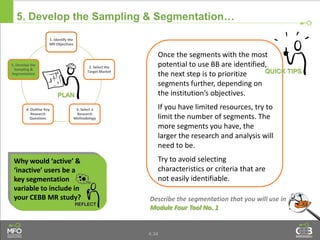
5. Develop the Sampling & Segmentation…
Once the segments with the most
potential to use BB are identified,
the next step is to prioritize
segments further, depending on
the institution’s objectives.
If you have limited resources, try to
limit the number of segments. The
more segments you have, the
larger the research and analysis will
need to be.
Try to avoid selecting
characteristics or criteria that are
not easily identifiable.
Describe the segmentation that you will use in
Module Four Tool No. 1
Why would ‘active’ &
‘inactive’ users be a
key segmentation
variable to include in
your CEBB MR study?
1. Identify the
MR Objectives
2. Select the
Target Market
3. Select a
Research
Methodology
4. Outline Key
Research
Questions
5. Develop the
Sampling &
Segmentation
35
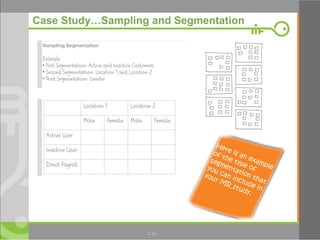
Case Study…Sampling and Segmentation
4.35
36
How is this planning process
adding or complementing the way
in which your organization designs
MR studies?
4.36
37
4.37
4.38
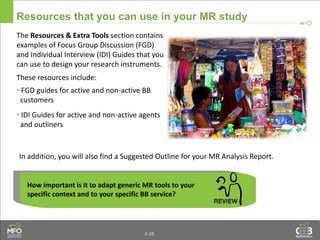
Resources that you can use in your MR study
The Resources & Extra Tools section contains
examples of Focus Group Discussion (FGD)
and Individual Interview (IDI) Guides that you
can use to design your research instruments.
These resources include:
• FGD guides for active and non-active BB
customers
• IDI Guides for active and non-active agents
and outliners
How important is it to adapt generic MR tools to your
specific context and to your specific BB service?
In addition, you will also find a Suggested Outline for your MR Analysis Report.
4.39
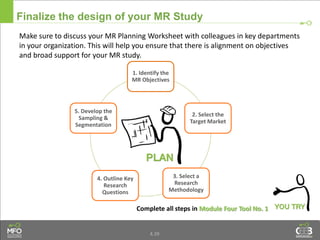
Finalize the design of your MR Study
1. Identify the
MR Objectives
2. Select the
Target Market
3. Select a
Research
Methodology
4. Outline Key
Research
Questions
5. Develop the
Sampling &
Segmentation
Complete all steps in Module Four Tool No. 1
Make sure to discuss your MR Planning Worksheet with colleagues in key departments
in your organization. This will help you ensure that there is alignment on objectives
and broad support for your MR study.
4.40
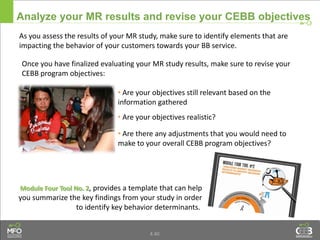
Analyze your MR results and revise your CEBB objectives
As you assess the results of your MR study, make sure to identify elements that are
impacting the behavior of your customers towards your BB service.
Module Four Tool No. 2, provides a template that can help
you summarize the key findings from your study in order
to identify key behavior determinants.
Once you have finalized evaluating your MR study results, make sure to revise your
CEBB program objectives:
• Are your objectives still relevant based on the
information gathered
• Are your objectives realistic?
• Are there any adjustments that you would need to
make to your overall CEBB program objectives?
4.41
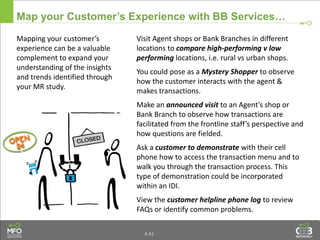
Map your Customer’s Experience with BB Services…
Mapping your customer’s
experience can be a valuable
complement to expand your
understanding of the insights
and trends identified through
your MR study.
Visit Agent shops or Bank Branches in different
locations to compare high-performing v low
performing locations, i.e. rural vs urban shops.
You could pose as a Mystery Shopper to observe
how the customer interacts with the agent &
makes transactions.
Make an announced visit to an Agent’s shop or
Bank Branch to observe how transactions are
facilitated from the frontline staff’s perspective and
how questions are fielded.
Ask a customer to demonstrate with their cell
phone how to access the transaction menu and to
walk you through the transaction process. This
type of demonstration could be incorporated
within an IDI.
View the customer helpline phone log to review
FAQs or identify common problems.

Module 4 identifying consumer needs ppt slideshare

  • 1.
  • 2.
  • 3.
    4.3 Why is MarketResearch for Consumer Education unique? An effective Consumer Education (CE) program begins by understanding your customers’ reality, and how your BB service is experienced from their perspective. Your business no doubt has experience implementing Market Research (MR) studies for product design and development. However, a MR study for CE to promote the sign up and active use of BB is different. What do you think might be unique or different about a MR study built specifically for CEBB?
  • 4.
    4.4 Why build yourMR study from the consumer perspective? Can you identify those things currently preventing, limiting or discouraging the likelihood of adoption or increased usage of Branchless Banking? The best way to identify if your BB service is working well and what adoption or usage challenges consumers are facing is to talk to your customers and invest into understanding how they experience your BB services!
  • 5.
    4.5 What is atthe centre of your CEBB Strategy Design? A well built MR study will provide the necessary information to enable you to keep the consumer perspective at the centre of the design of your CEBB Strategy. To design a CEBB strategy able to promote and reinforce the desired behaviors of adoption and sustained usage, your MR study needs to provide a deep understanding of the behavioral determinants of your target consumer segment.
  • 6.
    4.6 How is yourBB service experienced? …from the consumer perspective Will it put my money at risk? I don’t understand how to use it? From the consumer perspective, information gaps, lack of trust, technical challenges or low confidence represent barriers to adoption or potential break points in activity which could eventually lead to dormancy or dropout! It’s not for me… BB is for wealthy people!
  • 7.
    4.7 How is yourBB service experienced? …from the provider perspective Will it scale? Is it functional? Does the design make sense? From the providers perspective, the focus is often on the marketing and initial uptake of the BB product – rather than on the consumer experience of the BB product or what is required to encourage depth and breadth of use.
  • 8.
    4.8 How is yourBB service experienced? …from the consumer perspective How do I use the PIN to keep my money safe? It really doesn’t seem safe to me! …from the provider perspective It is all too complicated for me… From the providers perspective, it is often assumed that any potential consumer challenges have been managed within the design of the BB products. We have PIN & other security features in place to prevent loss We offer features to link electronic account to cell phone or card
  • 9.
    4.9 What insights canMarket Research gather? EXPECTATIONS EXPERIENCE Some of the key insights that can be gathered through a MR study include: How your customers perceive your BB Service Example: MR might show most customers are aware of the BB service, but that they believe it is meant for higher income people not lower income people like themselves. How your customers transact with BB Services Example: MR might identify that customers are experiencing trouble completing transactions on their own, giving PINs to the mobile money agents to complete transactions for them. What is blocking customers adoption of BB Example: MR might reveal customers distrust of financial products or services that don’t confirm successful transactions with paper receipts.
  • 10.
    4.10 The value ofidentifying consumer needs… Once you understand your target audience, you can build a CE program that is focused, relevant and more effective. Understanding your target audience reduces the risk of implementing a CE program that is not responsive to consumer needs, or of having to redevelop it or do major revisions.
  • 11.
    11 Why do youthink it is important to invest in identifying consumer needs before you design and develop your CEBB Strategy? 4.11
  • 12.
  • 13.
    4.13 What information doyou gather through the MR study? Your MR study needs to enable you to answer the following key questions: • What is the key challenge that your CEBB program needs to address? • What is the experience that different consumer segments are having with your BB service? • What are the key barriers that are blocking potential consumers from adoption? • What is getting in the way of increased frequency or breadth of customer use? • What are the benefits that your BB service is offering from the perspective of your customers? What other key questions should your MR study help you answer?
  • 14.
    4.14 What information doyou gather through the MR study? To promote behavior change toward BB, you need to identify gaps in knowledge and skills that prevent adoption. These Behavioral Determinants will then be used to design your CEBB strategy. They will also help you to identify what are the financial capabilities that customers need to have to address potential adoption barriers. However, it is also crucial to identify other elements that impact behavior, such as attitudes toward technology, self-efficacy, expectations, and factors that undermine trust. Module Four Tool No. 2 will help you analyze your key MR findings to identify the content needed to develop your CEBB program.
  • 15.
    4.15 Insight gathered fromInternal Determinants
  • 16.
    4.16 Insight gathered fromSocial Determinants & Physical Obstacles
  • 18.
  • 19.
    19 What are someof the behavioral determinants that are preventing the adoption of your BB service? 4.19
  • 20.
  • 21.
    4.21 Market Research DesignPhases… There are three main phases required to design and conduct a market research study: Planning Field Research Analysis & Reporting The entire process for a market research study can take between 1 and 2 months. This module will focus on the Planning Phase.
  • 22.
    4.22 Planning your CEBBMarket Research Study… There are five key elements that must be included in the planning of your study. Module Four Tool No. 1 provides as a template to guide you through the recommended steps. 1. Identify the MR Objectives 2. Select the Target Market 3. Select a Research Methodology 4. Outline Key Research Questions 5. Develop the Sampling & Segmentation
  • 23.
    4.23 1. Identify theMR Objectives… The outcome of a successful CEBB Strategy is to promote uptake and use of branchless banking services. Market Research for CEBB gathers sufficient information from target customers and key stakeholders to: • Design appropriate CEBB content • Identify the best delivery channels for reaching customers Use these questions to help you think through what your MR study objectives will be: “What knowledge, skills and degree of self-efficacy do customers need to make informed decisions on taking up and using branchless banking?” “How do customers prefer to learn new information?” “What delivery channels would be most appropriate for the CEBB to use to reach these customers?” 1. Identify the MR Objectives 2. Select the Target Market 3. Select a Research Methodology 4. Outline Key Research Questions 5. Develop the Sampling & Segmentation
  • 24.
    4.24 1. Identify theMR Objectives… Write down your MR Objectives in Module Four Tool No. 1 MR around how people currently manage, store or transfer their money can also be useful. This research can help to design features of BB products that can help customers with money management or to enhance their overall financial wellbeing.Why is it important to consult colleagues when you begin developing your MR objectives? 1. Identify the MR Objectives 2. Select the Target Market 3. Select a Research Methodology 4. Outline Key Research Questions 5. Develop the Sampling & Segmentation
  • 25.
    4.25 2. Select theTarget Market… The target market for the MR study will be the same audience that you intend for your CEBB program. The target market can be broad (i.e. inactive mobile money customers) or more specific (i.e. inactive mobile money customers in rural areas that receive remittances). If you are using the MR study to guide the launch of a new BB service, it is important to target all the key potential markets that you will promote the BB service to. Be sure to also interview key informants, including frontline staff and mobile money agents. 1. Identify the MR Objectives 2. Select the Target Market 3. Select a Research Methodology 4. Outline Key Research Questions 5. Develop the Sampling & Segmentation
  • 26.
    4.26 2. Select theTarget Market… Remember – Both Active and Inactive customers can provide you with valuable information to help you understand a consumer’s BB adoption journey. The questions on the next slide can give you a sense of the insights you can gather from each of these target markets Define your Target Market in Module Four Tool No. 1 What other key informants should also be included in your MR study? 1. Identify the MR Objectives 2. Select the Target Market 3. Select a Research Methodology 4. Outline Key Research Questions 5. Develop the Sampling & Segmentation
  • 28.
    4.28 3. Select aResearch Methodology… What research methodology does your institution value most? Why? Qualitative research methods are ideal for a CEBB MR study. They help us to understand the characteristics, current behavior and context of consumers. These methods also support the gathering of deeper insights into what drives consumer’s thought processes and behavior, and what is perceived as an obstacle or a barrier preventing behavior change: • How and why consumers think the way they do? • Why consumers behave the way they do? • What information consumers need to adopt and use financial services? • What consumers misunderstand, distrust, or fear? These methods include Individual Interviews (IDIs), Focus Group Discussions (FGDs), Case Studies, Participatory Rapid Appraisal Exercises or Participant Observation. Qualitative research methods: • Use open-ended questions • Answer How & Why rather than What & How much • Require skilled researchers for data collection • Require less time and money than quantitative methods 1. Identify the MR Objectives 2. Select the Target Market 3. Select a Research Methodology 4. Outline Key Research Questions 5. Develop the Sampling & Segmentation
  • 29.
    4.29 3. Select aResearch Methodology… Quantitative research methods (such as surveys, transaction data, call centre or agent logs, enrolment data or other client records from the institution) help us to assess the potential size and key characteristics of the market for consumer education (CE). It answers the questions ‘What’ and ‘How Much’? Quantitative data analysis (for example of existing BB transaction data) can help to identify what types of customers or transactions require attention through CE. Quantitative data collection of participant socio- economic characteristics or transaction patterns can be used to compare MR participants to the target population. However, large-scale surveys are often not an efficient or economical way to uncover consumer motivations and information needs, or to find out what consumer barriers or other needs exist that researchers are not yet aware of. 1. Identify the MR Objectives 2. Select the Target Market 3. Select a Research Methodology 4. Outline Key Research Questions 5. Develop the Sampling & Segmentation
  • 30.
    4.30 3. Select aResearch Methodology… Consider if you will implement only qualitative MR or if you will be able to implement a mix of both quantitative data analysis and qualitative methods? Describe the research methodology that you will use in Module Four Tool No. 1 What would be the right mix of qualitative and quantitative research methodologies for your MR study? Check out: Microfinance Opportunities. Implementation Guidance. Financial Education for the Poor Project 2006. 1. Identify the MR Objectives 2. Select the Target Market 3. Select a Research Methodology 4. Outline Key Research Questions 5. Develop the Sampling & Segmentation
  • 31.
    4.31 4. Outline KeyResearch Questions… Manageable Useful Essential In general, a small and focused set of research questions lead to more credible, useful and cost effective research. If our MR objectives are too broad and all embracing, we can fall into the trap of wanting to know ‘everything’! In most cases it is necessary to go through a process of refining and refocusing the research questions against the MR objectives to just the ESSENTIAL information. Useful: We usually start our MR on the basis of ‘What is useful to know’. This will invariably tend to be too large. Manageable: Careful thought and examination can help you focus the research questions on ‘What can be managed’ within your timeframe and budget. Essential to know: Another round of discussions and review of existing secondary data should allow you to further focus your questions on ‘What is essential to know’. 1. Identify the MR Objectives 2. Select the Target Market 3. Select a Research Methodology 4. Outline Key Research Questions 5. Develop the Sampling & Segmentation
  • 32.
    4.32 4. Outline KeyResearch Questions… Remember – consider what other sources of information already exist! Think carefully about each of your key research questions in your MR study. Does each question gather ‘essential’ data or is it really a secondary question that gathers ‘nice-to-have’ or ‘useful’ information? Eliminate secondary questions that are ‘non-essential’ for the CEBB program or that can be explored through other sources of information to make your study manageable and cost effective. Outline your Key Research Questions in Module Four Tool No. 1 What do you risk if you skip the important step of cross-checking MR questions to objectives? 1. Identify the MR Objectives 2. Select the Target Market 3. Select a Research Methodology 4. Outline Key Research Questions 5. Develop the Sampling & Segmentation
  • 33.
    4.33 5. Develop theSampling & Segmentation… Segmentation divides a market into subgroups based on certain characteristics. The purpose is to prioritize research on consumers the institution most wants to reach with the CEBB program. Widely used bases for segmenting include: • Geography (rural v urban) • Demographics (gender, age, etc) • Use of products (active v inactive users) • Socio-economic (income levels, occupation) Include outliers or early adopters in your MR study. Outliers are consumers that have very positive behaviors toward BB. They can help you identify effective ways to promote adoption. However, do consider that their behavior is an exception rather than the rule. 1. Identify the MR Objectives 2. Select the Target Market 3. Select a Research Methodology 4. Outline Key Research Questions 5. Develop the Sampling & Segmentation
  • 34.
    4.34 5. Develop theSampling & Segmentation… Once the segments with the most potential to use BB are identified, the next step is to prioritize segments further, depending on the institution’s objectives. If you have limited resources, try to limit the number of segments. The more segments you have, the larger the research and analysis will need to be. Try to avoid selecting characteristics or criteria that are not easily identifiable. Describe the segmentation that you will use in Module Four Tool No. 1 Why would ‘active’ & ‘inactive’ users be a key segmentation variable to include in your CEBB MR study? 1. Identify the MR Objectives 2. Select the Target Market 3. Select a Research Methodology 4. Outline Key Research Questions 5. Develop the Sampling & Segmentation
  • 35.
  • 36.
    36 How is thisplanning process adding or complementing the way in which your organization designs MR studies? 4.36
  • 37.
  • 38.
    4.38 Resources that youcan use in your MR study The Resources & Extra Tools section contains examples of Focus Group Discussion (FGD) and Individual Interview (IDI) Guides that you can use to design your research instruments. These resources include: • FGD guides for active and non-active BB customers • IDI Guides for active and non-active agents and outliners How important is it to adapt generic MR tools to your specific context and to your specific BB service? In addition, you will also find a Suggested Outline for your MR Analysis Report.
  • 39.
    4.39 Finalize the designof your MR Study 1. Identify the MR Objectives 2. Select the Target Market 3. Select a Research Methodology 4. Outline Key Research Questions 5. Develop the Sampling & Segmentation Complete all steps in Module Four Tool No. 1 Make sure to discuss your MR Planning Worksheet with colleagues in key departments in your organization. This will help you ensure that there is alignment on objectives and broad support for your MR study.
  • 40.
    4.40 Analyze your MRresults and revise your CEBB objectives As you assess the results of your MR study, make sure to identify elements that are impacting the behavior of your customers towards your BB service. Module Four Tool No. 2, provides a template that can help you summarize the key findings from your study in order to identify key behavior determinants. Once you have finalized evaluating your MR study results, make sure to revise your CEBB program objectives: • Are your objectives still relevant based on the information gathered • Are your objectives realistic? • Are there any adjustments that you would need to make to your overall CEBB program objectives?
  • 41.
    4.41 Map your Customer’sExperience with BB Services… Mapping your customer’s experience can be a valuable complement to expand your understanding of the insights and trends identified through your MR study. Visit Agent shops or Bank Branches in different locations to compare high-performing v low performing locations, i.e. rural vs urban shops. You could pose as a Mystery Shopper to observe how the customer interacts with the agent & makes transactions. Make an announced visit to an Agent’s shop or Bank Branch to observe how transactions are facilitated from the frontline staff’s perspective and how questions are fielded. Ask a customer to demonstrate with their cell phone how to access the transaction menu and to walk you through the transaction process. This type of demonstration could be incorporated within an IDI. View the customer helpline phone log to review FAQs or identify common problems.