1
“When you borrow money, you enter the world of debt. It has rules, players and strategies. One of the best things you can do for yourself is to learn how to use debt well.” -Debt Management Module Content Note 
2 
©Microfinance Opportunities. 2014.
Online Orientation 
This online Debt Management Overview guides users in the use of the Debt Management: Handle with Care module of the Financial Education Core Curriculum (FECC). 
It is recommended that you participate in the online Orientation prior to viewing this Overview so that you are familiar with the tools and background of the FECC. 
3 
©Microfinance Opportunities. 2014.
Navigating this Overview 
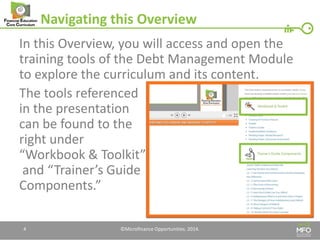
In this Overview, you will access and open the training tools of the Debt Management Module to explore the curriculum and its content. 
The tools referenced in the presentation can be found to the right under “Workbook & Toolkit” and “Trainer’s Guide Components.” 
4 
©Microfinance Opportunities. 2014.
Objectives 
By the end of this overview on the Debt Management Module, you will have: 
•Explored the importance of debt management 
•Reviewed current and desired behaviors of consumers regarding debt management 
•Examined the attitudes, knowledge, skills, and self- efficacy consumers will acquire through participating in debt management learning sessions 
•Considered the unique perspective in your community and target population to most successfully deploy the module 
•Reviewed important methodological considerations for delivery of the Debt Management Module 
5 
©Microfinance Opportunities. 2014.
Reflect 
6 
Do you consider debt management a “core” or fundamental money management topic? Why or why not? 
©Microfinance Opportunities. 2014.
Debt Management: Handle with Care – Introduction
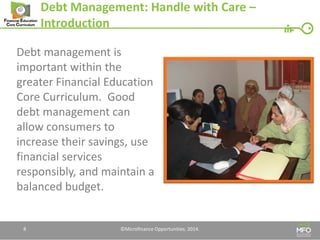
Debt Management: Handle with Care – Introduction 
Debt management is important within the greater Financial Education Core Curriculum. Good debt management can allow consumers to increase their savings, use financial services responsibly, and maintain a balanced budget. 
8 
©Microfinance Opportunities. 2014.
Consumer Behavior & Behavior Change
Debt Management and Financial Education 
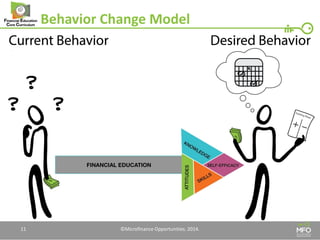
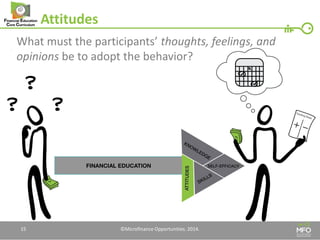
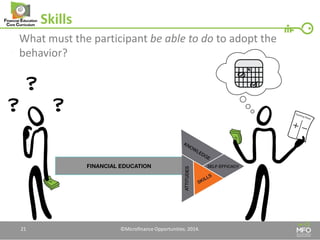
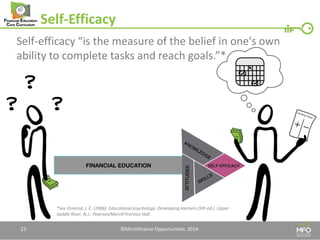
MFO’s definition of financial education aims to change consumers’ behavior through addressing attitudes, knowledge, skills, and self-efficacy. In this section, you will use each tool from the Debt Management Module. This will allow you to see how each of these aspects is addressed during a participant’s learning journey. 
10 
©Microfinance Opportunities. 2014.
Behavior Change Model 
©Microfinance Opportunities. 2014. 
11
Reflect 
12 
What are common financial behaviors in relation to debt management that you see in the communities where you work? 
©Microfinance Opportunities. 2014.
Market Research and Consumer Behavior 
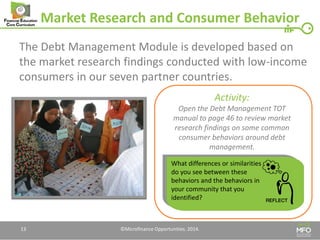
The Debt Management Module is developed based on the market research findings conducted with low-income consumers in our seven partner countries. 
13 
What differences or similarities do you see between these behaviors and the behaviors in your community that you identified? 
Activity: Open the Debt Management TOT manual to page 46 to review market research findings on some common consumer behaviors around debt management. 
©Microfinance Opportunities. 2014.
Debt Management: Changing Consumer Behavior 
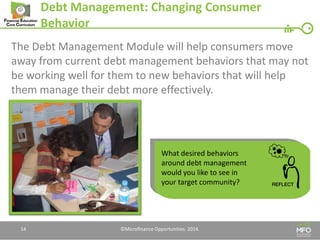
The Debt Management Module will help consumers move away from current debt management behaviors that may not be working well for them to new behaviors that will help them manage their debt more effectively. 
14 
What desired behaviors around debt management would you like to see in your target community? 
©Microfinance Opportunities. 2014.
Attitudes 
What must the participants’ thoughts, feelings, and opinions be to adopt the behavior? 
15 
©Microfinance Opportunities. 2014.
Attitudes 
Attitudes about money are based on what we have seen, heard, and experienced in the past. We build our behaviors on them. However, some common beliefs about money are not accurate and they hold us back unnecessarily. For example, many of us believe that we cannot manage money well because we are not good at math. 
16 
What attitude do you think the mother has about borrowing based on her reaction to her daughter’s suggestion to buy a refrigerator? 
Activity: Each module of the FECC is accompanied by a video. The Debt Management video was produced in Colombia. It shows a real-life situation in which a family deals with a debt management challenge. 
Click here to watch. 
©Microfinance Opportunities. 2014.
Attitudes 
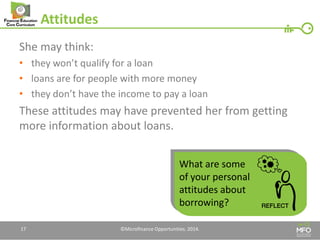
She may think: 
•they won’t qualify for a loan 
•loans are for people with more money 
•they don’t have the income to pay a loan 
These attitudes may have prevented her from getting more information about loans. 
17 
©Microfinance Opportunities. 2014. 
What are some of your personal attitudes about borrowing?
Attitudes 
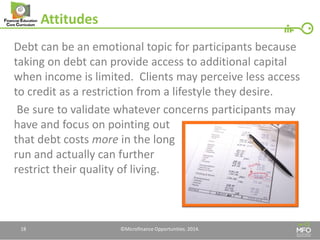
Debt can be an emotional topic for participants because taking on debt can provide access to additional capital when income is limited. Clients may perceive less access to credit as a restriction from a lifestyle they desire. 
Be sure to validate whatever concerns participants may have and focus on pointing out that debt costs more in the long run and actually can further restrict their quality of living. 
©Microfinance Opportunities. 2014. 
18
Knowledge 
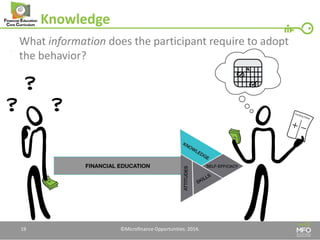
What information does the participant require to adopt the behavior? 
19 
©Microfinance Opportunities. 2014.
Knowledge 
20 
What knowledge would you expect a participant to acquire by participating in the Debt Management Module learning sessions? 
Activity: What key ideas or knowledge do you think your participants will need related to debt management? Jot down a few sentences. 
Take a look at the Learning Sessions at a Glance document. Compare the session titles and purposes with the list you made. 
©Microfinance Opportunities. 2014. 
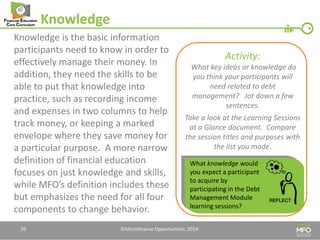
Knowledge is the basic information participants need to know in order to effectively manage their money. In addition, they need the skills to be able to put that knowledge into practice, such as recording income and expenses in two columns to help track money, or keeping a marked envelope where they save money for a particular purpose. A more narrow definition of financial education focuses on just knowledge and skills, while MFO’s definition includes these but emphasizes the need for all four components to change behavior.
Skills 
What must the participant be able to do to adopt the behavior? 
21 
©Microfinance Opportunities. 2014.
Skills 
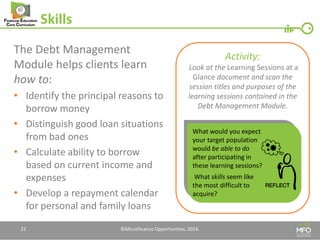
The Debt Management Module helps clients learn how to: 
•Identify the principal reasons to borrow money 
•Distinguish good loan situations from bad ones 
•Calculate ability to borrow based on current income and expenses 
•Develop a repayment calendar for personal and family loans 
22 
What would you expect your target population would be able to do after participating in these learning sessions? 
What skills seem like the most difficult to acquire? 
Activity: Look at the Learning Sessions at a Glance document and scan the session titles and purposes of the learning sessions contained in the Debt Management Module. 
©Microfinance Opportunities. 2014.
Self-Efficacy 
23 
©Microfinance Opportunities. 2014. 
Self-efficacy “is the measure of the belief in one's own ability to complete tasks and reach goals.”* 
*See Ormrod, J. E. (2006). Educational psychology: Developing learners (5th ed.). Upper Saddle River, N.J.: Pearson/Merrill Prentice Hall.
Self-Efficacy 
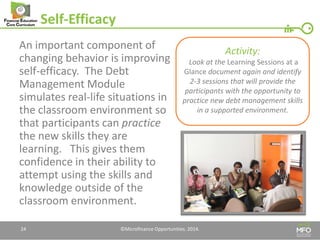
An important component of changing behavior is improving self-efficacy. The Debt Management Module simulates real-life situations in the classroom environment so that participants can practice the new skills they are learning. This gives them confidence in their ability to attempt using the skills and knowledge outside of the classroom environment. 
24 
©Microfinance Opportunities. 2014. 
Activity: Look at the Learning Sessions at a Glance document again and identify 2-3 sessions that will provide the participants with the opportunity to practice new debt management skills in a supported environment.
Delivery of the Debt Management Module
Methodology: ALPPs 
Open up the Trainer’s Guide to the Table of Contents on page VII. Choose a session that interests you and read through it. 
The curriculum was designed based on Adult Learning Principles and Practices (ALPPs). What ALPPs do you see integrated in the learning session you selected? 
•Respect 
•Affirmation 
•Relevance 
•Dialogue 
•Engagement 
26 
©Microfinance Opportunities. 2014.
Methodology: Activities 
The Core Curriculum was designed to be engaging and interactive. In the learning session you selected, what types of activities do you see? 
•Paired activity 
•Group discussion 
•Game 
•Story 
•Presentation 
•Role-play 
•Skit 
27 
©Microfinance Opportunities. 2014.
How to Use the Video 
Videos are a great way to spark a group discussion. Some questions you can ask participants related to the Debt Management Video are: 
•What challenge is the family in this video facing? 
•How did the family get more information about borrowing? 
•What did the family do well? 
•What would you advise them about budgeting? 
More guidance about how to incorporate videos into learning sessions is available in the Orientation module. 
28 
©Microfinance Opportunities. 2014.
Wrap-Up
Objectives Revisited 
Through the Debt Management Overview, you have: 
Explored the importance of debt management 
Reviewed current and desired behaviors of consumers regarding debt management 
Examined the attitudes, knowledge, skills, and self-efficacy consumers will acquire through participating in debt management learning sessions 
Considered the unique perspective in your community and target population to most successfully deploy the module 
Reviewed important methodological considerations for delivery of the Debt Management Module 
What other questions do you have about the content or use of the Debt Management Module? 
30 
©Microfinance Opportunities. 2014.
Wrap-Up 
Now that you’re ready to use the training tools of the Debt Management Module, be sure to stay connected with our global network of providers. Let us know how you’re doing so we can add your program and numbers to our roster! Click on the impact reporting document to report back on how many clients you’re reaching. 
We can be reached at info@mfopps.org. 
31 
©Microfinance Opportunities. 2014.
Microfinance Opportunities: 
E: info@mfopps.org 
T: 202-721-0050 
F: 202-721-0010 
W: microfinanceopportunities.org

Debt Management Handle with Care

  • 1.
  • 2.
    “When you borrowmoney, you enter the world of debt. It has rules, players and strategies. One of the best things you can do for yourself is to learn how to use debt well.” -Debt Management Module Content Note 2 ©Microfinance Opportunities. 2014.
  • 3.
    Online Orientation Thisonline Debt Management Overview guides users in the use of the Debt Management: Handle with Care module of the Financial Education Core Curriculum (FECC). It is recommended that you participate in the online Orientation prior to viewing this Overview so that you are familiar with the tools and background of the FECC. 3 ©Microfinance Opportunities. 2014.
  • 4.
    Navigating this Overview In this Overview, you will access and open the training tools of the Debt Management Module to explore the curriculum and its content. The tools referenced in the presentation can be found to the right under “Workbook & Toolkit” and “Trainer’s Guide Components.” 4 ©Microfinance Opportunities. 2014.
  • 5.
    Objectives By theend of this overview on the Debt Management Module, you will have: •Explored the importance of debt management •Reviewed current and desired behaviors of consumers regarding debt management •Examined the attitudes, knowledge, skills, and self- efficacy consumers will acquire through participating in debt management learning sessions •Considered the unique perspective in your community and target population to most successfully deploy the module •Reviewed important methodological considerations for delivery of the Debt Management Module 5 ©Microfinance Opportunities. 2014.
  • 6.
    Reflect 6 Doyou consider debt management a “core” or fundamental money management topic? Why or why not? ©Microfinance Opportunities. 2014.
  • 7.
    Debt Management: Handlewith Care – Introduction
  • 8.
    Debt Management: Handlewith Care – Introduction Debt management is important within the greater Financial Education Core Curriculum. Good debt management can allow consumers to increase their savings, use financial services responsibly, and maintain a balanced budget. 8 ©Microfinance Opportunities. 2014.
  • 9.
    Consumer Behavior &Behavior Change
  • 10.
    Debt Management andFinancial Education MFO’s definition of financial education aims to change consumers’ behavior through addressing attitudes, knowledge, skills, and self-efficacy. In this section, you will use each tool from the Debt Management Module. This will allow you to see how each of these aspects is addressed during a participant’s learning journey. 10 ©Microfinance Opportunities. 2014.
  • 11.
    Behavior Change Model ©Microfinance Opportunities. 2014. 11
  • 12.
    Reflect 12 Whatare common financial behaviors in relation to debt management that you see in the communities where you work? ©Microfinance Opportunities. 2014.
  • 13.
    Market Research andConsumer Behavior The Debt Management Module is developed based on the market research findings conducted with low-income consumers in our seven partner countries. 13 What differences or similarities do you see between these behaviors and the behaviors in your community that you identified? Activity: Open the Debt Management TOT manual to page 46 to review market research findings on some common consumer behaviors around debt management. ©Microfinance Opportunities. 2014.
  • 14.
    Debt Management: ChangingConsumer Behavior The Debt Management Module will help consumers move away from current debt management behaviors that may not be working well for them to new behaviors that will help them manage their debt more effectively. 14 What desired behaviors around debt management would you like to see in your target community? ©Microfinance Opportunities. 2014.
  • 15.
    Attitudes What mustthe participants’ thoughts, feelings, and opinions be to adopt the behavior? 15 ©Microfinance Opportunities. 2014.
  • 16.
    Attitudes Attitudes aboutmoney are based on what we have seen, heard, and experienced in the past. We build our behaviors on them. However, some common beliefs about money are not accurate and they hold us back unnecessarily. For example, many of us believe that we cannot manage money well because we are not good at math. 16 What attitude do you think the mother has about borrowing based on her reaction to her daughter’s suggestion to buy a refrigerator? Activity: Each module of the FECC is accompanied by a video. The Debt Management video was produced in Colombia. It shows a real-life situation in which a family deals with a debt management challenge. Click here to watch. ©Microfinance Opportunities. 2014.
  • 17.
    Attitudes She maythink: •they won’t qualify for a loan •loans are for people with more money •they don’t have the income to pay a loan These attitudes may have prevented her from getting more information about loans. 17 ©Microfinance Opportunities. 2014. What are some of your personal attitudes about borrowing?
  • 18.
    Attitudes Debt canbe an emotional topic for participants because taking on debt can provide access to additional capital when income is limited. Clients may perceive less access to credit as a restriction from a lifestyle they desire. Be sure to validate whatever concerns participants may have and focus on pointing out that debt costs more in the long run and actually can further restrict their quality of living. ©Microfinance Opportunities. 2014. 18
  • 19.
    Knowledge What informationdoes the participant require to adopt the behavior? 19 ©Microfinance Opportunities. 2014.
  • 20.
    Knowledge 20 Whatknowledge would you expect a participant to acquire by participating in the Debt Management Module learning sessions? Activity: What key ideas or knowledge do you think your participants will need related to debt management? Jot down a few sentences. Take a look at the Learning Sessions at a Glance document. Compare the session titles and purposes with the list you made. ©Microfinance Opportunities. 2014. Knowledge is the basic information participants need to know in order to effectively manage their money. In addition, they need the skills to be able to put that knowledge into practice, such as recording income and expenses in two columns to help track money, or keeping a marked envelope where they save money for a particular purpose. A more narrow definition of financial education focuses on just knowledge and skills, while MFO’s definition includes these but emphasizes the need for all four components to change behavior.
  • 21.
    Skills What mustthe participant be able to do to adopt the behavior? 21 ©Microfinance Opportunities. 2014.
  • 22.
    Skills The DebtManagement Module helps clients learn how to: •Identify the principal reasons to borrow money •Distinguish good loan situations from bad ones •Calculate ability to borrow based on current income and expenses •Develop a repayment calendar for personal and family loans 22 What would you expect your target population would be able to do after participating in these learning sessions? What skills seem like the most difficult to acquire? Activity: Look at the Learning Sessions at a Glance document and scan the session titles and purposes of the learning sessions contained in the Debt Management Module. ©Microfinance Opportunities. 2014.
  • 23.
    Self-Efficacy 23 ©MicrofinanceOpportunities. 2014. Self-efficacy “is the measure of the belief in one's own ability to complete tasks and reach goals.”* *See Ormrod, J. E. (2006). Educational psychology: Developing learners (5th ed.). Upper Saddle River, N.J.: Pearson/Merrill Prentice Hall.
  • 24.
    Self-Efficacy An importantcomponent of changing behavior is improving self-efficacy. The Debt Management Module simulates real-life situations in the classroom environment so that participants can practice the new skills they are learning. This gives them confidence in their ability to attempt using the skills and knowledge outside of the classroom environment. 24 ©Microfinance Opportunities. 2014. Activity: Look at the Learning Sessions at a Glance document again and identify 2-3 sessions that will provide the participants with the opportunity to practice new debt management skills in a supported environment.
  • 25.
    Delivery of theDebt Management Module
  • 26.
    Methodology: ALPPs Openup the Trainer’s Guide to the Table of Contents on page VII. Choose a session that interests you and read through it. The curriculum was designed based on Adult Learning Principles and Practices (ALPPs). What ALPPs do you see integrated in the learning session you selected? •Respect •Affirmation •Relevance •Dialogue •Engagement 26 ©Microfinance Opportunities. 2014.
  • 27.
    Methodology: Activities TheCore Curriculum was designed to be engaging and interactive. In the learning session you selected, what types of activities do you see? •Paired activity •Group discussion •Game •Story •Presentation •Role-play •Skit 27 ©Microfinance Opportunities. 2014.
  • 28.
    How to Usethe Video Videos are a great way to spark a group discussion. Some questions you can ask participants related to the Debt Management Video are: •What challenge is the family in this video facing? •How did the family get more information about borrowing? •What did the family do well? •What would you advise them about budgeting? More guidance about how to incorporate videos into learning sessions is available in the Orientation module. 28 ©Microfinance Opportunities. 2014.
  • 29.
  • 30.
    Objectives Revisited Throughthe Debt Management Overview, you have: Explored the importance of debt management Reviewed current and desired behaviors of consumers regarding debt management Examined the attitudes, knowledge, skills, and self-efficacy consumers will acquire through participating in debt management learning sessions Considered the unique perspective in your community and target population to most successfully deploy the module Reviewed important methodological considerations for delivery of the Debt Management Module What other questions do you have about the content or use of the Debt Management Module? 30 ©Microfinance Opportunities. 2014.
  • 31.
    Wrap-Up Now thatyou’re ready to use the training tools of the Debt Management Module, be sure to stay connected with our global network of providers. Let us know how you’re doing so we can add your program and numbers to our roster! Click on the impact reporting document to report back on how many clients you’re reaching. We can be reached at info@mfopps.org. 31 ©Microfinance Opportunities. 2014.
  • 32.
    Microfinance Opportunities: E:info@mfopps.org T: 202-721-0050 F: 202-721-0010 W: microfinanceopportunities.org