1
Target Market
Framed by:
Mr.Moumni Souhail
Realised by :
Kaoutar Ihssane
Mariem Oubair
 Introduction
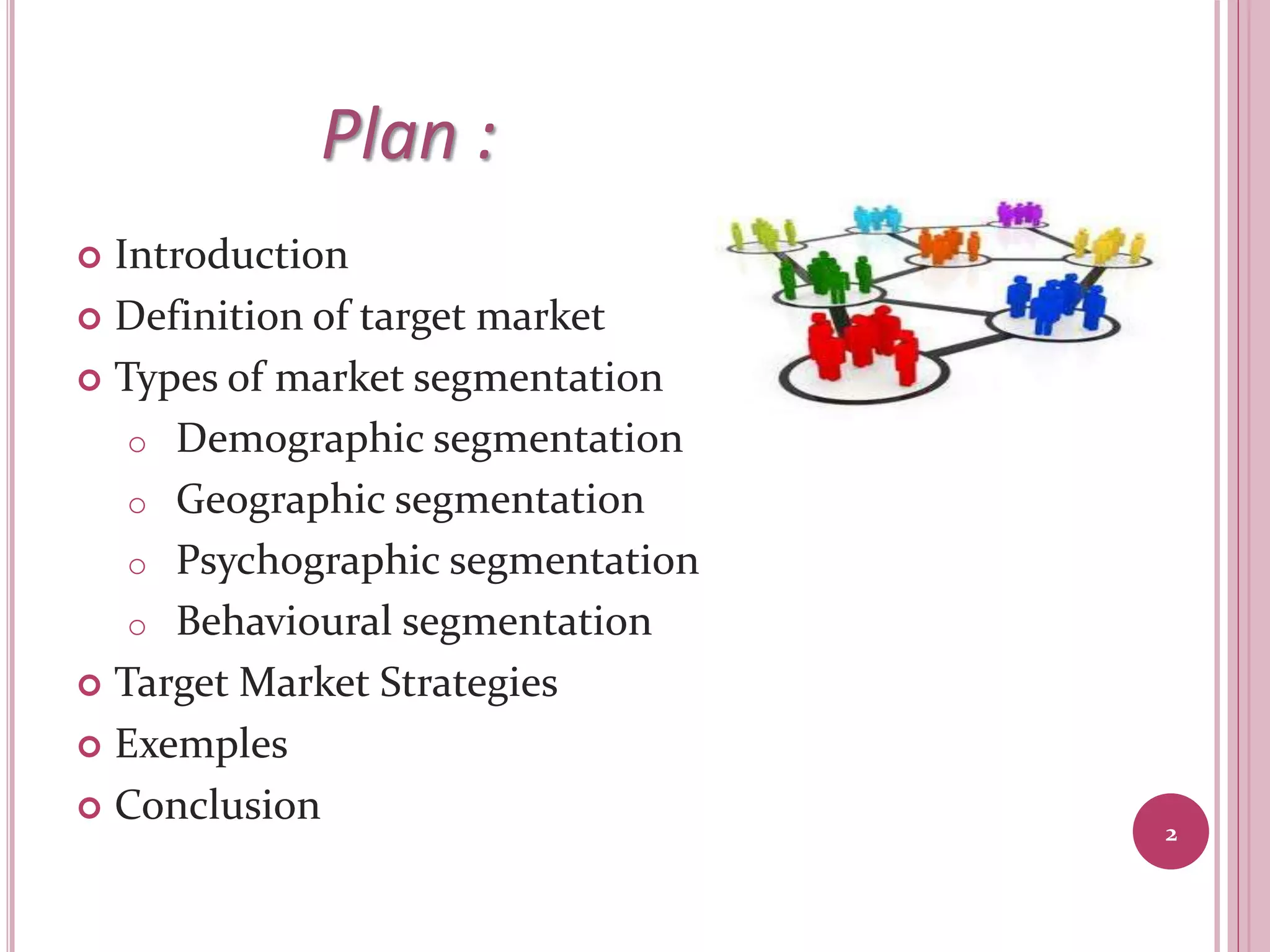
 Definition of target market
 Types of market segmentation
o Demographic segmentation
o Geographic segmentation
o Psychographic segmentation
o Behavioural segmentation
 Target Market Strategies
 Exemples
 Conclusion
2
Plan :
3
Introduction
 Definition :
Target market is a business term
meaning the market segment to which a
particular good or service is marketed. It is
mainly defined by age, gender, geography,
socio-economic grouping, or any other
combination of demographics.
4
 Target market is defined in terms of :
o Demographic segmentation
o Geographic segmentation
o Psychographic segmentation
o Behavioural segmentation
5
 Demographic segmentation :
The demographic segmentation divides customers into
segments based on demographic values such as age, gender,
family size, family life cycle, occupation, education, religion,
generation, social class and nationality.
6
a. Age and life-cycle segmentation :
The consumer’s needs and wants change with
age. Therefore some companies use age and life-cycle
segmentation, where age and the life-cycle determine
the marketing approach.
7
b. Gender segmentation :
Gender segmentation is used to differentiate the
needs and wants between men and women due to
the fact that men and women have different
attitudes toward a product.
8
c. Income segmentation :
Income segmentation divides the market into
different income groups. It is used in automobiles,
clothing, cosmetics, and travel.
9
d. Generation segmentation :
Each generation is influenced by the times in
which they grow up for example the music, the
movies, politics and other significant events
characteristic of that period.
10
e. Social Class segmentation
Social class segmentation divides the customers
according to their preferences in cars, clothing, home
furnishings, leisure activities, reading habits.
11
 Geographic segmentation
The geographic segmentation divides
customers into segments based on geographical
areas such as nations, states, regions, countries,
cities.
12
Psychographic segmentation
The psychological variables derive from two
principal types of customer: personality profiles and
lifestyle profiles.
13
Behavioural segmentation
Behavioural segmentation is based on the
customers’ attitude toward, use of, or response
to a product.
14
Technographic Segmentation:
This type of segmentation differentiates people
based on technology they use. With technology
becoming such an ingrained part of our lives,
technographic segmentation becomes all the more
important.
15
 Analyzing our Product and Service:
Write out a list of each feature of your product or
service. Next to each feature, list the benefits they
provide (and the benefits of those benefits).
16
 Decisions involved in targeting, including strategy :
 which segments to targeting.
 how many products to offer.
 which products to offer in which segments.
17
 Targeting strategy decisions are influenced by:
 Market maturity.
 Diversity of buyers' needs and preferences.
 Strength of the competition.
 The volume of sales required for profitability.
18
1. Concentrated strategy (Single-segment strategy).
One market segment (not the entire market). A single-
segment approach often is the strategy of choice for
smaller companies with limited resources.
19
Target Market Strategies
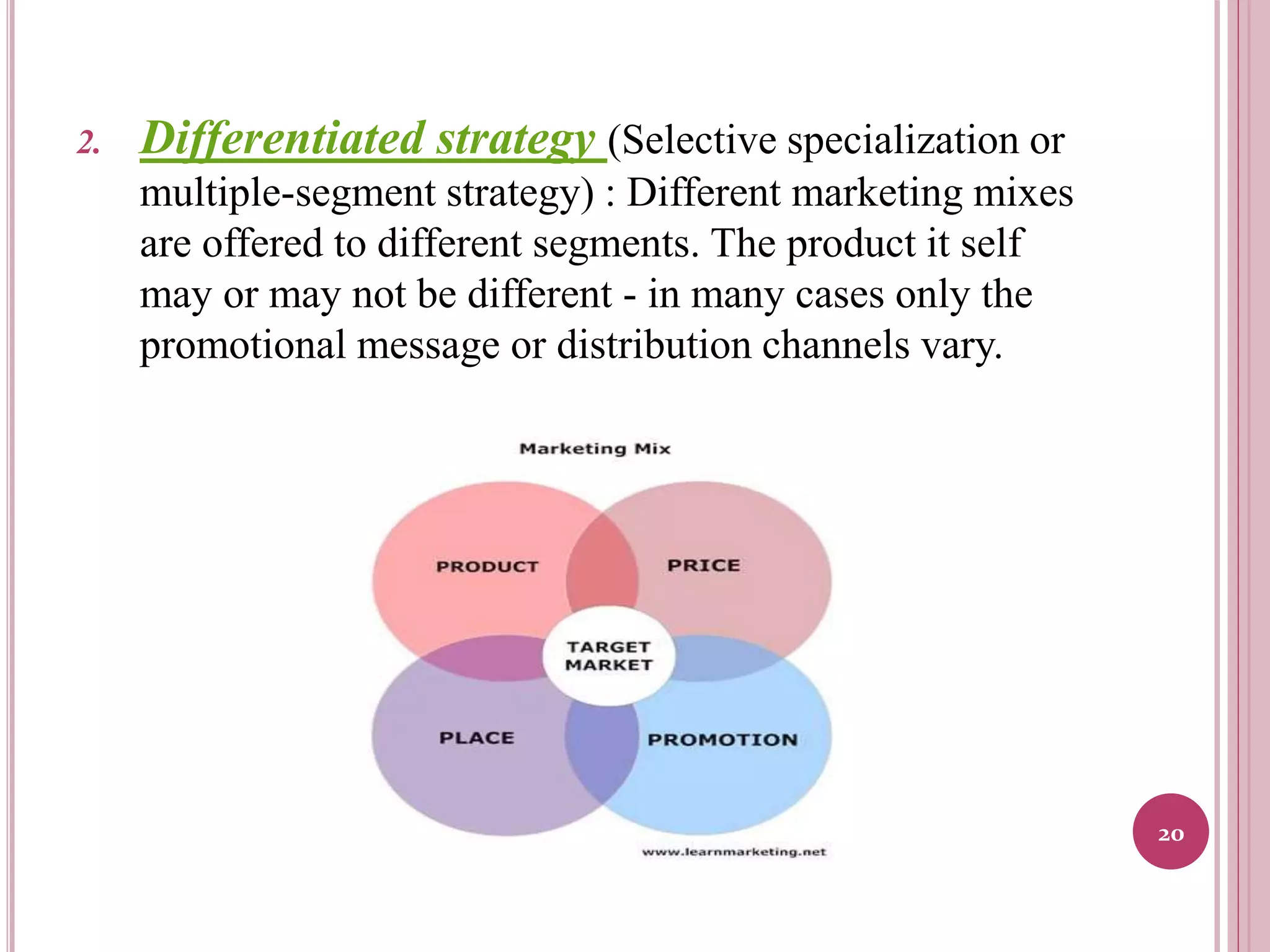
2. Differentiated strategy (Selective specialization or
multiple-segment strategy) : Different marketing mixes
are offered to different segments. The product it self
may or may not be different - in many cases only the
promotional message or distribution channels vary.
20
 Product specialization. The firm specializes in a
particular product and tailors it to different market
segments.
21
 Exemples
 Desert Coolers : If your company is selling desert
coolers, it is obvious that the target market will be
extremely in hot regions of the world and not the
cold ones.
22
 Baby Products:
Marketers selling baby products have to segment
their market in terms of age group, but they also have
to consider pyschographic segmentation, because
sales will depend on the lifestyle of the parents. If the
parents have a lavish lifestyle, they will agree to
spend money on expensive baby products.
23
 Cosmetics:
Cosmetics are gender-based, exclusively for men or
women, thus, segmentation based on gender will
have to be done. However, just dividing the market
on the basis of gender is not enough. Lifestyles of
men and women come into play, because cosmetics
come in all ranges and thus depending on the cost of
the product, it will require psychographic and
behavioral segmentation.
24
o Results of wrong targeting strategy
o Ineffective augmentation and targeting led
to wrong product offers,
o inappropriate marketing appeals wrong
pricing
No firm can offer single product to
satisfy all the segment.
25
Conclusion
26
27

Target market

  • 1.
    1 Target Market Framed by: Mr.MoumniSouhail Realised by : Kaoutar Ihssane Mariem Oubair
  • 2.
     Introduction  Definitionof target market  Types of market segmentation o Demographic segmentation o Geographic segmentation o Psychographic segmentation o Behavioural segmentation  Target Market Strategies  Exemples  Conclusion 2 Plan :
  • 3.
  • 4.
     Definition : Targetmarket is a business term meaning the market segment to which a particular good or service is marketed. It is mainly defined by age, gender, geography, socio-economic grouping, or any other combination of demographics. 4
  • 5.
     Target marketis defined in terms of : o Demographic segmentation o Geographic segmentation o Psychographic segmentation o Behavioural segmentation 5
  • 6.
     Demographic segmentation: The demographic segmentation divides customers into segments based on demographic values such as age, gender, family size, family life cycle, occupation, education, religion, generation, social class and nationality. 6
  • 7.
    a. Age andlife-cycle segmentation : The consumer’s needs and wants change with age. Therefore some companies use age and life-cycle segmentation, where age and the life-cycle determine the marketing approach. 7
  • 8.
    b. Gender segmentation: Gender segmentation is used to differentiate the needs and wants between men and women due to the fact that men and women have different attitudes toward a product. 8
  • 9.
    c. Income segmentation: Income segmentation divides the market into different income groups. It is used in automobiles, clothing, cosmetics, and travel. 9
  • 10.
    d. Generation segmentation: Each generation is influenced by the times in which they grow up for example the music, the movies, politics and other significant events characteristic of that period. 10
  • 11.
    e. Social Classsegmentation Social class segmentation divides the customers according to their preferences in cars, clothing, home furnishings, leisure activities, reading habits. 11
  • 12.
     Geographic segmentation Thegeographic segmentation divides customers into segments based on geographical areas such as nations, states, regions, countries, cities. 12
  • 13.
    Psychographic segmentation The psychologicalvariables derive from two principal types of customer: personality profiles and lifestyle profiles. 13
  • 14.
    Behavioural segmentation Behavioural segmentationis based on the customers’ attitude toward, use of, or response to a product. 14
  • 15.
    Technographic Segmentation: This typeof segmentation differentiates people based on technology they use. With technology becoming such an ingrained part of our lives, technographic segmentation becomes all the more important. 15
  • 16.
     Analyzing ourProduct and Service: Write out a list of each feature of your product or service. Next to each feature, list the benefits they provide (and the benefits of those benefits). 16
  • 17.
     Decisions involvedin targeting, including strategy :  which segments to targeting.  how many products to offer.  which products to offer in which segments. 17
  • 18.
     Targeting strategydecisions are influenced by:  Market maturity.  Diversity of buyers' needs and preferences.  Strength of the competition.  The volume of sales required for profitability. 18
  • 19.
    1. Concentrated strategy(Single-segment strategy). One market segment (not the entire market). A single- segment approach often is the strategy of choice for smaller companies with limited resources. 19 Target Market Strategies
  • 20.
    2. Differentiated strategy(Selective specialization or multiple-segment strategy) : Different marketing mixes are offered to different segments. The product it self may or may not be different - in many cases only the promotional message or distribution channels vary. 20
  • 21.
     Product specialization.The firm specializes in a particular product and tailors it to different market segments. 21
  • 22.
     Exemples  DesertCoolers : If your company is selling desert coolers, it is obvious that the target market will be extremely in hot regions of the world and not the cold ones. 22
  • 23.
     Baby Products: Marketersselling baby products have to segment their market in terms of age group, but they also have to consider pyschographic segmentation, because sales will depend on the lifestyle of the parents. If the parents have a lavish lifestyle, they will agree to spend money on expensive baby products. 23
  • 24.
     Cosmetics: Cosmetics aregender-based, exclusively for men or women, thus, segmentation based on gender will have to be done. However, just dividing the market on the basis of gender is not enough. Lifestyles of men and women come into play, because cosmetics come in all ranges and thus depending on the cost of the product, it will require psychographic and behavioral segmentation. 24
  • 25.
    o Results ofwrong targeting strategy o Ineffective augmentation and targeting led to wrong product offers, o inappropriate marketing appeals wrong pricing No firm can offer single product to satisfy all the segment. 25
  • 26.
  • 27.

Editor's Notes

  • #6 bihayveral
  • #8 An example of this is single people who have a tendency of purchasing new fashionable items due to the fact that they have no other economic obligations. This is opposed to married people, who have a large economic obligation and thereby they prioritize their economy different
  • #9 clothing, hairstyling, cosmetics and magazines.
  • #10 Many companies within the mentioned categories seek to target the high-income customers. Others seek to target the customers with a lower income in order to gain consumer loyalty and lessen the competitive pressures
  • #12 many companies design products for specific social classes.
  • #13 A company can target one or more areas. It is important to segment according to geographic, due to the fact that the purchasing behaviour of the customers are influenced on where they live, work etc.
  • #14 , interests and opinions activities
  • #17 For example, a graphic designer offers high quality design services. The resulting benefit is a professional company image. A professional image will attract more customers because they see the company as professional So ultimately , the benefit of high quality design is to gain more customers and make more money.
  • #20 Choose a product for smaller companies
  • #21 Mix marketing : the combination of the features of a product its price the way it advertised and where it is sold . To presuade people to buy the product When we talk about marketing mix we mean 4 P
  • #26 in Indian market many MNCs offered single product to the entire segment. The offer did not suit middle class as such. They suited only the premium segment. Naturally, the firms were unable to gather worthwhile volumes. As the firm did not target those segments and as they failed to make product offers that were appropriate for them, the end result was poor. For this reason firms like Reebok, Ray-ban, and Levi did not showed satisfactory resultfor quite sometime in Indian market while they were very successful in the western markets.
  • #27 . A firm that is seeking to enter a market and grow should first target the most attractive segment , because Target marketing can be the key to a small business’s success.