Parul Institute of Engineering & Technology
Subject Code : 150001
Name Of Subject : MANAGEMENT- 2
Name of Unit : INTRODUCTION TO MARKETING
Topic : FOUR P’s of Marketing,Concepts of Marketing
Name of Students: Agrawal Swapnil J.
• INTRODUCTION
– What is Marketing?
– Marketing Management
• 4 P’s of Marketing
– Introduction to Marketing Mix
– Product
– Price
– Place
– Promotion
Sub: MANAGEMENT-2 Topic: Marketing Function
CONTENTS
CONTENTS
• Different Concept of Marketing
– Introduction
– The Marketing Concept
– Core Marketing Concept
– Management Orientation
• Production Concept
• Product Concept
• Selling Concept
• Marketing Concept
• Holistic Concept
• Societal Concept
Sub: MANAGEMENT-2 Topic: Marketing Function
What is Marketing?
• Marketing is managing profitable customer
relationships
– Attracting new customers
– Retaining and growing current customers
• ā€œMarketingā€ is NOT synonymous with ā€œsalesā€
or ā€œadvertisingā€
Sub: MANAGEMENT-2 Topic: Marketing Function
Marketing Management
• Marketing management is ā€œthe art and
science of choosing target markets and
building profitable relationships with them.ā€
– Creating, delivering and communicating
superior customer value is key.
Sub: MANAGEMENT-2 Topic: Marketing Function
Marketing Management
• Customer Management:
– Marketers select customers that can be
served well and profitably.
• Demand Management:
– Marketers must deal with different demand
states ranging from no demand to too much
demand.
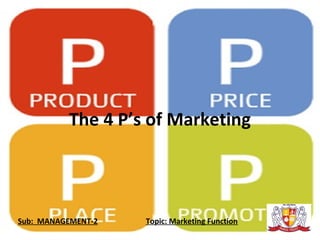
The 4 P’s of Marketing
Sub: MANAGEMENT-2 Topic: Marketing Function
The 4 P’s of Marketing
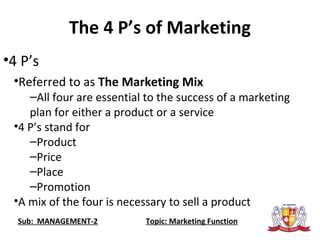
•Referred to as The Marketing Mix
–All four are essential to the success of a marketing
plan for either a product or a service
•4 P’s stand for
–Product
–Price
–Place
–Promotion
•A mix of the four is necessary to sell a product
•4 P’s
Sub: MANAGEMENT-2 Topic: Marketing Function
The Marketing Mix
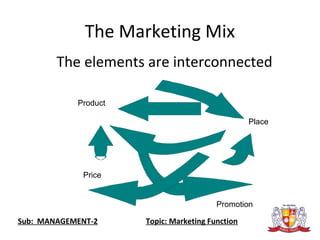
The elements are interconnected
Product
Place
Price
Promotion
Sub: MANAGEMENT-2 Topic: Marketing Function
The Marketing Mix
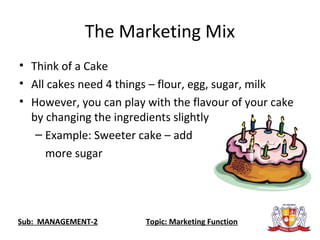
• Think of a Cake
• All cakes need 4 things – flour, egg, sugar, milk
• However, you can play with the flavour of your cake
by changing the ingredients slightly
– Example: Sweeter cake – add
more sugar
Sub: MANAGEMENT-2 Topic: Marketing Function
The Marketing Mix
• The same thing is true with the marketing mix
• You can very the type of message you are sending
out about your product/service by mixing different
elements of each of the P’s
• Example: Want to be seen as a luxury item – make
the price high, have limited selection
Sub: MANAGEMENT-2 Topic: Marketing Function
Product
• Refers to the benefits of buying a
product
– What need does the service/product fulfill
– Quality
• What will the quality of your service/product
be?
• Some people really want quality vs. others that
don’t really matter
– Features
• How will your product/service differ from the
competition
• What will you do differently?
Sub: MANAGEMENT-2 Topic: Marketing Function
Product
– Packaging – if your selling a product what image
will the packaging communicate?
• If a service – how will the appearance of your
operation communicate an image about your
business
– Range of Products – what complimentary
products may you offer
• If service: Will you offer other products with
your service
• E.g. Think of range of products that apple has
Sub: MANAGEMENT-2 Topic: Marketing Function
Price
• Marketing is responsible for establishing the price of
their service/product
• Must consider the costs of all the inputs (materials,
labour, etc)
• Mark-up Price – How much profit do you want to
make on every product/customer
• Example: Selling Cupcakes
– Every cupcake uses $1 of materials and labour
roughly costs $0.25 to make one muffin
– You must charge at least $1.25 to break-even
Sub: MANAGEMENT-2 Topic: Marketing Function
Price
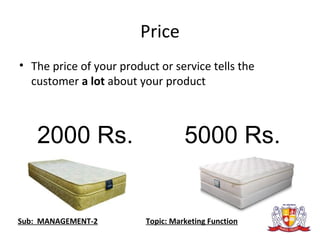
• The price of your product or service tells the
customer a lot about your product
2000 Rs. 5000 Rs.
Sub: MANAGEMENT-2 Topic: Marketing Function
Price
• Different Pricing Strategies
– Competition – basing your prices on those of the
competition
– Penetration – making your price low while new
just to get some business
– Bundle – putting the product/service with
another item and bundling the prices
– Psychological – making the price say something
about the quality of your product
Sub: MANAGEMENT-2 Topic: Marketing Function
Place
• Simply refers to how & where you are going to sell
the product to the consumer
• Direct Distribution – selling your product directly
to the consumer
– Brick & Mortar vs. Virtual Store
• Indirect Distribution – sold through a 3rd
party
– What retailers are the best for reaching your
Target Market?
– Example: Selling protein powder – where do I sell?
Sub: MANAGEMENT-2 Topic: Marketing Function
Place
• For a service : where are you going to locate in
order to best reach your target market
• You want to be in an area that
– your target market frequents
– Says something about your business
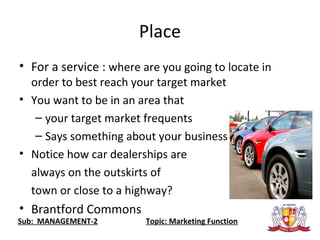
• Notice how car dealerships are
always on the outskirts of
town or close to a highway?
• Brantford Commons
Sub: MANAGEMENT-2 Topic: Marketing Function
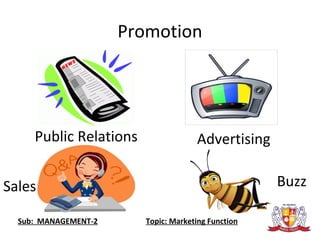
Promotion
• A successful product or service means nothing unless
the benefit of that product/service can be
communicated to the Target Market
• There are many ways to get the ā€œword outā€
• How many can we think of...
Sub: MANAGEMENT-2 Topic: Marketing Function
Promotion
BuzzSales
AdvertisingPublic Relations
Sub: MANAGEMENT-2 Topic: Marketing Function
Different Concept of Marketing
The marketing concept has suffered in two
ways:
• First, it has been established as optimal
management philosophy when it is not necessarily so in
all instances
• Second, we can see many examples of poor
marketing practice that have been adopted in the
name of the marketing concept.
Sub: MANAGEMENT-2 Topic: Marketing Function
Different Concept of Marketing
The marketing concept
• Customer focus
• Profits
• Integration of organizational efforts.
Sub: MANAGEMENT-2 Topic: Marketing Function
Different Concept of Marketing
–Customer orientation
• Satisfying its customers at a profit…
• Determining the needs and wants of target
markets…
• Discovering the wants of a target audience and
then creating the goods and services to satisfy
them…
Sub: MANAGEMENT-2 Topic: Marketing Function
• Goods
• Services
• Experiences
• Events
• Persons
• Places
• Properties
• Organizations
• Information
• Ideas
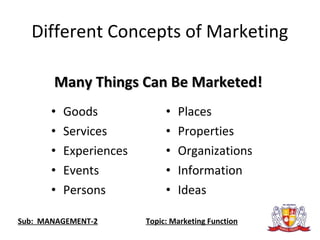
Many Things Can Be Marketed!Many Things Can Be Marketed!
Different Concepts of Marketing
Sub: MANAGEMENT-2 Topic: Marketing Function
Different Marketing Concept
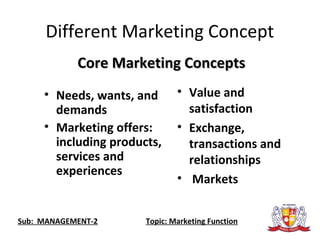
• Needs, wants, and
demands
• Marketing offers:
including products,
services and
experiences
• Value and
satisfaction
• Exchange,
transactions and
relationships
• Markets
Core Marketing ConceptsCore Marketing Concepts
Sub: MANAGEMENT-2 Topic: Marketing Function
Different Marketing Concept
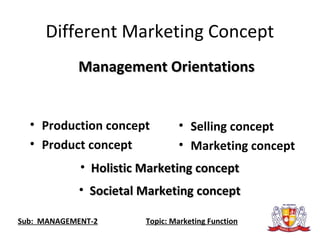
• Production concept
• Product concept
• Selling concept
• Marketing concept
• Holistic Marketing conceptHolistic Marketing concept
• Societal Marketing conceptSocietal Marketing concept
Management OrientationsManagement Orientations
Sub: MANAGEMENT-2 Topic: Marketing Function
•A firm focusing on a production orientation specializes
in producing as much as possible of a given product or
service.
•Thus, this signifies a firm exploiting economies of scale
until the minimum efficient scale is reached.
•A production orientation may be deployed when a
high demand for a product or service exists, coupled
with a good certainty that consumer tastes will not
rapidly alter (similar to the sales orientation).
PRODUCTION CONCEPTPRODUCTION CONCEPT
Sub: MANAGEMENT-2 Topic: Marketing Function
PRODUCT CONCEPTPRODUCT CONCEPT
•A firm employing a product orientation is chiefly
concerned with the quality of its own product.
•A firm would also assume that as long as its product
was of a high standard, people would buy and
consume the product.
Sub: MANAGEMENT-2 Topic: Marketing Function
SELLING CONCEPTSELLING CONCEPT
•A firm using a sales orientation focuses primarily on
the selling/promotion of a particular product, and not
determining new consumer desires as such.
Consequently, this entails simply selling an already
existing product, and using promotion techniques to
attain the highest sales possible.
•Such an orientation may suit scenarios in which a firm
holds dead stock, or otherwise sells a product that is in
high demand, with little likelihood of changes in
consumer tastes that would diminish demand.
Sub: MANAGEMENT-2 Topic: Marketing Function
MARKETING CONCEPTMARKETING CONCEPT
•The 'marketing orientation' is perhaps the most
common orientation used in contemporary marketing.
• It involves a firm essentially basing its marketing plans
around the marketing concept, and thus supplying
products to suit new consumer tastes.
•E.g. a firm would employ market research to gauge
consumer desires , use R&D to develop a product
attuned to the revealed information, and then utilize
promotion techniques to ensure persons know the
product exists.
Sub: MANAGEMENT-2 Topic: Marketing Function
HOLISTIC CONCEPTHOLISTIC CONCEPT
•The holistic marketing concept looks at marketing as a
complex activity and acknowledges that everything
matters in marketing - and that a broad and integrated
perspective is necessary in developing, designing and
implementing marketing programs and activities.
•The four components that characterize holistic
marketing are relationship marketing, internal
marketing, integrated marketing, and socially
responsive marketing.
Sub: MANAGEMENT-2 Topic: Marketing Function
SOCIETAL CONCEPTSOCIETAL CONCEPT
•Societal marketing emerged in the 1960s.
•The societal marketing concept deals with the needs,
wants and demands of customers: how to satisfy them
by producing superior value that should satisfy the
customers and promote the well-being of society.
•The producer should not produce products deemed
hazardous to society.
•Societal marketing developed into sustainable
marketing.
REFERENCES
Books:-
1.Management-2
Second Edition by Pearson Publication
2.Management-2
By Mahajan Publication
Web Resources:-
1.Google
2.Wikipedia
ANY QUERIES???

Four P's of Marketing

  • 1.
    Parul Institute ofEngineering & Technology Subject Code : 150001 Name Of Subject : MANAGEMENT- 2 Name of Unit : INTRODUCTION TO MARKETING Topic : FOUR P’s of Marketing,Concepts of Marketing Name of Students: Agrawal Swapnil J.
  • 2.
    • INTRODUCTION – Whatis Marketing? – Marketing Management • 4 P’s of Marketing – Introduction to Marketing Mix – Product – Price – Place – Promotion Sub: MANAGEMENT-2 Topic: Marketing Function CONTENTS
  • 3.
    CONTENTS • Different Conceptof Marketing – Introduction – The Marketing Concept – Core Marketing Concept – Management Orientation • Production Concept • Product Concept • Selling Concept • Marketing Concept • Holistic Concept • Societal Concept Sub: MANAGEMENT-2 Topic: Marketing Function
  • 4.
    What is Marketing? •Marketing is managing profitable customer relationships – Attracting new customers – Retaining and growing current customers • ā€œMarketingā€ is NOT synonymous with ā€œsalesā€ or ā€œadvertisingā€ Sub: MANAGEMENT-2 Topic: Marketing Function
  • 5.
    Marketing Management • Marketingmanagement is ā€œthe art and science of choosing target markets and building profitable relationships with them.ā€ – Creating, delivering and communicating superior customer value is key. Sub: MANAGEMENT-2 Topic: Marketing Function
  • 6.
    Marketing Management • CustomerManagement: – Marketers select customers that can be served well and profitably. • Demand Management: – Marketers must deal with different demand states ranging from no demand to too much demand.
  • 7.
    The 4 P’sof Marketing Sub: MANAGEMENT-2 Topic: Marketing Function
  • 8.
    The 4 P’sof Marketing •Referred to as The Marketing Mix –All four are essential to the success of a marketing plan for either a product or a service •4 P’s stand for –Product –Price –Place –Promotion •A mix of the four is necessary to sell a product •4 P’s Sub: MANAGEMENT-2 Topic: Marketing Function
  • 9.
    The Marketing Mix Theelements are interconnected Product Place Price Promotion Sub: MANAGEMENT-2 Topic: Marketing Function
  • 10.
    The Marketing Mix •Think of a Cake • All cakes need 4 things – flour, egg, sugar, milk • However, you can play with the flavour of your cake by changing the ingredients slightly – Example: Sweeter cake – add more sugar Sub: MANAGEMENT-2 Topic: Marketing Function
  • 11.
    The Marketing Mix •The same thing is true with the marketing mix • You can very the type of message you are sending out about your product/service by mixing different elements of each of the P’s • Example: Want to be seen as a luxury item – make the price high, have limited selection Sub: MANAGEMENT-2 Topic: Marketing Function
  • 12.
    Product • Refers tothe benefits of buying a product – What need does the service/product fulfill – Quality • What will the quality of your service/product be? • Some people really want quality vs. others that don’t really matter – Features • How will your product/service differ from the competition • What will you do differently? Sub: MANAGEMENT-2 Topic: Marketing Function
  • 13.
    Product – Packaging –if your selling a product what image will the packaging communicate? • If a service – how will the appearance of your operation communicate an image about your business – Range of Products – what complimentary products may you offer • If service: Will you offer other products with your service • E.g. Think of range of products that apple has Sub: MANAGEMENT-2 Topic: Marketing Function
  • 14.
    Price • Marketing isresponsible for establishing the price of their service/product • Must consider the costs of all the inputs (materials, labour, etc) • Mark-up Price – How much profit do you want to make on every product/customer • Example: Selling Cupcakes – Every cupcake uses $1 of materials and labour roughly costs $0.25 to make one muffin – You must charge at least $1.25 to break-even Sub: MANAGEMENT-2 Topic: Marketing Function
  • 15.
    Price • The priceof your product or service tells the customer a lot about your product 2000 Rs. 5000 Rs. Sub: MANAGEMENT-2 Topic: Marketing Function
  • 16.
    Price • Different PricingStrategies – Competition – basing your prices on those of the competition – Penetration – making your price low while new just to get some business – Bundle – putting the product/service with another item and bundling the prices – Psychological – making the price say something about the quality of your product Sub: MANAGEMENT-2 Topic: Marketing Function
  • 17.
    Place • Simply refersto how & where you are going to sell the product to the consumer • Direct Distribution – selling your product directly to the consumer – Brick & Mortar vs. Virtual Store • Indirect Distribution – sold through a 3rd party – What retailers are the best for reaching your Target Market? – Example: Selling protein powder – where do I sell? Sub: MANAGEMENT-2 Topic: Marketing Function
  • 18.
    Place • For aservice : where are you going to locate in order to best reach your target market • You want to be in an area that – your target market frequents – Says something about your business • Notice how car dealerships are always on the outskirts of town or close to a highway? • Brantford Commons Sub: MANAGEMENT-2 Topic: Marketing Function
  • 19.
    Promotion • A successfulproduct or service means nothing unless the benefit of that product/service can be communicated to the Target Market • There are many ways to get the ā€œword outā€ • How many can we think of... Sub: MANAGEMENT-2 Topic: Marketing Function
  • 20.
  • 21.
    Different Concept ofMarketing The marketing concept has suffered in two ways: • First, it has been established as optimal management philosophy when it is not necessarily so in all instances • Second, we can see many examples of poor marketing practice that have been adopted in the name of the marketing concept. Sub: MANAGEMENT-2 Topic: Marketing Function
  • 22.
    Different Concept ofMarketing The marketing concept • Customer focus • Profits • Integration of organizational efforts. Sub: MANAGEMENT-2 Topic: Marketing Function
  • 23.
    Different Concept ofMarketing –Customer orientation • Satisfying its customers at a profit… • Determining the needs and wants of target markets… • Discovering the wants of a target audience and then creating the goods and services to satisfy them… Sub: MANAGEMENT-2 Topic: Marketing Function
  • 24.
    • Goods • Services •Experiences • Events • Persons • Places • Properties • Organizations • Information • Ideas Many Things Can Be Marketed!Many Things Can Be Marketed! Different Concepts of Marketing Sub: MANAGEMENT-2 Topic: Marketing Function
  • 25.
    Different Marketing Concept •Needs, wants, and demands • Marketing offers: including products, services and experiences • Value and satisfaction • Exchange, transactions and relationships • Markets Core Marketing ConceptsCore Marketing Concepts Sub: MANAGEMENT-2 Topic: Marketing Function
  • 26.
    Different Marketing Concept •Production concept • Product concept • Selling concept • Marketing concept • Holistic Marketing conceptHolistic Marketing concept • Societal Marketing conceptSocietal Marketing concept Management OrientationsManagement Orientations Sub: MANAGEMENT-2 Topic: Marketing Function
  • 27.
    Sub: MANAGEMENT-2 Topic:Marketing Function •A firm focusing on a production orientation specializes in producing as much as possible of a given product or service. •Thus, this signifies a firm exploiting economies of scale until the minimum efficient scale is reached. •A production orientation may be deployed when a high demand for a product or service exists, coupled with a good certainty that consumer tastes will not rapidly alter (similar to the sales orientation). PRODUCTION CONCEPTPRODUCTION CONCEPT
  • 28.
    Sub: MANAGEMENT-2 Topic:Marketing Function PRODUCT CONCEPTPRODUCT CONCEPT •A firm employing a product orientation is chiefly concerned with the quality of its own product. •A firm would also assume that as long as its product was of a high standard, people would buy and consume the product.
  • 29.
    Sub: MANAGEMENT-2 Topic:Marketing Function SELLING CONCEPTSELLING CONCEPT •A firm using a sales orientation focuses primarily on the selling/promotion of a particular product, and not determining new consumer desires as such. Consequently, this entails simply selling an already existing product, and using promotion techniques to attain the highest sales possible. •Such an orientation may suit scenarios in which a firm holds dead stock, or otherwise sells a product that is in high demand, with little likelihood of changes in consumer tastes that would diminish demand.
  • 30.
    Sub: MANAGEMENT-2 Topic:Marketing Function MARKETING CONCEPTMARKETING CONCEPT •The 'marketing orientation' is perhaps the most common orientation used in contemporary marketing. • It involves a firm essentially basing its marketing plans around the marketing concept, and thus supplying products to suit new consumer tastes. •E.g. a firm would employ market research to gauge consumer desires , use R&D to develop a product attuned to the revealed information, and then utilize promotion techniques to ensure persons know the product exists.
  • 31.
    Sub: MANAGEMENT-2 Topic:Marketing Function HOLISTIC CONCEPTHOLISTIC CONCEPT •The holistic marketing concept looks at marketing as a complex activity and acknowledges that everything matters in marketing - and that a broad and integrated perspective is necessary in developing, designing and implementing marketing programs and activities. •The four components that characterize holistic marketing are relationship marketing, internal marketing, integrated marketing, and socially responsive marketing.
  • 32.
    Sub: MANAGEMENT-2 Topic:Marketing Function SOCIETAL CONCEPTSOCIETAL CONCEPT •Societal marketing emerged in the 1960s. •The societal marketing concept deals with the needs, wants and demands of customers: how to satisfy them by producing superior value that should satisfy the customers and promote the well-being of society. •The producer should not produce products deemed hazardous to society. •Societal marketing developed into sustainable marketing.
  • 33.
    REFERENCES Books:- 1.Management-2 Second Edition byPearson Publication 2.Management-2 By Mahajan Publication Web Resources:- 1.Google 2.Wikipedia
  • 34.