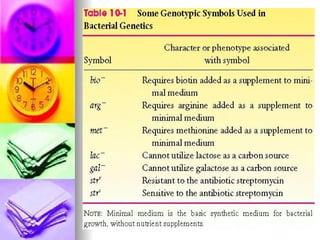
Bacterial Genetics

     A very, very, very brief
       introduction………
Introduction:
   Bacteria have four important
    advantages for "traditional types of
    genetic experiments":
       They are haploid (no masking).
       New generation is produced every 20
        minutes.
       Easy to grow in ENORMOUS
        NUMBERS.
       Individual members of these large
        populations are GENETICALLY
        IDENTICAL (or very nearly so).
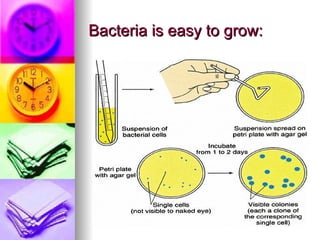
Bacteria is easy to grow:
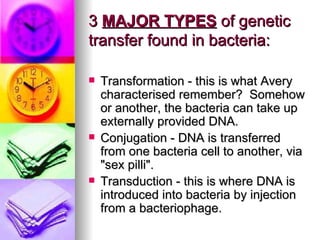
3 MAJOR TYPES of genetic
transfer found in bacteria:

   Transformation - this is what Avery
    characterised remember? Somehow
    or another, the bacteria can take up
    externally provided DNA.
   Conjugation - DNA is transferred
    from one bacteria cell to another, via
    "sex pilli".
   Transduction - this is where DNA is
    introduced into bacteria by injection
    from a bacteriophage.
Bacterial Transformation


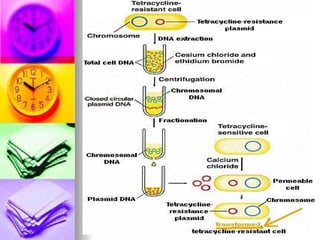
   "Transformation" is simply the
    process where bacteria manage to
    "uptake" or bring in a piece of
    external DNA (somehow or
    another). Usually, this process is
    used in the laboratory to introduce a
    small piece of PLASMID DNA into a
    bacterial cell.
   DNA is the genetic material -
    The First demonstration of
    bacterial transformation.
    Experiments done by
    Frederick Griffith (in London)
    in 1928 found there were two
    different types of the
    bacterium Streptococcus
    pneumoniae:
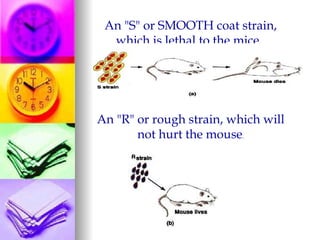
An "S" or SMOOTH coat strain,
     which is lethal to the mice.


 An "R" or rough strain, which will
        not hurt the mouse.


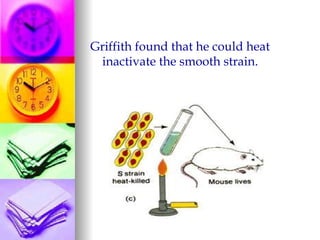
Griffith found that he could heat
 inactivate the smooth strain.


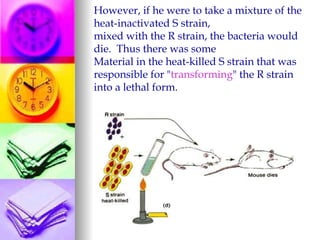
However, if he were to take a mixture of the
heat-inactivated S strain,
mixed with the R strain, the bacteria would
die.  Thus there was some
Material in the heat-killed S strain that was
responsible for "transforming" the R strain
into a lethal form.


   Griffith (and a lab co-worker) was
    killed in their laboratory in 1940
    from a German bomb. However,
    their work continued on in the U.S.,
    and in 1944, Oswald Avery, C.M.
    MacLeod, and M. McCarty carefully
    demonstrated that the ONLY
    material that was responsible for
    the transformation was DNA - thus,
    DNA was the "Genetic material" -
    however, many scientists were still
    not sure that it was REALLY DNA
    (and not proteins) that was the
    genetic material. responsible for
    "transforming" the R strain into a
    lethal form.
    McCarty,M., The Transforming
    Principle - Discovering that
    Genes are made of DNA, (New
    York: W.W.Norton & company,
    1985) - Although this book was
    written about 40 years after the
    experiments took place (1985),
    it is an excellent history of the
    research that was going on in
    the early 1940's
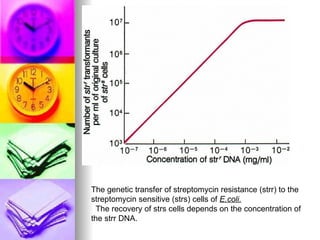
The genetic transfer of streptomycin resistance (strr) to the
streptomycin sensitive (strs) cells of E.coli.
  The recovery of strs cells depends on the concentration of
the strr DNA.
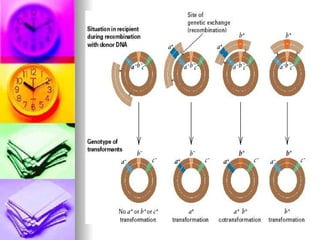
   Co-transformation is simply the
       simultaneous transformation of two
       different DNA fragments.
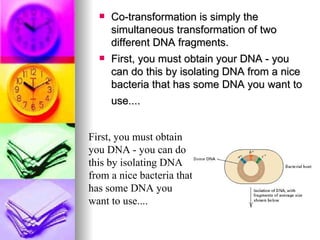
      First, you must obtain your DNA - you
       can do this by isolating DNA from a nice
       bacteria that has some DNA you want to
       use....


First, you must obtain       
you DNA - you can do 
this by isolating DNA 
from a nice bacteria that 
has some DNA you 
want to use.... 


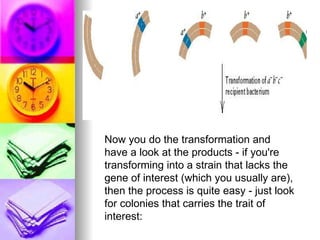
Now you do the transformation and
have a look at the products - if you're
transforming into a strain that lacks the
gene of interest (which you usually are),
then the process is quite easy - just look
for colonies that carries the trait of
interest:
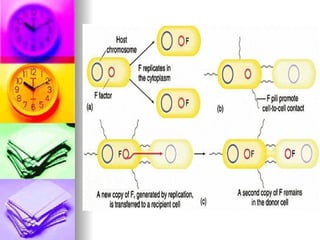
Bacterial Conjugation

   Bacterial conjugation is the
    pocess in which DNA is
    transferred from a bacterial
    donor cell to a recipient cell by
    cell-to-cell contact. It has been
    observed in many bacterial
    species and is best understood
    in E.coli, in which it was
    discovered by Joshua
    Lederberg in 1951.
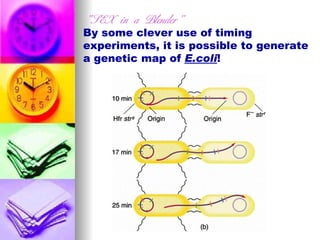
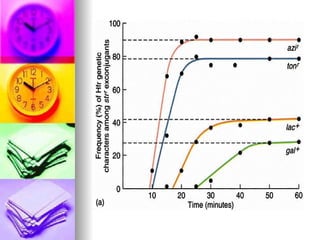
"SEX in a Blender"
By some clever use of timing
experiments, it is possible to generate
a genetic map of E.coli!                                    
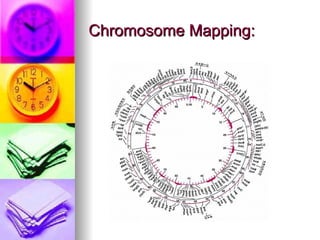
Chromosome Mapping:
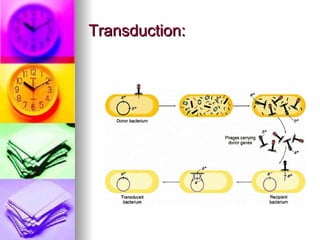
Transduction:

Module 3b bacterial genetics

  • 1.
    Bacterial Genetics A very, very, very brief introduction………
  • 2.
    Introduction:  Bacteria have four important advantages for "traditional types of genetic experiments":  They are haploid (no masking).  New generation is produced every 20 minutes.  Easy to grow in ENORMOUS NUMBERS.  Individual members of these large populations are GENETICALLY IDENTICAL (or very nearly so).
  • 3.
  • 5.
    3 MAJOR TYPESof genetic transfer found in bacteria:  Transformation - this is what Avery characterised remember? Somehow or another, the bacteria can take up externally provided DNA.  Conjugation - DNA is transferred from one bacteria cell to another, via "sex pilli".  Transduction - this is where DNA is introduced into bacteria by injection from a bacteriophage.
  • 6.
    Bacterial Transformation  "Transformation" is simply the process where bacteria manage to "uptake" or bring in a piece of external DNA (somehow or another). Usually, this process is used in the laboratory to introduce a small piece of PLASMID DNA into a bacterial cell.
  • 8.
    DNA is the genetic material - The First demonstration of bacterial transformation. Experiments done by Frederick Griffith (in London) in 1928 found there were two different types of the bacterium Streptococcus pneumoniae:
  • 9.
    An "S" orSMOOTH coat strain, which is lethal to the mice.                                                                                                   An "R" or rough strain, which will not hurt the mouse.                                                   
  • 10.
    Griffith found thathe could heat inactivate the smooth strain.                                                                  
  • 11.
    However, if hewere to take a mixture of the heat-inactivated S strain, mixed with the R strain, the bacteria would die.  Thus there was some Material in the heat-killed S strain that was responsible for "transforming" the R strain into a lethal form.                                                                                                           
  • 12.
    Griffith (and a lab co-worker) was killed in their laboratory in 1940 from a German bomb. However, their work continued on in the U.S., and in 1944, Oswald Avery, C.M. MacLeod, and M. McCarty carefully demonstrated that the ONLY material that was responsible for the transformation was DNA - thus, DNA was the "Genetic material" - however, many scientists were still not sure that it was REALLY DNA (and not proteins) that was the genetic material. responsible for "transforming" the R strain into a lethal form.
  • 13.
    McCarty,M., The Transforming Principle - Discovering that Genes are made of DNA, (New York: W.W.Norton & company, 1985) - Although this book was written about 40 years after the experiments took place (1985), it is an excellent history of the research that was going on in the early 1940's
  • 14.
    The genetic transferof streptomycin resistance (strr) to the streptomycin sensitive (strs) cells of E.coli. The recovery of strs cells depends on the concentration of the strr DNA.
  • 15.
    Co-transformation is simply the simultaneous transformation of two different DNA fragments.  First, you must obtain your DNA - you can do this by isolating DNA from a nice bacteria that has some DNA you want to use.... First, you must obtain     you DNA - you can do  this by isolating DNA  from a nice bacteria that  has some DNA you  want to use....                                                  
  • 16.
    Now you dothe transformation and have a look at the products - if you're transforming into a strain that lacks the gene of interest (which you usually are), then the process is quite easy - just look for colonies that carries the trait of interest:
  • 18.
    Bacterial Conjugation  Bacterial conjugation is the pocess in which DNA is transferred from a bacterial donor cell to a recipient cell by cell-to-cell contact. It has been observed in many bacterial species and is best understood in E.coli, in which it was discovered by Joshua Lederberg in 1951.
  • 20.
    "SEX in aBlender" By some clever use of timing experiments, it is possible to generate a genetic map of E.coli!                                    
  • 22.
  • 23.