By Dr. Sonia Goel
SGT University,
Gurugram
 Discovered in 1929 by Fridick Graffith.
 Bacterial transformation is a process of
horizontal gene transfer by which some
bacteria take up foreign genetic material
(naked DNA) from the environment.
 Mechanism :-
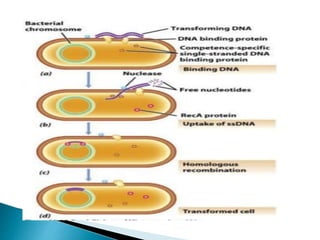
 1. Cell free transforming DNA in the
bacterium immediate environment can be
naturally released when cell die and lysis.
 2. Once DNA come in contact with
competent bacteria, linear dsDNA converted
by SsDNA and one strand is degraded.
 3. SsDNA exogonated is unstable and
degrade unless, they are integrated into
endogonate by homologus.
 Transformation is used for gene mapping.
 Genetics analysis of transformation is based on
principles that two marker gene transfer
together, of they are mean enough to be carried
on DNA fragments.
 Freq. Of co- transforamtion is inversely
proportional to the distance between the gene.
 Two type of transformation :-
 1. Natural
 2. Artificial
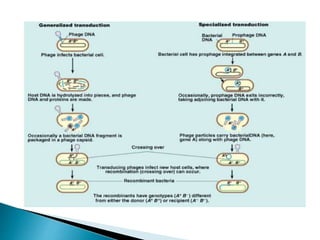
 It is a process in which bacteriophage
functions as a vector vehicle to transfer DNA
from donor bacterium to recipient bacteria.
 Discovered by :- Zinder and ledurberg in
salmonella typimurium 1951.
 It consists of Two type:-
 1. General Transduction. 2. Specialized.
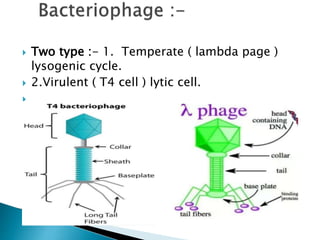
 Two type :- 1. Temperate ( lambda page )
lysogenic cycle.
 2.Virulent ( T4 cell ) lytic cell.

 Generalized :- The bacteriophage can pick up
any portion of host genome.
 Lytic cycle
 Specialized :- The bacteriophage can pick up
specific portion of host genome.
 Lysogenic
 Restrictions enzyme were discovered due to
name and phenomena of host restrictions of
bacterial phage.
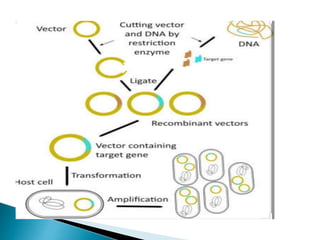
 Restrictions endonuclease are enzyme that
cut the DNA at specific site.
 The enzyme are found in bacteria and archea
provide a defence mechanism against
invading virus.
 Some bacteria defence themselves from
attack by bacteriophage by producing.
 The restrictions enzyme selectively cut up
foreign DNA in a process restriction
 There are 3 types of restrictions
endonuclease.
 Type 1 :- Recognition seq. Of about 15 bp
they cleave the DNA about 1000bp away from
5' end of seq. TCA located with recognition
site.
 Type 2 :- Restrictions mapping and gene
cloning.
 Type 3 :- Intermediate type 1 and type 2.
THANKYOU

Gene tranfer method

  • 1.
    By Dr. SoniaGoel SGT University, Gurugram
  • 2.
     Discovered in1929 by Fridick Graffith.  Bacterial transformation is a process of horizontal gene transfer by which some bacteria take up foreign genetic material (naked DNA) from the environment.  Mechanism :-  1. Cell free transforming DNA in the bacterium immediate environment can be naturally released when cell die and lysis.
  • 3.
     2. OnceDNA come in contact with competent bacteria, linear dsDNA converted by SsDNA and one strand is degraded.  3. SsDNA exogonated is unstable and degrade unless, they are integrated into endogonate by homologus.
  • 5.
     Transformation isused for gene mapping.  Genetics analysis of transformation is based on principles that two marker gene transfer together, of they are mean enough to be carried on DNA fragments.  Freq. Of co- transforamtion is inversely proportional to the distance between the gene.  Two type of transformation :-  1. Natural  2. Artificial
  • 6.
     It isa process in which bacteriophage functions as a vector vehicle to transfer DNA from donor bacterium to recipient bacteria.  Discovered by :- Zinder and ledurberg in salmonella typimurium 1951.  It consists of Two type:-  1. General Transduction. 2. Specialized.
  • 7.
     Two type:- 1. Temperate ( lambda page ) lysogenic cycle.  2.Virulent ( T4 cell ) lytic cell. 
  • 8.
     Generalized :-The bacteriophage can pick up any portion of host genome.  Lytic cycle  Specialized :- The bacteriophage can pick up specific portion of host genome.  Lysogenic
  • 10.
     Restrictions enzymewere discovered due to name and phenomena of host restrictions of bacterial phage.  Restrictions endonuclease are enzyme that cut the DNA at specific site.  The enzyme are found in bacteria and archea provide a defence mechanism against invading virus.  Some bacteria defence themselves from attack by bacteriophage by producing.
  • 12.
     The restrictionsenzyme selectively cut up foreign DNA in a process restriction  There are 3 types of restrictions endonuclease.  Type 1 :- Recognition seq. Of about 15 bp they cleave the DNA about 1000bp away from 5' end of seq. TCA located with recognition site.  Type 2 :- Restrictions mapping and gene cloning.  Type 3 :- Intermediate type 1 and type 2.
  • 13.