Co-funded by the European Union , through the Comenius Programme Web 2.0 Technologies & Tools  in Education
Structure Semantic Web XML RDF Ontologies OWL Educational Web 2.0 Activity Web 2.0 Technologies & Tools in Education
What is Web 2.0? Web 2.0 is a set of internet services and practices that give a voice to individual users It implies a step-change in the structure of a whole environment of computer activity – namely, the World Wide Web * Web 2.0 Technologies & Tools in Education *  Becta (2008) .  Web 2.0 technologies for learning: The current landscape – opportunities, challenges and tensions
Semantic Web A  collaborative effort led by W3C B ased on the Resource Description Framework (RDF), which integrates a variety of applications using XML for syntax and URIs for naming P roposed by World Wide Web inventor  Tim Berners-Lee Web 2.0 Technologies & Tools in Education * http://www.uen.org/core/edtech/glossary.shtml
Definition “ The Semantic Web is an  extension  of the current web in which information is given  well-defined  meaning, better enabling  computers and people  to work in cooperation.” * Web 2.0 Technologies & Tools in Education *Tim Berners-Lee, James Hendler, Ora Lassila The Semantic Web, Scientific American, May 17, 2001
Scope The  Semantic Web  provides a common framework that allows  data  to be shared and reused across application, enterprise, and community boundaries *   Web 2.0 Technologies & Tools in Education * http://www.w3.org/2001/sw/
Semantic Web The Semantic Web is about two things :   C ommon formats for integration and combination of data drawn from diverse sources L anguage for recording how the data relates to real world objects Web 2.0 Technologies & Tools in Education
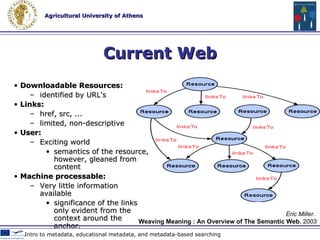
Old Web Downloadable Resources: identified by URL's  Links: href, src, ...  limited, non-descriptive  User: Exciting world semantics of the resource, however, gleaned from content  Machine processable: Very little information available significance of the links only evident from the context around the anchor.  Web 2.0 Technologies & Tools in Education Eric Miller.  Weaving Meaning : An Overview of The Semantic Web .  2003
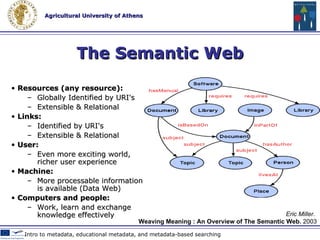
Semantic Web Resources (any resource): Globally Identified by URI's  Extensible & Relational Links: Identified by URI's  Extensible & Relational User: Even more exciting world, richer user experience  Machine: More processable information is available (Data Web)  Computers and people: Work, learn and exchange knowledge effectively  Web 2.0 Technologies & Tools in Education Eric Miller.  Weaving Meaning : An Overview of The Semantic Web .  2003
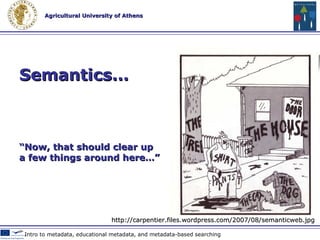
Semantics… “Now, that should clear up a few things around here…” http://carpentier.files.wordpress.com/2007/08/semanticweb.jpg  Web 2.0 Technologies & Tools in Education
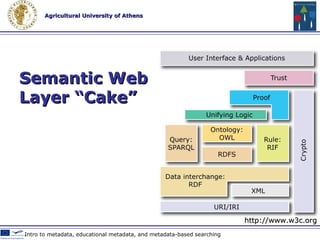
Semantic Web Layer “Cake” http://www.w3c.org Web 2.0 Technologies & Tools in Education
URI Every resource available on the Web  has an address that may be encoded by  a  Uniform Resource Identifier , or “URI” Web 2.0 Technologies & Tools in Education
What is XML? ” A set of rules for defining and representing information as structured documents for applications on the Internet” * Web 2.0 Technologies & Tools in Education
e X tensible  M arkup  L anguage Extensible : User tags can be defined Supports a variety of applications Markup : The user can “markup”: Elements ,  Attributes ,  Comments  and  Processing instructions Meta Language : Gives the rules for other languages to be implemented Web 2.0 Technologies & Tools in Education
E-mail in XML <message>   <to> [email_address] </to>   <from> [email_address] </from>  <text>   Is XML easy? I am giving a presentation...   </text>   </message>  Web 2.0 Technologies & Tools in Education
What is RDF? “ A framework for constructing logical languages that can work together in the Semantic Web. A way of using XML for data rather than just documents ” * RDF extends XML by introducing  subject   –   predicate   –   object   expressions  Web 2.0 Technologies & Tools in Education http://www.w3c.org
RDF A  general method for conceptual description or modeling of information  that is implemented in web resources Describes documents, images, videos, etc. Web 2.0 Technologies & Tools in Education
RDF Schema “ Extensible knowledge representation language, providing basic elements for the description of ontologies” Extends RDF offering ontology building capacity Web 2.0 Technologies & Tools in Education
Ontologies “ An ontology is an explicit specification of a  conceptualization ” * The term is borrowed from philosophy, where an ontology is a systematic account of Existence Web 2.0 Technologies & Tools in Education * Thomas Gruber, 1993
Conceptualization “ A conceptualization is an abstract, simplified view of the world that we wish to represent for some purpose” * Ontologies provide  controlled ,  consistent  vocabularies to describe  concepts  and  relationships Web 2.0 Technologies & Tools in Education * Thomas Gruber, 1993
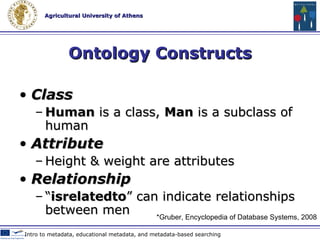
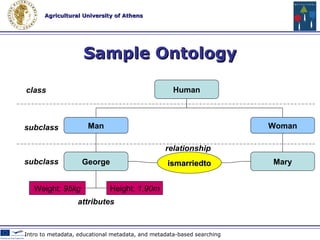
Ontology Constructs Class Human  is a class,  Man  is a subclass of human Attribute Height & weight are attributes Relationship “ isrelatedto ” can indicate relationships between men Web 2.0 Technologies & Tools in Education *Gruber,  Encyclopedia of Database Systems , 2008
Sample Ontology Web 2.0 Technologies & Tools in Education Human Man Woman George Mary ismarriedto class subclass subclass relationship Height:  1,90m Weight:  95kg attributes
OWL A family of knowledge representation languages for authoring ontologies C ompatible with the architecture of the World Wide Web in general, and the Semantic Web in particular Web 2.0 Technologies & Tools in Education * www.w3c.org
OWL extends RDF A dds more vocabulary for describing properties and classes . For example: R elations between classes , C ardinality , E quality,  Properties (and their characteristics) Web 2.0 Technologies & Tools in Education * www.w3c.org
Why OWL? OWL has more facilities for expressing meaning and semantics than : XML  RDF RDF-S Web 2.0 Technologies & Tools in Education * www.w3c.org
Versions of OWL OWL Lite (decidable) OWL DL (Description Logic) (Decidable) OWL Full (Allows classes as instances) From OWL Lite to OWL Full expressiveness and logical complexity increases Web 2.0 Technologies & Tools in Education
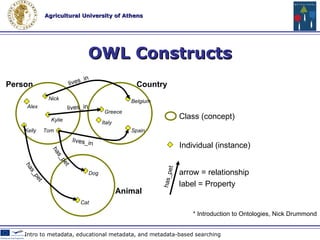
OWL Constructs Web 2.0 Technologies & Tools in Education * Introduction to Ontologies, Nick Drummond Person Country Class (concept) Animal Individual (instance) Belgium Greece Spain Italy Nick Tom Alex Kylie Kelly Cat Dog lives_in lives_in lives_in has_pet has_pet arrow = relationship label = Property has_pet
Classes E.g.  Person, Animal, Job Classes are  sets  of Individuals Membership of a Class is dependent on its  logical description , not its name Classes do not have to be named  (they can be  logical expressions ) Web 2.0 Technologies & Tools in Education
Properties E.g. hasPart, isMemberOf, owns Properties are used to relate Individuals We often say that Individuals are related  along  a given property Subject – Predicate – Object  E.g.: Nikos – hasPet – Cat   Web 2.0 Technologies & Tools in Education
Individuals E.g. Nikos, me, this room, this cat Individuals are the  objects  (aka instances)  in our domain of interest Individuals can be members of multiple Classes Web 2.0 Technologies & Tools in Education
How are they linked? HTML and XML HTML  uses predefined tags to tell a web browser how to display a web page XML  uses not-predefined tags to describe data in order to carry and not to display them Web 2.0 Technologies & Tools in Education
How are they linked? XML – RDF RDF  also describes resources and is based on XML providing a model for data, and a syntax so that independent parties can exchange data Web 2.0 Technologies & Tools in Education
How are they linked? RDF – OWL OWL  is built on RDF and is based on XML In a way, it extends RDF by allowing to create logical dependencies between structures Web 2.0 Technologies & Tools in Education
Are these linked to education? Semantic Web     Links learning objects (LOs)      Links them to the real world XML       Send around documents RDF       Send more than docs (LOs) Ontologies      Relationships between LOs OWL       Defines relationships between LOs and is compatible with the Semantic Web   Web 2.0 Technologies & Tools in Education
Categories of educational  Web 2.0 activity* Media Sharing Media Manipulation Conversational Areas Online games and virtual worlds Social Networking Blogging Web 2.0 Technologies & Tools in Education *  Becta (2008) .  Web 2.0 technologies for learning: The current landscape – opportunities, challenges and tensions
Categories of educational  Web 2.0 activity Social Bookmarking Recommender Systems Collaborative Editing Wikis  Syndication Web 2.0 Technologies & Tools in Education
Media Sharing Synchronize slides with video http://www.zentation.com/   Storing and Sharing Class Notes http://www.notecentric.com/   Web 2.0 Technologies & Tools in Education
Web 2.0 Technologies & Tools in Education
Media Manipulation Online Diagram Software http://www.gliffy.com/   Linking literature to geography http://www.googlelittrips.com /   Web 2.0 Technologies & Tools in Education
Web 2.0 Technologies & Tools in Education
Conversational Areas Educational conversations http://vyew.com/site/   International conversations http://www.thinkquest.org/   Conversations for young learners http://b.whyville.net/smmk/nice   Web 2.0 Technologies & Tools in Education
Web 2.0 Technologies & Tools in Education
Social Networking & Blogging Casual talks around school interests  http://www.goldstarcafe.net/   Educational Blogs http://edublogs.org/   Web 2.0 Technologies & Tools in Education
Web 2.0 Technologies & Tools in Education
Wikis School Wiki http://school20.wikispaces.com/   Educational Wikis http://wikisineducation.wetpaint.com/   Web 2.0 Technologies & Tools in Education
Web 2.0 Technologies & Tools in Education
Dear user, please take the time (5 minutes) to help us improve METASCHOOL modules! Find the  Module Questionnaire  here: METASCHOOL Portal:  http://lreforschools.eun.org/metaschool   Find present module (ask your workshop leader, if you are unsure)  Scroll to the end of the module description  Fill in the Module Questionnaire If you took part in a METASCHOOL Workshop  and  this is the last module of your workshop,    please  ALSO  help us improve our METASCHOOL Workshops    by completing the  Workshop Questionnaire   (10 minutes): METASCHOOL Portal:  http://lreforschools.eun.org/metaschool      Click on a language:  Evaluation
Web 2.0 Technologies & Tools  in Education Informatics Laboratory Agricultural University of Athens http://infolab-dev.aua.gr/   Web 2.0 Technologies & Tools in Education

Web 2.0 tools in education

  • 1.
    Co-funded by theEuropean Union , through the Comenius Programme Web 2.0 Technologies & Tools in Education
  • 2.
    Structure Semantic WebXML RDF Ontologies OWL Educational Web 2.0 Activity Web 2.0 Technologies & Tools in Education
  • 3.
    What is Web2.0? Web 2.0 is a set of internet services and practices that give a voice to individual users It implies a step-change in the structure of a whole environment of computer activity – namely, the World Wide Web * Web 2.0 Technologies & Tools in Education * Becta (2008) . Web 2.0 technologies for learning: The current landscape – opportunities, challenges and tensions
  • 4.
    Semantic Web A collaborative effort led by W3C B ased on the Resource Description Framework (RDF), which integrates a variety of applications using XML for syntax and URIs for naming P roposed by World Wide Web inventor Tim Berners-Lee Web 2.0 Technologies & Tools in Education * http://www.uen.org/core/edtech/glossary.shtml
  • 5.
    Definition “ TheSemantic Web is an extension of the current web in which information is given well-defined meaning, better enabling computers and people to work in cooperation.” * Web 2.0 Technologies & Tools in Education *Tim Berners-Lee, James Hendler, Ora Lassila The Semantic Web, Scientific American, May 17, 2001
  • 6.
    Scope The  SemanticWeb  provides a common framework that allows  data  to be shared and reused across application, enterprise, and community boundaries * Web 2.0 Technologies & Tools in Education * http://www.w3.org/2001/sw/
  • 7.
    Semantic Web TheSemantic Web is about two things : C ommon formats for integration and combination of data drawn from diverse sources L anguage for recording how the data relates to real world objects Web 2.0 Technologies & Tools in Education
  • 8.
    Old Web DownloadableResources: identified by URL's Links: href, src, ... limited, non-descriptive User: Exciting world semantics of the resource, however, gleaned from content Machine processable: Very little information available significance of the links only evident from the context around the anchor. Web 2.0 Technologies & Tools in Education Eric Miller. Weaving Meaning : An Overview of The Semantic Web . 2003
  • 9.
    Semantic Web Resources(any resource): Globally Identified by URI's Extensible & Relational Links: Identified by URI's Extensible & Relational User: Even more exciting world, richer user experience Machine: More processable information is available (Data Web) Computers and people: Work, learn and exchange knowledge effectively Web 2.0 Technologies & Tools in Education Eric Miller. Weaving Meaning : An Overview of The Semantic Web . 2003
  • 10.
    Semantics… “Now, thatshould clear up a few things around here…” http://carpentier.files.wordpress.com/2007/08/semanticweb.jpg Web 2.0 Technologies & Tools in Education
  • 11.
    Semantic Web Layer“Cake” http://www.w3c.org Web 2.0 Technologies & Tools in Education
  • 12.
    URI Every resourceavailable on the Web has an address that may be encoded by a Uniform Resource Identifier , or “URI” Web 2.0 Technologies & Tools in Education
  • 13.
    What is XML?” A set of rules for defining and representing information as structured documents for applications on the Internet” * Web 2.0 Technologies & Tools in Education
  • 14.
    e X tensible M arkup L anguage Extensible : User tags can be defined Supports a variety of applications Markup : The user can “markup”: Elements , Attributes , Comments and Processing instructions Meta Language : Gives the rules for other languages to be implemented Web 2.0 Technologies & Tools in Education
  • 15.
    E-mail in XML<message> <to> [email_address] </to> <from> [email_address] </from> <text> Is XML easy? I am giving a presentation... </text> </message> Web 2.0 Technologies & Tools in Education
  • 16.
    What is RDF?“ A framework for constructing logical languages that can work together in the Semantic Web. A way of using XML for data rather than just documents ” * RDF extends XML by introducing subject – predicate – object expressions Web 2.0 Technologies & Tools in Education http://www.w3c.org
  • 17.
    RDF A general method for conceptual description or modeling of information that is implemented in web resources Describes documents, images, videos, etc. Web 2.0 Technologies & Tools in Education
  • 18.
    RDF Schema “Extensible knowledge representation language, providing basic elements for the description of ontologies” Extends RDF offering ontology building capacity Web 2.0 Technologies & Tools in Education
  • 19.
    Ontologies “ Anontology is an explicit specification of a conceptualization ” * The term is borrowed from philosophy, where an ontology is a systematic account of Existence Web 2.0 Technologies & Tools in Education * Thomas Gruber, 1993
  • 20.
    Conceptualization “ Aconceptualization is an abstract, simplified view of the world that we wish to represent for some purpose” * Ontologies provide controlled , consistent vocabularies to describe concepts and relationships Web 2.0 Technologies & Tools in Education * Thomas Gruber, 1993
  • 21.
    Ontology Constructs ClassHuman is a class, Man is a subclass of human Attribute Height & weight are attributes Relationship “ isrelatedto ” can indicate relationships between men Web 2.0 Technologies & Tools in Education *Gruber, Encyclopedia of Database Systems , 2008
  • 22.
    Sample Ontology Web2.0 Technologies & Tools in Education Human Man Woman George Mary ismarriedto class subclass subclass relationship Height: 1,90m Weight: 95kg attributes
  • 23.
    OWL A familyof knowledge representation languages for authoring ontologies C ompatible with the architecture of the World Wide Web in general, and the Semantic Web in particular Web 2.0 Technologies & Tools in Education * www.w3c.org
  • 24.
    OWL extends RDFA dds more vocabulary for describing properties and classes . For example: R elations between classes , C ardinality , E quality, Properties (and their characteristics) Web 2.0 Technologies & Tools in Education * www.w3c.org
  • 25.
    Why OWL? OWLhas more facilities for expressing meaning and semantics than : XML RDF RDF-S Web 2.0 Technologies & Tools in Education * www.w3c.org
  • 26.
    Versions of OWLOWL Lite (decidable) OWL DL (Description Logic) (Decidable) OWL Full (Allows classes as instances) From OWL Lite to OWL Full expressiveness and logical complexity increases Web 2.0 Technologies & Tools in Education
  • 27.
    OWL Constructs Web2.0 Technologies & Tools in Education * Introduction to Ontologies, Nick Drummond Person Country Class (concept) Animal Individual (instance) Belgium Greece Spain Italy Nick Tom Alex Kylie Kelly Cat Dog lives_in lives_in lives_in has_pet has_pet arrow = relationship label = Property has_pet
  • 28.
    Classes E.g. Person, Animal, Job Classes are sets of Individuals Membership of a Class is dependent on its logical description , not its name Classes do not have to be named (they can be logical expressions ) Web 2.0 Technologies & Tools in Education
  • 29.
    Properties E.g. hasPart,isMemberOf, owns Properties are used to relate Individuals We often say that Individuals are related along a given property Subject – Predicate – Object E.g.: Nikos – hasPet – Cat Web 2.0 Technologies & Tools in Education
  • 30.
    Individuals E.g. Nikos,me, this room, this cat Individuals are the objects (aka instances) in our domain of interest Individuals can be members of multiple Classes Web 2.0 Technologies & Tools in Education
  • 31.
    How are theylinked? HTML and XML HTML uses predefined tags to tell a web browser how to display a web page XML uses not-predefined tags to describe data in order to carry and not to display them Web 2.0 Technologies & Tools in Education
  • 32.
    How are theylinked? XML – RDF RDF also describes resources and is based on XML providing a model for data, and a syntax so that independent parties can exchange data Web 2.0 Technologies & Tools in Education
  • 33.
    How are theylinked? RDF – OWL OWL is built on RDF and is based on XML In a way, it extends RDF by allowing to create logical dependencies between structures Web 2.0 Technologies & Tools in Education
  • 34.
    Are these linkedto education? Semantic Web  Links learning objects (LOs)  Links them to the real world XML  Send around documents RDF  Send more than docs (LOs) Ontologies  Relationships between LOs OWL  Defines relationships between LOs and is compatible with the Semantic Web Web 2.0 Technologies & Tools in Education
  • 35.
    Categories of educational Web 2.0 activity* Media Sharing Media Manipulation Conversational Areas Online games and virtual worlds Social Networking Blogging Web 2.0 Technologies & Tools in Education * Becta (2008) . Web 2.0 technologies for learning: The current landscape – opportunities, challenges and tensions
  • 36.
    Categories of educational Web 2.0 activity Social Bookmarking Recommender Systems Collaborative Editing Wikis Syndication Web 2.0 Technologies & Tools in Education
  • 37.
    Media Sharing Synchronizeslides with video http://www.zentation.com/ Storing and Sharing Class Notes http://www.notecentric.com/ Web 2.0 Technologies & Tools in Education
  • 38.
    Web 2.0 Technologies& Tools in Education
  • 39.
    Media Manipulation OnlineDiagram Software http://www.gliffy.com/ Linking literature to geography http://www.googlelittrips.com / Web 2.0 Technologies & Tools in Education
  • 40.
    Web 2.0 Technologies& Tools in Education
  • 41.
    Conversational Areas Educationalconversations http://vyew.com/site/ International conversations http://www.thinkquest.org/ Conversations for young learners http://b.whyville.net/smmk/nice Web 2.0 Technologies & Tools in Education
  • 42.
    Web 2.0 Technologies& Tools in Education
  • 43.
    Social Networking &Blogging Casual talks around school interests http://www.goldstarcafe.net/ Educational Blogs http://edublogs.org/ Web 2.0 Technologies & Tools in Education
  • 44.
    Web 2.0 Technologies& Tools in Education
  • 45.
    Wikis School Wikihttp://school20.wikispaces.com/ Educational Wikis http://wikisineducation.wetpaint.com/ Web 2.0 Technologies & Tools in Education
  • 46.
    Web 2.0 Technologies& Tools in Education
  • 47.
    Dear user, pleasetake the time (5 minutes) to help us improve METASCHOOL modules! Find the Module Questionnaire here: METASCHOOL Portal: http://lreforschools.eun.org/metaschool Find present module (ask your workshop leader, if you are unsure) Scroll to the end of the module description Fill in the Module Questionnaire If you took part in a METASCHOOL Workshop and this is the last module of your workshop, please ALSO help us improve our METASCHOOL Workshops by completing the Workshop Questionnaire (10 minutes): METASCHOOL Portal: http://lreforschools.eun.org/metaschool  Click on a language: Evaluation
  • 48.
    Web 2.0 Technologies& Tools in Education Informatics Laboratory Agricultural University of Athens http://infolab-dev.aua.gr/ Web 2.0 Technologies & Tools in Education