Co-funded by the European Union , through the Comenius Programme Intro to the COSMOS and NaturNet tools for describing resources with metadata
Structure COSMOS Tools Description Example of use NaturNet Tools Description Example of use / 21 Intro to the COSMOS and Organic.Edunet, NaturNet tools for describing resources with metadata
COSMOS Tools Description and  example of use
Discover the COSMOS: Educational Resources for Teaching Astronomy


2001 2005 1998 2006
Access to unique scientific resources     www.discoveryspace.net
Go Observing
 
… advanced infrastructures…
January 2007, Opening of the EA Observatory, the first school observatory in Greece
 
http://faulkes-telescope.com/support/rti_demo


Access to Real Data…
… and high quality content
Digital content is useful ...
…  only if you are able to find what you are looking for The main issue is to find educational content and use it effectively
COSMOS Added Value COSMOS demonstrating the way for the  unification of the existing tools and on-line materials  of a network of observatories and research institutions and at offering students and teachers unique educational resources to as the sky is a vast and unique laboratory of science, always in operation, accessible at all times from everybody from everywhere, where all sorts of interesting physical phenomena take place most of which is impossible to reproduce in any scientific laboratory .
 
Teaching the Uniform Circular Motion A The teacher accesses the COSMOS Portal looking for relevant material COSMOS Portal I am a Teacher from Greece looking for Learning activities for ages 14-16 on “ Uniform circular motion”  SEARCH
B The teacher receives a “learning pathway” suggestion from the system We suggest the following learning pathway: Uniform Circular Motion   (Lesson Plan, duration 1h) Measurement of the Solar Rotation (D-Space activity, duration 1h) Rotation of a spiral galaxy (Reading material and FITS images, duration 30 min) Suggested further reading (Collection of links) The Rotating Quiz (On-Line quiz on circular motion, duration 15 min) See more Modify Accept COSMOS Portal     
COSMOS Portal C The teacher inspects the suggested Learning Objects personalizing the Activity Measurement of the Solar Rotation  I. General Information Duration for the implementation of the proposed scenario  Vocabulary relating with the proposed scenario  Tools and Materials needed for the implementation of the proposed scenario  Aims and objectives of the proposed activity  User’s Misconceptions relating to the activity under discussion II. Educational Phase Stimulation: use of material that prompt to the certain activity proposed by the scenario  Experimental Activities (Phase 1st and Phase 2nd)  Observation of the phenomenon/a under study – Discussion depending on the product of that observation  Consolidation through questions, discussion, in class exercises  Exercises in a form of home assignments relating to the discussed phenomenon  Questions around the observation, product and relating subjects.  Rate it Include it Exclude it
COSMOS Portal D The student interacts directly with the portal through structured Learning Objects The Rotating Quiz Question 12/20:  The equatorial perimeter of the Earth is 40.000km and the planet completes a full rotation within 24h. What is the linear velocity of any point on the equator? 463 m/s 872 m/s 121 m/s 252 m/s 400 m/s   << >> Rate it ILLUSTRATIVE
 
Organized according to the science curriculum 24 categories with overall 424 terms for several science subjects (mechanics, astronomy, E/M, waves,…)
User Generated Content…


The Rotation of the Sun   Required information Data from observations of sunspots in the optical light from Galileo and in the present time Sunspots images from the internet. The data can be found in the recommended links. Stages of Project Measurement of coordinates of the sunspots in Galileo’s sketches by Microsoft PhotoEditor or Photoshop and estimation of the rotation period of the sun in his time.  Measurement of coordinates of the sunspots for current observations.  Comparison of the rotation periods and the predominant sunspots position from Galileo’s observation till now.  The differential rotation should be taken into consideration.  Summary of the project.  Recommended site (general knowledge) http:// www.exploratorium.edu/sunspots/index.html Recommended sites for Data Background and general information.Optical Pictures from the Satellite SOHO OBSERVATORY:   http://sohowww.nascom.nasa.gov/cgi-bin/soho   - sunspots observations from the Hawaii observatory  -  sunspots in real time from the COSMOS service
The Rotation of the Sun,  from Galileo to the present time   Aims To compare Galileo’s observations of the sun’s rotation from 400 years ago to recent observations.  To check any changes during the 400  years and describe them, if found.  To explain the reasons for these changes, if found.  Objects  Sunspots and the solar rotation.  The Research Question What are the changes in the sun’s rotation over the 400 years from Galileo to the present. General Knowledge Historical Background: The history of science in Galileo's time. Background in Physics:   Mechanics:  rotation, angular motion and rotation period, conserving of angular momentum.  Electricity and Magnetism: Electric fields and currents, magnetic fields, Ohm’s Law, Faraday’s Law.  Astronomical Background:   The structure of the sun.  The origin of solar energy.  The propagation of solar energy outwards from the center.  The origin of magnetic fields in the sun.  Mathematics and computer background :   Algebra, Spherical geometry, trigonometry, EXCEL.
 
Creating effective links between schools and the research community
Collaborative Learning and community development “ George Paterakis  is  teaching Astronomy . Today he is preparing a lecture on  Uranus and its satellites , and he is revisiting his slides from last year. He knows that during the last year,  on the 14 th  of August a unique phenomenon of the eclipse of Oberon from Umbriel took place and he would like to include this information to his presentation.  To do so,  he is searching in the COSMOS repository and locating an expert in the field, Apostolos Christou who works at  Armagh  Observatory. Now  he  is  contact ing   Christou  and ask s  him if he can find and send him more information and audiovisual material about this  event. Christou has observed this event and he has detailed information &quot;.  Then each scenario can identify a number of challenges for the particular context, that  COSMOS  should aim to address (e.g. to offer  George  a way to find such case studies and information online).
Digital Content on COSMOS  (July 2010) 90,000 FITS images 2000 weblinks 800 videos and animations 600 Tests and students activities 500 Detailed Lesson Plans Educational Software and applications Training Materials


Expanding the user community COSMOS in 100HA project
 
Expanding the user community in Rural Schools across Europe


I think the classroom can help. It is up to schools, and to all initiatives that can educate, including reliable Internet sites, to ensure that young people gradually acquire the correct understanding of scientific procedure .  A most difficult task, Because even knowledge transmitted by schools is often deposited in the memory like a sequence of miraculous episodes: Madame Curie who come home one evening and discovers radioactivity thanks to a mark on a sheet of paper,  ...... Galileo who sees a lamp swaying and suddenly discovers everything, even that the world rotates… It is the duty of a man of learning not only to do scrupulous research but also to present his knowledge effectively. Scientists sometimes still feel it’s not dignified to take an interest in popularization, although masters in the field include Einstein and Heisenberg.   But if we are to teach a nonmagical view of science, we cannot expect it to come from the mass media. The scientific community itself must construct it bit by bit in the collective awareness, starting with the young.
Sharing our experiences Is the best resource  we can have.
NatureNet Tools Description and  example of use
NaturNet URM tools  (1/2) The tool allows content providers to connect repositories for the purpose of sustainable development The tool  support combination of heterogeneous information, spatial information, text, web pages, videos, photos etc. The tools support combination of heterogeneous information into curriculum / 21 Intro to the COSMOS and Organic.Edunet, NaturNet tools for describing resources with metadata / 21 Intro to metadata, educational metadata, and metadata-based searching
NaturNet URM tools  (2/2) The tool support multiple search trough more catalogues, publishing data and metadata, publishing digital maps, building maps composition, preparing e learning lectures The tool is built upon open standards and specifications, such as the  Catalog Services for Web 2.0.2 and Open Web Search and on other Open Geospatial Consortium standards / 21 Intro to the COSMOS and Organic.Edunet, NaturNet tools for describing resources with metadata / 21 Intro to metadata, educational metadata, and metadata-based searching
Usage NaturNet URM tools Multiple search for information Visualization of information Publishing of spatial information Publishing of non spatial information eLearning tools / 21 Intro to the COSMOS and Organic.Edunet, NaturNet tools for describing resources with metadata / 21 Intro to metadata, educational metadata, and metadata-based searching
C ollaborative  T ools / 21 Intro to the COSMOS and Organic.Edunet, NaturNet tools for describing resources with metadata 22.7.2010 ISAF Praha 2008 lecture editor  Thesaurus Catalogue Service Data Management Shockwave 3D UMN Mapserver Mobile device WPS HTML-Web Site   SCORM 1.2 QR - Garp
Multiple search for information / 21 Intro to the COSMOS and Organic.Edunet, NaturNet tools for describing resources with metadata / 21 Intro to metadata, educational metadata, and metadata-based searching Searching trough more catalogues
Multiple search for information / 21 Intro to the COSMOS and Organic.Edunet, NaturNet tools for describing resources with metadata / 21 Intro to metadata, educational metadata, and metadata-based searching Adding more catalogues
Multiple search for information / 21 Intro to the COSMOS and Organic.Edunet, NaturNet tools for describing resources with metadata / 21 Intro to metadata, educational metadata, and metadata-based searching Simple search
Multiple search for information / 21 Intro to the COSMOS and Organic.Edunet, NaturNet tools for describing resources with metadata / 21 Intro to metadata, educational metadata, and metadata-based searching Advanced search
Multiple search for information / 21 Intro to the COSMOS and Organic.Edunet, NaturNet tools for describing resources with metadata / 21 Intro to metadata, educational metadata, and metadata-based searching Metadata overview
Multiple search for information / 21 Intro to the COSMOS and Organic.Edunet, NaturNet tools for describing resources with metadata / 21 Intro to metadata, educational metadata, and metadata-based searching Metadata detail
Visualization of information / 21 Intro to the COSMOS and Organic.Edunet, NaturNet tools for describing resources with metadata / 21 Intro to metadata, educational metadata, and metadata-based searching Visualization of non spatial information
Visualization of non spatial information / 21 Intro to the COSMOS and Organic.Edunet, NaturNet tools for describing resources with metadata / 21 Intro to metadata, educational metadata, and metadata-based searching
Visualization of spatial information / 21 Intro to the COSMOS and Organic.Edunet, NaturNet tools for describing resources with metadata / 21 Intro to metadata, educational metadata, and metadata-based searching
Visualization of e learning content / 21 Intro to the COSMOS and Organic.Edunet, NaturNet tools for describing resources with metadata / 21 Intro to metadata, educational metadata, and metadata-based searching
Login for publishing content / 21 Intro to the COSMOS and Organic.Edunet, NaturNet tools for describing resources with metadata / 21 Intro to metadata, educational metadata, and metadata-based searching
Login for publishing content / 21 Intro to the COSMOS and Organic.Edunet, NaturNet tools for describing resources with metadata / 21 Intro to metadata, educational metadata, and metadata-based searching New functionality
Map composition / 21 Intro to the COSMOS and Organic.Edunet, NaturNet tools for describing resources with metadata Creation of new map project and compositions geo-data displaying in the internet enviroment Usage of external internal and sources OG C  standards (WMS, WFS) connectivity to other tools (metadata catalog, map visualization tools)
Transmission of Images Queries GetCapabilities   - metadata about services GetMap   - map   GetFeatureInfo   – queries on maps Web Map Service (WMS) / 21 Intro to the COSMOS and Organic.Edunet, NaturNet tools for describing resources with metadata <Exception> <Format>application/vnd.ogc.se_xml</Format> <Format>application/vnd.ogc.se_inimage</Format> <Format>application/vnd.ogc.se_blank</Format> </Exception> <VendorSpecificCapabilities /> <Layer> <Name>corine</Name> <Title>Corine CR map</Title> <SRS>EPSG:28403 EPSG:4326 EPSG:2065</SRS> <LatLonBoundingBox minx=&quot;15.2647&quot; miny=&quot;49.9462&quot; maxx=&quot;15.2717&quot; maxy=&quot;49.9508&quot; /> <BoundingBox SRS=&quot;EPSG:28403&quot; minx=&quot;3.519e+006&quot; miny=&quot;5.535e+006&quot; maxx=&quot;3.5195e+006&quot; maxy=&quot;5.5355e+006&quot; /> <Layer queryable=&quot;0&quot; opaque=&quot;0&quot; cascaded=&quot;0&quot;> <Name>foto</Name> <Title>fotografie</Title> <Abstract>No a toto je strucný popis toho vseho &lt;a href='http://www.bnhelp.cz' target='_blank'&gt; Metadata&lt;/a&gt;</Abstract> </Layer> <Layer queryable=&quot;0&quot; opaque=&quot;0&quot; cascaded=&quot;1&quot;> <Name>dmu25</Name> <Title>DMU25</Title> <SRS>EPSG:28403</SRS> </Layer> topograf. mapa tématický obsah Klient Klient CSS Cascading
Web Features Service (WFS) / 21 Intro to the COSMOS and Organic.Edunet, NaturNet tools for describing resources with metadata Data transmission in  GML Basic GetCapabilities   -   metadata services DescribeFeatureType   - structure (XML schema)   GetFeature   - GML data Extended  (edit ing ) LockFeature   Transaction  ( INSERT, UPDATE, DELETE, QUERY, DISCOVERY )
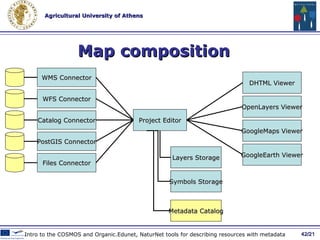
Map composition / 21 Intro to the COSMOS and Organic.Edunet, NaturNet tools for describing resources with metadata Project Editor Layers Storage Symbols Storage WMS Connector WFS Connector Catalog Connector PostGIS Connector Files Connector DHTML Viewer OpenLayers Viewer GoogleMaps Viewer GoogleEarth Viewer Metadata Catalog
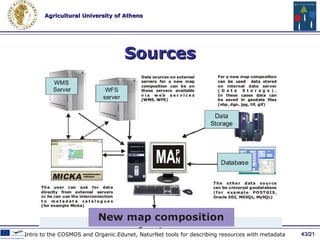
Sources / 21 Intro to the COSMOS and Organic.Edunet, NaturNet tools for describing resources with metadata
Publication / 21 Intro to the COSMOS and Organic.Edunet, NaturNet tools for describing resources with metadata
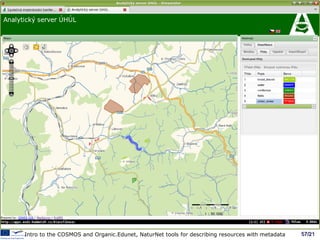
An  Example / 21 Intro to the COSMOS and Organic.Edunet, NaturNet tools for describing resources with metadata
/ 21 Intro to the COSMOS and Organic.Edunet, NaturNet tools for describing resources with metadata WFS SHP WMS WMS
Parameters / 21 Intro to the COSMOS and Organic.Edunet, NaturNet tools for describing resources with metadata
Spatial extend / 21 Intro to the COSMOS and Organic.Edunet, NaturNet tools for describing resources with metadata
Coordinate system / 21 Intro to the COSMOS and Organic.Edunet, NaturNet tools for describing resources with metadata
Metadata / 21 Intro to the COSMOS and Organic.Edunet, NaturNet tools for describing resources with metadata
Styling / 21 Intro to the COSMOS and Organic.Edunet, NaturNet tools for describing resources with metadata
Connecting layers / 21 Intro to the COSMOS and Organic.Edunet, NaturNet tools for describing resources with metadata
Preview / 21 Intro to the COSMOS and Organic.Edunet, NaturNet tools for describing resources with metadata
Publishing of non spatial data / 21 Intro to the COSMOS and Organic.Edunet, NaturNet tools for describing resources with metadata / 21 Intro to metadata, educational metadata, and metadata-based searching
Web Processing Service Based on  PyWPS  – OpenSource (HSRS) GIS analysis on internet WPS used form INSPIRE transformation services http://pywps.wald.intevation.org/ / 21 Intro to the COSMOS and Organic.Edunet, NaturNet tools for describing resources with metadata
/ 21 Intro to the COSMOS and Organic.Edunet, NaturNet tools for describing resources with metadata
/ 21 Intro to the COSMOS and Organic.Edunet, NaturNet tools for describing resources with metadata 22.7.2010 Web Portal – eLearning E-learning modules: Moodle/ - eLearning platform - Learning Management System (LMS) eXe - lecture editor  - Offline editor, user friendly interface  - Integration of text, images, flash movies, videos  - Multiple choice test, etc   - Integration of NNR tools and multimedia content
MOODLE Lectures / 21 Intro to the COSMOS and Organic.Edunet, NaturNet tools for describing resources with metadata 26.8.2008 AFITA IALD WCCA 2008
Dear user, please take the time (5 minutes) to help us improve METASCHOOL modules! Find the  Module Questionnaire  here: METASCHOOL Portal:  http://lreforschools.eun.org/metaschool   Find present module (ask your workshop leader, if you are unsure)  Scroll to the end of the module description  Fill in the Module Questionnaire If you took part in a METASCHOOL Workshop  and  this is the last module of your workshop,    please  ALSO  help us improve our METASCHOOL Workshops    by completing the  Workshop Questionnaire   (10 minutes): METASCHOOL Portal:  http://lreforschools.eun.org/metaschool      Click on a language:  Evaluation

Introduction to Cosmos and Organic.Edunet

  • 1.
    Co-funded by theEuropean Union , through the Comenius Programme Intro to the COSMOS and NaturNet tools for describing resources with metadata
  • 2.
    Structure COSMOS ToolsDescription Example of use NaturNet Tools Description Example of use / 21 Intro to the COSMOS and Organic.Edunet, NaturNet tools for describing resources with metadata
  • 3.
    COSMOS Tools Descriptionand example of use
  • 4.
    Discover the COSMOS:Educational Resources for Teaching Astronomy
  • 5.
  • 6.
  • 7.
  • 8.
  • 9.
  • 10.
    Access to uniquescientific resources www.discoveryspace.net
  • 11.
  • 12.
  • 13.
  • 14.
    January 2007, Openingof the EA Observatory, the first school observatory in Greece
  • 15.
  • 16.
  • 17.
  • 18.
  • 19.
  • 20.
  • 21.
  • 22.
  • 23.
  • 24.
    … and highquality content
  • 25.
  • 26.
    … onlyif you are able to find what you are looking for The main issue is to find educational content and use it effectively
  • 27.
    COSMOS Added ValueCOSMOS demonstrating the way for the unification of the existing tools and on-line materials of a network of observatories and research institutions and at offering students and teachers unique educational resources to as the sky is a vast and unique laboratory of science, always in operation, accessible at all times from everybody from everywhere, where all sorts of interesting physical phenomena take place most of which is impossible to reproduce in any scientific laboratory .
  • 28.
  • 29.
    Teaching the UniformCircular Motion A The teacher accesses the COSMOS Portal looking for relevant material COSMOS Portal I am a Teacher from Greece looking for Learning activities for ages 14-16 on “ Uniform circular motion” SEARCH
  • 30.
    B The teacherreceives a “learning pathway” suggestion from the system We suggest the following learning pathway: Uniform Circular Motion (Lesson Plan, duration 1h) Measurement of the Solar Rotation (D-Space activity, duration 1h) Rotation of a spiral galaxy (Reading material and FITS images, duration 30 min) Suggested further reading (Collection of links) The Rotating Quiz (On-Line quiz on circular motion, duration 15 min) See more Modify Accept COSMOS Portal     
  • 31.
    COSMOS Portal CThe teacher inspects the suggested Learning Objects personalizing the Activity Measurement of the Solar Rotation I. General Information Duration for the implementation of the proposed scenario Vocabulary relating with the proposed scenario Tools and Materials needed for the implementation of the proposed scenario Aims and objectives of the proposed activity User’s Misconceptions relating to the activity under discussion II. Educational Phase Stimulation: use of material that prompt to the certain activity proposed by the scenario Experimental Activities (Phase 1st and Phase 2nd) Observation of the phenomenon/a under study – Discussion depending on the product of that observation Consolidation through questions, discussion, in class exercises Exercises in a form of home assignments relating to the discussed phenomenon Questions around the observation, product and relating subjects. Rate it Include it Exclude it
  • 32.
    COSMOS Portal DThe student interacts directly with the portal through structured Learning Objects The Rotating Quiz Question 12/20: The equatorial perimeter of the Earth is 40.000km and the planet completes a full rotation within 24h. What is the linear velocity of any point on the equator? 463 m/s 872 m/s 121 m/s 252 m/s 400 m/s << >> Rate it ILLUSTRATIVE
  • 33.
  • 34.
    Organized according tothe science curriculum 24 categories with overall 424 terms for several science subjects (mechanics, astronomy, E/M, waves,…)
  • 35.
  • 36.
  • 37.
  • 38.
  • 39.
    The Rotation ofthe Sun Required information Data from observations of sunspots in the optical light from Galileo and in the present time Sunspots images from the internet. The data can be found in the recommended links. Stages of Project Measurement of coordinates of the sunspots in Galileo’s sketches by Microsoft PhotoEditor or Photoshop and estimation of the rotation period of the sun in his time. Measurement of coordinates of the sunspots for current observations. Comparison of the rotation periods and the predominant sunspots position from Galileo’s observation till now. The differential rotation should be taken into consideration. Summary of the project. Recommended site (general knowledge) http:// www.exploratorium.edu/sunspots/index.html Recommended sites for Data Background and general information.Optical Pictures from the Satellite SOHO OBSERVATORY: http://sohowww.nascom.nasa.gov/cgi-bin/soho - sunspots observations from the Hawaii observatory - sunspots in real time from the COSMOS service
  • 40.
    The Rotation ofthe Sun, from Galileo to the present time Aims To compare Galileo’s observations of the sun’s rotation from 400 years ago to recent observations. To check any changes during the 400 years and describe them, if found. To explain the reasons for these changes, if found. Objects Sunspots and the solar rotation. The Research Question What are the changes in the sun’s rotation over the 400 years from Galileo to the present. General Knowledge Historical Background: The history of science in Galileo's time. Background in Physics: Mechanics: rotation, angular motion and rotation period, conserving of angular momentum. Electricity and Magnetism: Electric fields and currents, magnetic fields, Ohm’s Law, Faraday’s Law. Astronomical Background: The structure of the sun. The origin of solar energy. The propagation of solar energy outwards from the center. The origin of magnetic fields in the sun. Mathematics and computer background : Algebra, Spherical geometry, trigonometry, EXCEL.
  • 41.
  • 42.
    Creating effective linksbetween schools and the research community
  • 43.
    Collaborative Learning andcommunity development “ George Paterakis is teaching Astronomy . Today he is preparing a lecture on Uranus and its satellites , and he is revisiting his slides from last year. He knows that during the last year,  on the 14 th of August a unique phenomenon of the eclipse of Oberon from Umbriel took place and he would like to include this information to his presentation. To do so, he is searching in the COSMOS repository and locating an expert in the field, Apostolos Christou who works at Armagh Observatory. Now he is contact ing Christou and ask s him if he can find and send him more information and audiovisual material about this event. Christou has observed this event and he has detailed information &quot;. Then each scenario can identify a number of challenges for the particular context, that COSMOS should aim to address (e.g. to offer George a way to find such case studies and information online).
  • 44.
    Digital Content onCOSMOS (July 2010) 90,000 FITS images 2000 weblinks 800 videos and animations 600 Tests and students activities 500 Detailed Lesson Plans Educational Software and applications Training Materials
  • 45.
  • 46.
  • 47.
  • 48.
  • 49.
  • 50.
  • 51.
  • 52.
    Expanding the usercommunity COSMOS in 100HA project
  • 53.
  • 54.
    Expanding the usercommunity in Rural Schools across Europe
  • 55.
  • 56.
  • 57.
  • 58.
  • 59.
  • 60.
  • 61.
  • 62.
  • 63.
  • 64.
    I think theclassroom can help. It is up to schools, and to all initiatives that can educate, including reliable Internet sites, to ensure that young people gradually acquire the correct understanding of scientific procedure . A most difficult task, Because even knowledge transmitted by schools is often deposited in the memory like a sequence of miraculous episodes: Madame Curie who come home one evening and discovers radioactivity thanks to a mark on a sheet of paper, ...... Galileo who sees a lamp swaying and suddenly discovers everything, even that the world rotates… It is the duty of a man of learning not only to do scrupulous research but also to present his knowledge effectively. Scientists sometimes still feel it’s not dignified to take an interest in popularization, although masters in the field include Einstein and Heisenberg. But if we are to teach a nonmagical view of science, we cannot expect it to come from the mass media. The scientific community itself must construct it bit by bit in the collective awareness, starting with the young.
  • 65.
    Sharing our experiencesIs the best resource we can have.
  • 66.
    NatureNet Tools Descriptionand example of use
  • 67.
    NaturNet URM tools (1/2) The tool allows content providers to connect repositories for the purpose of sustainable development The tool support combination of heterogeneous information, spatial information, text, web pages, videos, photos etc. The tools support combination of heterogeneous information into curriculum / 21 Intro to the COSMOS and Organic.Edunet, NaturNet tools for describing resources with metadata / 21 Intro to metadata, educational metadata, and metadata-based searching
  • 68.
    NaturNet URM tools (2/2) The tool support multiple search trough more catalogues, publishing data and metadata, publishing digital maps, building maps composition, preparing e learning lectures The tool is built upon open standards and specifications, such as the Catalog Services for Web 2.0.2 and Open Web Search and on other Open Geospatial Consortium standards / 21 Intro to the COSMOS and Organic.Edunet, NaturNet tools for describing resources with metadata / 21 Intro to metadata, educational metadata, and metadata-based searching
  • 69.
    Usage NaturNet URMtools Multiple search for information Visualization of information Publishing of spatial information Publishing of non spatial information eLearning tools / 21 Intro to the COSMOS and Organic.Edunet, NaturNet tools for describing resources with metadata / 21 Intro to metadata, educational metadata, and metadata-based searching
  • 70.
    C ollaborative T ools / 21 Intro to the COSMOS and Organic.Edunet, NaturNet tools for describing resources with metadata 22.7.2010 ISAF Praha 2008 lecture editor Thesaurus Catalogue Service Data Management Shockwave 3D UMN Mapserver Mobile device WPS HTML-Web Site SCORM 1.2 QR - Garp
  • 71.
    Multiple search forinformation / 21 Intro to the COSMOS and Organic.Edunet, NaturNet tools for describing resources with metadata / 21 Intro to metadata, educational metadata, and metadata-based searching Searching trough more catalogues
  • 72.
    Multiple search forinformation / 21 Intro to the COSMOS and Organic.Edunet, NaturNet tools for describing resources with metadata / 21 Intro to metadata, educational metadata, and metadata-based searching Adding more catalogues
  • 73.
    Multiple search forinformation / 21 Intro to the COSMOS and Organic.Edunet, NaturNet tools for describing resources with metadata / 21 Intro to metadata, educational metadata, and metadata-based searching Simple search
  • 74.
    Multiple search forinformation / 21 Intro to the COSMOS and Organic.Edunet, NaturNet tools for describing resources with metadata / 21 Intro to metadata, educational metadata, and metadata-based searching Advanced search
  • 75.
    Multiple search forinformation / 21 Intro to the COSMOS and Organic.Edunet, NaturNet tools for describing resources with metadata / 21 Intro to metadata, educational metadata, and metadata-based searching Metadata overview
  • 76.
    Multiple search forinformation / 21 Intro to the COSMOS and Organic.Edunet, NaturNet tools for describing resources with metadata / 21 Intro to metadata, educational metadata, and metadata-based searching Metadata detail
  • 77.
    Visualization of information/ 21 Intro to the COSMOS and Organic.Edunet, NaturNet tools for describing resources with metadata / 21 Intro to metadata, educational metadata, and metadata-based searching Visualization of non spatial information
  • 78.
    Visualization of nonspatial information / 21 Intro to the COSMOS and Organic.Edunet, NaturNet tools for describing resources with metadata / 21 Intro to metadata, educational metadata, and metadata-based searching
  • 79.
    Visualization of spatialinformation / 21 Intro to the COSMOS and Organic.Edunet, NaturNet tools for describing resources with metadata / 21 Intro to metadata, educational metadata, and metadata-based searching
  • 80.
    Visualization of spatialinformation / 21 Intro to the COSMOS and Organic.Edunet, NaturNet tools for describing resources with metadata / 21 Intro to metadata, educational metadata, and metadata-based searching
  • 81.
    Visualization of elearning content / 21 Intro to the COSMOS and Organic.Edunet, NaturNet tools for describing resources with metadata / 21 Intro to metadata, educational metadata, and metadata-based searching
  • 82.
    Visualization of elearning content / 21 Intro to the COSMOS and Organic.Edunet, NaturNet tools for describing resources with metadata / 21 Intro to metadata, educational metadata, and metadata-based searching
  • 83.
    Login for publishingcontent / 21 Intro to the COSMOS and Organic.Edunet, NaturNet tools for describing resources with metadata / 21 Intro to metadata, educational metadata, and metadata-based searching
  • 84.
    Login for publishingcontent / 21 Intro to the COSMOS and Organic.Edunet, NaturNet tools for describing resources with metadata / 21 Intro to metadata, educational metadata, and metadata-based searching New functionality
  • 85.
    Map composition /21 Intro to the COSMOS and Organic.Edunet, NaturNet tools for describing resources with metadata Creation of new map project and compositions geo-data displaying in the internet enviroment Usage of external internal and sources OG C standards (WMS, WFS) connectivity to other tools (metadata catalog, map visualization tools)
  • 86.
    Transmission of ImagesQueries GetCapabilities - metadata about services GetMap - map GetFeatureInfo – queries on maps Web Map Service (WMS) / 21 Intro to the COSMOS and Organic.Edunet, NaturNet tools for describing resources with metadata <Exception> <Format>application/vnd.ogc.se_xml</Format> <Format>application/vnd.ogc.se_inimage</Format> <Format>application/vnd.ogc.se_blank</Format> </Exception> <VendorSpecificCapabilities /> <Layer> <Name>corine</Name> <Title>Corine CR map</Title> <SRS>EPSG:28403 EPSG:4326 EPSG:2065</SRS> <LatLonBoundingBox minx=&quot;15.2647&quot; miny=&quot;49.9462&quot; maxx=&quot;15.2717&quot; maxy=&quot;49.9508&quot; /> <BoundingBox SRS=&quot;EPSG:28403&quot; minx=&quot;3.519e+006&quot; miny=&quot;5.535e+006&quot; maxx=&quot;3.5195e+006&quot; maxy=&quot;5.5355e+006&quot; /> <Layer queryable=&quot;0&quot; opaque=&quot;0&quot; cascaded=&quot;0&quot;> <Name>foto</Name> <Title>fotografie</Title> <Abstract>No a toto je strucný popis toho vseho &lt;a href='http://www.bnhelp.cz' target='_blank'&gt; Metadata&lt;/a&gt;</Abstract> </Layer> <Layer queryable=&quot;0&quot; opaque=&quot;0&quot; cascaded=&quot;1&quot;> <Name>dmu25</Name> <Title>DMU25</Title> <SRS>EPSG:28403</SRS> </Layer> topograf. mapa tématický obsah Klient Klient CSS Cascading
  • 87.
    Web Features Service(WFS) / 21 Intro to the COSMOS and Organic.Edunet, NaturNet tools for describing resources with metadata Data transmission in GML Basic GetCapabilities - metadata services DescribeFeatureType - structure (XML schema) GetFeature - GML data Extended (edit ing ) LockFeature Transaction ( INSERT, UPDATE, DELETE, QUERY, DISCOVERY )
  • 88.
    Map composition /21 Intro to the COSMOS and Organic.Edunet, NaturNet tools for describing resources with metadata Project Editor Layers Storage Symbols Storage WMS Connector WFS Connector Catalog Connector PostGIS Connector Files Connector DHTML Viewer OpenLayers Viewer GoogleMaps Viewer GoogleEarth Viewer Metadata Catalog
  • 89.
    Sources / 21Intro to the COSMOS and Organic.Edunet, NaturNet tools for describing resources with metadata
  • 90.
    Publication / 21Intro to the COSMOS and Organic.Edunet, NaturNet tools for describing resources with metadata
  • 91.
    An Example/ 21 Intro to the COSMOS and Organic.Edunet, NaturNet tools for describing resources with metadata
  • 92.
    / 21 Introto the COSMOS and Organic.Edunet, NaturNet tools for describing resources with metadata WFS SHP WMS WMS
  • 93.
    Parameters / 21Intro to the COSMOS and Organic.Edunet, NaturNet tools for describing resources with metadata
  • 94.
    Spatial extend /21 Intro to the COSMOS and Organic.Edunet, NaturNet tools for describing resources with metadata
  • 95.
    Coordinate system /21 Intro to the COSMOS and Organic.Edunet, NaturNet tools for describing resources with metadata
  • 96.
    Metadata / 21Intro to the COSMOS and Organic.Edunet, NaturNet tools for describing resources with metadata
  • 97.
    Styling / 21Intro to the COSMOS and Organic.Edunet, NaturNet tools for describing resources with metadata
  • 98.
    Connecting layers /21 Intro to the COSMOS and Organic.Edunet, NaturNet tools for describing resources with metadata
  • 99.
    Connecting layers /21 Intro to the COSMOS and Organic.Edunet, NaturNet tools for describing resources with metadata
  • 100.
    Preview / 21Intro to the COSMOS and Organic.Edunet, NaturNet tools for describing resources with metadata
  • 101.
    Publishing of nonspatial data / 21 Intro to the COSMOS and Organic.Edunet, NaturNet tools for describing resources with metadata / 21 Intro to metadata, educational metadata, and metadata-based searching
  • 102.
    Web Processing ServiceBased on PyWPS – OpenSource (HSRS) GIS analysis on internet WPS used form INSPIRE transformation services http://pywps.wald.intevation.org/ / 21 Intro to the COSMOS and Organic.Edunet, NaturNet tools for describing resources with metadata
  • 103.
    / 21 Introto the COSMOS and Organic.Edunet, NaturNet tools for describing resources with metadata
  • 104.
    / 21 Introto the COSMOS and Organic.Edunet, NaturNet tools for describing resources with metadata 22.7.2010 Web Portal – eLearning E-learning modules: Moodle/ - eLearning platform - Learning Management System (LMS) eXe - lecture editor - Offline editor, user friendly interface - Integration of text, images, flash movies, videos - Multiple choice test, etc - Integration of NNR tools and multimedia content
  • 105.
    MOODLE Lectures /21 Intro to the COSMOS and Organic.Edunet, NaturNet tools for describing resources with metadata 26.8.2008 AFITA IALD WCCA 2008
  • 106.
    Dear user, pleasetake the time (5 minutes) to help us improve METASCHOOL modules! Find the Module Questionnaire here: METASCHOOL Portal: http://lreforschools.eun.org/metaschool Find present module (ask your workshop leader, if you are unsure) Scroll to the end of the module description Fill in the Module Questionnaire If you took part in a METASCHOOL Workshop and this is the last module of your workshop, please ALSO help us improve our METASCHOOL Workshops by completing the Workshop Questionnaire (10 minutes): METASCHOOL Portal: http://lreforschools.eun.org/metaschool  Click on a language: Evaluation

Editor's Notes