N e w tools, n e w schools Class presentation Skopje, 5 th  of May, 2008 NYUS, Macedonia by Radmila Zivanovic
“ The o r iginal thing I wanted to do with WWW was to make it a  c o llaborative  medium, a place where we could all  m e et  and  r e ad  and  w r ite ” Tim Berners-Lee, 1989 a f ter 1993-  from text and numbers based research tool to graphical world of information for the masses, big popularity, required knowledge of HTML codes to create a web page, desktop-based applications I n  recent years -  development of easy Internet publishing tools, web 2.0 tools
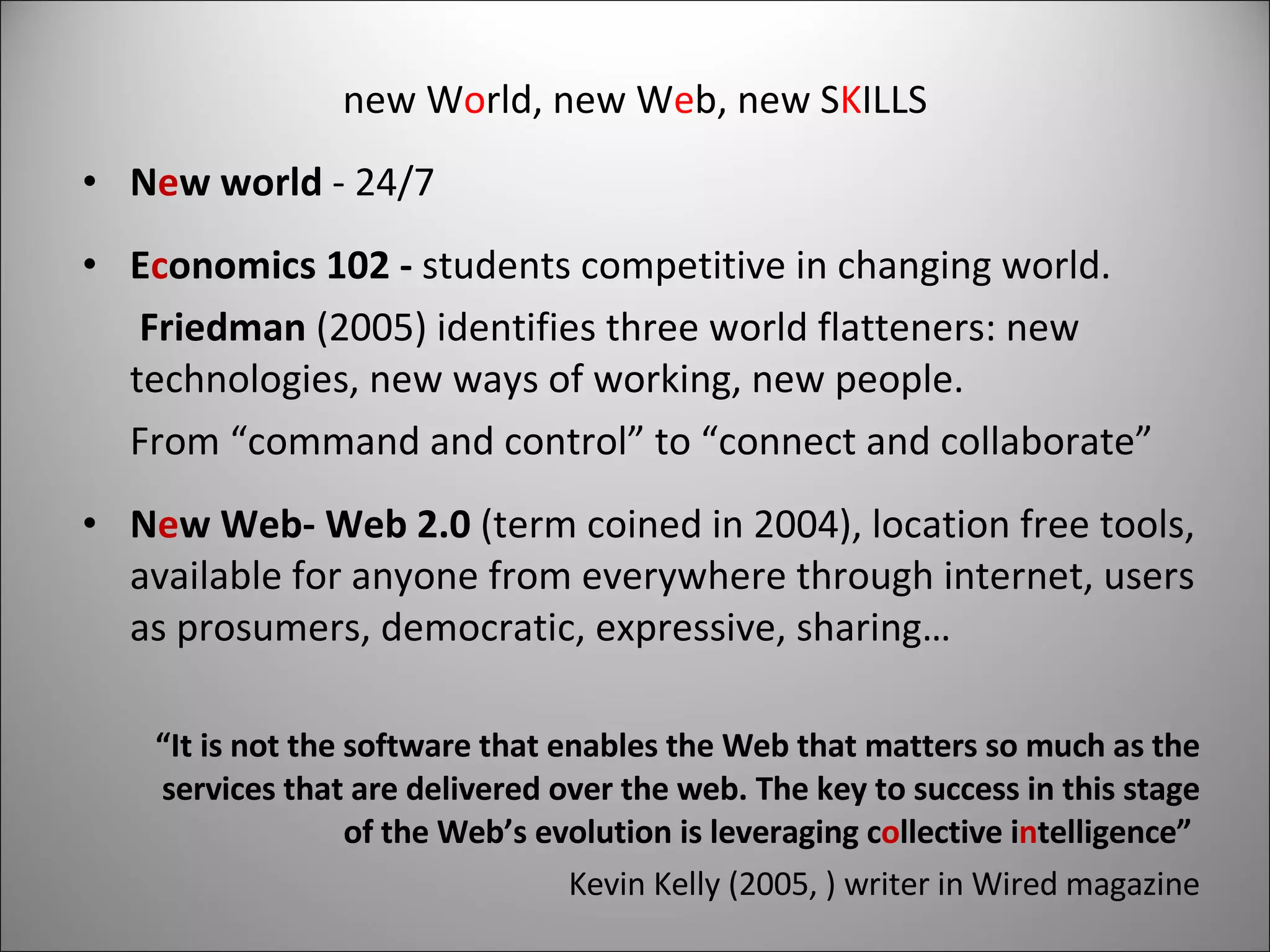
new W o rld, new W e b, new S K ILLS N e w world  - 24/7 E c onomics 102 -  students competitive in changing world.  Friedman  (2005) identifies three world flatteners: new technologies, new ways of working, new people. From “command and control” to “connect and collaborate” N e w Web- Web 2.0  (term coined in 2004), location free tools, available for anyone from everywhere through internet, users as prosumers, democratic, expressive, sharing… “ It is not the software that enables the Web that matters so much as the services that are delivered over the web. The key to success in this stage of the Web’s evolution is leveraging c o llective i n telligence”   Kevin Kelly (2005, ) writer in Wired magazine
2 1 st  Century skills T h e Partnership for the 21 st  Century Skills www.21stcenturyskills.org (digital-age literacy, inventive thinking, effective communication, high productivity) “ Today’s education system faces irrelevance unless we bridge the gap between how students live and how they learn.”  (report : Learning for the 21 st  Century) Student learn with Web 2.0 tools, but schools must help them to use tools in order to acquire new skills, not just to play with them..
“ F o r the kids, it’s like using a pencil. Parents do not talk about pencils but writing as kid’s do not talk about technology. K i d’s talk about playing, building a web site, writing a friend, about the rain forest” Idit Harel, MIT
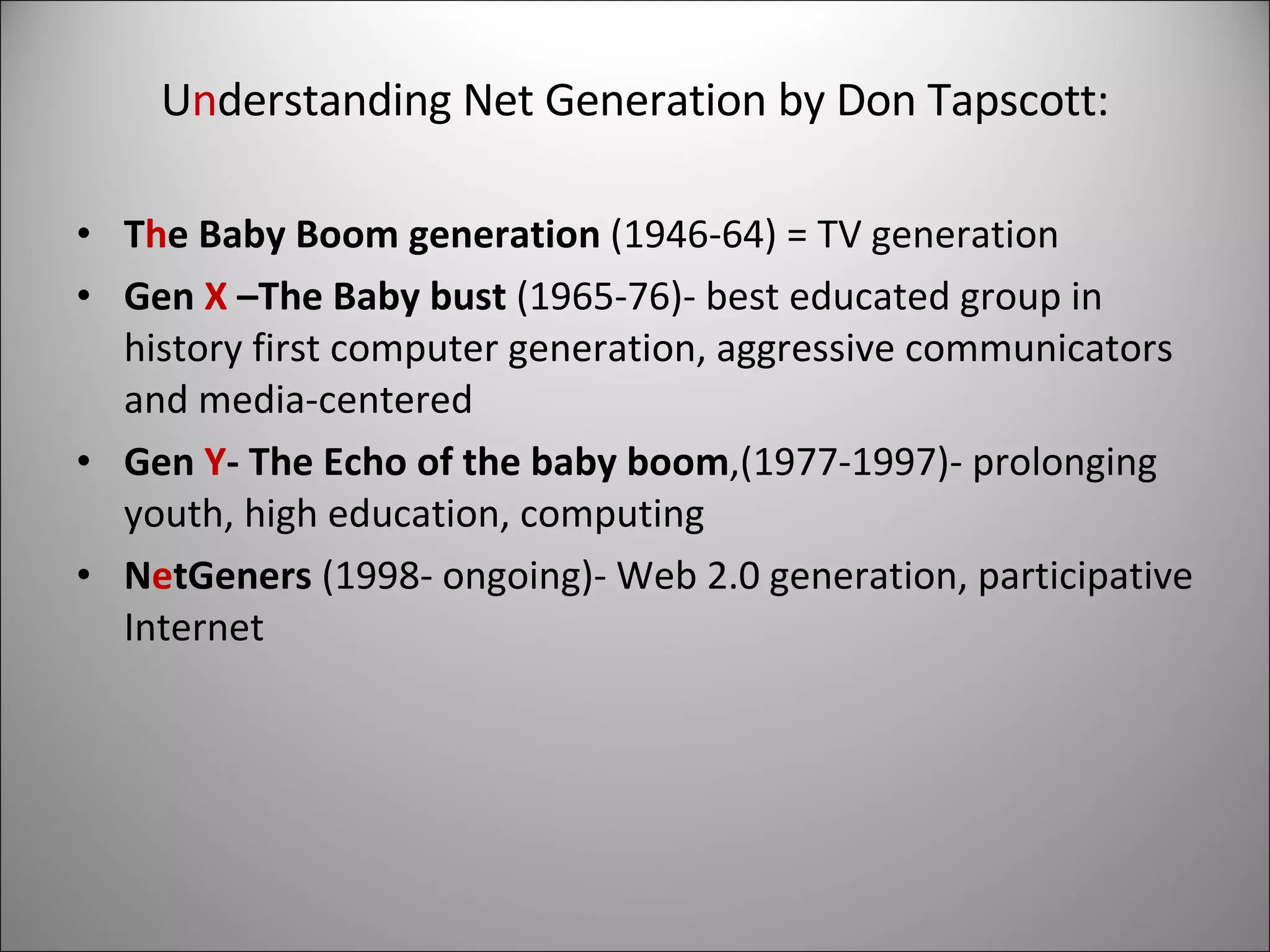
U n derstanding Net Generation by Don Tapscott: T h e Baby Boom generation  (1946-64) = TV generation Gen  X  –The Baby bust  (1965-76)- best educated group in history first computer generation, aggressive communicators and media-centered Gen  Y - The Echo of the baby boom ,(1977-1997)- prolonging youth, high education, computing N e tGeners  (1998- ongoing)- Web 2.0 generation, participative Internet
The  8  Net Gen Norms Don Tapscott  (2009,Grown up Digital: http://www.grownupdigital.com): Freedom Customization Scrutiny/Inspection/Research Integrity (job choices) Collaboration-achieving something with other people Entertainment Speed/instant response/real time information Innovation- (Nike + iPod Sport Kid)
“ I n  the future,  h o w  we educate our children will be more important than  h o w much  we educate them” Binder, cited in Friedman, 2005
U n derstanding L e arning B l oom’s Taxonomy  (1956) learning in six cognitive processes: remembering, understanding, applying, analysing, evaluating and creating 2 1 st  Century Taxonomy (2001)- the knowledge dimension is composed of 4 levels: factual knowledge-  terminology and elements of the subject conceptual knowledge-  understanding larger structure procedural knowledge-  how to do something, inquiry, etc.. meta-cognitive knowledge-  knowledge of cognition
B l oom’s taxonomy revized New (Anderson and Krathwohl, 2001)  Old (Bloom, 1956) Source: http://www.odu.edu/educ/roverbau/Bloom/blooms_taxonomy.htm
Other platforms of understanding learning: Constructionisam:  Learner actively constructs his knowledge upon the current and past knowledge, within certain group and context.  Source:  http://en.wikipedia.org/wiki/Constructivism_(learning_theory) Project-based learning:  inquiry-based methods to engage students in issues that are rich, real and relevant Source:  http://en.wikipedia.org/wiki/Project-based_learning Connectionism:  to find, see connection of information and to make decision- George Siemens (2004)  Source:  http://www.elearnspace.org
So, transforming k n owledge today suppose : I n strumentalization and commodification of the present knowledge and experience  N e w communicational meanings B i g communication potential I n corporation of the digital technology and its solutions R e -defining didactic goals Learning by d o ing Process of r e flection S h aring C o ntextualization C u stomization …… .
N e w Tools - new social revolution The genesis of Web 2.0 tools is the  o p en-source movement  (Linux, Mozilla) T a gging,  tag cloud= folksonomies Organizational power to students learning S y ndication – RSS  (Really Simple Syndication)-New information coming to you! Syndication is opposite of Hyperlinking A g gregators  (My Yahoo!, Google reader)
B a sic web 2.0 tools B l ogs  (edublogs),  http://edublogs.org Will Richardson blog:  http://weblogg-ed.com Dean Shareski blog:  http://ideasandthoughts.org/ David Warlick :  http://classblogmeister.com Learning and technology blogs:  http://www.elearnspace.org/edutechblogs.htm W i kis-  collaborative web page, the best known Wikipedia www.wikispaces.com P o dcasts-  creating and distributing a multimedia files (music and speech) on computer or mobile devices Apple iPod + Broadcast= Podcast
O t her popular Web 2.0 tools Social Bookmarking  – People connected through shared tags and URLs  www.del.icio.us www.backflip.com Confronts traditional bookmarking, available everywhere Photo sharing-  www.flickr.com Photo editing-   http://picasa.google.com http://apple.com/iphoto Video Showcasing-   www.youtube.com Video Editing www.jumpcut.com www.eyespot.com www.videoegg.com Presentations:  http://www.slide.com/ http://www.slideshare.net/
W e b 2.0 versions of desktop tools: Word, Spreadsheet and Presentations: Google Docs and Spreadsheeds www.zohoshow.com www.zohosheet.com
Search Engines:  Technocrati.com, google.com Electronic Portfolios:  wikis or  www.elgg.org Content Management:  www.moodle.org W e b 2.0 management tools: O t her Web 2.0 for education: Mapping:  Google Earth Social networking:  Myspace, Facebook Instant Messaging:  Gmail IM, Yahoo IM VoIP - Skype eHub:  www.emilychang.com/go/eHub/ Others: Think.com, Google for educators, Apple Education
S o , how you see your Education,  regarding New Media, especially web 2.0? O n e of the many conclusions to discuss further: When pedagogy and technologies are grounded in how students learn, schools provide the best strategies and results!
Other R e fferences http://www.downes.ca http://stephan.dahl.at http://www.educause.edu http://www.learningcircuits.org http://connectivism.ca http://www.elearnspace.org/blog/ http://incsub.org/blog/ http://weblogg-ed.com http://spotlight.macfound.org http://komunikacii.net http://henryjenkins.org www.iste.org http://www.papert.org/ http://www.lego.com   http://nasiotklas.blogspot.com/
H o pe you enjoyed it  [email_address]

New Tools, New Schools

  • 1.
    N e wtools, n e w schools Class presentation Skopje, 5 th of May, 2008 NYUS, Macedonia by Radmila Zivanovic
  • 2.
    “ The or iginal thing I wanted to do with WWW was to make it a c o llaborative medium, a place where we could all m e et and r e ad and w r ite ” Tim Berners-Lee, 1989 a f ter 1993- from text and numbers based research tool to graphical world of information for the masses, big popularity, required knowledge of HTML codes to create a web page, desktop-based applications I n recent years - development of easy Internet publishing tools, web 2.0 tools
  • 3.
    new W orld, new W e b, new S K ILLS N e w world - 24/7 E c onomics 102 - students competitive in changing world. Friedman (2005) identifies three world flatteners: new technologies, new ways of working, new people. From “command and control” to “connect and collaborate” N e w Web- Web 2.0 (term coined in 2004), location free tools, available for anyone from everywhere through internet, users as prosumers, democratic, expressive, sharing… “ It is not the software that enables the Web that matters so much as the services that are delivered over the web. The key to success in this stage of the Web’s evolution is leveraging c o llective i n telligence” Kevin Kelly (2005, ) writer in Wired magazine
  • 4.
    2 1 st Century skills T h e Partnership for the 21 st Century Skills www.21stcenturyskills.org (digital-age literacy, inventive thinking, effective communication, high productivity) “ Today’s education system faces irrelevance unless we bridge the gap between how students live and how they learn.” (report : Learning for the 21 st Century) Student learn with Web 2.0 tools, but schools must help them to use tools in order to acquire new skills, not just to play with them..
  • 5.
    “ F or the kids, it’s like using a pencil. Parents do not talk about pencils but writing as kid’s do not talk about technology. K i d’s talk about playing, building a web site, writing a friend, about the rain forest” Idit Harel, MIT
  • 6.
    U n derstandingNet Generation by Don Tapscott: T h e Baby Boom generation (1946-64) = TV generation Gen X –The Baby bust (1965-76)- best educated group in history first computer generation, aggressive communicators and media-centered Gen Y - The Echo of the baby boom ,(1977-1997)- prolonging youth, high education, computing N e tGeners (1998- ongoing)- Web 2.0 generation, participative Internet
  • 7.
    The 8 Net Gen Norms Don Tapscott (2009,Grown up Digital: http://www.grownupdigital.com): Freedom Customization Scrutiny/Inspection/Research Integrity (job choices) Collaboration-achieving something with other people Entertainment Speed/instant response/real time information Innovation- (Nike + iPod Sport Kid)
  • 8.
    “ I n the future, h o w we educate our children will be more important than h o w much we educate them” Binder, cited in Friedman, 2005
  • 9.
    U n derstandingL e arning B l oom’s Taxonomy (1956) learning in six cognitive processes: remembering, understanding, applying, analysing, evaluating and creating 2 1 st Century Taxonomy (2001)- the knowledge dimension is composed of 4 levels: factual knowledge- terminology and elements of the subject conceptual knowledge- understanding larger structure procedural knowledge- how to do something, inquiry, etc.. meta-cognitive knowledge- knowledge of cognition
  • 10.
    B l oom’staxonomy revized New (Anderson and Krathwohl, 2001) Old (Bloom, 1956) Source: http://www.odu.edu/educ/roverbau/Bloom/blooms_taxonomy.htm
  • 11.
    Other platforms ofunderstanding learning: Constructionisam: Learner actively constructs his knowledge upon the current and past knowledge, within certain group and context. Source: http://en.wikipedia.org/wiki/Constructivism_(learning_theory) Project-based learning: inquiry-based methods to engage students in issues that are rich, real and relevant Source: http://en.wikipedia.org/wiki/Project-based_learning Connectionism: to find, see connection of information and to make decision- George Siemens (2004) Source: http://www.elearnspace.org
  • 12.
    So, transforming kn owledge today suppose : I n strumentalization and commodification of the present knowledge and experience N e w communicational meanings B i g communication potential I n corporation of the digital technology and its solutions R e -defining didactic goals Learning by d o ing Process of r e flection S h aring C o ntextualization C u stomization …… .
  • 13.
    N e wTools - new social revolution The genesis of Web 2.0 tools is the o p en-source movement (Linux, Mozilla) T a gging, tag cloud= folksonomies Organizational power to students learning S y ndication – RSS (Really Simple Syndication)-New information coming to you! Syndication is opposite of Hyperlinking A g gregators (My Yahoo!, Google reader)
  • 14.
    B a sicweb 2.0 tools B l ogs (edublogs), http://edublogs.org Will Richardson blog: http://weblogg-ed.com Dean Shareski blog: http://ideasandthoughts.org/ David Warlick : http://classblogmeister.com Learning and technology blogs: http://www.elearnspace.org/edutechblogs.htm W i kis- collaborative web page, the best known Wikipedia www.wikispaces.com P o dcasts- creating and distributing a multimedia files (music and speech) on computer or mobile devices Apple iPod + Broadcast= Podcast
  • 15.
    O t herpopular Web 2.0 tools Social Bookmarking – People connected through shared tags and URLs www.del.icio.us www.backflip.com Confronts traditional bookmarking, available everywhere Photo sharing- www.flickr.com Photo editing- http://picasa.google.com http://apple.com/iphoto Video Showcasing- www.youtube.com Video Editing www.jumpcut.com www.eyespot.com www.videoegg.com Presentations: http://www.slide.com/ http://www.slideshare.net/
  • 16.
    W e b2.0 versions of desktop tools: Word, Spreadsheet and Presentations: Google Docs and Spreadsheeds www.zohoshow.com www.zohosheet.com
  • 17.
    Search Engines: Technocrati.com, google.com Electronic Portfolios: wikis or www.elgg.org Content Management: www.moodle.org W e b 2.0 management tools: O t her Web 2.0 for education: Mapping: Google Earth Social networking: Myspace, Facebook Instant Messaging: Gmail IM, Yahoo IM VoIP - Skype eHub: www.emilychang.com/go/eHub/ Others: Think.com, Google for educators, Apple Education
  • 18.
    S o ,how you see your Education, regarding New Media, especially web 2.0? O n e of the many conclusions to discuss further: When pedagogy and technologies are grounded in how students learn, schools provide the best strategies and results!
  • 19.
    Other R efferences http://www.downes.ca http://stephan.dahl.at http://www.educause.edu http://www.learningcircuits.org http://connectivism.ca http://www.elearnspace.org/blog/ http://incsub.org/blog/ http://weblogg-ed.com http://spotlight.macfound.org http://komunikacii.net http://henryjenkins.org www.iste.org http://www.papert.org/ http://www.lego.com http://nasiotklas.blogspot.com/
  • 20.
    H o peyou enjoyed it  [email_address]